WISA Group - Premium plywood from the Nordics to world markets

It’s worth opening a dedicated thread for WISA Group, as the company will soon start trading as an independent listed company.

Partial demergers, which have become more common on the Helsinki Stock Exchange, will continue as WISA (formerly UPM Plywood), focusing on the plywood business, separates from UPM-Kymmene into its own independent listed company. The implementation of the demerger is expected to take place on the last day of October, and trading in WISA’s shares is estimated to begin on November 2, 2026. The share exchange will be executed at a 1:1 ratio, meaning each UPM-Kymmene share entitles the holder to one WISA share. The shares will be transferred to owners’ book-entry accounts automatically, and the demerger does not require any separate actions from shareholders.

The company hosted a Capital Markets Day on Wednesday, which I attended. I wrote an article about the company for Salkunrakentaja.

Forest sector play: UPM spin-off WISA brings fresh color to the stock exchange
A steady profit-maker, WISA focuses on premium plywood in the fragmented European market.

  • Europe’s second-largest plywood manufacturer
  • Return on capital and cash flow in good shape
  • Wide guidance range for this year’s earnings
  • Plywood is used in various industrial sectors
  • A potential end to the war in Ukraine would alter the competitive landscape
  • A new steady profit-maker on the stock exchange

Link to the article:
Metsäsektorin pelipaikka: UPM:stä eriytyvä WISA tuo uutta väriä pörssiin

33 Likes

You can now watch WISA’s CMD afterwards here:

16 Likes

[quote="PorssiPatruuna, post:4330, topic:725"]\n5. Special situation: UPM’s major owners might trigger a large wave of selling for Wisa’s stock in November, and at what price would it be considered a bargain? Should we start scooping it up around 70-80 cents?\n[/quote]\n\nJust speculating for Friday evening entertainment.\n\nIt is predicted to largely be a so-called “unsexy” dividend company, which makes the minimum dividend requirement relatively high, i.e., at least 5%.\n\nAnnounced earnings guidance for 2026 = 32 - 50 mil.\nIf the 2026 earnings = 40 mil, the dividend will be = €0.037.\nAt a price of €0.70, the dividend yield = 5.3%.\nThus, €0.70 would be pretty much a fair median price without high growth expectations.\n\n€0.60 would be on the cheap side, as the dividend yield would rise to 6.1%.\nAt a price of €0.80, the dividend yield would be 4.6%.\n\nConclusion:\n €0.80 = Sell.\n €0.70 = Hold.\n €0.60 = Buy.\n\nOf course, if earnings come in closer to the upper end of the forecast (50 mil), the fair price will rise correspondingly, and also if one believes the company’s growth will accelerate from the current level.

11 Likes

You have estimated WISA’s market pricing at a slightly lower level than I have (from November 2, 2026 onwards, the share price would be just under a euro, and around 70-80 cents is where one should start tinkering with the buy button). In my own back-of-the-envelope calculations, I estimated that WISA would progress according to its targets and be able to leverage its earnings operating leverage, which largely explains the differences in our pricing. On November 2, 2026, around WISA’s listing, UMP’s major investors and index funds might sell WISA heavily, causing the price to drop quite low, at least temporarily. We’ll see how it goes.

P.S. @Tomi_Lindell excellently opened a dedicated thread for WISA. Should @Sijoittaja-alokas move these discussions from this pulp-love thread over there?

16 Likes

For quite a few retail investors, Visa is going to be a miniscule holding in their portfolio once they appear there. Thanks for the insights regarding the price. Holding is an easy choice. Buying is so difficult that one could first make this a real investment by buying from the ask side and hoping to get to add more at a lower price a few times. This is of course the Visa thread, but somehow next week UPM’s valuation will also take a swing.

6 Likes

Looking at this image’s “scenario analysis”, I really have to say, I hope it was a joke. Aside from the first one, the scenarios were completely off the wall. Sometimes it’s downright terrifying how thinking is being outsourced to AI.

18 Likes

A couple of takeaways:

"UPM has been a good incubator and has enabled a lot. However, I believe that within the UPM context, we haven’t always been in the front row when considering the terms on which the future is built. That’s where Wisa’s difference comes from.

An investor might wonder what makes an independent plywood business an attractive investment target. According to Suur-Hamari, there is a reliable foundation in place, upon which a new, even more agile operating culture can be built. According to him, the comparable EBITDA margin has remained in double digits throughout the 2020s, despite the COVID-19 pandemic and the inflation shock."

21 Likes

What kind of company is Wisa Group, spinning off from UPM?

“We are a leading plywood manufacturer in Europe, focusing on end-use applications where the demands for product quality, performance, and service are the highest,” says Tuija Suur-Hamari, CEO of Wisa Group.

Wisa’s plywood is used, among other things, in construction and for truck flooring. More than ten percent of its revenue comes from the insulation lining of tankers used to transport liquefied natural gas. LNG tankers are a high-specification specialty application where there is less competition and, consequently, profitability is presumably higher than in standard grades.

“The performance of UPM’s plywood business has been very resilient and stable through the years,” Tuija Suur-Hamari notes.

@Karo_Hamalainen

16 Likes

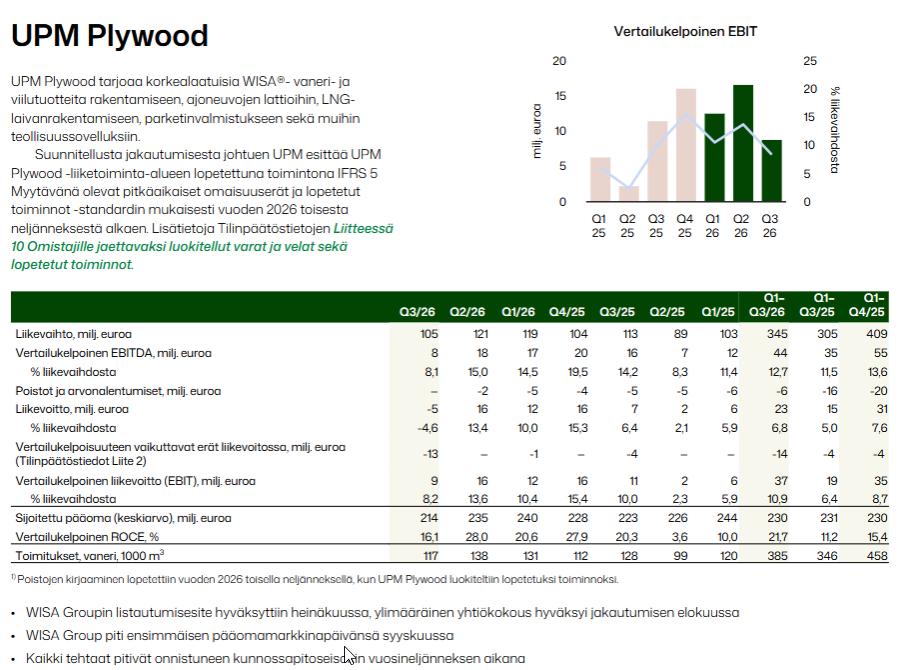
This doesn’t look very good at all, or does someone disagree? Investors are hardly going to be rushing excitedly to buy Wisa.

EBITDA down 50% year-on-year. Revenue also declining.
Operating profit in the red.

Result
Q3 2026 compared to Q3 2025
Comparable operating profit for the UPM Plywood business area
decreased. Deliveries were lower than last year during the post-strike
order backlog. Variable costs increased, and fixed costs were driven up by maintenance and preparations for the demerger. In accordance with the IFRS 5 standard, no depreciation was recognized in the third quarter.

Q3 2026 compared to Q2 2026
Comparable operating profit decreased. Deliveries declined
seasonally, and variable costs increased. In accordance with the IFRS 5
standard, no depreciation has been recognized since May.
Due to preparations for separating IT functions from UPM,
a portion of sales shifted from the third quarter to the
second quarter. The separation of IT operations was
successfully completed.

January–September 2026 compared to January–September
2025
Comparable operating profit increased. The positive impact of higher deliveries
was partially offset by an increase in fixed costs. In the comparison period, fixed costs were lower due to the strike. In 2026, preparations for the demerger drove up fixed costs.

Market Environment
• In the third quarter of 2026, the plywood market was
seasonally weaker.
• Demand for vehicle flooring remained good. Markets in
distribution and construction end-uses became
more challenging.
• Demand in LNG end-use was strong.

9 Likes

I wouldn’t look at the Q3 figures quite so unequivocally, considering Q1-Q2/2025 were exceptionally weak since plywood production was shut down in Finland for 10 weeks. For this reason, Q3 was exceptionally good last year.

12 Likes

Positioning for Wisa’s Listing Next Week

The decisions have been made, UPM’s latest interim report (incl. UPM Plywood) is in hand, and the company transitioning from Plywood to Wisa enters the stock market arena on Monday. What is the playing field looking like? A few thoughts:

A Repeat of Mandatum?

When Mandatum was spun off and listed from the large parent Sampo, selling pressure was heavy at the start and the share price sank to about half of its current level. As is well known, more than half of UPM-Kymmene is owned by foreign entities, and as a large cap it is included in many kinds of indexes. Nearly 60% of the shares are held behind nominee registrations of SEB and Citibank. Sizable stakes held by the likes of BlackRock and Vanguard are also known.

In Wisa’s case as well, many will likely dump their shares, but not all, and the timelines may vary. Furthermore, Solactive, for example, announced yesterday that it will add Wisa to a whole range of different indexes. Based on this information, it is impossible to say exactly when the selling pressure will be at its peak and when pricing on Wisa’s shareholder register will be at its cheapest. The only way is to monitor the market closely.

Valuation of Wisa’s Share: At What Price Is It Worth Buying More?

Earlier, I did some back-of-the-envelope calculations suggesting that if Wisa manages to deliver on its targets for growth, operating leverage, etc. over the next few years, the share price could hover around one euro, meaning it would be worth accumulating more around 70–80 cents as a long-term investment. But taking the company’s current situation as a baseline, pricing might hover around 60–70 cents, and further accumulation would likely make sense around 50+ cents. However, there is also a third level, and for various reasons, that could materialize as well. See below.

Wisa’s Listing at a Difficult Juncture

UPM’s recent interim report, including UPM Plywood’s figures, did not provide strong evidence of resilience. The forest industry—both as a sector and as an investment—has drifted from its former glory days to the sidelines as troubles accumulate and become chronic. Wisa’s stock will likely be priced as a penny stock, which many prefer to steer well clear of. Etc.

The combination is such that one shouldn’t be surprised if Wisa’s share sinks even lower—especially if large volumes hit the market for sale. The aforementioned third level for the share price could therefore also materialize, and Wisa might occasionally trade below half a euro. In heavy selling situations, perhaps even down to 30–40 cents?

Trying to define “the right” price level for Wisa’s share has indeed been truly challenging.

Adding to the degree of difficulty is that the listing coincides with the US midterm elections. You can expect any kind of harebrained stunt from Trump, and the Kremlin’s madness should never be underestimated either. General market storms could easily erupt, and Wisa’s stock will be left bobbing and swaying in those big waves.

What to Do?

I see no reason to sell off Wisa shares. The company has nevertheless managed decent performances under the volatile and demanding conditions of the 2020s. If times improve, it has substantial earnings leverage, as production can be increased significantly without massive capital expenditures. Well, what about buying more then? Price is the deciding factor here, and in the wake of UPM’s recent interim report (incl. Plywood) offering an unclear outlook, I have markedly lowered my threshold price for additional purchases. And I have leaned more and more toward that third level. Next week, I’ll be closely monitoring the market every day, and then the strike to buy will come. If it’s meant to come at all.

Everything written above may prove right or wrong next week—or somewhere in between:)

53 Likes

One could think about the valuation based purely on dividends alone. EPS will likely settle around €0.06–0.07. I’ve somehow got the feeling that the 50% payout of earnings will indeed be distributed. Therefore, at a price of €0.60, it’s definitely a buy. If prices drop even further in the turmoil, I’ll be digging deeper into my pockets to buy more. I have a hunch that the folks at UPM don’t want to go down in history for a botched spin-off, either. This is bound to turn out well, not like some L&T. We are living in great times.

13 Likes

Did a bit of homework.

Based on the provided Pro forma balance sheet as of June 30, 2026, and other information (incl. Q3’26 figures), combined with my own rough estimates and Q4’26e projections, I calculated that Wisa would have roughly EUR 100.6–110.5 million in equity at the end of 2026e. This would put the book value per share (BV, equity / share) at around EUR 0.19–0.21.

Based on my rough estimates, interest-bearing debt at the end of 2026e would be perhaps around EUR 100 million—roughly equal to equity—and cash assets would stand at around EUR 42 million, matching the amount in the Pro forma balance sheet as of June 30, 2026.

According to my conservative growth and profitability forecasts, an EPS level of EUR 0.06–0.07 will be reached in 2028e at the earliest.

When putting together Wisa’s short- and long-term growth and profitability projections, I wouldn’t really apply the financial targets presented by the company, except perhaps as rough guidelines until the company demonstrates actual evidence of improving growth and profitability. In my view, reaching a comparable EBIT margin of 13% by the end of 2030e is an extremely challenging target, considering the company’s future heavier fixed cost base as an independent listed company.

My own 2030e forecast is roughly as follows: revenue slightly above EUR 500 million (with an approx. 3% annual growth rate p.a.) and a comparable EBIT margin of 9.7% (slightly under 10%, meaning not 13%).

In my opinion, Wisa’s reported Q3’26 figures were poor, which was explained by seasonality, higher IT expenses, and other temporary factors (incl. temporary inventory destocking by customers). I anticipate that these temporary factors weighing on the numbers will also persist into Q4’26e. If I calculated correctly, around EUR 7.5 million of one-off IPO-related expenses remain unrecorded after Q3’26 (out of a total of EUR 23 million). Consequently, the reported Q4’26 figures will also be poor, perhaps below market expectations.

In itself, Wisa Group may very well be a decent listed company, but with my current rough knowledge and estimates, I’m certainly not keen on adding WISA shares at a price around EUR 0.60 (P/B 2.9x–3.2x). Only if the share price dips below EUR 0.44 would I start considering launching a cautious “falling knife” buying program.

47 Likes

Great post!

Based on the capital structure details presented in the demerger prospectus, I also arrived at pretty similar calculations regarding an attractive price level. I rounded the interest-bearing net debt to about €90 million. From there, assuming a realistic non-recurring-item-free EBIT level of, say, €40 million in the coming years, an EV/EBIT of 10 would yield a share price just under €0.60, and an EV/EBIT of 8 around €0.44.

I almost always do these kinds of very rough roundings, and back-of-the-envelope calculations like this are never the sole basis for an investment decision. But unless I made a terrible typo on my phone’s calculator while lying flat on the couch, those are roughly the multiples we are looking at if the share price is between €0.40 and €0.60. An EV/EBIT of 8 or less would, in my view, already be an attractive starting level, considering we aren’t riding any cyclical peak here.

21 Likes

Nice to see tomorrow’s listing. I’d bet on high volatility during the first month as large portfolios rebalance. That definitely gives retail investors opportunities to accumulate shares if they believe in Wisa in the long run.

5 Likes

Trailing operating profit has fluctuated between 20 and 50 million over the past couple of years, which, in a fairly steady business, could typically be valued at a multiple of around 14x. That would imply a market cap of roughly 280–700 million, which for 527 million shares would be in the range of 0.53–0.95 euros. How much of an impact on earnings the IPO will have over the coming year is a bit of a question mark, but you’d think enough administrative staff was hired a long time ago. With operating profit currently at the high end of the range, pricing the stock around the midpoint doesn’t seem particularly crazy. Based on this, 0.75 euros feels at a glance like a pretty fair price for the stock.

10 Likes

Isn’t that quite a high multiple for this type of business? What is it based on?

10 Likes

I’m not so sure that multiple is particularly high. In my opinion, it’s pretty neutral pricing for a stable business, especially with the ROE exceeding the required rate of return.

I added WISA to my watchlist WISA Group Oyj (WISA.he) - Summary. The system wasn’t really designed with IPOs in mind, but surprisingly enough, this case runs through the system quite well. It’s currently assuming a trading price of €0.75 in the background, but I’ll update that tomorrow.

1 Like

Wisa published an announcement like this yesterday (Sunday) :slight_smile:

WISA Group Plc, Stock Exchange Release (Other information disclosed pursuant to the rules of the exchange), 1 November 2026 at 17:30 EET

The Board of Directors has resolved on WISA’s long-term incentive plans, remuneration policy, and share ownership recommendation for the CEO and other members of the Group Management Team

WISA’s long-term incentive plans

The Board of Directors of WISA Group Plc (“WISA”, the “Company”) has today resolved to establish a performance share plan and a restricted share plan for the years 2027–2029.

Performance Share Plan

The target group of the Performance Share Arrangement (“PSA”) consists of the CEO, other members of the Group Management Team, and selected key employees. The performance share plan comprises three-year share-based plans commencing annually. The Board of Directors resolves annually on the key terms, performance criteria, and participants for each three-year plan. When the Board of Directors resolves to establish the first three-year plan under the PSA, the details of the plan, including the key terms, will be published in a separate stock exchange release.

Restricted Share Plan 2027–2029

The Restricted Share Plan for the years 2027–2029 (“Restricted Share Plan”, “RSP 2027–2029”) is used as a retention instrument for the CEO and other members of the Group Management Team, as well as in specific recruitment situations. The purpose of the RSP 2027–2029 is to serve as a tool to align the interests of the participants and the Company’s shareholders, thereby promoting the favorable development of shareholder value in the long term. The RSP 2027–2029 will be used, in particular, as a one-off transitional plan for the CEO and other members of the Group Management Team during the first three years following the listing of WISA’s shares on the regulated market of Nasdaq Helsinki (“Transitional RSP”). In addition, the RSP 2027–2029 may be used in potential key recruitment situations (“Recruitment RSP”).

The rewards under the Transitional RSP will be delivered to the participants in three equal installments in December 2027, December 2028, and December 2029. The amount of the reward (“Reward”) under the Transitional RSP is determined as a percentage of the participant’s gross annual salary at the time of admission to the RSP 2027–2029. The Reward represents a gross amount from which income tax, transfer tax, any other applicable taxes, as well as social security, pension, and other employment- or service-related insurance contributions or other levies that the participant or the Company is obligated to pay, will be deducted.

The Recruitment RSP may be used for potential key recruitments made during the years 2027–2029 to compensate for variable remuneration forfeited from previous employment or service. In connection with such key recruitments, the Board of Directors will resolve on the payment schedule and additional terms of the Recruitment RSP.

As the Company’s shares are not yet traded on the regulated market of Nasdaq Helsinki and trading in WISA’s shares begins on 2 November 2026, the maximum number of shares to be delivered under the RSP 2027–2029 cannot be defined. However, the maximum amount in euros that the Company may spend on rewards payable under the RSP 2027–2029 is EUR 2 million. Given the nature and purpose of the RSP 2027–2029, no specific performance criteria apply to the plan. No reward will be delivered or paid to a participant if their employment or service relationship with the Company terminates, an agreement on the termination of the employment or service relationship is entered into, or the participant or the Company gives notice of termination of the employment or service relationship (whichever occurs first) prior to the delivery date of the Reward. Unless the Board of Directors resolves otherwise at the time of payment, share deliveries under the RSP 2027–2029 will be carried out using existing shares; thus, the plans will have no dilutive effect, and the value of the shares will be determined based on the market price.

Remuneration Policy

The Board of Directors of WISA has today approved the Remuneration Policy for Governing Bodies of WISA (“Remuneration Policy”), which sets the framework for the remuneration of WISA’s Board of Directors and CEO. The Remuneration Policy will be available on WISA’s website and will be presented to WISA’s first Annual General Meeting. The General Meeting’s resolution on the Remuneration Policy is advisory.

Share ownership recommendation for the CEO and other members of the Group Management Team

The Board of Directors has resolved on a share ownership recommendation for the CEO and other members of the Group Management Team. The share ownership recommendations are as follows:

  • For the CEO: “The CEO shall hold WISA shares corresponding to the amount of one year’s gross salary. Until the share ownership recommendation is met, the CEO shall retain 100% of the net shares received from WISA’s long-term incentive plans.”

  • For other members of the Group Management Team: “It is recommended that the members of the Group Management Team (excluding the CEO) hold WISA shares corresponding to the amount of one year’s gross salary. Until the share ownership recommendation is met, it is recommended that the members of the Group Management Team (excluding the CEO) retain 100% of the net shares received from WISA’s long-term incentive plans.”

5 Likes

A reverse split right off the bat would be good. 1-for-5. It would get it out of penny stock territory.

25 Likes