Hi Verneri,
Thanks for your questions! Here are the answers.
Q: Key changes in the strategy update?
A: We have renewed our strategy and long-term financial targets to better support growth and value creation in our business. At the same time, we continue to create value in the bioeconomy with our renewable products that solve global sustainability challenges. We focus on meeting our customers’ demands for environmentally friendly and circular economy-based solutions, and we invest in innovation.
Stora Enso will have three growth focus areas going forward:
Packaging Materials and Packaging Solutions, driven by high demand for plastic-free and environmentally friendly, circular economy-designed packaging. We are market leaders and see attractive investment opportunities in these businesses.
Building Solutions within the Wood Products division, driven by the growing market for wooden buildings. We offer alternatives to fossil-based building materials and are a leading global supplier.
In the Biomaterials division, our innovation program focuses on lignin, and innovations are aimed at strong growth in new applications and new markets.
Q: Packaging products and pulp are supported by several strong growth drivers, from the growth of the Asian middle class to sustainable development. Still, for most product categories, market growth forecasts are at or below GDP growth forecasts. In your opinion, do the story and the numbers contradict each other?
A: According to the latest forecasts, the long-term growth prospects for the Packaging Materials division are good. The combined markets for consumer board and corrugated board raw material are estimated to grow from 2020-2030: in China +2.9%, in the rest of Asia +2.9%, and in Europe +1.7% annually. These markets are growing faster than, for example, the North American market, which is not a focus area for us. The Chinese market is significant in size – 61 million tonnes per year, while the European market is 42 million tonnes and the rest of Asia 41 million tonnes. Replacing fossil raw materials with renewable materials is a significant long-term growth driver that supports our business. In addition, the growth of e-commerce increases the need for corrugated packaging, which creates demand for our products.
Stora Enso is a market leader in consumer board in Europe and the fourth largest player globally.
Q: In recent years, Stora Enso has invested significantly more in product development than its competitors. How do you measure the productivity of product development investments, and what results have you achieved with these investments? What results should investors expect from product development work in the future?
A: Our innovations are based on the idea that everything currently made from non-renewable raw materials can be made from wood in the future. In line with the new strategy, our innovation projects will focus on new, sustainable packaging materials and barrier coatings, as well as the opportunities offered by lignin in biochemistry. In addition, our goal is to bring new products to market even faster.
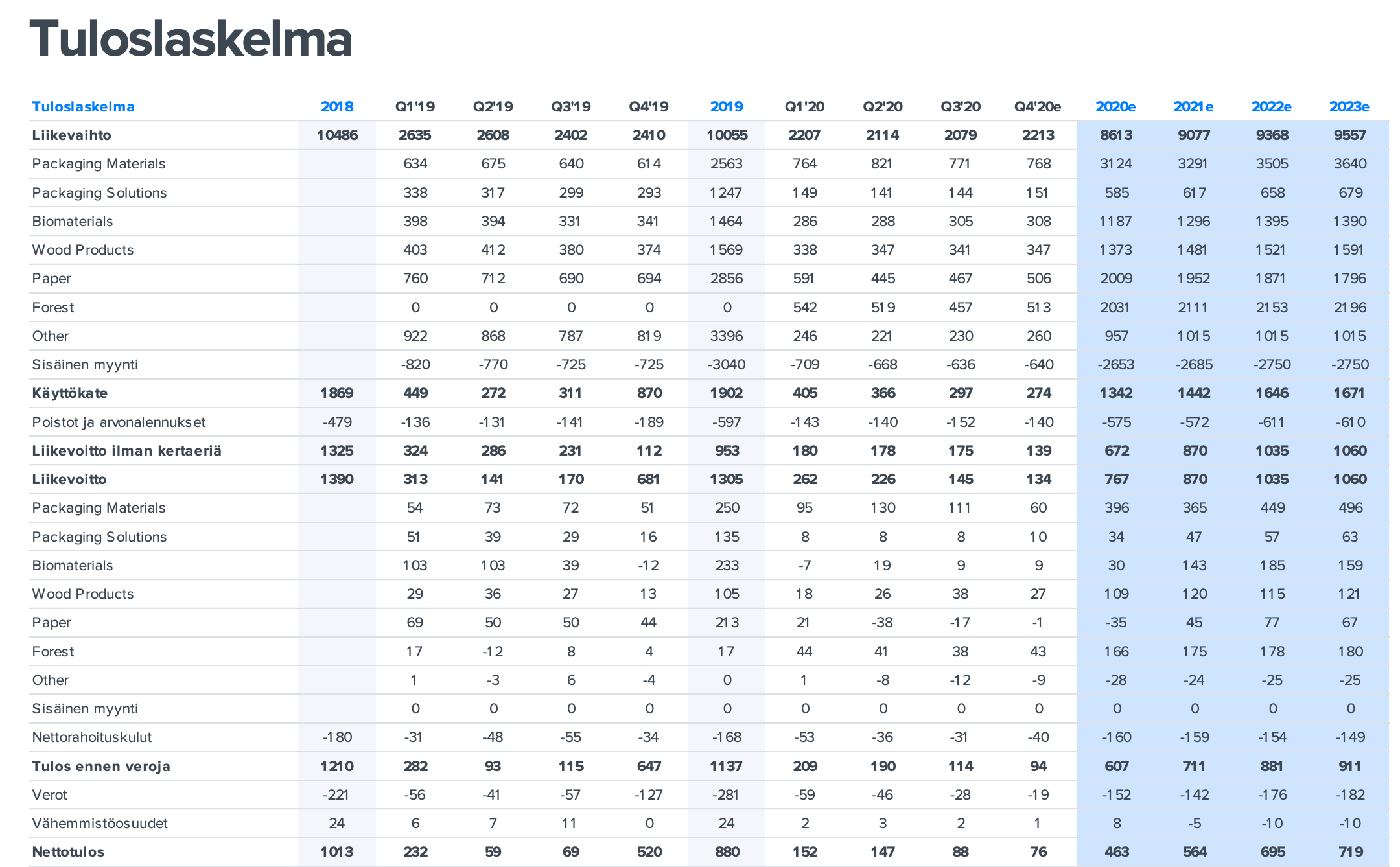
We have invested more in research and development than our competitors, both absolutely and relatively. In 2019, our R&D investments were 141 million euros, or 1.4% of our net sales.
Q: At CMD, you hinted at significant market sizes and very high margin potentials for certain new packaging products, building components, and biochemical applications. What are these estimates based on? What does achieving a ROCE-% of over 13% (excl. Forest) require?
A: The estimates are based on comprehensive strategy work carried out within the company during 2020. We focus on leading positions and accelerating growth in the Packaging Materials and Packaging Solutions divisions, as well as in Building Solutions and Biomaterials innovations. Our new long-term ROCE target is >13% excluding the Forest division. The profitability levels of the three focus areas mentioned above are high, and by growing in these businesses, it is possible to achieve the Group’s operational return on capital employed (ROCE) target.
Q: Regarding the balance sheet, Stora Enso aims for a net gearing ratio of less than 60% and a net debt/EBITDA ratio of less than 2x. The net gearing ratio is already quite clearly below the target, and the Q4 revaluations of forest assets will likely reduce it further. On the other hand, the net debt/EBITDA is above the target. What should investors think about Stora Enso’s capital allocation in the coming years? Why don’t you use cheap debt leverage more than before, when the balance sheet now clearly has more low-risk and low-return forest assets than in recent years?
A: One of our key competitive advantages is our significant forest assets. They guarantee us a renewable and competitively priced fiber. Preliminary estimates, based on transactions in areas where Stora Enso has forest land, indicate that the value of the Group’s forest assets, including leased land, is 6.5–7.0 billion euros, compared to a book value of 5.4 billion euros at the end of the third quarter. Approximately 30% of the Group’s wood raw material needs are met from its own sources or through long-term supply agreements globally.
Our balance sheet is currently strong. At the end of the third quarter of 2020, our liquidity position was 2.2 billion euros, including cash, credit limits, and available financing sources. In the new strategy, the financial targets measuring indebtedness have remained unchanged. Our net debt/operational EBITDA target is <2.0x, and for net gearing, <60%. When we look at our balance sheet, we want to emphasize that we want to maintain an investment grade credit rating and be a good dividend payer.
You can view Stora Enso’s CMD 2020 presentation materials here:
Stora Enso CMD 2020 presentations