I think it’s time to create a section on the theme of pulp. I bought Stora in the autumn, and although the stock has been in a slight decline during my short ownership, I am still excited about what can be made from pulp in the future and the strategic ability of companies to innovate. Free discussion on the topic from an investment perspective. For me, Stora is in my long-term portfolio.
7 Likes
I think this is a very inspiring article about pulp and its potential. (For subscribers, but I think it’s worth logging in, because two weeks for free, and read the article in its entirety).
7 Likes
Over 50% of my portfolio is in forest industry, mainly UPM, then Stora, Ahlström and MetsäBoard. Bought cheap but this year has been cold and these are not great dividend stocks. Still, I would see that the potential is only just coming.
3 Likes
Html
1 Like
What?
1 Like
Sulapac  Stora!
Even though I haven’t traditionally used Iltalehti as a source for investment information, this was worth sharing because it shows that wood-based packaging is gaining market share at an exponential rate. The cosmetics market in Finland alone is 2 billion (though the contents of the jar are, of course, the most expensive part).
4 Likes
Antti is now slightly more positive on Metsä Board after its valuation has decreased significantly. Antti comments on the company as an investment target in the video.
If you are generally interested in forest companies, you should listen to this podcast inderesPodi jakso 9: Mitkä tekijät ohjaavat metsäyhtiöiden liiketoimintaa? - Inderes
3 Likes

It’s usually been beneficial to agree with those most knowledgeable about the company’s affairs
1 Like
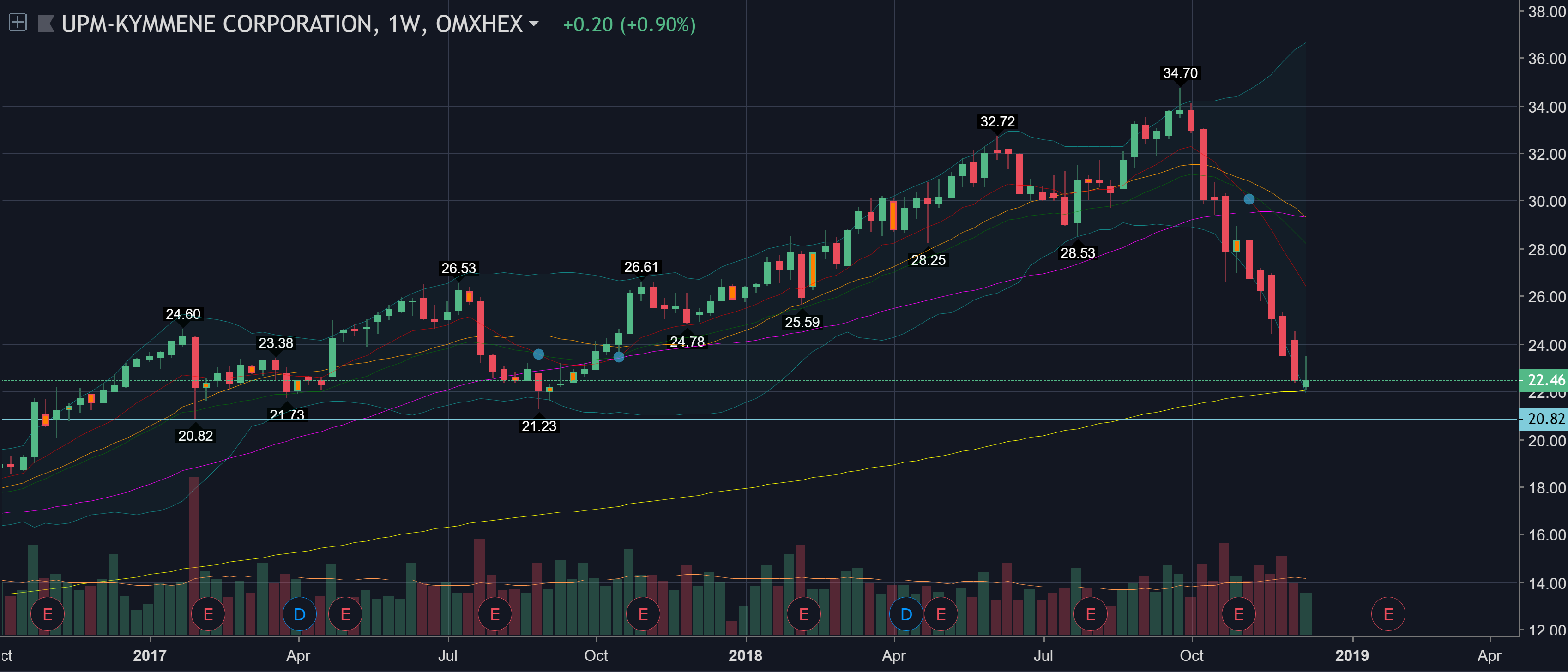
Are these UPM management purchases their own buys or some kind of bonuses from the company?
1 Like
Yeah, to me those look like actual purchases.
Of course, those guys are rich, so it’s nothing too outrageous.
Millions in income every year, like winning the lottery every year… insane
1 Like


Let’s make use of this open tax data from Finland 
A quick calculation: 5M - 2.5M = 2.5 million, and then buying 450k € worth of company shares → with about an 18% post-tax income. Of course, with those income amounts, everything is relative… 20K UPM shares → with Inderes’ 2018 forecast, that already brings in 27K € in dividends.

And yes, they have “Skin in the game,” to borrow from Restamax’s roast. How many other company managements have it on the same scale?

2 Likes
EU’s plastics strategy moved forward, which should be positive news for the forest sector that can offer substitute alternatives. It remains to be seen whether the rest of the world will follow suit later.
Let’s hope green gold takes black gold in a headlock 
2 Likes
An interesting transformation underway and much needed, at least from an environmental perspective.
As I understand it - at least at this stage - biorefineries mainly produce raw materials for other industries, and according to the Ministry of Agriculture and Forestry’s list, there were quite a lot of these industries, and the range is constantly expanding. So, in that sense, they are not necessarily direct competitors to all traditional operators, at least not immediately. For example, once a week, a vinegar truck leaves Kotka for a perfume factory in France. This is a by-product entirely from the pulp cooking process. It’s positive if this sector pushes traditional operators towards a greener direction.
It may be that cardboard will remain “eco” for a long time, because everyone is now waking up to the plastic problem, and it must be solved quickly. Cardboard does not have the same monstrous stigma as plastic, and generally, renewal only happens when it’s absolutely necessary, i.e., through a crisis. However, forests also need to be taken care of, and not everything can or should be clear-cut, and at that point, recycling is again key. Recycling is only just developing. We need to be concerned about forests because some important decomposer fungi have already disappeared from Finland simply because forests are being harvested and managed excessively, and trees are not allowed to age, and the forest’s own cycle is not realized.
But expertise is needed, so could @Verneri_Pulkkinen perhaps tag an Inderes pulp expert to comment on this.
6 Likes
This is a great topic; I’ll try my best to answer, even though my technical understanding of the intricacies of wood fibers/molecules is very limited.
“Could someone wiser answer how you view the forest sector’s new business opportunities?”
In principle, the opportunities are enormous, as wood can be used to make everything that oil can. Practical limitations include costs (production/investment) and probably a bunch of technical issues too. However, when investing in forest companies, it’s good to understand that the majority of these companies’ turnover in 10 years will come from the same products as this year. Developing and commercializing new products is a long-term endeavor, but building sustainable business on renewable and recyclable raw materials is excellent in the long run, and the opportunity should be seized. Stora Enso, in particular, has been active in recent years, and its financial investments in research and product development have been significant even internationally within the industry. At the CMD, the company also hinted at the first promising financial results from recent years’ investments (e.g., biocomposite, lignin).
“The forest sector has now started investing in biorefineries. One big problem with renewable biofuels seems to be the availability of raw materials. Here, in my opinion, forest companies should have a slight competitive advantage as they control the waste streams from wood.”
Biodiesel is a niche product, and wood-based biodiesel is a niche within a niche. Given the raw material base and the scale of fuel consumption, wood-based biodiesel is unlikely to become a particularly significant scalable product. UPM produces biodiesel from crude tall oil (a side stream of softwood pulp production) in Lappeenranta, but due to raw material availability constraints (crude tall oil is also competed for by other industrial sectors), there probably aren’t many such factories that can fit into the world. Biodiesel factories based on gasification technology have been planned, but the economic feasibility of the process is still a question mark. Political risks are also significant in the industry, which argues for caution in seeking growth.
“UPM has also announced biochemicals. Does anyone know if there’s a chance to compete with traditional players here, and if the chemical industry is generally trying to get rid of fossil carbon?”
With biochemicals, UPM would likely challenge the traditional chemical industry. Thanks to its control over raw material properties, the company could also have an angle to challenge strong traditional chemical players. However, the project is still at a very early stage, and details haven’t been disclosed, making a more precise assessment difficult.
“Forest companies also have power plants; will electricity produced from biomass become more profitable if coal power plants are banned and shut down in the near future?”
The profitability of power plants (including surplus energy from pulp mills) depends on the price of electricity, which is determined by supply and demand (including marginal production costs). Generally speaking, a large-scale shift away from coal would increase electricity prices in Europe (the impact on Nordic countries depends partly on the development of transmission connections). On the other hand, at the group level, it’s good to remember that an increase in electricity prices would raise the production costs of many other products for forest companies. From memory, our forest companies’ energy balances are relatively neutral or slightly in deficit at the group level, so a direct net benefit (dynamic effects are more complex) from an increase in electricity prices is unlikely.
“Finally, I often hear that it would be good if pulp-based products could replace all plastic packaging, but how long will cardboard packaging be considered environmentally friendly? I’m sure everyone has noticed that cardboard is sometimes used a bit too much in some situations. Unnecessary packaging is unfortunately always unnecessary packaging, regardless of what it’s made of.”
True, over-packaging is unnecessary, and there’s certainly plenty of room for efficiency improvements in this area. I’ve sometimes wondered how it’s possible that by ordering 3 products from a German online store, 4-5 corrugated cardboard boxes end up at home (of course, the cheapest possible quality; higher-quality, expensive cardboards are used much more sparingly). However, the purpose of packaging is 1) to protect the product, 2) to streamline logistics, and 3) to serve as a marketing aid. In the foreseeable future, the entire combination is unlikely to be digitalized, and renewable, reusable, and recyclable cardboard (the same fiber can practically be made into packaging about 6-8 times through recycling, and finally the fiber that has lost its properties can be burned for energy) is often the least bad solution for the environment. However, cardboard will not replace all plastic in any scenario, and plastic will continue to have its place in the future.
8 Likes
It would be interesting to hear Inderes’ comment on this: Kassavirta-analyysi yllättää: UPM onkin halvempi kuin Stora Enso? | Kauppalehti
Especially since Inderes’ recommendation is “add” for Stora and “reduce” for UPM
Has Stora been examined based on too one-sided key figures?
1 Like
I was just checking out UPM Holdings, and these caught my eye:






Sellers include:



2 Likes
“It would be interesting to hear Inderes’s comment on this.”
Cash flows are generally discussed too little, but they are not a panacea either. Often, cash flow fluctuates (due to, among other things, significantly more than profit), which makes drawing conclusions challenging. In my opinion, it is important to ensure that profit and cash flow tell the same story, at least in the medium and long term.
The Kauppalehti article did not specify very precisely which figures were being discussed. The conclusion certainly seems correct: in the short term, UPM is clearly cheaper than Stora Enso on a cash flow basis. This is due, among other things, to Stora Enso’s significantly higher investments than UPM, its greater tendency to tie up more working capital in the short term (Stora Enso’s revenue is growing faster), and UPM’s better profitability (UPM is in top shape, while for Stora Enso, for example, the large board machine investment in China is still far from its potential). UPM also pays significantly less interest than Stora Enso due to lower debt (conversely, capital utilization is currently less efficient). Already within a few years, the valuation indicated by cash flow multiples can change significantly when Stora Enso’s investments start producing and UPM invests 2 billion in new capital (+ working capital) in the Uruguay pulp mill. In practice, due to very different cash flow cycles, comparing results is also, in our opinion, well-justified.
3 Likes
Thanks.
Would it be fair to conclude from this that Stora’s dividend prospects are better than UPM’s?
1 Like