Employment data provides at least a general overview of the situation. Additionally, comparing two time periods provides an indication of the number of bankruptcies.
2 Likes
Ask that friend of yours for the reasoning behind that claim as well. What exactly does he think is going to happen?
Personally, I can’t figure out how the situation would appear just as bad from the perspective of, say, an entrepreneur or even just debtors. Individual tragedies are certainly always plenty. And of course, when talking about the 1990s recession, one must remember that for the majority of the population, their jobs were not lost, and only a small portion of mortgage holders bought their homes at the peak from which prices basically halved.
5 Likes
The Stat.fi website has statistics on housing loans. For example:
Statistics Finland - The standard of living in the Helsinki metropolitan area has remained unchanged for three generations (stat.fi)
When talking about previous housing market slumps, it’s worth remembering this (summarized from those pages):
Loan terms were very short back in the seventies, meaning prices were very modest relative to wages.
loan terms 70s: 6-8 years
80s: 10-15 years
00s: 20-25 years
now: 30 years
Of course, the level of amenities has changed, but there is significantly more absolute debt relative to annual income now than in the 70s and 80s. Now that loan amounts are very large relative to income, the strangling effect of rising interest rates (and the simultaneous drop in nominal prices) on the consumer is on a completely different scale. So while there probably won’t be many reckless forced sales unless unemployment starts to rise, consumer spending power will certainly be limited for years to come.
Bloomberg also just noted that Sweden is heading into a recession for at least a couple of years now, partly because of the real estate bubble.
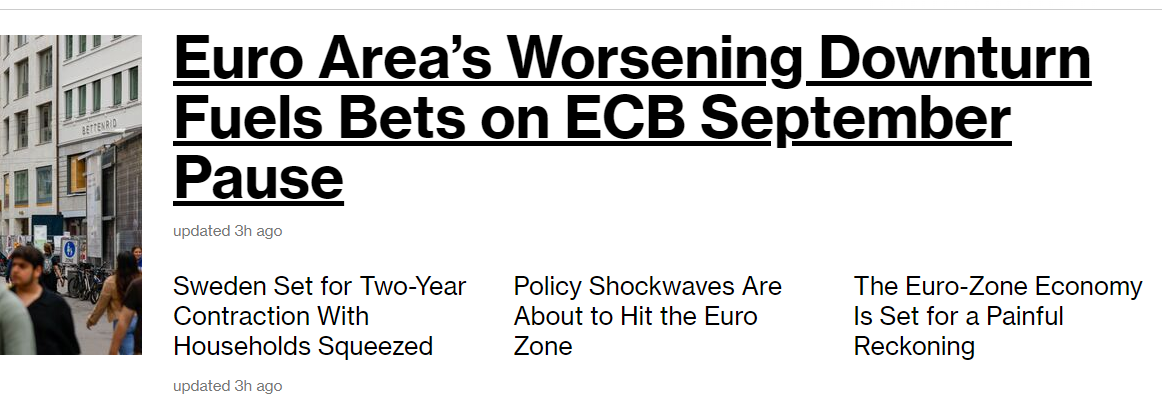
All of this is reflected in our stock markets as well. The rise in interest rates really does slow down activity, as intended, to curb inflation. The US consumer has held up so far, but at some point, the rates will bite them too. Then eventually, we’ll be ready for some stimulus again.
17 Likes
@anon34312866 and Tuomas talked about the stock market week. 
AI has boosted US stock markets this year, and one name in particular stands out in the AI sector: NVIDIA. The company releases its quarterly results today after the markets close, and these results could determine market sentiment far into the future. Professional trader Jukka Lepikkö also points out two other things to keep an eye on this week in the episode.

0:00 Intro 1:42 Markets now 7:50 Asset to watch 1/3: NVIDIA 9:36 Asset to watch 2/3: bank stocks 11:33 Asset to watch 3/3: interest rates 12:50 Market overview 22:48 Portfolio overview 27:40 Bloopers
10 Likes
Once major banks, such as Nordea, Danske, and OP, go bust or are taken over by the state, we can talk about a situation similar to the 90s recession. The current mild recession is not even on the same planet compared to what happened 30 years ago.
31 Likes
In Finland, we always stimulate during an economic boom and make cuts during a downturn. That is the intention this time as well. It is exactly the opposite of Keynes’s idea.
This approach will certainly result in a deeper recession than in neighboring countries, but fortunately, we no longer have our own currency, so there is no threat of devaluation. At least this absence of currency risk distinguishes us from the situation in the 1990s.
18 Likes
The situation is different from the 90s. Worse by some measures, better by most. What is worse now is the smaller share of the working-age population compared to the 90s, and furthermore, this share is constantly shrinking. There are far more elderly people than in the 90s, and this puts a significantly heavier burden on public finances.
2 Likes
Thanks everyone for the replies! 
Yeah, that’s exactly the problematic part. The gentleman has been an entrepreneur for at least 60 years and is still heavily involved in business operations. So he has the weight to throw out comments like that, whereas I, a student in my twenties, should always have facts to offer.
Generally, I believe he means specifically the weakening of purchasing power, bankruptcies, and unemployment. When following these indicators, I find it difficult to put them into a historical perspective. You just see in Kauppalehti that yeah, things are going poorly, but compared to what?
That’s why I’m wondering if there is a single clear indicator that could be reliably compared to history. Usually, when something is presented, there are at least five things that need to be taken into account and measurement methods have changed etc. etc., so I don’t know what the most reliable indicator would be.
This is exactly my own impression of the current times, based on what I’ve read.
1 Like
Eastern trade, i.e., trade with the Soviet Union, which accounted for a large portion of Finland’s exports, collapsed, and this was one of the biggest, if not the biggest, problems during the 1990s recession. Now, this is not quite the case.
6 Likes
However, the signs of the recession were already in the air before the collapse of eastern trade. As I understand it, the significance of Soviet trade as a cause of the recession has also decreased in later research compared to contemporary estimates:
“The overheating of the financial markets ended with the bursting of the stock market bubble in the second quarter of 1989, more than a year before the end of Soviet trade. The consequence was a wave of bankruptcies and a massive banking crisis.”
It is certainly true that there were entire industries in Finland that had no foothold anywhere after the collapse of eastern trade.
3 Likes
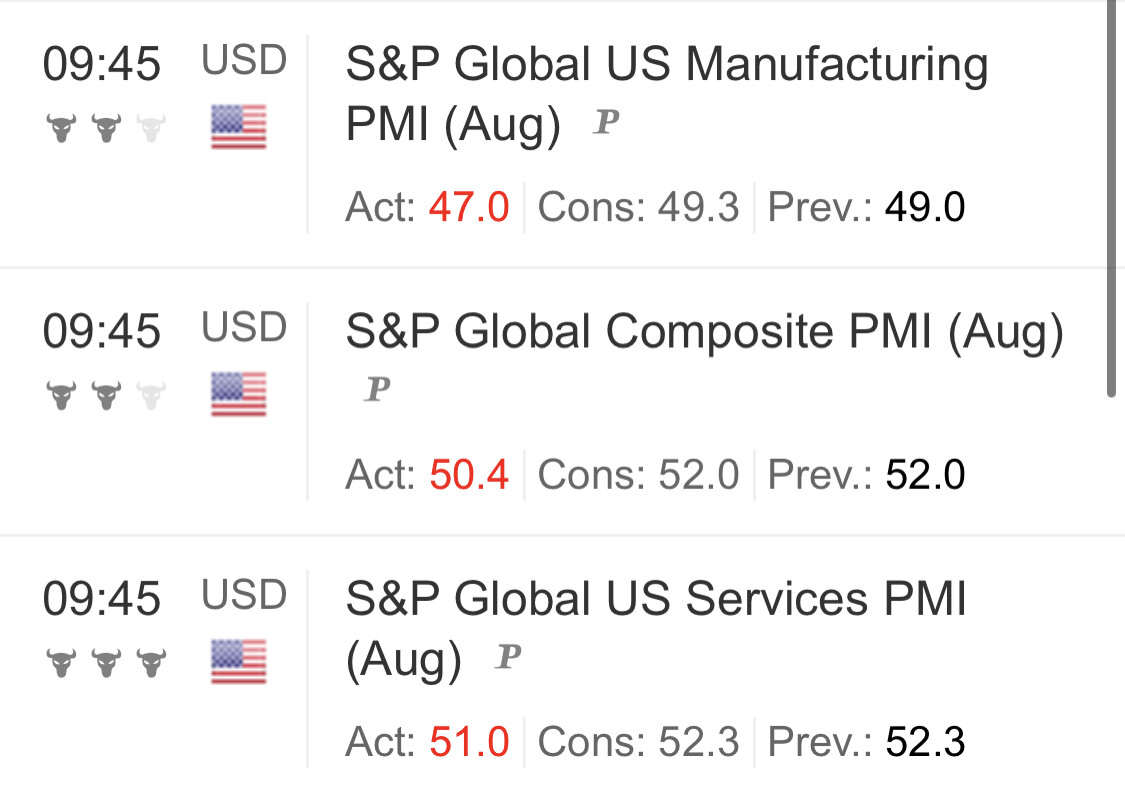
And more from US purchasing managers. Services are still above the critical threshold for now, but there is a decline there as well. The United States has been a bright spot in the global economy so far, but weaker data is starting to emerge from there, too.
12 Likes
And in the wake of this, the VIX is falling and US10Y yields are dropping. Bad news is good news 
7 Likes
And when looking at what Germany, for example, is doing, countries within the EU are indeed heading in different directions…
6 Likes
Regarding the causes of the 1990s depression, something like the following has been said:
- Collapse of bilateral Soviet trade
- International recession or downturn
- Wrong, self-inflicted economic policy choices: this involved the government, as well as trade and employer unions
Additionally, in the preceding years, many individuals and companies had become frantic and quite blinded by speed with their foreign currency loans. This opportunity had (apparently) only opened up recently; I can’t say much about the volumes, though, or what kind of a “popular pastime” it was. I still remember the news coverage: Finland will not devalue, Finland will not devalue, …, and once more, Finland will not devalue, until suddenly it did. The darkest moments were probably around then. Back then, Finland (or thereabouts) was unable to take on more debt: we took all the hits the hard way, or at least that’s how it felt.
How many of these boxes can we check now? I doubt that trade with Russia has reached a similar level of importance, and I would also imagine that our economic environment is more diverse nowadays—or rather, more resilient. Is it?
This time, we have clearly gone into debt more “cheerfully,” at quite a brisk pace. It’s hard to say whether that is good or bad in the long run, and personally, I would prefer a slightly more conservative line regarding borrowing. I would imagine that some shock effects have been milder so far due to that borrowing. Is this the case?
4 Likes
One very significant factor was a peculiar change in bank lending in the late 1980s; lending was deregulated, but deposit-taking remained strictly controlled. As a result, interest rates did not reach a justified level in any sense.
If I recall correctly, the collapse of Soviet trade mostly exposed the lack of competitiveness in our industry. We couldn’t generate replacement trade from the West without a major devaluation.
Now we can no longer devalue, as we don’t have our own currency.
This probably means that the internal devaluation, which remained untested during the 90s recession, is our only option. Whether we like it or not. But it will be incredibly tough, as prices rise and wages might even fall due to mass unemployment.
And regarding the topic in the title, one could guess that the stonks of companies operating in the domestic market might not be the winning choice in the coming years. Eventually, we’ll hit the bottom, which will create buying opportunities if you happen to be among the lucky few with cash on hand—but as for when, if only one knew.
8 Likes
Again, I’m digging into my hazy memory. Was it the case that foreign banks were initially prevented from entering Finland, so Finnish banks were practically forced, or at least instructed, to act as intermediaries? The reason, at least publicly expressed, was the fear that foreigners would come and buy up Finnish assets. And the public didn’t understand the risks of foreign currency loans.
So, there you go.
https://twitter.com/LiveSquawk/status/1694445474319614193?s=20
https://twitter.com/DeItaone/status/1694445365905236368?s=20
So, there’s that…
27 Likes
It’s quite odd that companies didn’t realize the devaluation risk, because even though a strong markka policy was pursued in Finland, one would have thought the specter of past devaluations would be haunting their minds.
After all, foreign currency loans were only a burden for corporate debtors (+ those entangled in their debts), as foreign lending to consumer customers was only liberalized in the 1990s.
The dynamics of the US housing market are very confusing to watch

https://twitter.com/KobeissiLetter/status/1694147165495443516?s=20
28 Likes