The Future of China's Economy

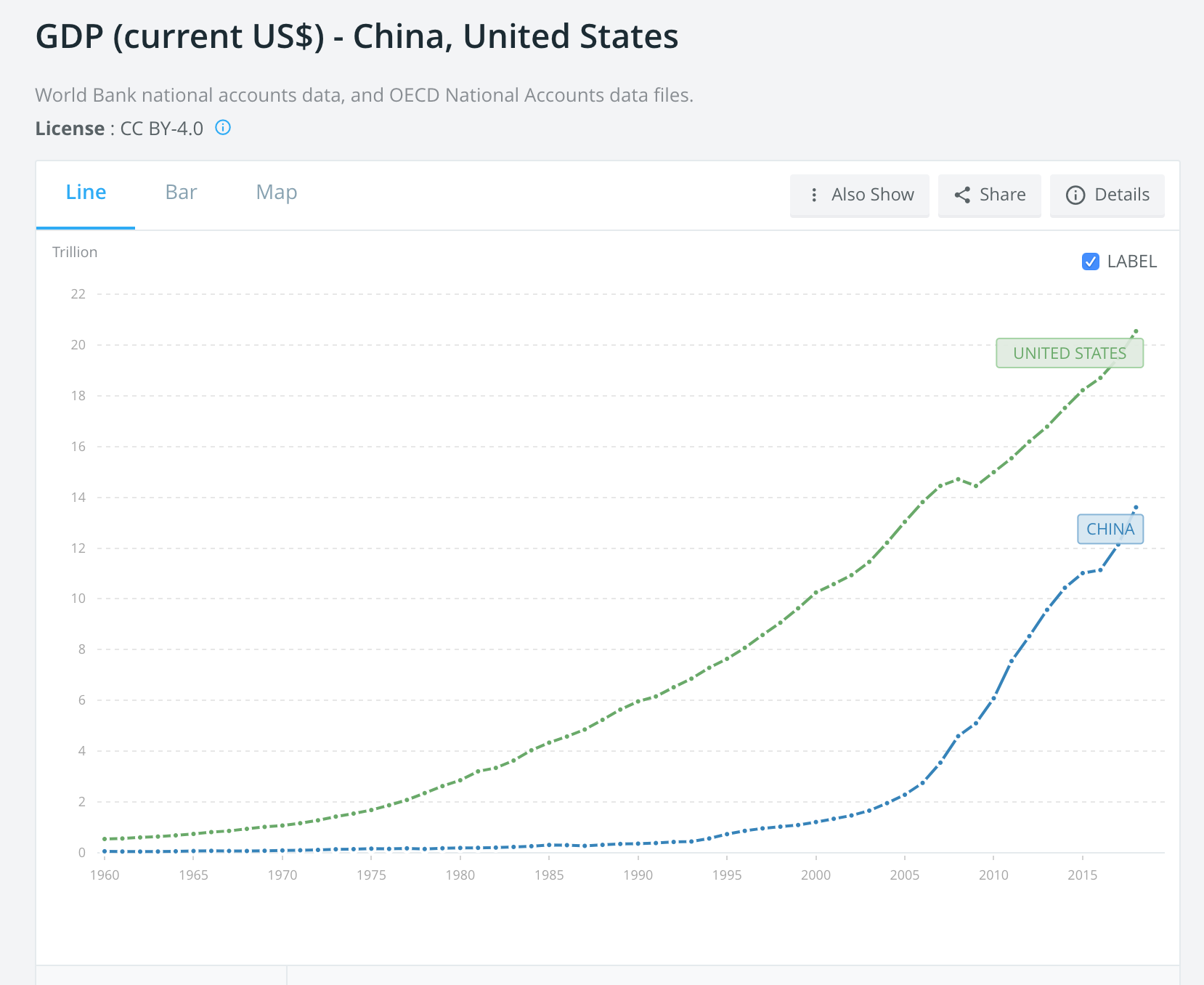
China’s economy has risen in 40 years from a small experiment in agrarian socialism ravaged by the Cultural Revolution to become the world’s second-largest economy after the United States. China is not called the world’s factory for nothing, and it is a significant source of demand for raw materials. The country has also developed technologically, and some leading technology companies, such as Tencent and Alibaba, are the backbone of the country’s technological leap.
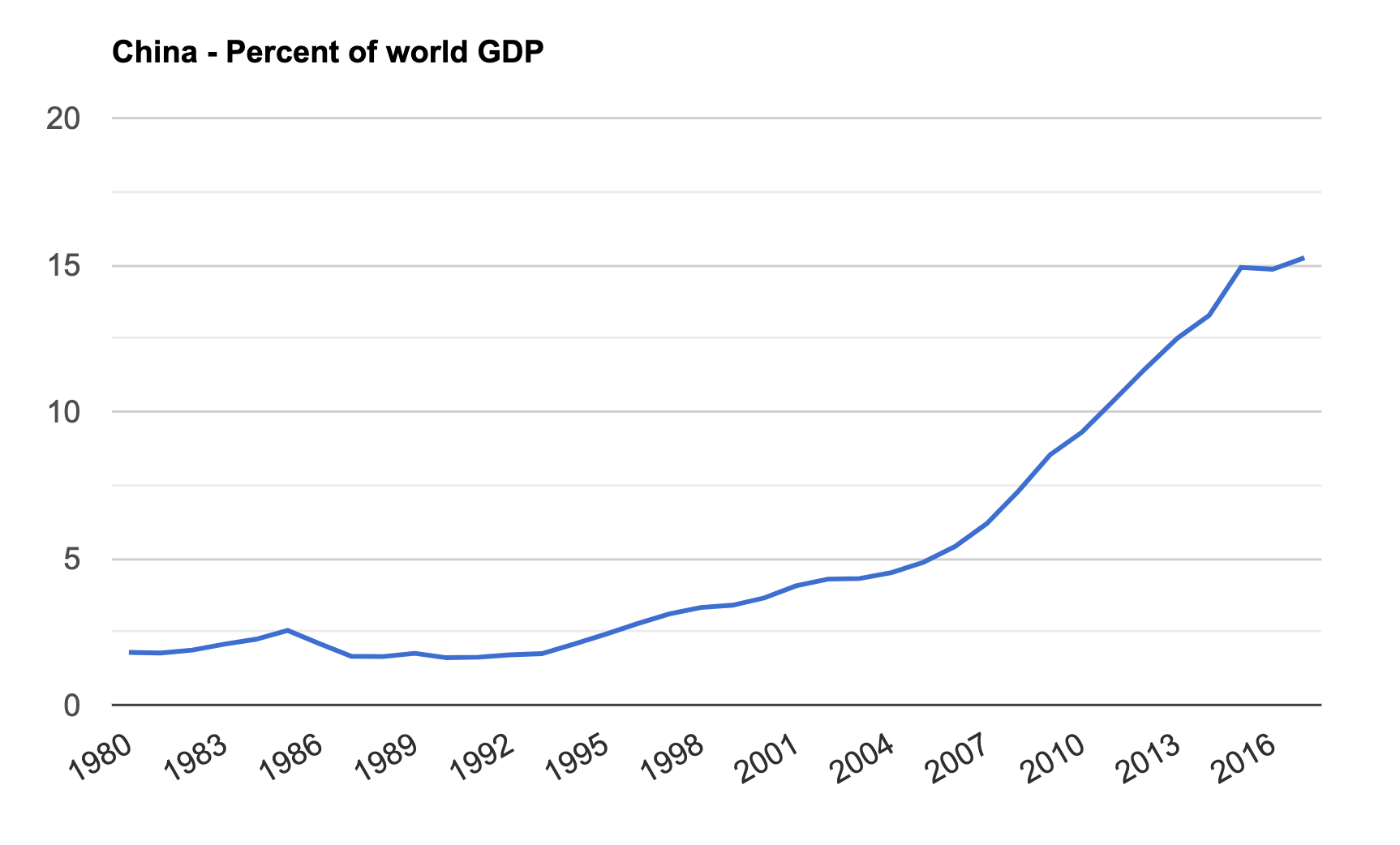
China has become significantly wealthier as a result of its investment-driven economic growth model, but at the same time, numerous dark clouds have appeared on the horizon: environmental pollution, reckless indebtedness, the growth of the system’s authoritarianism during Xi Jinping’s leadership, and an aging demography. China is aging faster than it is getting rich. At the same time, the country has drifted into more or less direct confrontations on the global arena, for example, due to industrial espionage. The most well-known of these is probably the trade war with the United States that began in 2018.
In this thread, one can discuss the future direction of China’s economy and companies in China.

From our domestic stock exchange, for example, a significant portion of KONE’s revenue comes from China. China is also a significant market for Optomed, for example. Because a large part of many companies’ production is located in China, when China sneezes, the whole world trembles.

36 Likes

Who do I follow on the Chinese economy?

Michael Pettis is often my “main source” for good, albeit often difficult-to-understand, writings on the Chinese economy. You should follow him on Twitter: https://twitter.com/michaelxpettis

I also read George Magnuson’s articles: https://twitter.com/georgemagnus1

Generally, for Asian economics, Trinh Nguyen, an economist based in Hong Kong, always brightens things up: https://twitter.com/Trinhnomics

The Bank of Finland also has material on China: BOFIT

4 Likes

Just out of curiosity, it’s worth noting that Japan was once predicted to become an economic superpower of the future. It didn’t become small, but the whole thing stalled into a couple of decades of zero growth. My knowledge of the matter is very limited, but as I understand it, the reasons have been an aging population, a lack of new innovations, and a rigid (work) culture. When looking at China, the same factors repeatedly emerge as challenges, along with an authoritarian government. How can China avoid the obstacles Japan faced?

This, of course, does not apply only to China, Japan, or Asia. The same problems can be found in many, if not most, European countries. In general, there seem to be very few countries that are industrialized and “wealthy” but are still surging economically. Most of them seem to be struggling with the same problems of how to prevent stagnation.

Edit: And sorry if the topic goes off on too much of a tangent :smiley:

16 Likes

As I understand it, China’s model doesn’t differ much from Japan’s in certain respects. Japan, like many growth economies including Finland (as Kekkonen asked, Do we have the patience to prosper) from the 1950s onwards, grew through investment-led development.

This means keeping interest rates artificially low and forcing households to save (e.g., by making it harder for them to get loans) —> channeling money through banks as cheap loans to industry, which invests (or is forced to invest) in production and raw material utilization. Another sector is infrastructure construction: airports, motorways, canals, etc.

At some point, the model should then shift to consumption-led, with households becoming the main driver.

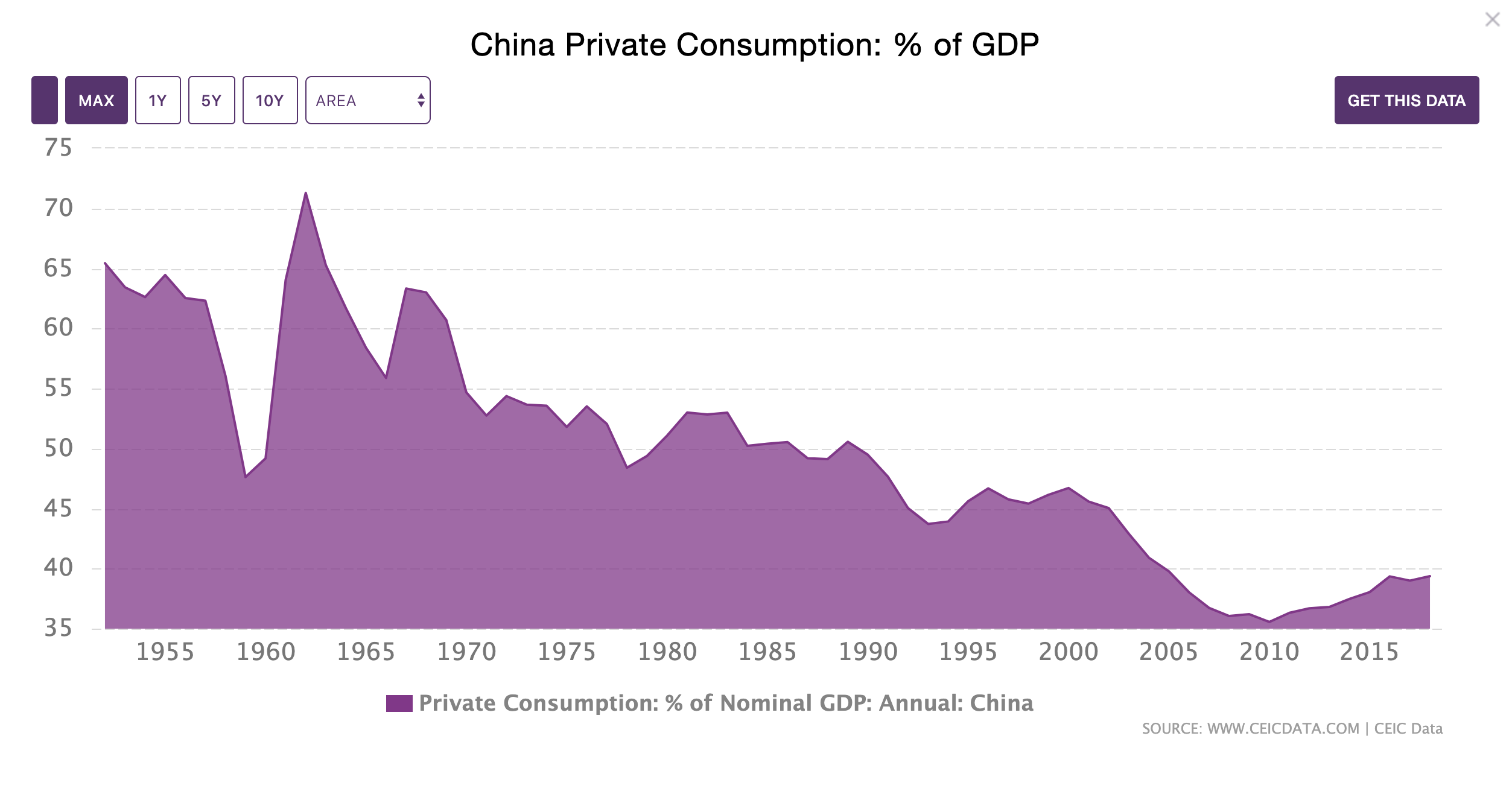
In China, this hasn’t gone quite as planned:

Households’ share of the economic “pie” is still small. In addition, the current model yields significant benefits for the party or entities close to the party (investors who receive cheap loans). A change in the model would mean a transfer of income from these entities to households. Not an easy task. The share of household consumption in GDP is still below 40%, whereas in developed countries, the figure is usually 60-70%.

8 Likes

Let’s move this discussion here. :slight_smile:

I agree with you about this upheaval: the global system that was built during the Second World War (with the United States at the helm) and became completely unipolar after the collapse of the Soviet Union in the 90s, is facing severe challenges. It is likely that no one will ever have the same kind of leadership position as the US has/had from 1945–2???. After all, the country’s GDP was 50% of the world’s GDP in 1945. No one can achieve that, no matter how much they grow, when at the same time the US, China, India, and the Eurozone, as well as others, fill the space. A multipolar, unclear future (cf. the Cold War’s bipolar “clear” arrangement) seems most likely in my eyes.

China is now eagerly filling vacuums where the United States’ weak foreign policy (although Trump’s foreign policy is an entertaining divide-and-conquer circus in the short term, its long-term implications are open…) creates them.


I understand the strategic purpose of these investments, but at the same time, they can become a big burden for China. My understanding is that there is also the problem that China can no longer invest at the same pace domestically (at some point, the marginal benefit of a new highway, maglev railway, and airport becomes too small), and now this investment machinery has been partly exported abroad.

But in the long run, a weak ROI eats away at strategic advantages, because the return on investments is so low that they do not generate enough cash flow to make new strategic investments. Other capital, on the other hand, is freed up for something more productive. In the short term, it looks scary; in the long run, not so much.

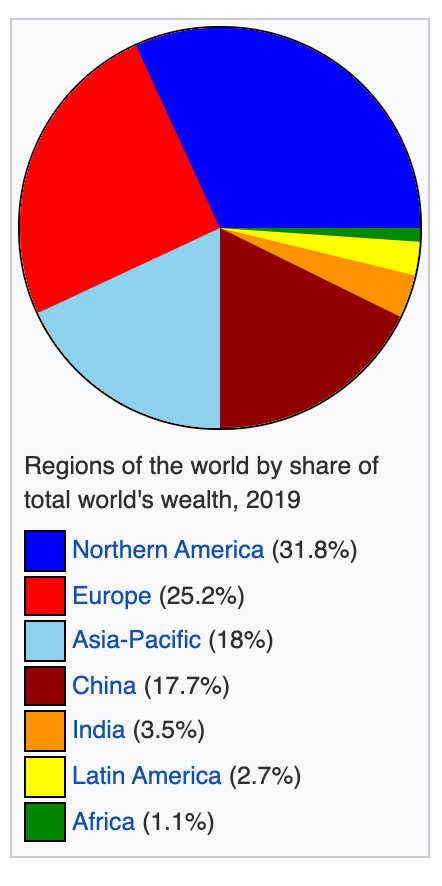
And, China’s wealth is still considerably smaller compared to Western countries. It wouldn’t “afford” to splash money around.

8 Likes

I’ve understood that the purchasing power of the population in China is exceptionally weak compared to its GDP (sorry, no link to share right now). In practice, a smaller share of the money generated by Chinese companies ends up with employees (a workers’ paradise, indeed :D). The money that remains as a difference practically goes to foreign investments through the state or state-owned enterprises. Of course, this has at least strategic advantages, and it might work to some extent if citizens don’t revolt or if dissatisfaction can be suppressed by force.

However, it is probably clear that this system has other problems, because it, for example, erodes domestic market demand and practically shifts it into foreign investments. Low domestic market demand guides the economy in a certain direction, and is that a good direction in the long run?

5 Likes

I follow the views of Nordea’s chief economist Tuuli Koivu regarding the Chinese economy.

4 Likes

I understand the strategic purpose of those investments, but at the same time, they can become a big burden for China.

Yes, my understanding is that on a large scale, China also benefits economically from the infrastructure investments it is pursuing with the new Silk Road (One Belt, One Road). It is investing about 900 billion dollars into it. Better infrastructure also increases trade, and the economy gains momentum. I’m not claiming that all of China’s investments are strategic; the perspective of my study just happens to be the aforementioned, partly due to a research vacuum.

When examining China’s case, it’s good to remember that nationalism is very strong at the national level there. Chinese people want to do everything to make their country the most powerful in the world (now it’s our turn).

China’s case also has special characteristics, so the country cannot be directly compared to the Soviet Union. Confucianism, which defines Chinese culture, emphasizes hard work and long-term thinking. Confucianism is also partly associated with a strong belief in authority and hierarchy, as is common in Asian countries. In China, the threshold to take to the streets to protest is much higher than in some European countries (e.g., France).

On the other hand, in Confucianism, it is acceptable to rise against the ruler if they act morally wrong. What, then, do the Chinese consider morally wrong? As I said earlier, I would think that the middle class has overlooked the trampling of their political rights when it has benefited their wallets. It is a realistic concern that unrest will increase if the economy falters. This has happened, for example, in Russia.

The scale of China’s investments is very small, if I remember correctly, it’s one percent of all foreign investments in the entire EU area. It’s good to remember, of course, that from a strategic perspective, money only needs to be directed to a few chosen targets (e.g., Huawei) to gain more power.

In my opinion, it is somewhat worrying that Huawei, which is strongly linked to a dictatorship, would build a 5G network, or that a Chinese state-owned company would build a nuclear power plant in Finland (as it is doing in Britain and France). The price tag is not everything.

8 Likes

Belt&Road is indeed a massive project; it will be interesting to see how it pays for itself.

Haven’t some countries already recoiled somewhat from China’s position? As I understand it, in Central Asian or African countries, loyalty towards Chinese financiers is not selfless. Was it not Congo that tried to turn to the IMF for its debts to China? I’m not entirely sure about this, though.

1 Like

That is true in itself now. It’s funny to see how modern achievements are generally seen as being brought about by culture. What would have been said about the culture of Mao’s China? Or about the Chinese 100 years ago, when the country’s reputation was opium addiction, laziness, and backwardness? Politics and institutions also define many of these things. And now they are on the side of a more authoritarian system.

4 Likes

China rattles sabers as the rest of the world writhes in the grip of the coronavirus. Attention must be diverted from its own stumbling with the virus…

https://www.reuters.com/article/us-china-security/china-rattles-sabres-as-world-battles-coronavirus-pandemic-idUSKBN2230GC

3 Likes

The rattling of sabers and foreign policy crises are traditional ways of dealing with domestic problems, conveniently diverting attention elsewhere and boosting national sentiment. It remains to be seen what Russia will come up with if oil prices stay low for an extended period.

5 Likes

I heard from a work colleague in China that a hint of racism is developing in China = the Middle Kingdom, towards “Westerners”.
“Westerners” are not allowed into some parts, or certain shopping malls and restaurants, at all. Is that really such a bad thing?
If you can’t get into a Chinese shopping mall or eat “lily pads, lotuses, and similar local food products” in a local restaurant.

2 Likes

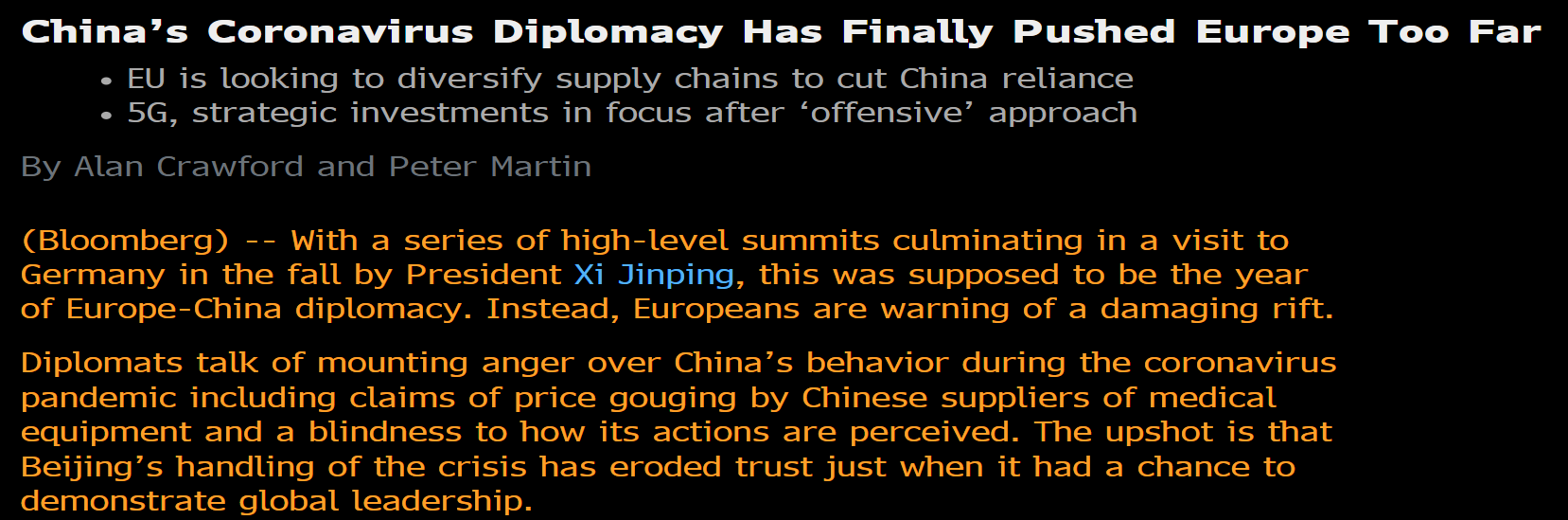
While China-criticism is healthy in the West, it is also a worrying development how trust is eroding on both sides. Bloomberg had an article about how, according to diplomatic sources, the attitude towards China has become significantly cooler in the EU. Previously, various forms of cooperation were being explored, but now the aim is to move away from excessive dependence on China.

In addition, China’s “modified truths” and outright propaganda about COVID-19 treatment have raised hackles.

COVID-19 seems to be becoming China’s own Chernobyl, but I don’t know if the dissatisfaction within the country is similar to that outside it.

6 Likes

China has itself to blame for the change in attitudes.

  • China competes enthusiastically globally, but foreigners are not allowed to compete in China.
  • China bribes and blackmails as much as it can to extend its censorship outside of China (for example, the USA vows in the name of free speech, but NBA players are not allowed to criticize China, the WHO is completely on China’s leash, etc.)
  • A million Uighurs in (concentration) re-education camps
    Etc.

Singapore’s late president and China expert Lee Kuan Yew said that China’s biggest challenge in the future is its closed culture that rejects talent from outside, in contrast to the US where, despite Trump, talented foreigners are welcomed as employees and entrepreneurs. This makes the US bigger than its size and the opposite for China.

A good person to follow is Bill Bishop, who has the popular Sinocism newsletter: https://twitter.com/niubi?s=09

9 Likes

Hubei’s GDP (BKT) fell by as much as 40% in Q1.

The country’s growth target of about 6% will be something entirely different this year.

3 Likes

That’s a good point. Researchers’ opinions on the importance of culture have changed with the rise of the tiger economies. Culture itself is not a savior if the fundamentals are wrong (cf. North Korea and South Korea). China was in many ways a weaker state during Mao’s time, so cultural factors don’t have much significance in such cases. However, I would dare to say that, for example, the relatively high number of millionaires per capita in the US is at least partly due to American culture and identity.

4 Likes

We can go through my entire master’s thesis at the same time. :joy:

11 Likes

Yes, it’s ultimately a pretty blurry line where the boundary between institutions (and incentives), politics, and culture lies. Culture, in particular, is a slippery slope: few nations are completely homogeneous monocultures, and ultimately it comes down to individuals.

We have the same problem in Europe when Germans and others in the north talk about “lazy southerners.” Twenty years ago, Germany was the sick man of Europe, which often seems to be forgotten. Because Germany made radical reforms that shifted the national economy’s cake from households to companies (i.e., the so-called owning class), the entire national economy’s savings rate increased. For others in the Eurozone, the alternatives were either to accept higher unemployment (Germans produce goods for them, and Germans themselves don’t have the ability to buy all the goods they produce) or a massive injection of cheap money as Germany’s increased savings had to be allocated somewhere. Thus, debt money blew bubbles from Greece to Spain.

In this scenario, it’s difficult to be “industrious” unless one is willing to make as dramatic moves as the Germans themselves.

1 Like

From flower pots to… Apparently, in China, SOE (state-owned enterprises) controllers who rescue banks themselves lend the money that is poured in to strengthen bank capital.

https://twitter.com/michaelxpettis/status/1252882118637543425?s=21

Although the situation of an individual bank improves, the precariousness of the entire system does not change. :sweat_smile: Of course, China’s banking system is closed, so authorities there can shape the system like a baker kneads dough to their liking…

1 Like