Nasdaq reached new records again, and the slope of the rise in the longer term is only getting steeper. In this market, no one seems to believe in a downturn anymore. Who believes that these were the peaks and we would head into a longer-term decline? Does anyone even sell stocks to prepare for a bear market? The only chance for a decline is the realization of political risks, and superficial tariffs are definitely not enough for that 
5 Likes
Politico previously reported that US President Donald Trump is planning to restrict Chinese investments in over a thousand US companies.
According to the publication, the US administration is expected to announce the restrictions late next week.
The restrictions would apply to companies in the technology sector and other sectors that the US administration deems vital to national security.
It seems that measures tougher than import tariffs are already being considered… Perhaps uncertainty will grow considerably due to possible $200 billion tariffs and potential boycotts…
1 Like
Trump threatens 20 percent U.S. tariff on EU car imports … Is it just a lot of noise, or should we expect negative news from others besides Daimler soon?
2 Likes
Somehow I’ve lost faith in Trump’s speeches, as they change multiple times before decisions are made. Haven’t these 20% tariffs on cars been talked about many times, but no decisions have been seen? Even with China, they’ve been messing around with insignificant tariffs. The market doesn’t even react significantly to those, so it’s meaningless rhetoric if no decisions are made. And I mean decisions that aren’t canceled before they take effect
What percentage of car manufacturers’ revenue comes from exports to the US? Don’t almost all of them have factories in the US as well?
Of course, I hope the market would finally shake things up, so there would be room to rise in the future
Helsinki Stock Exchange seems to be the most defensive these days Elsewhere, markets are dropping by a couple of percent, but in Helsinki, it’s only half a percent. Helsinki has also been strangely strong recently. Are Finnish small investors keeping Helsinki afloat, or what explains this? Isn’t Helsinki one of the most expensive stock exchanges, and as a small fringe market, shouldn’t it have higher risks if the trade war really starts?
1 Like
We haven’t seen a real trade war yet. Just wait, if we do see one, HEX will lose its bottom for a while…
After Nasdaq, the Helsinki Stock Exchange is the second strongest this year, if one compares it to major stock exchanges:
Nasdaq  : +14 %
OMXH 25 : +7 %
Sensex30 : +7 %
SP500: +5 %
CAC 40 : +2 %
Nikkei 225 : -0 %
OMXS 30 : -1 %
DAX : -3 %
Shanghai Comp : -15 %
If dividends were included, we would already be over +10 %.
2 Likes
I calculated that for the companies followed by Inderes (>100 companies), the median P/E for this year’s forecasts is ~16 for the stock market, and for 2019, which we’re already starting to look at, ~14. Doesn’t seem expensive. Last year’s concerns about the stock market surging and valuation multiples stretching have settled down with earnings growth. Assuming that the earnings are on a sustainable basis 
3 Likes
What about the P/B? Has someone calculated it?
Low P/E ratios can also indicate the peak of a business cycle. The economy has been growing above its potential for some time, so company earnings are too high relative to their potential. The P/E ratio alone doesn’t tell you anything, so it’s pointless to draw conclusions about the stock market’s expensiveness from it.
The stock market was probably really expensive in 2009 when P/E ratios were high and P/B was low. Now things are completely the opposite and the stock market is cheap. So, with this logic, one should have rushed to sell in 2009. If individual figures are taken out of context, things can be made to look whatever way one wants.
The P/B ratio is a good indicator of the valuation level relative to long-term potential. Of course, it is now higher than usual due to interest rates, but it can be used to interpret the growth rate required for capital to make the investment sensible. P/B comparison cannot, of course, be used for comparing industries and companies, but the P/B ratio of the entire stock market clearly indicates whether the stock market is expensive or cheap.
2 Likes
The P/B ratio for OMXH25 is now around 2.2. For companies in that index, P/B is at least for now a quite practical metric, and it certainly suggests that things are getting quite expensive. Or have been for some time.
At this stage of the cycle, I personally couldn’t imagine investing in, for example, engineering companies, whose P/E based on last year’s realized earnings hovers around 20 or more. And if one looks at the P/B ratios of basic industry companies, they certainly don’t make them look any cheaper…
1 Like
Here’s a pretty cool link for tracking various countries’ indices: StarCapital stock market valuation.
It’s updated once a month. For Finland, at the end of June:
- Schiller CAPE: 22.3
- P/E 22.5
- P/B 2.3
Then they calculate a “fair value corridor” to which they compare current valuations:
German stock market trades slightly above Fair Value
Finland isn’t separately listed behind that link, but Europe is, for example.
Edit: I’d say we’re not in any bubble, at least not here in the Nordics…
Good thoughts here and a good link, Aston
P/B is probably still a relevant metric in Helsinki, as the stock exchange is full of capital-intensive manufacturers of “oily gears”, and it’s slightly elevated.
Here’s a possible additional global concern: the Yuan has significantly weakened, causing competitiveness issues for other Asian economies and smelling of deflation elsewhere in the world https://www.investing.com/news/stock-market-news/asia-stocks-subdued-as-european-trade-fears-flare-trump-comments-hit-dollar-1537857
1 Like
Adding fuel to the fire in the trade war https://www.investing.com/news/economy-news/trump-threatens-china-with-500-billion-in-tariffs-1538246
It’s hard to retaliate in kind to that, because “The strategy behind Trump’s move appeared to be to outstrip any possible retaliation as U.S. Census Bureau data showed that the U.S. only exported $129.9 billion to China in 2017.”
1 Like
P/B is still likely a relevant metric in Helsinki, as the stock exchange is full of capital-intensive manufacturers of “oily cogs,” and it is somewhat elevated.
I’d like to ask why the P/B ratio wouldn’t be a good metric for non-capital-intensive industries. An equity investment is an investment in the company’s equity, and once the equity is depleted, the investment becomes worthless. A company can only acquire equity through profitable business operations and by raising it from owners through share issues. While the value of a software company isn’t in its operational furnishings and computers, these are what remains for the owner when key personnel leave. Return on equity (ROE) can vary, but equity is a more stable kind of capital.
There’s also the angle that share buybacks are considered a method of profit distribution because the key ratios of the remaining shares improve. If improving shareholder value means nothing, what do these accounting figures accomplish? Is a P/B of 0.8 as good as a P/B of 2.0, depending on the sector?
1 Like
Apparently you mean that the situation will change in the future. It will not change significantly. If business operations no longer tie up capital to the same extent as before, it means the return of capital to shareholders. This, in turn, leads to increased availability of money in the market and causes inflation, forcing central banks to absorb money from the market. This results in rising interest rates, and as a consequence, stock prices fall and a lower P/B level is reached. The P/B level will continue to correlate with inflation and interest rates. Companies will not generate significantly higher returns on capital in the future than they do now.
1 Like
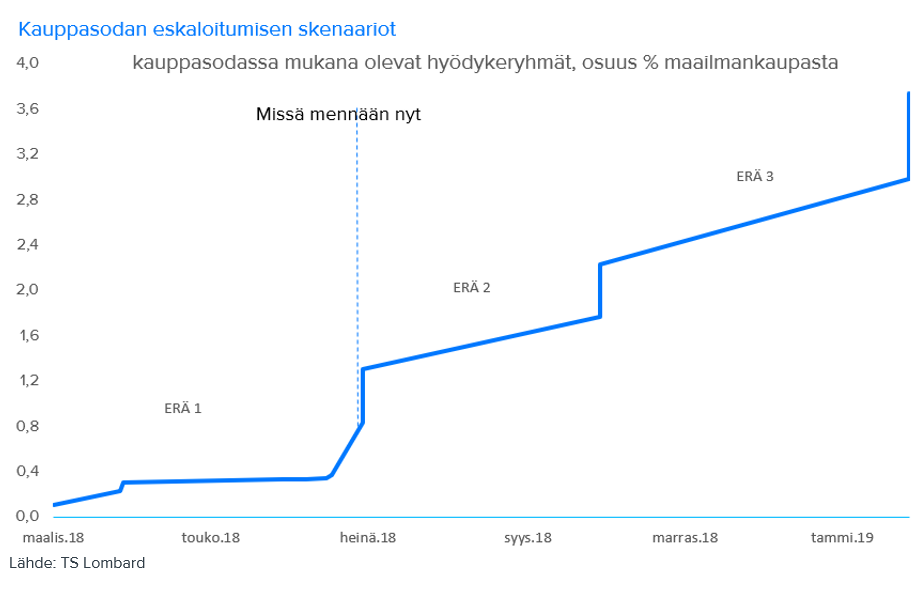
Marianne’s macro from 16.7. I have to save the possible timeline for the trade war here too… This could have an impact on all of our operations this fall.
Phase II would mean 200bn tariffs and Phase III 500bn tariffs from Trump’s side.
1 Like
Quote: “Regarding this, I’d like to ask why the P/B ratio wouldn’t be a good metric for non-capital-intensive industries? An equity investment is an equity investment in the company, and once the equity is eaten up, the investment becomes worthless. A company can only acquire equity through profitable business operations and by raising it from owners through share issues. Even if a software company’s value isn’t in operational furniture and computers, these are still what the owner is left with when key personnel leave. Return on equity (ROE) can vary, but equity is a more stable kind of asset.”
Equity, for example, doesn’t reflect the expertise of the staff, the competitive advantage brought by an established platform, network effects, work culture, or a structure that provides a fertile ground for launching new inventions or “moonshots” (cf. Amazon’s or Supercell’s experimental cultures that celebrate failures and have led to brilliant results), etc. In these cases, you cannot rely on P/B, but rather on more qualitative and “softer” metrics. Of course, these often manifest as explosive growth in revenue and profit, and if they don’t materialize, the stock naturally doesn’t have much value. You are absolutely right about that! 
As an interesting side note, the tobacco company Philip Morris has been operating with negative equity for years, and their cigarette business is still doing quite well…
Quote: “Apparently, you mean that the situation will change in the future. It won’t change significantly. If business operations no longer tie up capital to the same extent as before, it means that capital will be returned to shareholders. This, in turn, means that the availability of money in the market will increase, causing inflation, and central banks will be forced to drain money from the market. This will lead to a rise in interest rates, and as a result, stock prices will fall, reaching a lower P/B level. The P/B level will continue to correlate with inflation and interest rates. Companies will not significantly increase their return on capital more than they do now.”
It might not change immediately in Finland, but over time. Given how capital-intensive the sectors listed on our stock exchange are, I’m not holding my breath.
Now, going to the next level: even if all capital were returned to owners, it wouldn’t change the amount of money in the entire system. Most likely, that money would be reinvested in stocks, causing their prices to rise. From a holistic perspective, the situation is theoretically “the same” whether the money is sitting in the company’s accounts or in the accounts of the people who own them.
However, this doesn’t cause a general increase in prices. Money would have to go into consumption, raising the prices of goods and services, for that to happen.
The availability of money increases if banks lend more and credit expansion occurs. This can cause inflation if there’s scarcity of goods buyers are scrambling for, and sellers have the opportunity to raise prices. If production is abundant, it’s difficult for inflation to take hold.
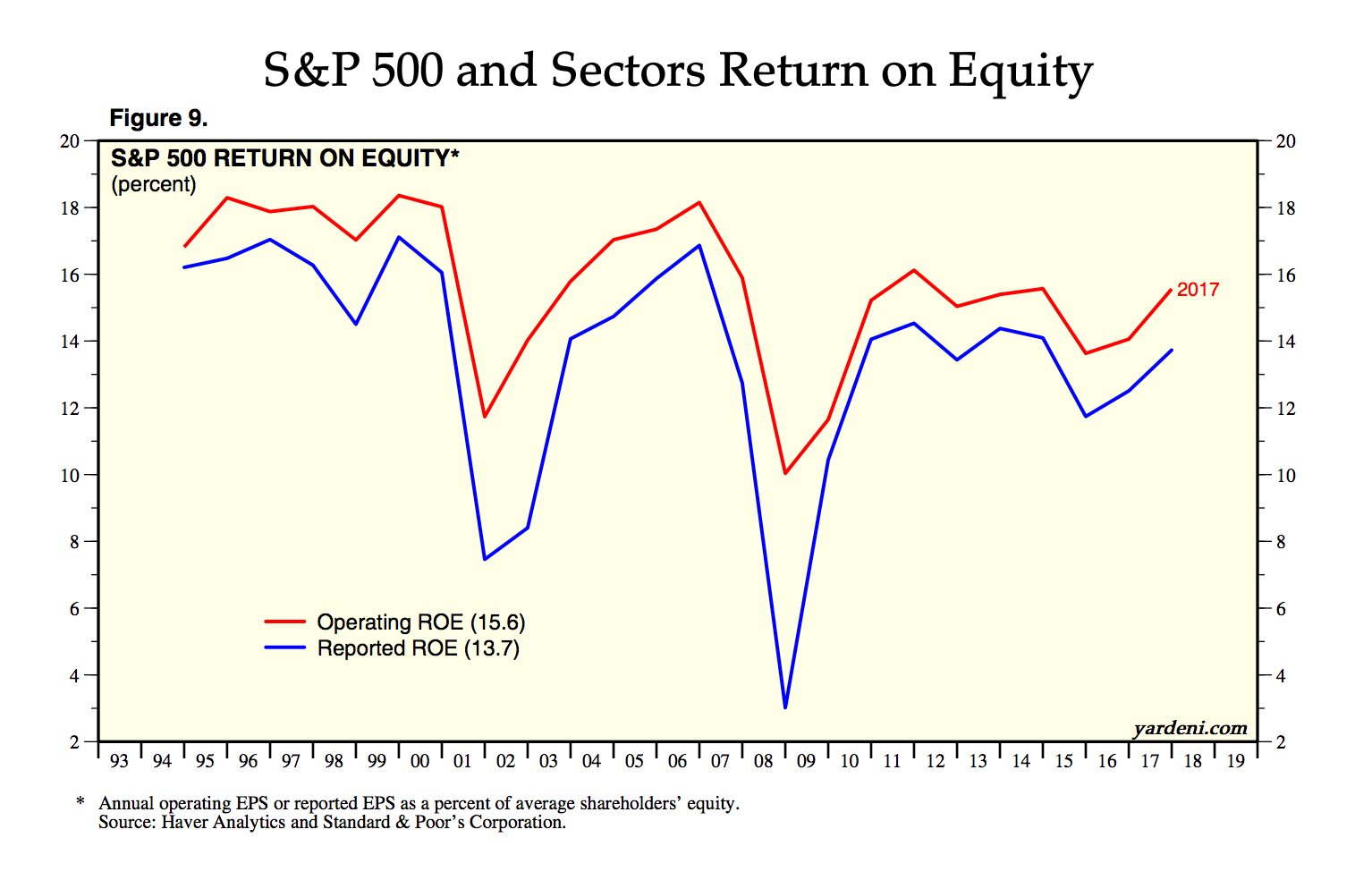
I agree about the change in return on capital; in aggregate, the stock market’s ROE has remained surprisingly stable over time, as it should. It would signal a total failure of the market economy if one cluster of listed companies could consistently earn abnormally high returns compared to others without everyone rushing to compete in the same field and lowering prices! See image below 35|690x442

Do you have more specific data on how P/B correlates with inflation and interest rates? These likely reflect the same thing (the economy is doing well → inflation accelerates, interest rates rise, P/Bs expand; the economy is doing poorly vice versa).
1 Like
P/B is dependent on the required rate of return. If interest rates are high, then the required rate of return on equity is also high, which brings P/B down. So it is a very logical consequence.
Also, the velocity of money affects the price level, not just interest rates.
In reality, it doesn’t sit in an account but is put to work. Money is directed to where it yields something. If a company distributes unproductive money to its owners, it will lead to an increase in demand through some channel. Either directly or indirectly through financial markets.
Now, if we get to a point where significantly higher returns on equity are achieved in the future as technology develops, it means significantly higher return percentages. This doesn’t happen without increased competition, inflation, and rising interest rates.
If the limiting factor becomes the expertise, number, etc., of the staff, it raises the prices of these components and lowers the company’s profit, ultimately leading back to a state where a certain risk-adjusted return is required for the capital.
1 Like