If capital becomes a scarce commodity and inflation is rampant, the economy and consumers can be doing quite well at the same time as there’s a bloodbath in the stock market.
Interest rates are certainly one thing to watch now, also with an eye on stock market movements.
For example, when will the rise in Euribor rates calm down? Then there might be “more room” for stocks as well. Even though the 12-month Euribor is certainly not the most relevant interest rate, it shows the direction.
In May, I pondered that many FOMC members would probably like to see the S&P 500 at 3000 points. Stock market equities are not a highly leveraged asset class, which reduces the risk of unpleasant side effects. A negative wealth effect nicely hits where it helps in fighting inflation but does not harm lower social classes.
Until summer, FOMC members categorically refused to comment on the stock markets at all. In late summer, scattered comments began to emerge about how the market’s rally was annoying, and they were giving thumbs up to a decline.
The free market mechanism certainly determines the prices, but one can wonder where the Fed put strike price might be. Certainly not above 3000 points.
As you stated, the negative wealth effect hits the middle class and above. They have saved their pensions in both stocks and bonds, while inflation hits the lower middle class and the poor the hardest.
The elections are very close, and both sides are blaming the Fed for the wrong policies. Well, they can play the same record, which is “we look at the data.” And the same data is available to everyone, weekly.
I find the manic guessing of the Fed’s decision by American investors somewhat amusing. We are now rapidly heading towards a disagreeably high terminal rate, which can be seen from the 2-year yield and various inflation indicators, and in the big picture, it doesn’t matter if one decision is 100 or 75 basis points.
I’ve been a bear since the beginning of the year, with the exception of the recent bear rally. Now I’m becoming more optimistic about the markets. I expect at least a temporary rise, which could be strong. This is despite the fact that, in my opinion, a recession (in the US) is certain.
The reasons for a potential price increase are as follows:
Peak inflation has been seen, and often a market turnaround coincides with this.
Investor sentiment is at a record low. This is a good contra-indicator.
Cash on the sidelines. A tremendous amount of money has flowed out of the markets into cash. Sellers are simply running out, and even a small bounce in prices will lead to buyers returning to the market.
The turning point could coincide with the FED’s interest rate meeting next week. In any case, I expect it to happen before the end of October.
If the FED sticks to a +0.75 hike and doesn’t go for a full +1.00, that alone could cause a small rally. A larger rally would then require a clear turnaround in the inflation story - although the market might anticipate it a bit in this regard. It already tried to do that before this week’s numbers and drove full speed into a wall
It’s worth noting that in US inflation data, housing costs, which cover 30% of the index, lag far behind actual real-life expenses. The data is even from 18 months ago!!! In reality, the inflation peak has already been seen, and inflation will come down quickly.
Edith: Good article on inflation from the link below:
I’ve been looking into Shiller CAPE (high) and Shiller CAPE yield (low), but the Shiller CAPE excess yield is actually pretty close to the historical norm.
Historically, have we never before been dependent on central banks and thus government stimulus packages for 14 years in a similar way? The last few years are not comparable to anything prior.
This concerned the Fed, but how would the ECB act in a similar situation? An ECB key interest rate of 7 percent would be an impossible situation for Mediterranean countries. No amount of austerity would be enough to cope with the interest rates. Would it simply be easier for the ECB to accept high inflation? If not, why not?
Of course, interest rates from across the pond also affect the pricing of euro stocks.
Thus, an increase in interest rates does not occur in a vacuum, but the transfer of income changes: an increase benefits debt owners, a decrease benefits borrowers.
A borrower, such as a state, can certainly make higher payments if there is political will. That is a question mark, of course. The private sector adjusts by force.
Austerity is a weak solution at the eurozone level: an economic area the size of the eurozone cannot sustainably “fix” itself by exporting at the expense of the rest of the world. Offense is the best defense. An individual country can, of course, tighten its belt, as long as it’s not Germany.
Perhaps the most interesting party is precisely the private sector, as raised in the thread, and especially real estate and other asset masses, and how they withstand rising interest rates.
Public debt is a problem in the eurozone if politics gets tangled. That is, of course, a risk.
If we compare the S&P 500 CAPE nominal yield to the real yield of a ten-year bond, what does this really describe? How profitable is it to invest in stocks in a world without inflation relative to bond investments in a world with inflation? Or did I misunderstand the calculation method? One would think that investment decisions are always made based on nominal returns, because inflation is the same regardless of the investment product. So, if the S&P 500 CAPE yield is 3.1% (or for optimists, S&P 500 trailing 12-month E/P is 5%) and the ten-year bond is 4%, then it doesn’t matter if inflation is 10% when the alternative is to lose the entire 10% with cash or lose a bit less with stocks or bonds.
The valuations in the US are still outrageous in my opinion. If an earnings yield of 5% is expected and you can get 4% from interest rates, that ERP (Equity Risk Premium) seems quite timid.
Have you watched this yet? What do you think? I personally guess that the Fed will not raise interest rates in a Volcker-like manner and cause a new financial crisis.
Currently, in addition to rising interest rates, the equation is broken by increasing energy costs, which will be reflected in housing company charges.
Unpaid car loans and collapsing crypto card houses will not crash the stock market. Bigger corpses are needed. There would be potential in the investment apartment scene, but rising rents in the US suggest that owners will survive their debts for at least the next six months. States will not let energy companies go bankrupt, so there will be no crash from that either.
Potential additional impetus for the downturn could come from office buildings. A large wave of layoffs has not yet occurred, and already in the San Francisco area, 24% of offices are vacant (the normal figure before the corona pandemic was about 10%). If tech companies continue to reduce staff, interest rates rise, and the collateral values of offices weaken, some real estate company / REIT might go bankrupt, causing credit losses. The risks of bad real estate loans could spread like a house of cards, similar to the subprime loans in the US in 2008.
The REIT thread in the forum linked a SeekingAlpha article where a REIT investor was of the opinion that office REITs should not be touched yet. On the other hand, for example, in Europe, there does not seem to be as much empty office space.
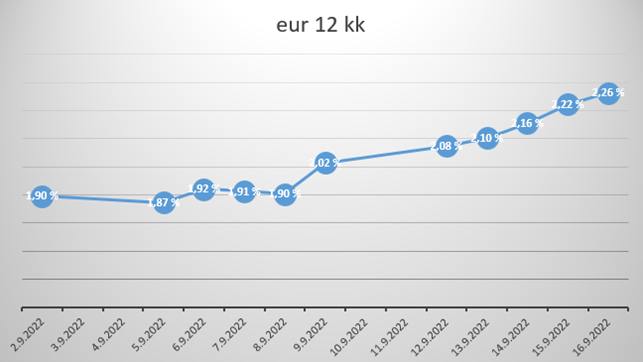


 16xx —> depending on how broadly one interprets the matter.