Possible stock market crash and how to act?

Hey,

Lately, there’s been a lot of talk about a market bubble and an anticipated stock market crash. As an investor, I’m quite new to this, and I’ve really “gotten into” stock investing over the past six months. However, even with my limited experience, the ride, especially in sectors like green energy, EVs, etc., has started to become terrifying, and I’ve begun to suspect that this talk of a potential bubble might be quite relevant. In early 2020, I was almost exclusively an ETF investor. When the markets crashed in March, I probably made the common beginner’s mistake: I waited too long and hastily sold a large portion after prices had already dropped close to rock bottom. Looking back now, it would have been wiser to act sooner, or not to sell anything at all. However, I’ve now managed to claw back my losses, and I don’t want the same situation to repeat.

So, I’d like to ask for tips from more experienced investors: how do you prepare for this possible scenario? I’ve been wondering, for example, if using stop-losses for every stock would be wise? There’s also talk that one could benefit from bear certificates in a falling market; I roughly know how these work, but I haven’t personally tried them yet. At the moment, I have a good amount of cash reserves for a possible crash, but it feels pointless to just let them sit in an account waiting for something to happen. In that case, I’d probably miss a lot of good opportunities for growth, wouldn’t I?
14 Likes

-Don’t go for bear/bull certificates or leveraged products if you don’t know 100% how they work.

-Have cash ready

-Stop-losses can be smart, I use them at least

19 Likes

Stop-losses are probably good, especially for speculative holdings or those you don’t know very well, where a potential drop might cause a lot of uncertainty. But if you own, for example, Kesla and know it inside out, knowing it’s more valuable than its current price – then I, for one, would rather buy more when a -20% dip or similar comes, than sell it off with stop-losses.

Another certainly sensible strategy is to build a portfolio more around stop-losses, but this doesn’t suit me personally.

I like to keep some cash (almost) all the time, so I know I can add at least a little bit when that dip or other buying opportunity comes, even if it acts as a constant handbrake. But for me, maximized returns are not the most important thing.

8 Likes

I did very well when starting my investment, set up my portfolio in January 2020 and got “big” in mid-March. I keep companies in my portfolio that I see as more valuable than their current price, if they fall, I buy more. I still plan to buy a couple of companies when the opportunity arises and make small changes in weight within the portfolio.

I am a “forever holder”, I keep cash in reserve and sell very rarely. So if we crash, I sit on my hands and buy more when the opportunity arises. I believe that if the investment strategy is a “long game”, then small dips do not matter.

13 Likes

It might be a boring answer, but the most important thing is your own mental well-being and balance. Everyone practically knows how not to act in a stock market crash. So, if you panic, panic first. If you don’t get to panic first, then don’t panic, it’s probably already too late. Even if everything looks terrible, buy companies that seem cheap. Even though their prices are plummeting at some incredible speed. Everyone knows this, and it’s not some secret science. Yet most people don’t follow these instructions, why?

That’s why, instead of an optimal strategy, the most important thing is to try to keep your head together. If you can’t, then finely crafted strategies can be used to wipe your behind. It’s easy to say now how you’re going to keep a war chest and buy with a smile when all hope seems lost. But what about when you sleep poorly due to stress? Everywhere seems to be facing layoffs, and in the back of your mind, there’s the fear that you’ll lose your job soon, and the editorial in Helsingin Sanomat (Finnish newspaper) wonders if we’ll ever recover from this.

I’d say self-reflection helps. Try to imagine what it feels like in that situation, and if/when that day comes again, keep a journal. When you put worries into words, it helps process them and helps deal with things in a cold, rational way. I’d also recommend advice for your strategy like: “Don’t rush.” Even in the Corona dip, which I understand was by far the fastest in history, a couple of days or even a week were ultimately short periods. I mean, if you feel like you absolutely have to churn your portfolio right now, it’s more often better to postpone the decision for a couple of days and think about it than to act immediately. Of course, sometimes acting immediately is better, but more often it’s not.

Regarding the first sentence, also add factors to your bear market strategy such as: “Go outside. Get enough sleep. Spend time with friends/family. If you start to feel too anxious, change your broker’s password to something you can’t remember, write it on paper, burn the paper, and report it to the broker, so you’ll get a new one perhaps in a week, and during that time you won’t have to stress about the rates.” And above all, remember that you should never, ever invest money that you are not prepared to lose.

67 Likes

Well, the stop loss isn’t such an absolutely good method either. The dip might be just below that stop loss. What do you do after that? Look for a new target forgetting about the security, or buy back at a higher price and never use a stop loss again?

During the approximately 15 years I’ve been in the game, there has almost always been talk of an upcoming crash. The crash is always “around the corner” and it will happen, but when will it happen? That’s the big question. It’s also worth considering whether it’s even worth preparing for a crash. At least during financial and other crises, those who were completely unprepared have fared the best. Of course, it has been worthwhile to make purchases when the weekly and monthly RSI was oversold. So, if you have reserves available when the weekly RSI is OS, using those reserves is not necessarily foolish.

High valuation multiples in a certain sector are not yet enough for a crash. Valuation multiples can also be high for good reason. High valuation multiples really only become problematic when no criticism is presented against them.

21 Likes

Thanks for the good answers! I’ve actually been thinking about stop-loss from that perspective as well, that it’s possible it just hits that level and then continues its rise. Even if I set a -20% limit, this could be quite likely for my portfolio even in “normal” times. My portfolio contains quite a few high-volatility stocks, and thus the risks for stop-loss action are naturally greater. The underlying idea, of course, would be to hold most of these long-term, so it would probably be wisest to supplement them when possible, if/when the much-talked-about collapse ever occurs.

2 Likes

I wrote about collapse scenarios at length in another thread. Briefly, input for this thread:

It’s good to note that the current financial system is getting more leveraged and filled with major risk elements year by year. An investor should consider the possibility that the rubber band won’t snap gradually, or even within a short period, but completely suddenly. If all investment assets are in the stock market, and for example, something revolutionary happens over the weekend that corrects valuations to -60% at Monday’s opening, a well-diversified stock portfolio or well-thought-out stop-losses won’t help at all.

Therefore, an investor should implement TRUE diversification. For example, real estate assets, physical gold, a stake in a strong local small business, land and forest ownership, collectibles, etc. However, one investment that protects against collapse is above all others: investing in one’s own skills and professional competence. If that’s in order, things will most likely always work out for the best.

28 Likes

You shouldn’t invest money you can’t afford to lose. Sell to optimists and buy from pessimists. I’m going to increase my cash portfolio to a fifth of my stock portfolio during the spring and hope that the correction doesn’t come before then.

The surest way to avoid the portfolio-melting effect of a market correction is to sell when the weather is good and watch from atop a mountain of cash, dry-footed, as the ice breaks. Then, with that money, you can buy many more of the same stocks. Of course, you have to trust that the crash will materialize.

I’m such a bull that I don’t believe any major, long-term recession is coming to the world; in fact, there’s even positive anticipation domestically that we’ll be able to get back to business.

Currently, there’s such a rally in Helsinki that money is being poured into stocks as if fearing that there won’t be anything left to buy. P/E ratios are such that the average investor will be in their grave by the time the company has generated profits equal to its price.

6 Likes

Selling at the top and buying at the bottom is so difficult. Historically, it has been best to just ride out crises, as stock prices have recovered within a couple of years. Of course, it would be good to have cash available to take advantage of oversold markets. If one exits the market to await a crash, a significant amount of returns will be missed, judging by history.

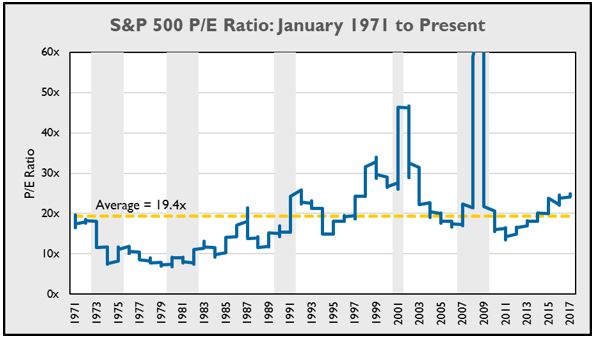
Is the average valuation in the stock market exceptionally high then? Below is a picture of the S&P500 index’s average P/E ratio from recent decades.

9 Likes

@mskomu Great writing. These “obvious” instructions you mentioned (don’t panic, etc.) are absolutely good but extremely difficult to follow if the shit hits the fan and you have fear in the back of your mind. I especially liked the self-reflection part, you have to have self-discipline and faith that the whole thing doesn’t turn into a “gamble”.

And this in particular is advice that I, at least, follow.

Good stuff.

5 Likes

Yeah, I guess no one can really time the crashes right now. The problem with Hex is that when Nasdaq in the US crashes, everything else goes with it, no matter how good the valuations are here. That pessimism tends to spread.

If you don’t sell your shares, the much-talked-about loss of profit will only be temporary. It’s obvious that it’s better to sell at 7 now than at 5 later, even if the price goes to 10 in between and you might miss out on the best returns.

A sale made too early is easier to fix than one made too late. Panic is best on the stock market, especially when you have cash and short positions. Panic is worst for those whose portfolios are melting before their eyes.

Often, people are advised to keep a cool head during a crash. That’s also easier when your portfolio isn’t melting.

3 Likes
  1. Set stop-losses for all your lottery tickets (investment positions).
  2. Increase your cash position.
  3. If you’re very confident, get an investment loan decision in advance.
  4. Wait. The collapse could take years to arrive. Exiting the market completely could cost you huge returns.
8 Likes

Thanks for the tips. Regarding that cash reserve, I’m just wondering if it’s worth hoarding most of the cash in advance now? If it takes a long time to get to a collapse, for example, then one might also miss out on many good opportunities for an upswing? What is the weight compared to your portfolio, how much is in stocks and how much in cash?

For those who weren’t heavily involved in last spring’s dip or autumn’s correction, it can be said that simply sitting tight can also work, although it might take time if a longer drop is ahead.

I know a few comrades who sold everything at the bottom last March and left the market forever, disappointed. Of course, it would have been nice to avoid those situations myself, no doubt.

One should indeed have cash almost always or access to cheap loans. Luckily, I had a lot of cash in the autumn, I wish I had had it in the spring too. Preferably, one should keep about 10-20% available at all times, at least.

1 Like

When a crash occurs, institutions sell, and real professional traders sell or make other moves. Probably most people here are just ordinary small investors who don’t necessarily have to sell. The decline happens due to institutional volume, and ordinary small investors don’t have to sell when the market is oversold.

A good rule for ordinary small investors is that in an oversold market, it’s not worth following the big players; it’s better to stay calm. If the weekly RSI is heavily oversold, it’s not worth selling; it’s better to just wait. The markets and big players will eventually buy back the dip over time.

4 Likes

It really depends on how monetary policy continues, whether we’re looking at a correction or a longer bear market. If it’s a bear market, then more “rum” (i.e. pain) might be in store, but a correction is just a great temporary buying opportunity after which the direction would be up.

I’m currently only 7% in cash, for small corrections. I’d like to increase my cash position to +20% later, but I don’t feel the need for it now. As long as central banks keep pouring more money into the game, I trust that when we come down, we’ll be able to go back up again. If central banks turn down the music, I’ll start slowly pulling out of the market and increasing my cash reserves.

4 Likes

Stock markets always reach new highs. But that’s a different thing than assuming all stocks would return to their previous levels. The price behavior of a bubbly stock and some regular stock are different. A bubbly stock won’t return to its bubble, and not necessarily ever to its old price.

4 Likes