Building a portfolio from fashion stocks?

I trade with Mr. Market every now and then.

Now he recommends the following portfolio of 13 companies (edit: added Optomed on 10.8.). I would go all-in on these today with equal weightings. Mr. Market boasts that thanks to sufficient company and industry diversification, I will gain access to great business opportunities with very moderate risk.

I won’t bore the discussion by rambling too much in this opening post.

What does the council say?

Of the portfolio:

  • strengths, weaknesses, opportunities, risks?
  • expected annualized and cumulative total return from 9.8.2021 to 9.8.2031 before fees and taxes?
  • expected volatility?
  • expected maximum drawdown?

The floor is open! :slight_smile:

I will join the discussion today, of course.

2021 forecasts are from Inderes. A few have not been updated based on Q2 earnings, and I suspect there is upward pressure on revenue forecasts for those parts.

|||3 yrs.|||rev.|
|—|—|—|—|—|—|
|||price-|||growth|
||ev/s 2021|change|2018-rev.|2021-rev.|18–21|
|||%|Me|Me|%|
|||||||
|Qt|30|2150|46|124|170|
|Revenio |20|271|31|80|158|
|Admicom|18|403|11|25|127|
|Remedy|10|508|20|46|130|
|Talenom|8,8|460|49|82|67|
|Harvia|6,5|918|62|177|185|
|Tecnotree|6,1|1975|42|62|48|
|Marimekko|4,3|354|112|143|28|
|Musti|3,8||216|340|57|
|Gofore|2,6|116|51|101|98|
|Orthex|2,5||62|87|40|
|Boreo |1,6|780|57|138|142|
|Rapala|1,5|164|262|295|13|
|||||||
|median|6,1|460|||98|\

EDIT: Below are the share prices on which these are based:

Admicom 92,00
Boreo 72,80
Gofore 18,75
Harvia 61,00
Marimekko 76,00
Musti 36,40
Orthex 10,85
Qt 149,40
Remedy 41
Talenom 15,50
Rapala 9,76
Revenio 61,20
Tecnotree 1,34

EDIT:

On 10.8., let’s include Optomed in the fashion stock tracking

  • at a share price of 13.45
  • with a P/S (price-to-sales) valuation of 12x

More diversification into the game <3

22 Likes

A versatile comparison to Nasdaq in March 2000 could be interesting?

3 Likes

If the median company’s share price in that set were to drop by the same 82% as the Nasdaq did from 3.2000 to 9.2002…

…its EV/S would still be over 1x.

Quite pessimistic, but hardly a worst-case scenario, right?

EDIT:

1 Like

I’ll have to wait for this thread to really take off :smiley: So I’ll put one calculation here before others hopefully get excited.

For a median stock, the EV/S (enterprise value to sales) is:

  • 6 in the numerator
  • 1 in the denominator

In a best-case scenario, the companies in this portfolio could double their revenue over the next ten years.

So, let’s put 2 in the denominator.

But since 3x would already be a huge EV/S valuation and the upper limit for what can be used as a multiple…

… the halving of the multiple compensates for the doubling of revenue.

So, let’s put zero percent annual stock price increase for the next ten years in the best-case scenario, with dividends on top. You can’t count much on those, as the dividend yield for that portfolio today is low.

4 Likes

A fun list that shows how, in recent years, one could have enjoyed tremendous returns from selected small and medium-sized Finnish companies.

When the market buys into the story, a fierce double leverage has been seen when both earnings/revenue have been on an upward curve and the multiples have at times skyrocketed manyfold.

As a general description: there is certainly a group of companies there that, if the markets were to get nervous, would as a group fall more sharply due to stretched valuation levels. It also includes some of the top-tier companies on the Helsinki Stock Exchange, measured by capital returns, profitability, revenue growth, and other metrics. Many have the potential for very long and profitable growth, so-called “compounder companies.” These tend to grow even through somewhat inflated multiples. Some of these will surprise positively, some negatively.

I would rather own this basket than OMXH 25 any day of the week. However, I would no longer be on the buy side for many, as the margin of safety remains narrow and the valuation demands nothing but top performance.

Many of these companies are so good that once you’ve been able to buy them cheaply, you’re quite happy to follow them as an owner for longer, calmly accepting general ups and downs and keeping an eye on business development :wink:

Yours truly, I own several companies on the list, and they are in my mental coffee can stash. For new purchases, I try to use a generous margin of safety, and now it’s already a bit difficult to find new things to buy…

10 Likes

The forum has been needing some good bears! Glad you keep making noise :slight_smile: Perhaps I would make the observation that some of the companies on the list seem expensive with an EV/S multiple, but I’ll highlight a few examples from that list if we look at, for example, P/E or EV/EBITDA figures. How comparable do you consider the comparison of these companies operating in very different industries using one and the same metric?

For example: If you allow us to look at the forecasts for the next year already during Q3 2021, Orthex with Inderes’ forecasts has a P/E of ~18, which is around the average of our domestic stock exchange. Not exactly cheap, but I wouldn’t call it expensive either.

I’ll be following the discussion with interest :bowing_woman:

6 Likes

True :slight_smile: Any single key figure can be completely misleading at any given time.

If you invested 10k at Friday’s closing prices in each of those, you’d get strikingly little revenue per investment this year, even though all of them are having an excellent year right now.

No one really knows as much about next year, let alone the more distant future, as they like to think :wink:

2 Likes

The median company’s revenue has doubled in the last three years. Why is the best case now a doubling in ten years?

2 Likes

Good question :slight_smile:

I diversified the pot into 13 companies.

Achieving 25% annual revenue growth for such a diversified portfolio is only possible in hindsight. In August 2018, no one could have put together a portfolio even close to that.

For some more concentrated portfolios, finding such growth has probably been successful. However, assessing the importance of luck in those cases is difficult.

In other words, when looking at past growth figures, outrageous data mining becomes possible. And from there, extrapolation and dreaming begin.

Given that, on the one hand, the average OMX company grows 2-3% p.a., and on the other hand, 25% p.a. for a diversified portfolio is not achievable for anyone, the next question is:

where in that range should the average growth of these 13 portfolio companies be placed?

Regression to the mean is such an incredibly strong force in these diversified portfolios that the best-case scenario must be placed clearly closer to 2-3% p.a. than 25%.

But is it 7% p.a. or something else? On the same playing field, though?

With this kind of thinking, many dozens of tragedies related to the end of growth stock parties around the world would have been avoided.

But perhaps we just have something unique going on in Finland with these :slight_smile:

6 Likes

By the way, in the spring there was a question for Juha Kinnunen about “fashion investing”: Kun täytin salkkuni supertähdillä - Inderes This is a timely topic as more new investors than average are entering the market, and they are naturally interested in much-discussed and admired companies. Both the question and the answer are quite long, but in my opinion, the main paragraph of Kinnunen’s answer is this:

“My inner contrarian forces me to also address your statement that your company choices are ‘superstars of investment discussion forums’. You are, of course, right, and the Inderes Forum has been very successful in finding top stocks. Still, I think this is a double-edged sword: generally popular stocks tend to be those that have found their way into the majority of portfolios and whose valuation levels have risen high. If popularity ever turns, there is more downside. I personally feel attracted to companies towards which general interest is weak or which are even hated. Of course, in any case, the requirement is that the fundamentals are in order and potential can be found. If such an outcast company ever found its way into popularity, one could potentially get a hefty increase in valuation multiples on top of earnings growth. But this is just typical for me, and generally superstars are popular. Perhaps I’m just trying to say that one should not even trust the Inderes Forum, and past success is no guarantee of future success.”

7 Likes

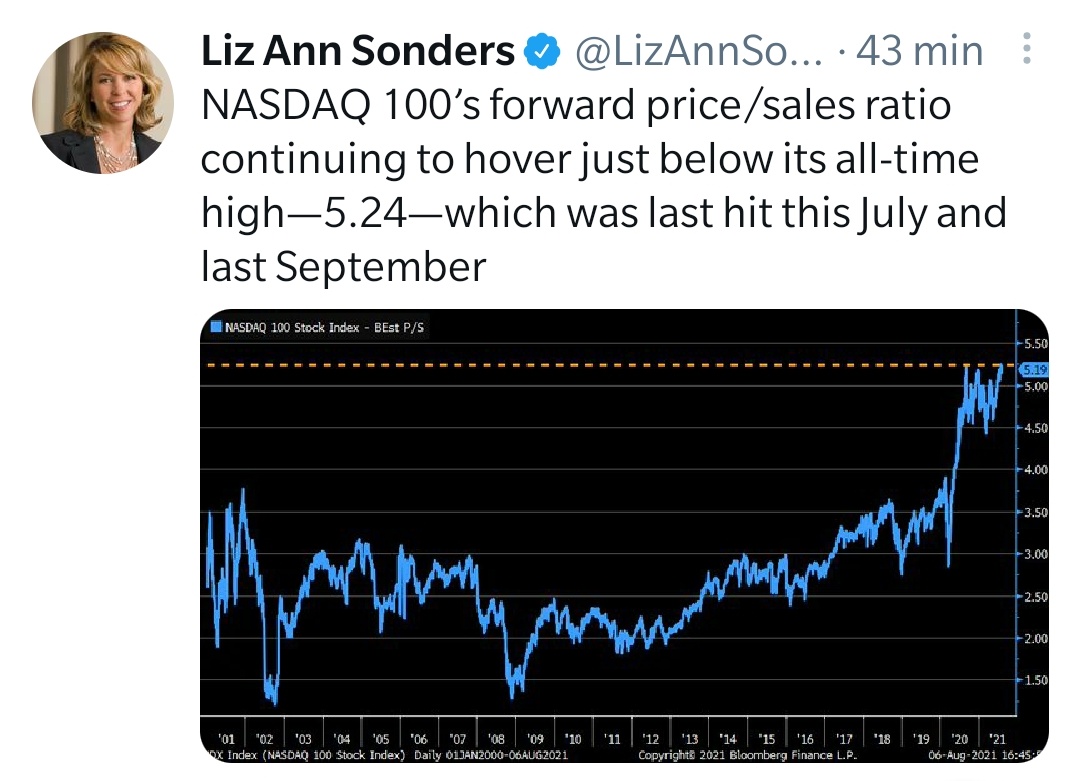
To add some context on why doubling portfolio company revenues in ten years is a strong achievement, assuming a reasonably diversified portfolio:

Nasdaq sales per share grew 120% in ten years, or 8.2% p.a., from 2010 to 2020.

This includes share buybacks. Without them, the figure would be slightly lower.

And above all, this figure is a result of data mining. I chose a starting point where growth figures looking back five or ten years were a big disappointment, and when a strong decade of growth for U.S. tech was just beginning.

From that list, I’d definitely pick Revenio, Remedium, QT, Harvia, Boreo, Talenom, and Admicom.
Qt will likely double within a couple of years.

Edit: I’m talking about revenue growth.

3 Likes

We will follow with interest what happens when, on one hand, there is strong tailwind and momentum, and on the other hand, regression to the mean, since there are 13 companies (or 14 with Optomed).

One fashionable stock investor will be a winner, another will fail. What happens to them collectively when they (largely retail investors) together own the fashionable stock scene?

1 Like

Probably a double. Oh, well. Sounds like such a sure bet that I have to invest real money in this one.

So KalleH meant that it would probably double its revenue. He didn’t guess at the market value development.

3 Likes

What to do if you suddenly want to post all possible interesting John Kenneth Galbraith quotes but then immediately realize it’s senseless spamming?

-Well, of course, you spam the only thread you’ve started yourself :wink:

John Kenneth Galbraith - Wikipedia

“The conventional view serves to protect us from the painful job of thinking.”

“The only function of economic forecasting is to make astrology look respectable.”

“Faced with the choice between changing one’s mind and proving that there is no need to do so, almost everybody gets busy on the proof.”

“There are two kinds of forecasters: those who don’t know, and those who don’t know they don’t know.”

“In all life one should comfort the afflicted, but verily, also, one should afflict the comfortable, and especially when they are comfortably, contentedly, even happily wrong.”

“One of my greatest pleasures in writing has come from the thought that perhaps my work might annoy someone of comfortably pretentious position. Then comes the saddening realization that such people rarely read.”

“The sense of responsibility in the financial community for the community as a whole is not small. It is nearly nil.”

“Wealth, in even the most improbable cases, manages to convey the aspect of intelligence.”

“It is a far, far better thing to have a firm anchor in nonsense than to put out on the troubled seas of thought.”

“Americans had [in 1929] built themselves a world of speculative pipe dreams. That world was inhabited, not by people who had to be convinced, but by people who sought excuses for believing.”

“Man, at least when educated, is a pessimist. He believes it safer not to reflect on his achievements; Jove is known to strike such people down.”

“Men can labor to make sense out of single steps toward the goal without ever pausing to reflect that the goal itself is ludicrous.”

“Do not be alarmed by simplification, complexity is often a device for claiming sophistication, or for evading simple truths.”

“In the world of minor lunacy, the behavior of both the utterly rational and the totally insane seems equally odd.”

“In economics, it is often professionally better to be associated with highly respectable error than uncertainly established truth.”

“The capacity for erroneous belief is very great, especially where it coincides with convenience.”

“Recurrent descent into insanity is not a wholly attractive feature of capitalism.”

“Fools, as it has long been said, are indeed separated, soon or eventually, from their money. So, alas, are those who, responding to a general mood of optimism, are captured by a sense of their own financial acumen. Thus it has been for centuries; thus in the long future it will also be.”

“The speculative episode always ends not with a whimper but with a bang.”

“Financial capacity and political perspicacity are inversely correlated. Long-run salvation by men of business has never been highly regarded if it means disturbance of orderly life and convenience in the present. So inaction will be advocated in the present even though it means deep trouble in the future. Here, at least equally with Communism, lies the threat to Capitalism. It is what causes men who know that things are going quite wrong to say that things are fundamentally sound.”

“For a decade after the bursting of the debt bubble in 1837, business conditions were depressed in the United States. The number of banks available for financing speculative adventures declined. Then, after another 10 years, public memory faded again.”

“Recurrent speculative insanity and the associated financial deprivation and larger devastation are, i am persuaded, inherent in the system. Perhaps it is better that this be recognized and accepted.”

“Anyone taken as an individual is tolerably sensible and reasonable - as a member of a crowd, he at once becomes a blockhead. - Friedrich Von Schiller, as quoted by Bernard Baruch”

“[…] to pursue the gold deposits that were presumed to exist in the great North American territory of Louisiana. There was no evidence of the gold, but this, as ever in such episodes, was no time for doubters or doubting.”

“Regulation and more orthodox economic knowledge are not what protect the individual and the financial institution when euphoria returns, leading on as it does to wonder at the increase in values and wealth, to the rush to participate that drives up prices, and to the eventual crash and its sullen and painful aftermath. There is protection only in a clear perception of the characteristics common to these flights into what must conservatively be described as mass insanity. Only then is the investor warned and saved.”

“The euphoric episode is protected and sustained by the will of those who are involved, in order to justify the circumstances that are making them rich. And it is equally protected by the will to ignore, exorcise, or condemn those who express doubts.”

“This map by cartographer Herman Moll was commissioned by the South Sea Company. The entire region displayed, with the exception of Brazil, was claimed as the company’s trading territory. Disregarded was the fact that Spain claimed the same territory.”

“There can be few fields of human endeavor in which history counts for so little as in the world of finance.”

“… out of the pecuniary and political pressures and fashions of the time, economics and larger economic and political systems cultivate their own version of the truth. This last has no relation to reality. No one is especially at fault; what is convenient to believe is greatly preferred.”

“Nobody blamed the credulity and avarice of the people—the degrading lust of gain…or the infatuation which had made the multitude run their heads with such frantic eagerness into the net held out for them by scheming projectors.”

"[…]for practical purposes, the financial memory should be assumed to last, at a maximum, no more than 20 years. This is normally the time it takes for the recollection of one disaster to be erased and for some variant on previous dementia to come forward to capture the financial mind. It is also the time generally required for a new generation to enter the scene, impressed, as had been its predecessors, with its own innovative genius.”

“When a mood of excitement pervades a market or surrounds an investment prospect, when there is a claim of unique opportunity based on special foresight, all sensible people should circle the wagons; it is the time for caution.”

“In all speculative episodes there is always an element of pride in discovering what is seemingly new and greatly rewarding in the way of financial instrument or investment opportunity. The individual or institution that does so is thought to be wonderfully ahead of the mob.”

“There would also be, we may be certain, the traditional reassuring words from Washington. Always when markets are in trouble, the phrases are the same: “The economic situation is fundamentally sound” or simply “The fundamentals are good.” All who hear these words should know that something is wrong.”

“Andrew W. Mellon said, “There is no cause for worry. The high tide of prosperity will continue.” Mr. Mellon did not know. Neither did any of the other public figures who then, as since, made similar statements. These are not forecasts; it is not to be supposed that the men who make them are privileged to look farther into the future than the rest. Mr. Mellon was participating in a ritual which, in our society, is thought to be of great value for influencing the course of the business cycle. By affirming solemnly that prosperity will continue, it is believed, one can help insure that prosperity will in fact continue.”

“Out of that belief, thus instilled, then comes action—the bidding up of values, whether in land, securities, or, as recently, art. The upward movement confirms the commitment to personal and group wisdom. And so on to the moment of mass disillusion and the crash. This last, it will now be sufficiently evident, never comes gently. It is always accompanied by a desperate and largely unsuccessful effort to get out.”“But now, as throughout history, financial capacity and political perspicacity are inversely correlated. Long-run salvation by men of business has never been highly regarded if it means disturbance of orderly life and convenience in the present. So inaction will be advocated in the present even though it means deep trouble in the future.”

“The recurrent and sadly erroneous belief that effortless enrichment is an entitlement associated with what is thought to be exceptional financial perspicacity and wisdom is not something that yields to legislative remedy.”

“The consequences of successful action seemed almost as terrible as the consequences of inaction, and they could be more horrible for those who took the action. A bubble can easily be punctured. But to incise it with a needle so that it subsides gradually is a task of no small delicacy.”

“It is possible to see here again the constants in these matters. Associated with the wealth of the Banque Royale, Law was a genius—intelligence, as ever, derived from association with money. When the wealth dissolved and disappeared, he was a fugitive mercilessly reviled.”

“In economics, the majority is always wrong.”

“In any great organization it is far, far safer to be wrong with the majority than to be right alone.”

2 Likes

If I were to build a proper “bull” portfolio here, how many companies should I invest in and what kind of return should I expect? I’ve listed a few quick high-return-seeking stocks for the “bull” section, and below that, some stocks I could imagine buying for a 10-year portfolio. All are, of course, growth companies that are not too large in size, although QT’s (Qt Group) valuation is already quite high.

  1. Kaspi (+50% by Q1 2022)
  2. Voxtur (+100-400% by Q1 2022)
  3. Oroco (+50% or more by year-end)
  4. SES-imagotag (I’ve more than doubled since December 2020, but let’s say significantly higher than now by year-end 2022)
  5. Nexoptic (binary, either 0 or x10+ in 1-2 years)
  6. Serviceware +30-50% by Q1 2022
    Let’s add IT Services Innofactor +30% by year-end.

10-year portfolio: By the way, this is incredibly (excuse my language) difficult to create :slight_smile: I believe these will be more valuable than now, and significantly so:
Talenom, Revenio?, Kamux, Harvia, Voxtur, SES-imagotag, InPost S.A. (dark horse), Leaddesk (dark horse), I’d also be tempted to say Qt Group.

I tried to diversify a bit :wink:

My child’s portfolio: Talenom approx. 65%, Qt Group approx. 25%, and Revenio approx. 10%. Horizon is still 13-14 years. Established in early 2018. Return so far (reasonable :slight_smile: )

10 Likes

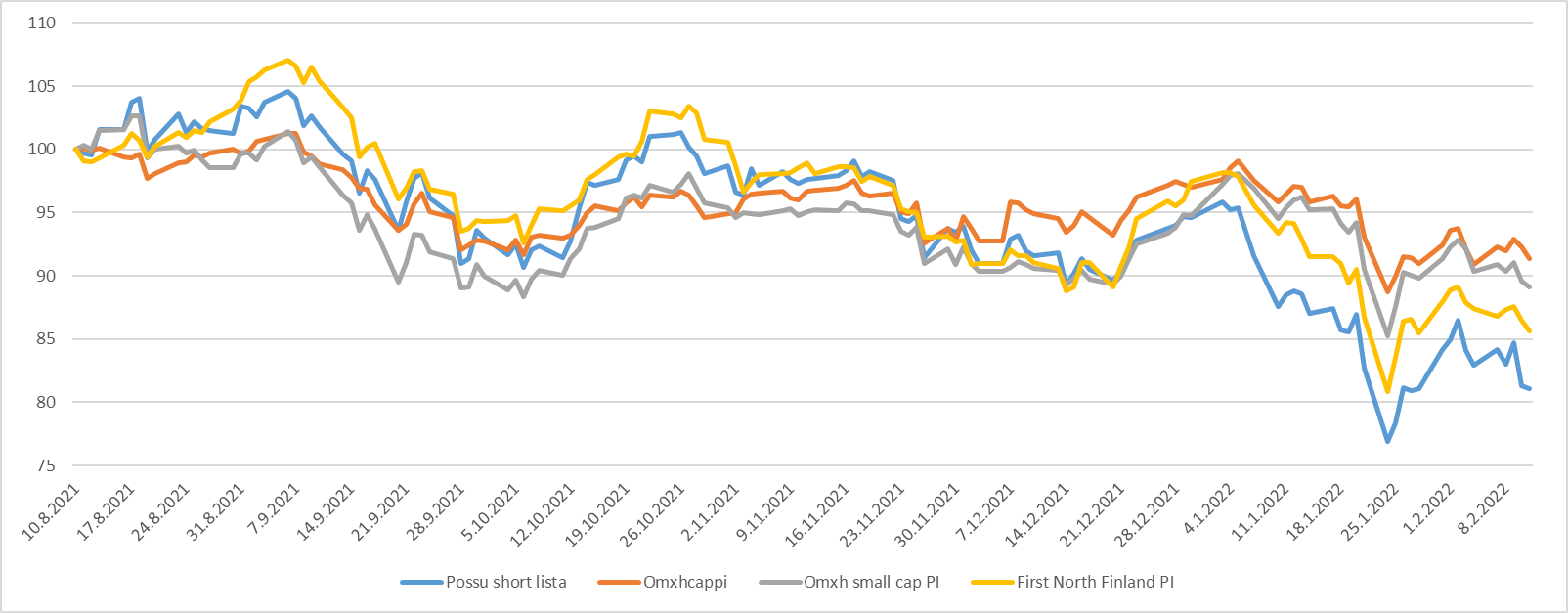
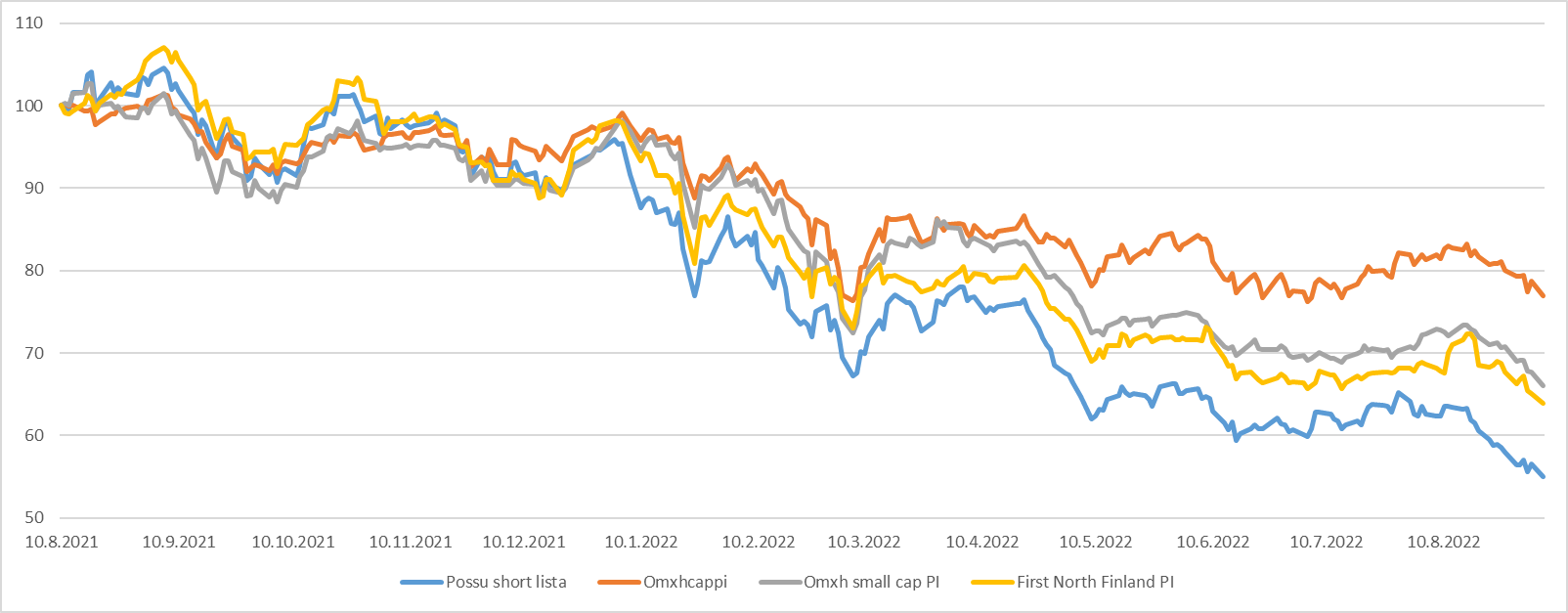
I checked in on the pig portfolio.
Did @musa_2 make a short portfolio? :slight_smile:

8 Likes

Bulls make money, bears make money, pigs get slaughtered :wink:

11 Likes

Soon the Forum’s favorite portfolio will be halved, and Kamux wasn’t even included in this…
Impressive work, the music still plays! (But I also have a small wish: would this be enough now? :slight_smile: )

17 Likes