Stock Market Direction (Part 2)

Is there any insight into how Ukraine’s reconstruction will change the sluggish economic outlook? Without a clearer idea, one could imagine reconstruction providing quite a boost to the markets. States are getting poorer due to aid, but companies are not. The reconstruction will be so massive that Ukraine naturally cannot cope with it alone.

Price estimate from May.

5 Likes

Eurozone industrial production already fell in July, as the Purchasing Managers’ Indices (PMI) predicted long ago.

https://twitter.com/c_barraud/status/1569974343161053184?s=21&t=VjKdqwviuxGSt92rLtM7BQ

11 Likes

I agree that user @Verneri_Pulkkinen’s disinflation guesses are welcome.

No one on this planet knows what theme will dominate the discussion a year from now:

  • Nasty inflation?
  • Disinflation that surprised with its speed?
  • Already heading towards deflation?
  • Good economic outlook?
  • Bad economic outlook?
  • Another theme?

Probably the most useful thing is to identify what is fashionable to think about and try to build a counter-thesis to it (e.g., disinflation that surprised with its speed).

Regarding this discussion on the theme of September 14, 2023, I have wondered where the idea that the stock market looks 12-18 months ahead comes from.

I myself would say 3 months ahead, with good luck 6 months ahead; sometimes even that 3 months is a stretch. The stock market almost always sniffs out turns in the coming months, but there are also many false signals.

34 Likes

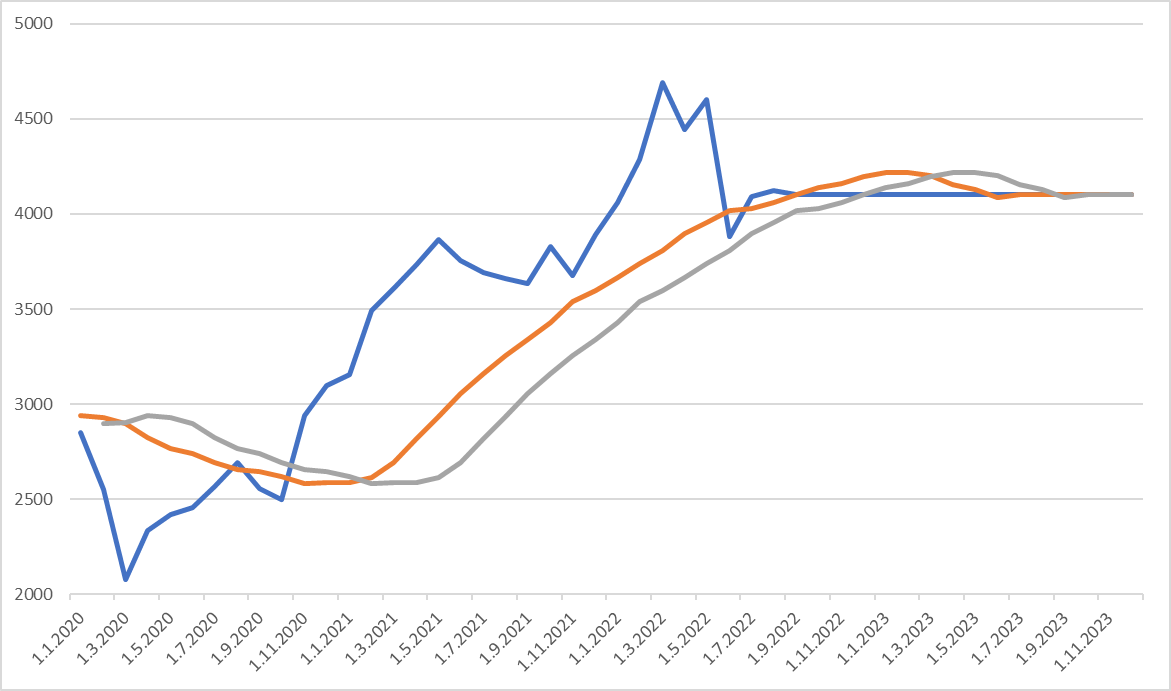
Here’s an alternative idea about the slow decline of inflation. For example, commodity prices (CRB index, blue line below) appear to have peaked, but inflation is not yet cooling.

Let’s take a hypothetical example of a manufacturing company, Oy AB. In this example, commodity prices no longer inflate but stabilize at today’s level.

The company’s purchase prices consist of thousands of different services and products, for which there are price agreements of varying lengths. Let’s assume that the average change in purchase prices follows the 12-month moving average of the CRB index (orange line). Despite its best efforts, manufacturing company Oy Ab (like other manufacturing companies right now) has not been able to immediately pass on the increase in its purchase prices to customer prices; instead, customer prices rise with a 4-month delay from the change in purchase prices (gray line).

From this exercise, we can see that even though commodities peaked in spring 2022, manufacturing company Oy Ab’s prices will only peak in spring 2023.

This simplification might be a rigid example, but it somehow illustrates the dynamic of how many companies are operating now.

This, of course, only considers the commodity outlook. Wages, service inflation, etc., will impact this equation differently.

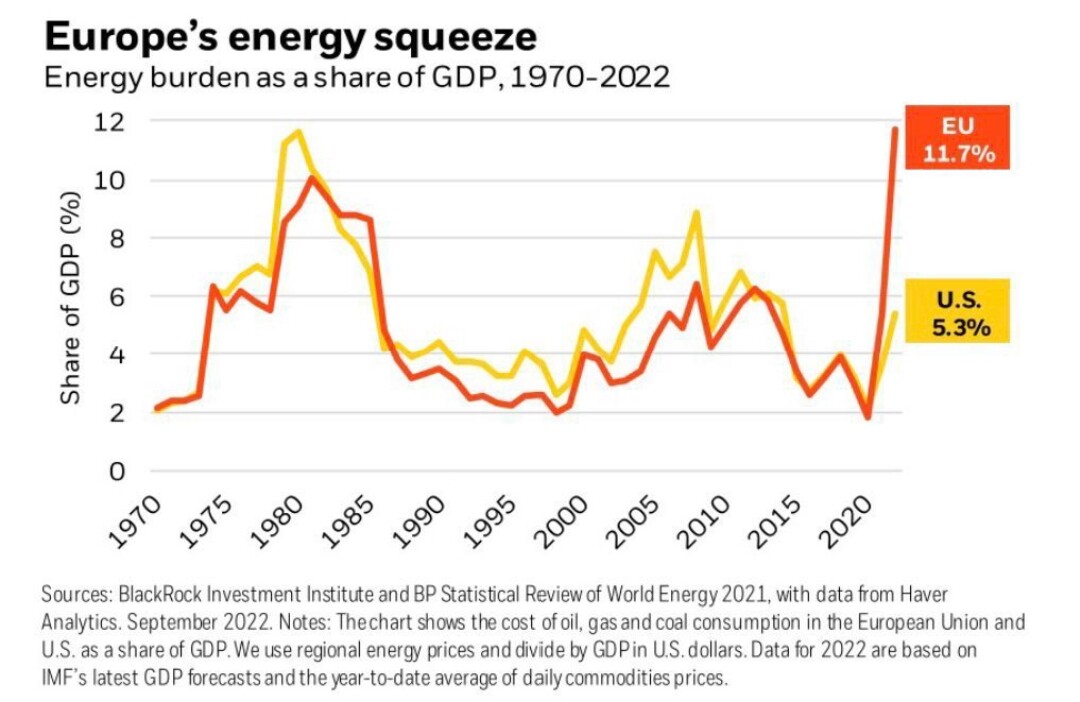
Currently, energy, and especially electricity, are very critical. Although all companies have tried to raise their prices in line with inflation, it has been difficult for most companies → There is a lagging upward pressure on prices that companies would like to factor in. Now, on top of that upward pressure, there is a very high energy price. This impacts every stage of the supply chain, as electricity is used at every stage.
→ The producer raises prices for the intermediary, who raises prices for the manufacturer, who raises prices for the wholesaler, who raises prices for the retailer. → This is a quite strong spiral, and I argue that its full extent is not currently well observable. Energy prices are, of course, in an exceptional state now, and an easing of the situation would alleviate this pressure.
11 Likes

I must, exceptionally, vocalize what I believe are the feelings of many of us and state that your thoughts are incredibly interesting to read. Thank you for sharing these, @musa_2!

(Edit: This, of course, applies to many other discussants as well. It’s truly excellent to read these reflections and thoughts! /pat on the back to the entire forum. :slight_smile:

34 Likes

That question is still open.

From the graph below, I don’t know exactly what day the forecast for 2022 was updated. Prices have fluctuated from day to day.

In my opinion, the ECB is now in a more difficult situation than the Fed was at any point in the 70s.

5 Likes

A weak euro again dilutes the effect of inflation on companies that trade in dollars? The euro has fallen 15% in a year. For example, engineering workshops still have strong order books.

If there is some kind of wage development in the offing, will that in part mitigate the effects of inflation here in Finland?

Pensions are getting a hefty index increase, there are still plenty of jobs available, and the wheels of the economy are still turning. If inflation starts to come down, we might still get through this with minor bruises.

There’s already a lot of negativity in the stock prices, for example, on the HGI stock exchange. I personally don’t see the future as very negative. Companies have the ability to adapt their operations. Very few co-determination negotiations have been seen yet… these will surely pop up in the winter, but it’s normal to have to streamline operations when sales start to falter.

With 30 years of investment history behind me, I’m not easily spooked anymore.

I see rising interest rates as the biggest threat to the economy faltering, but banks have also introduced very welcome flexibilities for consumers for such situations, e.g., Nordea’s “flexible mortgage.” This is also available for investment properties. You can, for example, put loans on interest every month without fees… and I believe the buffer for these has been built sufficiently…

For example, Wärtsilä’s geographical sales
https://www.wartsila.com/investors/financial-information/geographical-net-sales

In addition, maintenance operations often support companies with long maintenance contracts and where maintenance is a significant part of the business during somewhat weaker times.

10 Likes

Yardeni Review of Analyst Forecasts

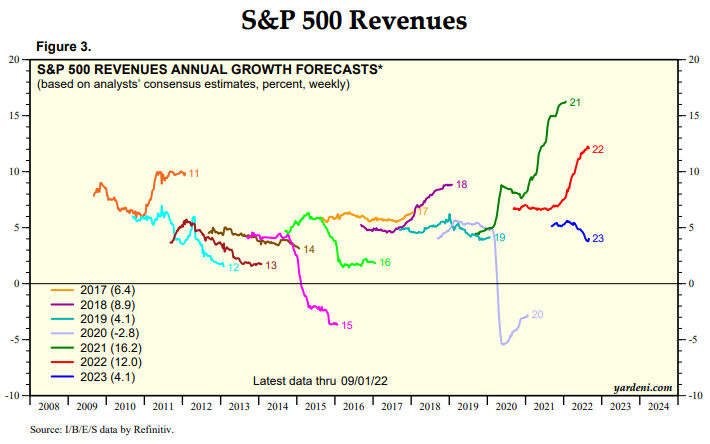
2022 revenue forecasts have remained strong. This makes perfect sense, as inflation will account for most of that, and there will still be a small economic growth for 22. Share buybacks should also provide a slight boost.
For 2023, only 4.1% revenue growth is predicted. The year-ahead inflation expectation is, if I recall correctly, somewhere between 5-6%. → The analyst consensus predicts either a recession or lower inflation (or underperformance of listed companies).

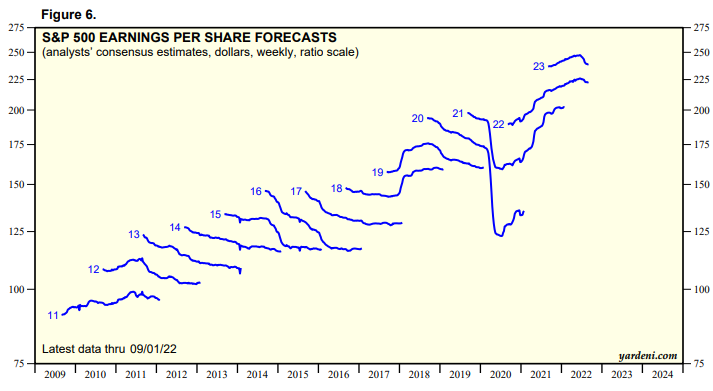
Earnings expectations have already retreated somewhat.


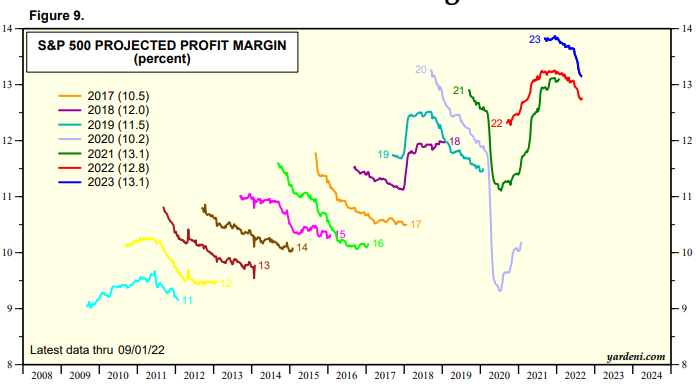
On the margin side, the decline is even more pronounced, as revenue growth + a shrinking bottom line doubles the impact. Even so, 2023 profitability would be at the record level of 2021.
It’s hard to imagine that corporate America will be able to improve margins if the top line shrinks in real terms, as analysts predict. So there is a contradiction in the forecasts.

  • If a recession occurs, earnings are unlikely to hold up as expected.
  • If no recession occurs, revenue will grow better than expected. In that case, the bottom line also has hope of performing as expected.
13 Likes

I think that timeframe is more about the length of analysts’ horizons – especially in valuation with target prices. These two things sometimes get mixed up.

Doesn’t the stock market always look a bit askew? One eye looking forward and to the right, and the other backward and to the left. In the case of individual sectors, this askew view doesn’t even seem to correct itself over decades, even though there are long periods of tunnel vision.

It sometimes feels like the stock market identifies larger movements later than before. The environment has also been challenging, but still. I’ll buy that 3-6 month timeline.

At this rate, in a year, ordinary people’s money will be gone, and you’ll get more for less, so I’m guessing the conversation will have already shifted to deflation.

6 Likes

Some companies haven’t even been able to pass on increased costs to prices yet due to long-term contracts. I believe that some, e.g., engineering workshops, will still surprise us with good results in the coming quarters. The P/E ratios for engineering workshops, for example, have been historically so low that I see them as a pretty good buying opportunity with these order books.

1 Like

One must remember that in machine shops, contracts can be from a year ago before delivery. From this perspective, it’s slowly approaching the point where the E-component will take a hit. At that time, freight prices were still rising, as were metals and components, for example. However, orders are financed with borrowed money, so costs are also coming in through that channel now.

The order books are indeed substantial.

1 Like

That’s true, but now is also the time when new contracts are being negotiated with new prices, which will improve future returns.

2 Likes

However, Ukraine is a rather modest economy and very corrupt. Of course, one can think that war, in a certain sense, cleanses the structures of state administration and unites the nation. Europe after the Second World War was a completely different class of building project and all countries had to participate in it. In addition, Ukraine is surrounded by relatively poor countries and far from the United States in particular. Based on these, I, at least, don’t see it as any kind of gold mine. Ukraine’s economy would have already collapsed without massive aid from the West.

Ukraine does not (yet) have competitive export products. The largest export and import country before the war was Russia. This is probably a thing of the past for both sides. I personally hope that reconstruction and thus development will start from Ukraine itself, just like in Finland in its time. Finland, for example, refused Marshall Aid.

In addition, talk of reconstruction has been ambitious, but actions are still awaited for now.

EDIT: Finland, for example, trained its soldiers, and some soldiers even completed their degrees at the front. At the same time, women had to do “men’s work”. After the war, all this was freed for use by the national economy. At the same time, grappling with limited resources certainly contributed to the innovation capacity of that generation. Finland’s economic development after the wars was something unprecedented. I don’t know much more about Ukraine and how, for example, education succeeds at the front there, so it’s more difficult to comment on the topic.

I would also add that individual companies can, of course, benefit from reconstruction, but a large trend-like development in the stock market due to this is unlikely to be seen. The negative effects of the war are obvious, but the direct positive drivers from Ukraine - even in the future - will be relatively small compared to these. Indirect positive drivers will certainly exist, such as the shift away from Russian energy.

8 Likes

Corruption is a big question mark; if we could assume all aid money genuinely went to reconstruction, investments could already have an impact on a European scale. After the war started, there was a shortage of concrete cast products because the factories and rebar production were located in Ukraine. Now the factories are destroyed, and soon the need will be considerable. The demand for timber is difficult even to estimate – at least the roof structures of all bombed houses are destroyed. There’s a lot of work for all of Europe to get new things built. However, it’s possible that the impact on stock markets will be limited to individual companies.

2 Likes

New Traders’ Club!

12 Likes

This is a real gem among your many interesting graphs. S&P 500 revenue year-over-year change vs. U.S. nominal GDP year-over-year change.

2001 as an example of a mild recession. Of course, inflation was slower then than what is now visible for the near future. Then in the 1-2% range.

Interestingly, revenues dipped more only during the anemic economic growth after the recession.

2 Likes

So if there are three precedents, one of which is not valid and the other two indicate the opposite, then it certainly doesn’t give Druckenmiller’s claim very strong statistical backing.

1 Like

Market psychology seems to be the most useful thing one can learn from history.

14 Likes

Good picture, from which one can outline where the predicted Fed Funds rate would hit inflation.

https://twitter.com/macroalf/status/1570039065965400066?s=21&t=Kmz4GtrO0F6QVR8tSR4bjg

It should have risen above inflation in high inflation…

Let’s imagine that core inflation, in a miraculous scenario, would remain at 6%.

The policy rate, for example, at 7%. Assume that short-term rates are at the same level.

Historical ERP (equity risk premium) approx. 5% but due to high inflation, it would widen to, say, 6%.

Required rate of return on stocks 7 + 6 = 13.

The accepted P/E for a static company that does not grow and can therefore pay out 100% of its earnings as dividends would be 7.7x. :sweat_smile:

This is also a good way to understand why high inflation and taming it is a challenging task.

38 Likes

The first thing that came to mind from this. Of course, it only pays 50% of earnings as dividends.

3 Likes