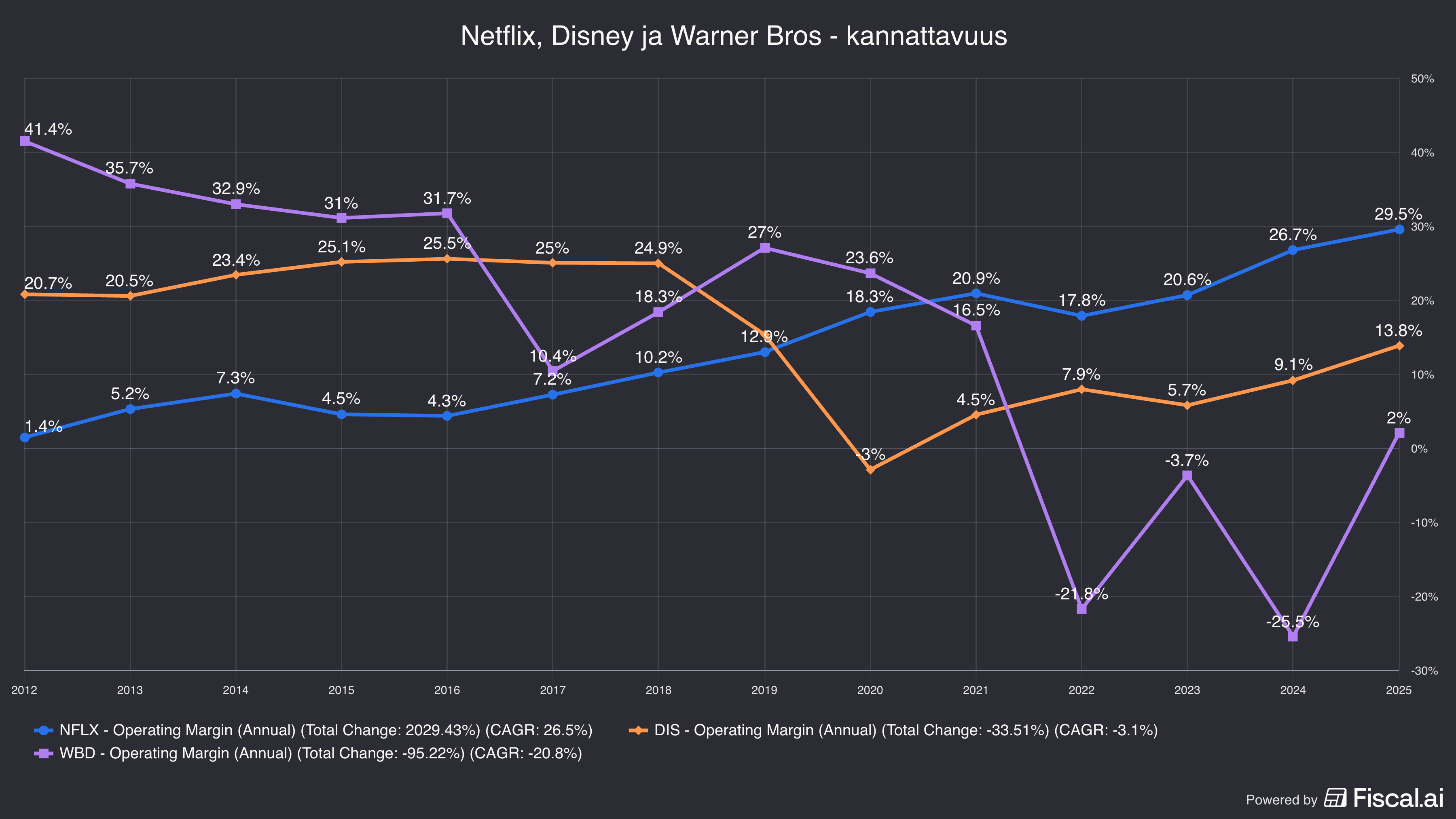
This graph explains why Netflix won the streaming market.
Disney, Warner Bros, and Paramount carry historical baggage from their legacy businesses, namely television channels. The transition to the streaming business has turned their previously high-quality business into a mediocre one.
The practice of fleecing customers with overpriced television fees has shifted into the unprofitable streaming business. Netflix never had this baggage from the past. Disney, Warner Bros, and Paramount are forced to ride two horses at once—linear TV channels and streaming services. The problem, however, is that they do not have enough subscribers in their streaming services to make streaming alone profitable.
The reason why Netflix is superior to its competitors is the low cost of content per subscriber. Netflix has a superior number of subscribers, and the marginal cost for a new subscriber is practically 0.
Disney spends $24 billion on content annually, but their direct-to-consumer platform generates only $25 billion in revenue, which includes Hulu, Disney Plus, and ESPN.
Netflix’s revenue is $45 billion with a $17 billion content budget. Currently, Disney’s streaming is not profitable if it had to support the entire content budget. Disney still has linear TV channels that make up a large part of the business, plus, of course, the parks and experiences business.
As seen in the image, Netflix has crushed its competitors when looking at profitability. The profitability of other players has collapsed drastically as streaming disrupts traditional television channels.