Movie studios and streaming (Disney, Netflix, Warner Bros, Paramount)

I decided to open a thread alongside individual company threads where we can discuss all companies in the movie, TV series, and streaming industry, as well as the industry in general, similar to how the gaming industry has its own thread. Perhaps this will make the discussion a bit more active. Feel free to delete this if the idea is bad. I’ll include brief introductions of the biggest companies in the industry in this first post.

NYSE:DIS
In addition to Disney’s own brands, the studios owned by Disney include Marvel, Lucasarts (Star Wars), 20th Century Studios (e.g., Avatar), and Pixar. Furthermore, Disney has its own streaming services, Disney+ and Hulu, as well as a large array of traditional TV channels (the largest being ABC and ESPN). Disney focuses largely on brand-aligned entertainment for the whole family through superheroes, animations, and adventure films. Disney also operates theme parks that rely on characters and worlds created in their films.
Company-specific discussion here.

NASDAQ:NFLX
Netflix is, on one hand, a relatively new player in the film industry compared to the old legacy studios, but on the other hand, it is the oldest and most established in the streaming space. The company hardly needs a longer introduction, as everyone knows Netflix’s service. Netflix’s most important series include Stranger Things, Squid Game, and Bridgerton.


NASDAQ:WBD
Warner Bros Discovery (WBD) was created last year when AT&T-owned Warner Bros merged with the publicly listed Discovery. The stormy start on the stock market is beginning to calm down as the company has managed to prune away its largest excess branches. The Warner Bros umbrella includes DC and Harry Potter, as well as the streaming service that has operated under the HBO brand until now and will be renamed Max in the future. Under WBD, there are also many traditional TV channels, such as CNN, Turner, Eurosport, Discovery, etc.
Company-specific discussion here.

NASDAQ:PARA
Paramount Global is also a relatively new company on the stock exchange, formed when CBS and Viacom merged and later changed their name to Paramount Global last year. Under the company, you can find Paramount Studios as well as the Paramount+ streaming service and the CBS TV channel. Last year’s number one hit, Top Gun Maverick, was a Paramount production, as was The Super Mario Bros Movie, which has already been predicted to be this year’s box office leader.


Universal Studios and its Peacock streaming service complete the ranks of the major studios. Universal includes the animation studio Dreamworks, and its most popular film series include Fast & Furious, Jurassic Park, and the Lego movies. Universal is owned by Comcast (NASDAQ:CMCSA). Comcast also owns the NBC TV channels.

Other industry players

  • Amazon recently acquired the Metro-Goldwyn-Mayer studio and operates its own Amazon Prime Video streaming service in markets where the parent company is active. Amazon is also increasingly producing its own movies and series under the Amazon Studios brand.
  • Apple has recently begun building its own film studio with relative success and, of course, offers streaming within its own ecosystem.
  • Lionsgate is perhaps the only smaller film studio that is publicly listed. Their most important asset at the moment is the John Wick film series.
  • Publicly traded companies that operate cinemas or are otherwise closely related also fall under this topic: AMC, Cinemark, Kinepolis, Cineplex, Dolby Laboratories, IMAX, Technicolor.

On the studio side, the industry is consolidating at a rapid pace, and there are constant rumors of new acquisitions. Apple, in particular, is expected to acquire a studio in the near future to gain a wider range of legacy content for its service. Potential acquisition targets could include Lionsgate, the privately-owned A24, or even WBD.

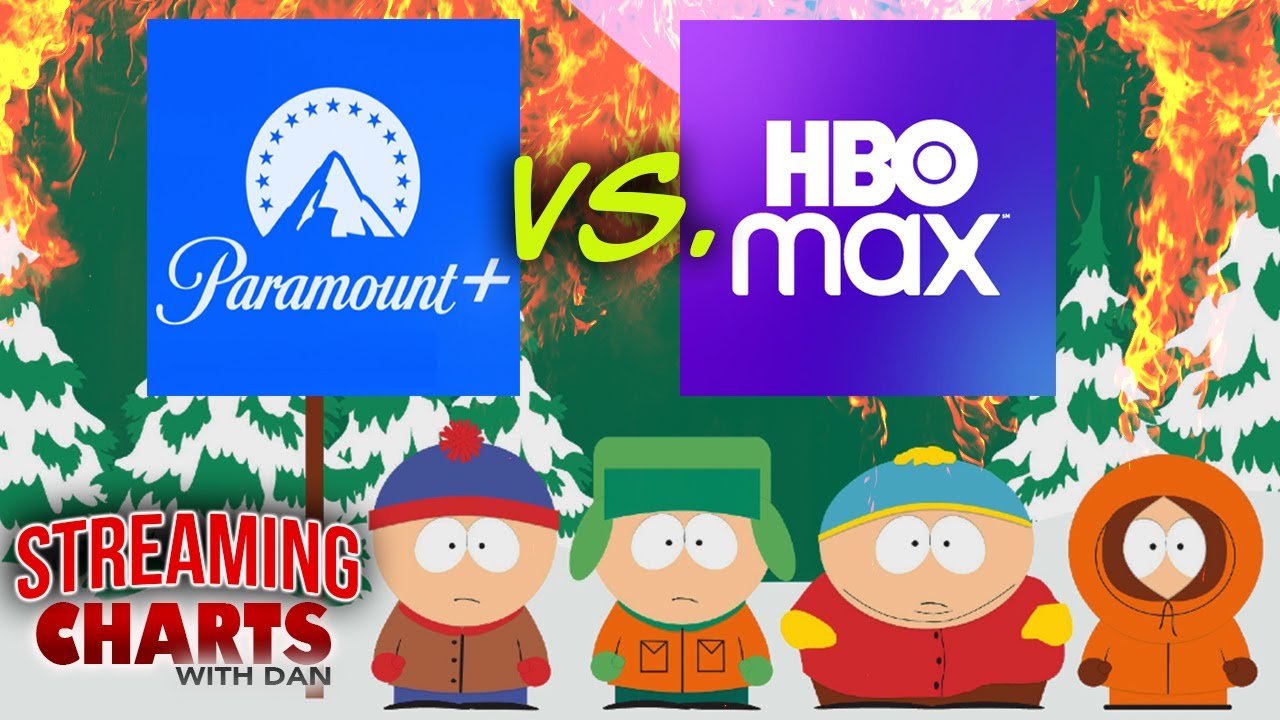
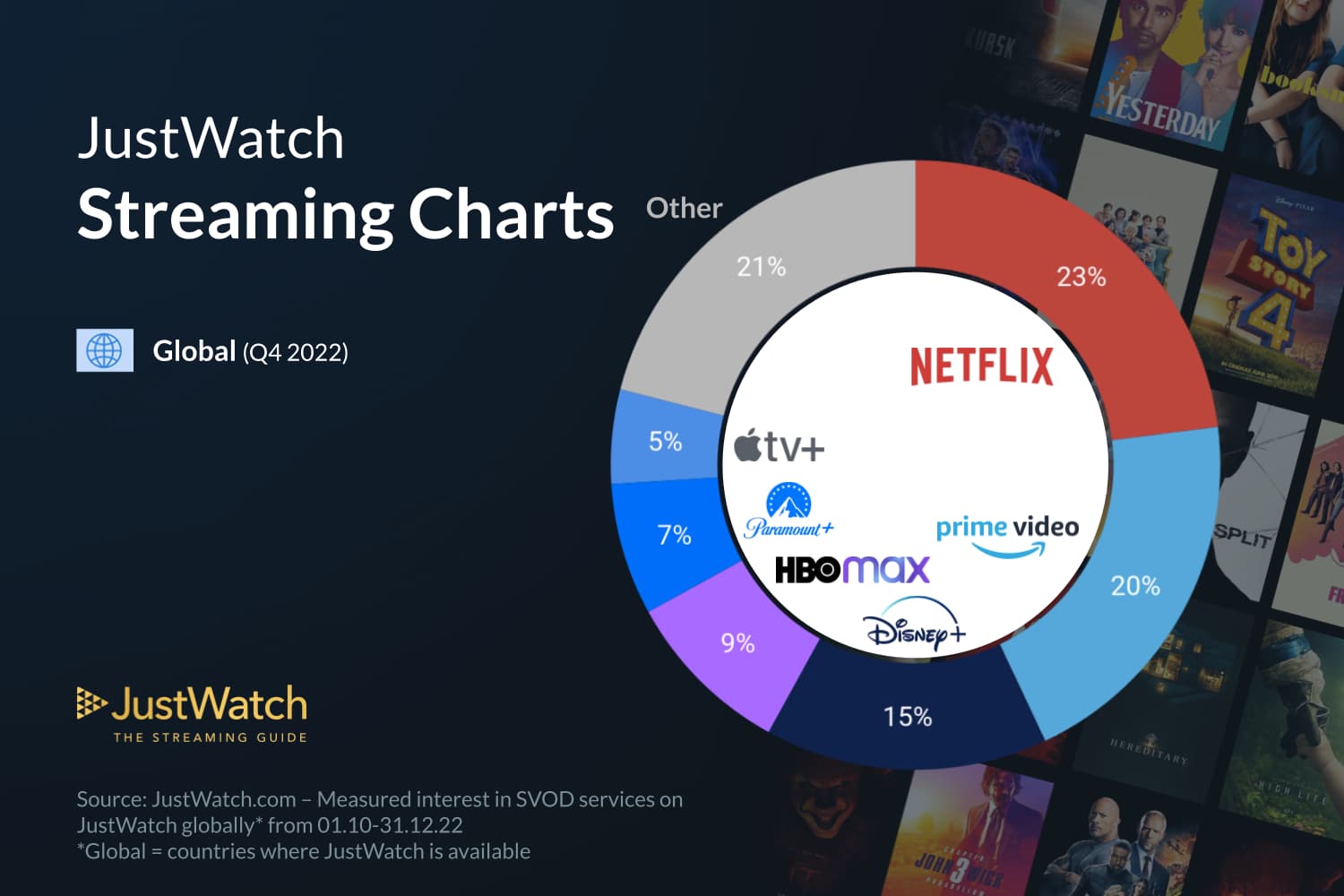
In streaming, competition for consumers’ time is fierce, as seen in the illustrative image below. It’s unlikely that all services will survive this battle; it will be interesting to see when individual services start dropping out of the game.
19 Likes

I recommend keeping a closer eye on Amazon, as there is no shortage of cash and it’s only a matter of time before they expand more strongly into this market. The MGM acquisition has been completed, and the first crumbs of its future production have been made public…

One thing about these US stocks that really puzzles and annoys me is the American legal culture. You never know what they’ll come up with next and what will be fought over in court next.

There is currently a public catfight going on between Viacom/Paramount and Warner over the streaming rights for South Park. Warner acquired the exclusive streaming rights for South Park TV episodes and promised to pay $500 million, as long as all new TV episodes were released on their platform over the next three years. Then came Covid-19. Only a limited number of South Park episodes were released.

At the same time, Paramount sought to circumvent the agreement by making a separate deal for South Park “movies” (which are about the length of a one-hour TV episode) and thus gained exclusive rights to South Park “movies” on the Paramount+ service. Warner was not very happy about this and sued Paramount.
Paramount, in turn, sued Warner for not honoring the contract payments. :point_right: :point_left: :point_left: :point_right: :point_left: :point_right:

Dan Murrell explains in more detail what it’s about

there are also 58 pages of legal text available if you’re interested - https://deadline.com/wp-content/uploads/2023/04/paramount-WBD-countersuit.pdf

5 Likes

If you’re interested in movie companies, I recommend keeping a close eye on social media next week. Cinemacon kicks off in Las Vegas on Monday.

MON 24.4.:

  • Sony Pictures Entertainment Kicks Things Off with an Exclusive Presentation Highlighting its Upcoming Releases

TUE 25.4.:

  • The state of the industry” and studio presentation from Warner bros. pictures

  • Warner bros. pictures invites you to a special advance screening of “The Flash”

  • FLASH, set for release in June, will be shown to an audience for the first time. James Gunn and Tom Cruise have already been hyping the film in advance, so it will be interesting to hear how the audience reacts.

WED 26.4.

  • Walt disney studios invites you to its 2023 presentation highlighting its upcoming release schedule, followed by a special advance screening of 20th century studios’ “the boogeyman”

  • Universal pictures and Focus features invite you to a special presentation featuring footage from their upcoming slate

THU 27.4.

  • Paramount pictures invites you to an exclusive presentation highlighting its upcoming slate

  • Lionsgate invites you to its 2023 studio presentation including a special advance screening of “joy ride”

5 Likes

I last made this about Netflix’s financial statements.

https://twitter.com/gaktus2/status/1617770553821265920?s=46&t=I9dt-5W4iRBc1FBHAy2kaA

I should probably take a look at some point to see how the story has progressed. Last time, investors were indeed excited when the number of subscriptions returned to growth.

5 Likes

The first reactions have been very positive for both Zaslav’s speech and The Flash movie.

1 Like

The Hollywood writers’ strike begins today and, if prolonged, will have a fairly strong impact on the operations of these companies. This will, of course, affect film releases only with a delay of a year or two, but series and especially current affairs programs may go on hiatus soon. Reality TV and other unscripted content emerged as winners last time.

https://seekingalpha.com/news/3963095-hollywood-writers-strike-for-first-time-since-2007-with-streaming-in-focus

While network shows will see their pipelines start to empty, immediate effects will be felt on late-night talk shows, Deadline noted, with all set to go dark and replace their new programming with reruns starting Tuesday.

The 2007 strike, 100 days long, cost billions of dollars in lost output, and wiped out a quarter of prime-time programming for the network TV season. In the years since, much has changed about how people view television.

1 Like

Paramount Global, also owned by Buffett’s Berkshire Hathaway, took significant losses last quarter related to the expansion of Paramount+ into new markets and the merger of Showtime with Paramount+. Additionally, advertising revenues in the TV segment are stalling in a weak market environment. At the same time, the dividend was cut significantly from $0.24 → $0.05. The market is responding with a 25% drop today.

https://seekingalpha.com/news/3965703-paramount-dives-22-amid-heavy-loss-cut-to-dividend

Revenue by segment: TV Media, $5.19B (down 8%); Direct-to-Consumer, $1.51B (up 39%); Filmed Entertainment, $588M (down 6%).

Paramount+ added 4.1M subscribers in the quarter to reach a total of 60M subscribers. Paramount’s free ad-supported TV offering, Pluto TV, has hit 80M monthly active users.

Tomorrow it’s WBD’s turn.

3 Likes

Warner’s Q1 earnings report - https://s201.q4cdn.com/336605034/files/doc_financials/2023/q1/WBD-1Q23-Earnings-Release-Final-05-04-23.pdf

  • Revenue: $10.7 billion vs. $10.78 billion expected
  • Loss per share: 44 cents vs. earnings of 1 cent expected

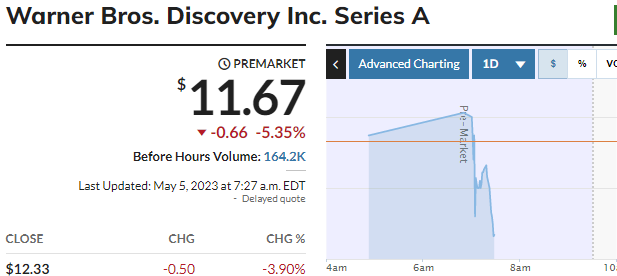
Earnings missed quite badly and here’s the reaction :cold_face:

I’m sure Zaslav will talk the stock back up again

3 Likes

Quick comments on WBD’s earnings report.

Positives:

  • The DTC segment was profitable for the first time, and US streaming is now expected to be profitable for the full year, a year earlier than previously guided. This is despite the ramp-up of the new Max service. Both subscriber numbers and ARPU rose quite nicely on the DTC side.
  • Hogwarts Legacy is selling like hotcakes, with over a billion in revenue already this year.
  • The Last of Us is a massive success, already the most-watched series in HBO Max history in Europe and South America.

Negatives:

  • The bottom line is deeply in the red. The reason: “pre-tax amortization from acquisition-related intangible assets and pre-tax restructuring expenses”. Without those, there would have been a profit of about $750 million.
  • Free cash flow is deeply in the red. The reasons include changes in working capital, interest, and payments for sports series.
  • Ad revenue on the TV side is -15%, the same issue as Paramount.
  • On the Studio side, this quarter’s flagship release Shazam 2 didn’t come close to the box office of The Batman, released in Q1 2022, and was a major disappointment.

Overall, this probably leans negative, but it shouldn’t be as big a bombshell as yesterday’s Paramount Global earnings report.

Let’s see if they’ve managed to squeeze out more savings or if the guidance changes.

7 Likes

Disney earnings report, hit estimates pretty well, but Disney+ lost 4 million users https://thewaltdisneycompany.com/app/uploads/2023/05/q2-fy23-earnings.pdf

  • Revenue: $21.82 billion versus $21.8 billion expected
  • Adj. earnings per share (EPS): $0.93 versus $0.94 expected
  • Total Disney+ subscribers: 157.8 million versus 163.1 million expected
2 Likes

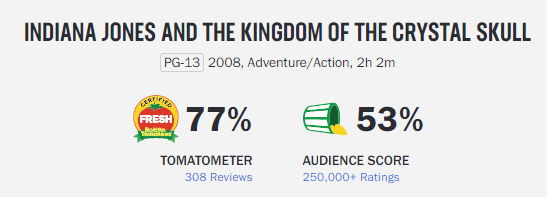
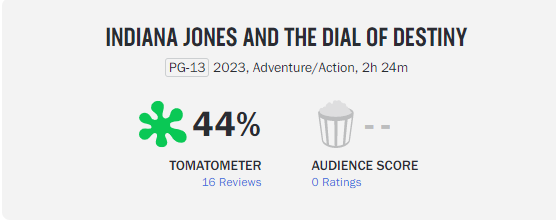
Disney continues to deliver new disappointments week after week. The latest Indiana Jones was screened at Cannes, and the reception was something other than half-hour-long thundering applause.

https://www.rottentomatoes.com/m/indiana_jones_and_the_dial_of_destiny/reviews?intcmp=rt-scorecard_tomatometer-reviews

VS

If any conclusions can be drawn from the initial reviews, this is the next box office flop. On the plus side, maybe Kathleen Kennedy will hopefully finally be shown the door.

3 Likes

Disney is indeed in an interesting situation right now, especially regarding Hulu. It seems the cards have been revealed, as it was first announced in Disney’s call that Disney+ and Hulu will be combined into the same streaming package.

First, as a significant step toward creating a growth business, I’m pleased to announce that we will soon begin offering a one-app experience domestically that incorporates our Hulu content via Disney+. And while we continue to offer Disney+, Hulu and ESPN+ as standalone options, this is a logical progression of our DTC offerings that will provide greater opportunities for advertisers while giving bundles of subscribers access to more robust and streamlined content, resulting in greater audience engagement and ultimately leading to a more unified streaming experience.

And later in the Q&A session, it was commented like this. “General entertainment” here refers specifically to Hulu.

I’ve now had another three months to really study this carefully and figure out what is the best path for us to grow this business. And it’s clear that a combination of the content that is on Disney+ with general entertainment is a very positive, is a very strong combination. From a subscriber perspective, from a subscriber acquisition, subscriber retention perspective, and also from an advertiser’s perspective.

On the other hand, it was pointed out that the deal is ultimately in Comcast’s hands. Comcast’s CEO commented on the matter after Disney’s call like this.

https://www.cnbc.com/2023/05/16/comcast-will-likely-sell-hulu-stake-to-disney-in-early-2024.html

As the icing on the cake, Disney moved the 9-1-1 series, which it produces itself, from Fox to its own ABC channel, thus taking full control of the series. 9-1-1 is one of Hulu’s biggest draws in the US.

It seems that the sale of the remaining third of Hulu to Disney is becoming quite certain. However, Disney’s balance sheet is stretched pretty thin, and Hulu won’t come cheap—especially now that Comcast knows that for Disney’s strategy, they almost have to buy it. They wouldn’t really want to take on more debt, and they don’t have an excess of cash either. They’ve also promised to reinstate the dividend next year. Disney will have to perform some serious balance sheet gymnastics if they really intend to see this through. Indiana Jones flopping would hardly help. Will ESPN go up for sale?

1 Like

Disney has no other choice but to acquire the rest of Hulu. They don’t have the money for this; they would need to take on 9-10 billion in debt. Comcast knows this and won’t agree to sell too cheaply. They are screwed.

Iger’s vision is to sell Disney to someone bigger within a couple of years or to split the company before he steps down, but Apple and Amazon are in a wait-and-see mode because performance has been quite weak over the last few years. The theme parks are indeed raking in money, but when the IP business struggles, it will eventually impact the theme parks as well.

E.g., the latest multi-billion Star Wars investment was quite a disaster -

The media outlets in Disney’s pocket aren’t yet willing to talk about the losses in Florida, except in a political sense, but Disney has no chance of succeeding in court. Florida can void the bonds and force Disney to pay taxes on them retroactively, which would involve losses of several billion.

As the movie business and Disney+ struggle and Disney is obsessed with “woke-ifying” all its famous brands, the next couple of years will be very challenging. Personally, I’m waiting for the right moment to strike and for them to get rid of Iger.

4 Likes

I wonder if such an arrangement would even pass anymore, now that the FTC has started taking an interest in antitrust matters again? I find it hard to believe, as even smaller deals are being scrutinized so closely now.

Well, at least something good, at least one billion was saved thanks to this battle.
https://www.nytimes.com/2023/05/18/business/disney-ron-desantis-florida.html
I personally don’t believe this is about anything other than political theater. All grudges will be forgotten after the upcoming elections, both sides scored points with their respective audiences, and life goes on in Florida as it has until now.

1 Like

Comcast believes Hulu’s value is over 70 billion, while Disney thinks it is several tens of billions less. So there is plenty of negotiating left to do to get this deal across the finish line.

2 Likes

Lionsgate (John Wick) released its quarterly report on Thursday. The results were pretty meh, but beat expectations.

https://investors.lionsgate.com/news-and-events/press-releases/2023/05-25-2023-210625252

https://investors.lionsgate.com/~/media/Files/L/LionsGate-IR-V3/quarterly-results/2022/fiscal-2023-q1-earnings-press-release.pdf

Lionsgate has decided to shut down its LIONSGATE+ streaming service at least in Europe and, to be honest, I didn’t even know such a thing existed. Operations in Finland already ended on March 30, 2023.

2 Likes

Time for something positive for a change. Contrary to at least my own expectations, The Little Mermaid movie—which has long been at the center of this political debate—seems to have received a good reception at the box office. The movie was expected to bring in $90-100 million in domestic box office revenue during its opening weekend, but the result was ultimately $119 million. A long Memorial Day weekend, of course. Internationally, the movie sold $185 million worth of tickets. If compared to previous live-action remakes, The Little Mermaid has a good chance of reaching a billion dollars in box office revenue this year, which would be an excellent performance on a $250 million budget. So maybe Disney does know its audience after all and knows what it’s doing with its legacy brands?

Sources:
https://seekingalpha.com/article/4608788-disneys-the-little-mermaid-proves-the-company-is-just-as-popular-as-ever

1 Like

This isn’t the whole truth. Forecasts were lowered just before the release to make them easier to hit. Originally, the forecast was 140 million and it fell way short of that.

For comparison, the 3-day opening revenue is typically used. The Little Mermaid grossed 95.5M in its opening weekend.

  • -7% below 2016’s The Jungle Book ($103.2M)
  • -17% below 2010’s Alice in Wonderland ($116.1M)
  • -45% below 2017’s Beauty and the Beast ($174.7M)
  • -50% below 2019’s The Lion King ($191.7M)
  • +4% above 2019’s Aladdin ($91.5M)

This doesn’t look very good, especially considering that ticket prices have risen by 25% in a few years, meaning viewership numbers are significantly lower than for other productions. Disney can, of course, still try to blame COVID, but I personally see Disney+ as the main culprit. Disney has shot itself in the foot and trained consumers to expect these movies to be available for free on the streaming service in a short while.

The ones above did gross a billion in box office revenue, but 60-70% of the earnings came from outside the US.

Beauty and the Beast The Jungle Book Alice in Wonderland The Lion King Aladdin
Worldwide Gross $1,263,521,126 $966,550,600 $1,025,467,110 $1,656,943,394 $1,050,693,953
Foreign gross $759,506,961 $602,549,477 $691,276,000 $1,113,305,351 $695,134,737
Foreign % 60.1% 62.3% 67.4% 67.2% 66.2%
Domestic % 39.9% 37.7% 32.6% 32.8% 33.8%

How is the situation looking for The Little Mermaid?

WORLDWIDE gross $217,544,240
DOMESTIC gross $138,583,114
DOMESTIC %** 63.7%
INTERNATIONAL gross $78,961,126
INTERNATIONAL % 36.3%

Even though the US opening was okay, the movie flopped badly globally, and at this rate, it looks more like it’s going to be a flop. The break-even point is estimated to be around $750 million.

It’s been especially difficult in China, with an opening of only $2.5M

  • -95% below The Lion King ($54.1M)
  • -94% below The Jungle Book ($48.8M)
  • -94% below Beauty and the Beast ($44.5M)
  • -86% below Aladdin ($18.5M)
3 Likes

Ok, I wasn’t aware of this. Was there a source for this?

It is a good question whether it matters to Disney if the same amount of money comes in from 100 viewers or 75 viewers? Well, maybe it does, if this IP is to be utilized for merchandise and theme park sales. A more interesting question is whether Disney still gets the same share of that increased ticket price, or if the cut taken by theaters has risen?

Yeah, a billion admittedly looks difficult to achieve. But where does your estimate of a 750 million break-even come from? At least according to Deadline’s sources, it would be much lower.

In a break-even scenario off a $560M global box office (meaning a net profit of $71M before participations and residuals are accounted for), we’re told that Little Mermaid ‘s global film revenues would amount to $547M against its combined production, global theatrical and home entertainment marketing expenses of $476M.

On the other hand, theatrical releases often have a longer tail outside the US than in America, so I wouldn’t stare too much at the percentages of USA vs. rest of the world at this stage. If you look at, for example, Aladdin’s performance, the US opening was about 25% of total theatrical revenue, while elsewhere in the world it has been around 15%. Of course, The Little Mermaid still isn’t doing well in China, as you said.

Finally, I completely agree with this. However, this is currently a curse for the entire industry. First, out of fear of Netflix, they tried releasing movies in theaters and on streaming at the same time (WB). As expected, nothing came of that. Now they are gradually trying to pull back from that, but as you said, viewers may have already gotten used to waiting to watch at home. The rise in ticket prices doesn’t help this.

2 Likes

The Deadline article does not reflect real life and the calculations are very strange. For example, if Disney releases a movie on the Disney+ service and pays itself 100M for it, moving money from the left pocket to the right doesn’t affect the final result in any way.

The author of the article also didn’t understand how the box office, i.e., ticket revenue, is shared. Generally speaking, in the US, the movie studio gets 60% of the box office in the first week, 55% the next, and 50% from then on. In the international market, the studio gets 40% of the box office, and in China only 20%.

Disney has usually been strong at negotiating deals, so it might even get over 60% of the revenue in the first week. So, let’s assume that in the US, Disney gets 60% of the box office. Based on the first week, the movie is only succeeding in the domestic market, so let’s split the market share as 60% Domestic and 40% international.

Boxoffice total M US BO INT BO Disney US income 60% Disney INT income 40% Production Marketing P/L
1000 600 400 360 160 250 150 120
900 540 360 324 144 250 150 68
800 480 320 288 128 250 150 16
700 420 280 252 112 250 150 -36
600 360 240 216 96 250 150 -88
500 300 200 180 80 250 150 -140

The calculation is rough, but to make a profit, the movie would have to gross over 700M, and based on current estimates, it is going to fall well short of that.

If Disney wants to continue on its chosen path and make a profit on movies one day, budgets should be brought well below 200 million, but …

You also cannot fully trust the budgets reported by movie studios…

https://www.forbes.com/sites/carolinereid/2023/04/14/revealed-two-latest-jurassic-world-movies-cost-845-million/?sh=58494d183b04

Universal has revealed it spent a staggering $844.7 million (£680.2 million) on the two latest movies in its Jurassic World trilogy which is more than twice their estimated budget.

4 Likes