NVIDIA - Enabler of the Impossible

NVIDIA - Enabling the Impossible

NVIDIA provides, both now and in the future, a significant portion of the programming and computing power required globally for customer needs across many industries. In the company’s case, the adjective “disruptive” doesn’t quite do it justice, as its solutions create something unprecedented—entirely new business. In my opinion, it is one of the most innovative companies in the world, capable of combining cutting-edge science and ICT for the benefit of its customers.

NVIDIA could be viewed as a “general store,” and why not? But almost always, the common denominator of its solutions is taking computing capacity to a completely new level. NVIDIA embodies those qualities that often lead to top success in U.S. companies: a founder who is still at the helm and a modern personnel policy: ”There’s only one team at NVIDIA. That means no politics, no hierarchy”. The company understands its responsibility as part of the community, and ESG is taken into account in its operations.

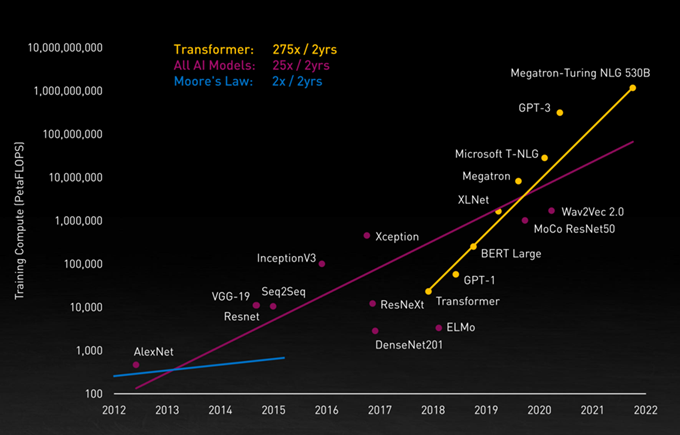
The image below is taken from the company’s Q3 presentation. It shows that the growth in computing capacity has surpassed Moore’s Law (blue line). Megatron-Turing (top right) is a recent joint venture between NVIDIA and Microsoft to develop interaction and understanding between humans and systems. This image perfectly illustrates my summary of the company: it innovates with the power of the best talent → then the company networks → and thus something entirely new is created for this world. This is why NVIDIA deserves its own thread here on the forum.
image

NVIDIA belongs to that class of companies where “holding” requires great staying power and constant reading to have the stamina and courage to ride through dips, stagnant periods, and red days. I believe the latest investor presentation (below) is very much in the moment—and provides a good look into the near future.
https://s22.q4cdn.com/364334381/files/doc_financials/2022/q3/NVDA-F3Q22-Investor-Presentation-FINAL.pdf

48 Likes

Jensen Huang is already being compared to Bill Gates and Steve Jobs. If the metaverse (Omniverse) really takes off with the help of Nvidia, these comparisons might not even be enough. Glad to be along for the ride.

6 Likes

Here are a few takeaways from Nvidia’s presentation at the Credit Suisse 25th Annual Technology Conference on November 30. CFO Colette Kress answered analysts’ questions for 30 minutes. A few highlights:

The common thread for the company has been and continues to be “accelerated computing.” According to Colette, gaming was the first area where the company noticed the need for more speed in computing. The gaming industry remains the heart and soul of the company. AI and its development was the next target area to benefit from Nvidia’s capabilities. And looking ahead, Colette sees Nvidia as a company that also produces “full stack” data center solutions. For Nvidia, “full stack” means a stack where the bottom layer consists of microchips, above which is the machinery for fast computing, and at the top are software and development environments for the needs of various industries. The Mellanox acquisition (in 2020, a company that produces components for supercomputers) enables top-tier data center functionalities.

Jensen Huang has recently emphasized that now that they have a “full stack,” they can produce software environments and solutions, for example, for AI, in a completely different way than before. The Arm deal (currently under scrutiny by competition authorities) is still a consistent effort to bring “full stack” to mobile devices and edge computing.

Nvidia’s Q3 results show strong cash flow utilization for long-term acquisitions and purchases. Colette states that their actions have helped their suppliers increase their capacity. According to Colette, they are ready for next year’s strong demand: "But when we think about the second half of next year, I think we’ll be in a great position given so much of the work that we’ve already done on long-term procurement.”

Questions and discussion moved to market assessment (TAM). Colette stated that fundamentally, half of their solutions reduce the cost of analytics (computing) and half are entirely new use cases, meaning they expand the market. Colette repeatedly emphasizes that they are growing faster than the gaming market or data centers – Nvidia offers not only gaming experiences but also tools for developers and distributors. Similarly, they see “accelerated computing” spreading comprehensively to data centers and programming platforms. “So, inferencing is now growing faster than our overall datacenter as a whole.” → This quite well encapsulates Nvidia’s view that traditional number crunching (traditional mathematics) and traditional digital processing of data, like from a document to a digital document, are being joined by solutions where the digital world becomes a true assistant to humans, inferring and recommending things in the blink of an eye, and, if the situation demands it, even saving from danger. This already brings us to the interface of the virtual and physical worlds. Colette sums up Omniverse well: “Omniverse really brings together the best breed of everything that we have developed.”

12 Likes

Nvidia is by far the most fascinating of these tech giants. Waiting for the stock market to crash so I can actually buy some someday…

Here’s a recent interview with Jensen Huang for those interested, I thought it was very interesting:

Instead of me highlighting the key points for you, let this guy do it for me:

I found the interview there. It’s a good blog overall, I read it from time to time.

Waiting for this day:

:smiley:

9 Likes

At the start of a red day for US Tech, there were speculations that the Arm deal would fail: “The probability of Nvidia (NASDAQ:NVDA) completing its planned $40B purchase of Arm Holdings (ARMHF) from Softbank was cut to 5% from 30% after the Federal Trade Commission yesterday sued to block the combination, according to Citi.” Other short-term factors that could cause a crash are not really visible at the moment…

1 Like

Interesting report, and it immediately brings up two key topics:

  • machine-learning operations (MLOps)
  • cloud technologies
    NVIDIA is at the forefront of both of these.

https://www.mckinsey.com/business-functions/mckinsey-analytics/our-insights/global-survey-the-state-of-ai-in-2021?cid=other-eml-dre-mip-mck&hlkid=e864d8599a39479cb4ef7708d385980c&hctky=3052965&hdpid=4b6f7bea-130b-4b17-a629-7f61772a3c6c

3 Likes

Surprising - I couldn’t find any NVIDIA investments or trading activities from Ark Invest. Has Cathie always kept her hands off this stock? Hmm… :slight_smile:

1 Like

US growth stocks have offered a wild roller coaster ride in 2021. My main takeaway is that fixating on valuations and multiples is not for me. In the Cloudflare group, I shared a Forbes article that made me wonder about the filtering length of Beth Kindig & I/O Fund - have growth investors become value investors!!! :slight_smile:

I myself lean entirely into growth. In my stocks, I prefer to see accelerating growth, increasing customer numbers, growing customer size, etc. I think that since my portfolio doesn’t currently have any so-called traditional safety nets, that safety net must be some new “tow hook” that, when current growth falters and the stock slides over 50%, slowly starts pulling the company into new growth. If the “tow hook” is, say, more than 3 years away, its impact has not yet been overly priced into the company.

Below, I’m sharing a link, through whose examples I see potential pull for some companies with a 3-5 year horizon. In other words, developing quantum computing is an example of the safety nets I’m looking for in my portfolio companies.

Quantum computing use cases—what you need to know | McKinsey

Drawing from that article to this day, the following paragraphs resonated with me the most:

Digital infrastructure

All quantum-computing use cases require machine-readable input data that are readily available from central repositories and digital and analytical workflows into which a quantum computer can be integrated. However, many fields that may benefit from quantum computing still lack basic digital infrastructure . Enterprises will need to evolve their data platforms, data governance, and data pipelines to make the right data sources available for quantum computation—and integrate the outputs into business processes and workflows. Leaders of industries with promising quantum-computing use cases should ensure that the necessary digital infrastructure is in place when quantum hardware progresses enough to enable industry-specific use cases. In the meantime, quantum-software providers should embed their quantum-computing offerings into conventional digitization services and help users set up integrated business solutions that tap into the power of quantum computing.

Cloud-based services

In the end, cloud-based quantum-computing services may become the most valuable part of the ecosystem and can create outsize rewards to those who control them. Most providers of cloud-computing services now offer access to quantum computers on their platforms, which allows potential users to experiment with the technology. Since personal or mobile quantum computing is unlikely this decade, the cloud may be the main way for early users to experience the technology until the larger ecosystem matures.

NVIDIA is already paving the way for quantum computing. It has a global full-stack software development environment, it is building a natural path from AI to quantum computing, it can produce simulation/development environments for the needs of quantum computing, and so on. Even though we are in the NVIDIA group, it’s good to highlight the ability of US companies to network with each other to build the big picture. When quantum computing is used in industry or in the daily lives of consumers, the computation/applications must be distributed to where the users are. That’s when 5G and Edge Computing (operators, Cloudflare) come into play. And companies need to break down their data silos and create a very clear and transparent data infrastructure (Snowflake).

This investment year is almost over, so I dare to wish you an exciting and successful investment year 2022!

9 Likes

NVIDIA has released a heavy set of new/updated stuff and services today. From what I gather, the company is moving forward with great momentum. I picked an interesting snippet about GeForce NOW Partners from the end of that news splash. The AT&T 5G partnership is quite strategic, as the key trinity of the future = AI + 5G + Edge Computing.

NVIDIA also announced a partnership with Samsung to integrate GeForce NOW in its Smart TVs, starting in Q2 of this year. This follows last month’s beta release of the GeForce NOW app for LG 2021 WebOS Smart TVs. Teaming with AT&T as a 5G Technical Innovation partner, GeForce NOW is bringing the power of PC gaming to mobile devices. Starting in January, AT&T customers with a 5G device on a 5G unlimited plan, or qualifying unlimited plan, can get a six-month GeForce NOW Priority membership at no charge.

5 Likes

NVIDIA is the number one in the Top Large series for 2022. Research can be found online on how a high Glassdoor rating and stock returns correlate with the S&P500 index… for example, “In the past 13 years, Glassdoor’s Best Places To Work have more than doubled the returns of the S&P 500 with consistency.”
https://www.glassdoor.com/Award/Best-Places-to-Work-LST_KQ0,19.htm

4 Likes

Defying the red day (a day with falling stock prices), some good news:

5 Likes

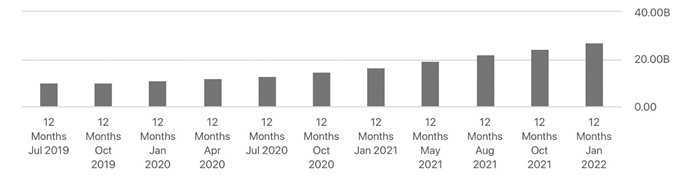
A few highlights from NVIDIA’s Q4 results (fiscal year ended January 31, 2022). Below is the annual revenue TTM by quarter:

Q4 revenue growth Y/Y was 52.8%. The concluded fiscal year’s revenue was 61% larger than the previous one.

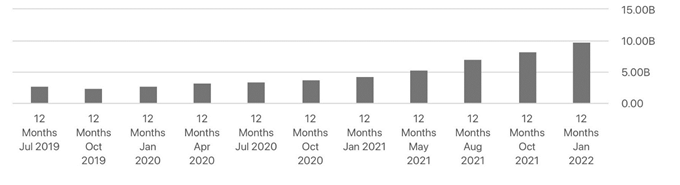
Below is the annual net income TTM by quarter:

Q4 net income growth was 106% Y/Y. In the concluded fiscal year, net income grew by 125%. Net income as a share of revenue in the concluded year was $9,752/$26,914 (in millions) = 36.2%. The figures are GAAP figures.

The 12-month trailing revenue and net income calculated quarterly, as described above, indicate that NVIDIA is continuously growing, and the growth is accelerating. At the same time, net income is consistently hitting 36% of revenue. The company’s profitability is excellent, and earnings growth is also accelerating.

The company’s Q1 guidance for the current fiscal year promises a continuation of the trend. Additionally, the Q4 Earnings Call revealed, among other things, that in Q4, the company was unable to meet increased demand due to supply-side bottlenecks, but the situation is expected to improve this year. In hockey terms, one could say that as long as the investor sticks to their game plan, there’s the highest probability of winning this tournament too :slight_smile:

10 Likes

Sci-fi or the near future? You can update your stance by listening to the discussion between Beth Kindig from I/O Fund and NVIDIA VP Richard Kerris.
https://www.forbes.com/sites/bethkindig/2022/02/18/nvidia-on-how-the-metaverse-can-overtake-the-current-economy/?sh=453647fe3614

3 Likes

Data extortionists who stole up to 1 terabyte of data from Nvidia have delivered one of the most unusual ultimatums ever in the annals of cybercrime: allow Nvidia’s graphics cards to mine cryptocurrencies faster or face the imminent release of the company’s crown-jewel source code.

Thanks for sharing. Quite specific blackmail, we’ll keep following.

GTC 2022 KEYNOTE

Keynote by NVIDIA CEO Jensen Huang | GTC March 2022 | NVIDIA
You should set aside some time for that!

3 Likes

In the latter part of that presentation, on page 72, NVIDIA states that the market opportunity, or TAM (Total Addressable Market), is $1 trillion, which is about 40x their current revenue. So, this company isn’t planning to slow down its growth yet.

https://s22.q4cdn.com/364334381/files/doc_presentations/2022/NVIDIA-Investor-Day-2022-Presentation.pdf

8 Likes

NVIDIA’s Q1 results were business as usual: high margins and strong growth. In my opinion, the most surprising thing in the results is the following:

Outlook

NVIDIA’s outlook for the second quarter of fiscal 2023 is as follows:

  • Revenue is expected to be $8.10 billion, plus or minus 2%. This includes an estimated reduction of approximately $500 million relating to Russia and the COVID lockdowns in China.

In other words, Q2 revenue will be slightly less than Q1’s $8.29 billion. If we make an “adjustment” by adding the lost $500 million to the Q2 forecast of $8.1 billion, we get $8.6 billion, which means approximately 4% Q/Q growth. For NVIDIA, one could talk about growth slowing down. The market surely demands stronger growth, so the stock will probably look for direction until growth starts to accelerate.

4 Likes

Regarding NVIDIA’s gaming cards, the next quarter is the last for the previous generation, meaning it will already cause a dip as they’ll have to start lowering prices on old stock to sell it. And on the data center side, new cards are still in ramp-up, so a generational change is underway there too.

Q3 should then be more normal again, assuming of course that the cost side doesn’t get completely out of hand…

8 Likes

A pretty good description of the fact that the current quarter will be a bit difficult for NVIDIA.

1 Like