Many of us have investments outside of Eurozone countries. For these, exchange rates are a significant risk; exchange rate changes can erode even double-digit percentage gains. What are your views on the future development of exchange rates?
From what I recall, the Norwegian krone has practically always been stronger than the Swedish krona, but now it’s the opposite, so it might be an opportune moment to invest in Norway. Norway also has more resources to put into post-crisis recovery than many other already indebted countries. The Russian ruble seems to follow the development of oil prices.
In recent weeks, the US dollar has weakened somewhat against the euro. A large part of my investments are denominated in dollars, so this has negatively affected the development of my portfolio. It remains to be seen how the trend will continue; some further weakening has been predicted.
The Norwegian krone, on the other hand, has already strengthened significantly from its historical low seen in March. That was the right time to invest.
Stock investors shouldn’t worry about the currency in which a paper is listed; some are listed in several. The impact of exchange rates on a stock investor’s euro returns primarily stems from the fact that the competitiveness of economies using their own “small currencies,” and thus the performance of companies, depends on how the currency’s value develops relative to the euro. So, there’s no need to lament that the SEK return on Swedish stocks was higher than the euro return, because a weak currency has boosted companies’ success. However, the US economy/domestic market is so independent that EUR/USD doesn’t affect the USD return of many local listed companies. But because these are the world’s two largest currency areas, both their terms of trade and thus their mutual exchange rate remain quite stable (vs. other crosses, especially commodity currencies). If the euro area starts to break apart, American stocks are, of course, a good hedge (at least better than other stocks).
So, the core points are:
A weakening currency does not mean that the euro return of a stock listed in it will be worse than that of a comparable company operating in euros. Companies’ exposures to exchange rate fluctuations depend on the structure of their revenues and expenses.
Exchange rates reflect macroeconomic trends that also correlate with stock markets. From an investor’s perspective, independent return factors (“principal components”) are essential.
This could be examined much more deeply, but it would also get technical. Exchange rates themselves are primarily a headache on the fixed income side. (It’s funny, by the way, how I’ve never heard an intelligent statement on the subject from chief economists/strategists etc. at banks.)
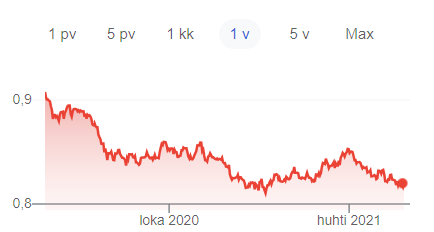
Are exchange rates even a risk? I was just looking at the interim report of a Swedish company I own. The company made a profit during the quarter, but the strengthening of the Swedish krona made the comprehensive income negative. There were no other items besides profit and exchange rate changes. Equity attributable to shareholders was 97.81% of what it was on March 31st. At the same time, however, the SEK/EUR exchange rate had risen during that period from 0.09027 to 0.09552, or 5.81% (source: XE).
0.9781 * 1.0581 - 1 = 3.50%
If we ignore the exchange rate effect, the company would have increased shareholder wealth by 3.21%. It seems that these pretty much cancel each other out.
EUR/USD is now trading at 1.1834. With the virus, stimulus, and potential global trade headaches looming, I don’t know what to do with my dollar account, as I’m not planning to sell US stocks, and there aren’t many left anyway - any ideas? At what values would the exchange rate be attractive enough that a) you would buy dollars for a currency account, b) and what about exchanging dollars for euros?
The US dollar has weakened by approximately 10% against the euro since spring. One euro is now worth over 1.20 dollars. This level was last seen in spring 2018.
Now I guess that course should be utilized in USD purchases. Gold purchases are also denominated in dollars, and the price of gold has just turned upwards, hopefully for a longer time. When repatriating profits, the profits should probably be left in a dollar account to await a better exchange rate.
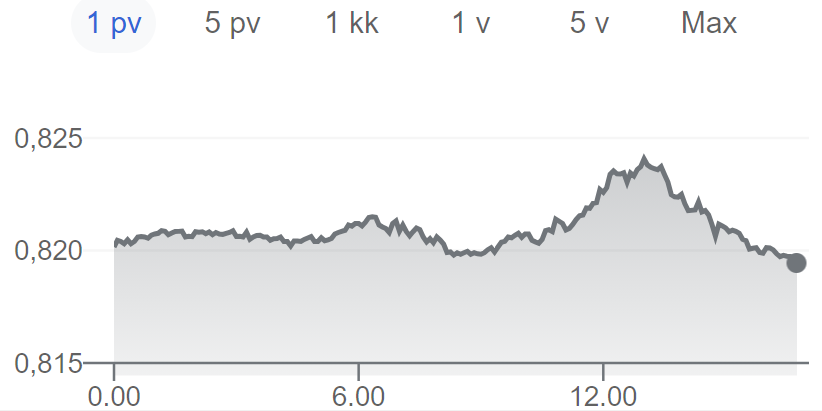
What are your thoughts on the dollar/euro development in the near future? Today, following poor US employment figures, the dollar’s exchange rate dropped by about 0.6% in an instant, and the decline continued into the evening. Such movements sting when you’re holding dollars in a currency account. The euro has strengthened by over 10% against the dollar during the year. How do you think the dollar/euro relationship will behave going forward?
I’m speculating on the development of the Dollar/Euro here. What are your views on the dollar’s development? In January-March, the dollar strengthened quite nicely, but since then it has been a steady slide downhill. Did the rise in the 10-year yield at the beginning of the year cause the dollar to strengthen, or what is going on here? News about unemployment data has caused quite significant intraday fluctuations in both directions, but I’m interested in the bigger picture of the dollar’s development.
It would be interesting to understand the behavior of the dollar/euro and the underlying factors better, so that one could anticipate in which direction exchange rates will develop in the future. If the strengthening of the dollar is related to the interest rate market, one could think that the dollar would strengthen further in the near future when monetary policy begins to tighten. However, it is presumably the case that the tightening of monetary policy will cause such a strong decline in stock prices that the strengthening of the dollar at that point will not be much comfort.
I’ll continue my monologue on the day’s dollar/euro considerations: First, a 0.5% rise, immediately followed by an equal drop, and the decline seems to be continuing. News of higher-than-expected inflation figures seemed to trigger the strengthening of the dollar, but what caused the sudden downward turn?
Was this about the higher-than-forecast inflation figures leading to an assumption that the 10-year interest rate would start rising again, but despite expectations, the rates actually started to fall?
Yep. Purely based on the trade balance, one might think the ruble would strengthen, as energy revenues have increased even though they have to sell at a discount to China and India. But if the ruble were freely convertible, there would likely be a significant capital flight. Everyone capable (including Putin himself) has one or more accounts in tax havens. It’s no coincidence that at the beginning of the war, the 80% rule for currency exchange into rubles for export companies was introduced. Otherwise, the oligarchs’ accounts in the Caymans would have swelled rapidly
Here, by the way, is an excellent article about the ruble from a couple of years ago, when times were still relatively normal:
Russia exports raw materials, which are priced in dollars. Whatever they manage to import is priced in dollars, yuan, or who knows what. When the ruble cannot be freely exchanged, it’s pretty much irrelevant what rate it is officially quoted at. With current oil prices, there’s certainly enough foreign currency for imports and modest travel.
The contracts are made in euros or dollars. In addition, the market prices oil and gas in dollars. It is mainly a matter of prestige why Putler demands payment in rubles.
Not really, it’s a completely artificial arrangement. Payment is made to a Russian bank in euros/dollars and exchanged for rubles into another account from which the payment is sent.
Could these ruble-related musings be moved to another forum? Wasn’t there a thread here that discussed currencies? I don’t think these previous messages really belong in this thread.