Diary of a Focused Value Investor

I asked Verner in the spring if I could start a new life in this blog area. I then decided to get straight to work and start the blog now in December.

I named my blog “The Focused Value Investor’s Diary”. I thought it was a perfectly suitable name, as focus is one of my biggest weaknesses. On the other hand, my portfolio is, according to general opinion, very concentrated and risky. So, a partially apt name with a double meaning?

I have kept a blog on a few different topics, where I have discussed long-term plans and then followed the implementation of those plans over time. Investing fits this perfectly, so I thought, why not? I haven’t been blessed with a sharp pen. Sometimes my messages lack a clear thread. Or it at least disappears as the paragraphs progress. What was I writing about again…?

The purpose of the blog is, above all, to be a diary for myself. A place where I go to justify, at least in broad outline, the thesis of my investments. Why did I buy company X at price Y? Is the company high-quality, or do I hope for the fastest possible value correction and exit? I believe that when these reasons are recorded somewhere, they won’t be forgotten or altered over time. I can review my own thoughts retrospectively. Whether the expectations were right or wrong.

In the blog, I will also follow and comment on the business development of the companies I own and various interesting corporate events.

As an investor, I consider myself a value investor. I research companies that are interesting to me and determine their value. If a company meets my criteria based on quality, financial health, and general gut feeling, I aim to buy the company when its market price is significantly lower than my own valuation. How significantly…?

I set a few different values for a company. First and foremost is the business value. Secondary is the company’s book value, more specifically a Graham-type liquidation value. I will not go into my valuation methods in more detail in this blog.

I aim to hold a high-quality company that itself generates a sufficient return on capital in my portfolio long-term. However, I may sell if the valuation becomes ridiculously high.

On the other hand, a company that I have bought based on its business value, but which I do not believe will generate a satisfactory return on capital in the long run, I aim to sell once the price has corrected close to my own valuation.

I sell a company bought based on liquidation value as soon as possible, even before the valuation has fully corrected.

I am stingy. I am stingy because I want the biggest possible return. I am also stingy because I want the largest possible margin of safety when I am wrong. I know I will be wrong often. To paraphrase Buffett (or Graham?); rule number one of investing is don’t lose much money. Rule number two is don’t forget rule number one.

I am in the early stages of my investment journey. Accumulating wealth. I focus on investing part-time, in the time left after work and home life. I don’t want to own twenty stocks. There simply isn’t time to understand them comprehensively. I feel that I can follow about five companies at a detailed level. Thus, my investment portfolio consists of a maximum of five companies at a time. Of course, my watch list includes several tens of companies that I have researched quite well and set valuations for.

In addition to knowing the companies in my concentrated portfolio exceptionally well, it also provides an expected return advantage. If my analysis is correct on average, it is more profitable to invest a larger proportion of investment assets in my best ideas. To quote Buffett again – why would I invest in the tenth best idea if I can invest more in the first?

I immensely enjoy doing investment analyses. I feel it is my calling. However, I don’t want to do it for anyone else, and that’s why I have consciously pursued a career in another field. Quite successfully, at least by my own standards.

My investment goal is financial freedom. The freedom to manage my own portfolio full-time. The freedom to spend time with family. The freedom to take a vacation when needed. The freedom to do what I want.

Upon achieving financial freedom, I intend to diversify the portfolio into a full ten stocks. It is not optimal. But if I have already left working life, additional diversification is still good insurance. It can also be wise for tax reasons.

My portfolio currently contains five stocks, one from China and four from Finland. I mainly follow Finnish companies, but I have no goal of keeping the portfolio Finland-weighted. It has been a natural place to start the analysis work. I add cash to the portfolio significantly once or twice a year.

I thought I would tell you about my holdings and their investment theses in the next posts, but since this message got quite long, and if you managed to read this far, you might be disappointed if the portfolio remained a secret. So here is a list. More on these later.

Viafin Service 34.95%
Alibaba Group 28.42%
SRV Group 12.54%
Inderes 11.52%
Saga Furs 10.72%

Cash 1.85%

47 Likes

More Saga Furs, funded by Viafin’s profits

Yesterday I did some rebalancing in my portfolio. I sold a piece of my largest holding, Viafin Service, to finance more Saga Furs purchases. It feels bad to sell a good and growing company to buy, if not a bad one, then at least a cyclical and long-term dying business. But greedy is greedy, and I can’t look away from Saga Furs’ euro-denominated net current asset mountain.

Viafin Service has been in the portfolio for a relatively short time, but has risen over 60% from the initial purchases and slightly (15%) from additions. I intentionally overweighted it because I couldn’t find anything else sensible to buy at the time, and my own confidence in Viafin’s long-term success is high. So the overweighting was okay for me - I didn’t perceive it as risky. Now, however, most of the undervaluation has unwound, so lightening the position to finance an investment with a better price/value ratio was appropriate.

I previously wrote a bit about my thoughts on the company’s investment case in the Saga Furs thread. This is a very recent investment otherwise:

Saga Furs’ current financial year has proceeded with pretty much the same figures as the previous financial year. The first half fell significantly short, but in the second half, based on the company’s announcements, they have reached roughly the same figures.

The value of brokerage sales for the current financial year after the September auction is 343 million euros (2022/2023: 349 million euros).

Revenue has been fairly consistently 13% of the value of brokerage sales, so it should settle at around €44.6 million. With an EBIT% similar to last year (6.9), an EBIT result of approximately €3.1 million would be achieved in the concluded financial year. The company’s historical average (since 2005) has been an EBIT of 8.5%. In addition, historically, the company has generated net profit on average 36% higher than EBIT, because the company provides financing to both producers and buyers. Thus, with an average assumption, the net profit for the concluded financial year would be €4.216 million, or approximately a 14.5% yield at the current share price (€29 million).

But let’s take these figures with a grain of salt. The company’s business is highly cyclical. It is truly difficult to estimate the normalized EBIT level of the business, given the intervening factors such as corona, bans in producer countries, etc., etc. But on the other hand, also the exit of competitors from the playing field. When the last competitor announced it was closing its doors, Saga Furs raised its EBIT target to 15%. I don’t know if that’s realistic, but even the direction gives a positive sign.

But as I already wrote in my quoted post. I did not invest in the company because of its business operations. There are too many question marks for me to build an investment case around it. But it’s a nice little extra while waiting for cash to be released from the balance sheet. We’re going with a market price correction, larger dividends, or a ban on the entire industry (and thus liquidation of the company’s assets). The company has paid dividends averaging approximately €3 million/year, which is over a 10% yield at current valuation. Will we get there? Healthy skepticism must be kept in mind, but from the numbers and the balance sheet, I find no reason why we wouldn’t.

There are some thoughts. We’ll see what happens. Confidence is not high, but I don’t yet know why I’m wrong. The reason should become clear in a couple of years :slight_smile:

Portfolio today:

Alibaba Group 28.3%
Viafin Service 25.6%
Saga Furs 20%
SRV Group 12.7%
Inderes 11.6%

Cash 1.9%

23 Likes

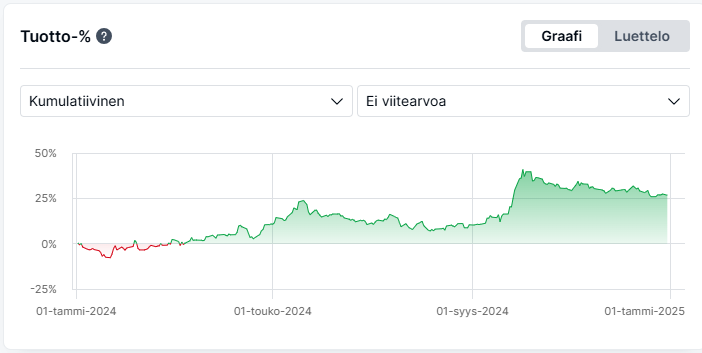
Investment year 2024 is wrapped up. The year was very successful in terms of results. This past year, I traded the portfolio more than I expected. I aim to minimize trading costs and will pay special attention to that in 2025.

Portfolio return 2024: 26.70%

Screenshot 2024-12-31 085221

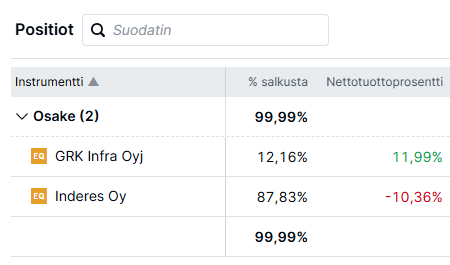
Portfolio movers 2024:

  • Viafin Service +55.88%
  • SRV Group +40.48%
  • Alibaba Group +19.71%
  • Vincit -23.09% (sold)
22 Likes

USA’s trade war against the world

Trump is messing around with tariffs, as expected. What surprised me, however, was that a trade war is being waged, for example, with Canada. More moderately with China, even though 60% tariffs were shouted about before the elections.

Macro matters are of little interest to my investment activities. But the news flow is hard to avoid, so I’ve been thinking about the effects of tariffs/trade war on my portfolio companies.

Alibaba

Alibaba is a massive company with direct business also towards the USA. However, its significance to the Alibaba whole is like a fart in the Sahara. Most important for Alibaba is the economic development of China and the rest of Asia. Effects of the trade war? Not negligible, but not significant. China stimulates+, cloud business rolls in Asia+, the company sells non-critical businesses away+.

Viafin Service

Viafin’s business is 100% domestic. Indirect effects, of course, from customers’ reduced production. On the other hand, reduced production is an opportunity to perform shutdown maintenance. Impact of the trade war? Practically non-existent.

Saga Furs

Sales from North America account for a few percent of Saga Furs’ total. China is 90%. China stimulates, especially consumer demand. Impact of the trade war? Practically non-existent.

SRV Group

SRV builds in Finland. Indirect effects perhaps on commodity prices? On the other hand, US tariffs might push the rest of the world to bring more to Europe and thus cheaper? Impact of the trade war? Non-existent or even marginally positive?

Inderes

Inderes operates in Finland and somewhat in other Nordic countries. The trade war causes uncertainty in financial markets. The number of IPOs might remain lower? Some Inderes client company might collapse, and drop coverage? Impact of the trade war? Not necessarily insignificant, but no concern.


Generally speaking, I feel that the portfolio could hardly take less of a hit from the US trade war campaign. Stocks can certainly move, but that only offers better buying opportunities.

This much for today. Saga Furs reported last week. Inderes tomorrow. SRV on Thursday. I’ll write about these when I have time, energy, and motivation.

Relaxing earnings season to all!

14 Likes

Heh. Heh-hee. Right.

I’ve been shuffling my portfolio more than ever in the beginning of the year. The earnings season has slightly changed my estimates of the true values of my portfolio companies. So I have adjusted the weightings of my portfolio and recently also dropped one of my investments.

At the beginning of the year, even before the earnings season, I sold some Viafin to buy more Inderes. Similarly, after the earnings season, I sold some Saga Furs to buy more Inderes. This week I sold my SRV position - to buy more Inderes.

Inderes is easily the most affordable quality-weighted investment target on my watchlist. Saga Furs is cheaper, and SRV was roughly at the same discount. But unlike SRV - I believe I could own Inderes long-term even after its valuation corrects. The world changes, of course, and facts with it, but based on current information, this is my view.

My metrics, seasoned with my own adjustments, showing the company’s return on capital percentage, are both at a quality company level. The company’s value creation is greater than my required return, the latter of which is quite high itself. On top of that, there’s over a 50% discount to my own valuation.

I am somewhat bewildered as to why this company is not valued by the market. This, of course, suits me perfectly as an owner. After the annual general meeting, I hope they will again buy back a good amount of their own shares. Perhaps investors do not understand the impact of FAS accounting goodwill amortizations on the income statement, despite management’s annual remarks. However, cash flow is developing as expected.

Summing up my overweighting in Inderes. I bought an excellent company that has developed its own niche market and operates monopolistically, with excellent prospects for geographical growth, as well as in the area of selected parallel services. Management thinks long-term and has demonstrated it with their actions (not just words). The company appears to create more value than I require in return, so it will be kept in the portfolio even if it is overpriced. In addition, it can be acquired today at a 50% discount. If the discount is at the same or a higher level when cash hits the investment account → the weighting will be increased further.

By the way, I have not changed my view on SRV, even though I dropped it from the portfolio. A small question mark still hangs over SRV’s financing solution, which matures in the summer of 2026. As the turnaround in construction has been considerably delayed, I’ve been wondering how SRV intends to pay that bill so that it doesn’t have to convert it into shares. However, that was not a decisive factor. SRV was the weakest in the portfolio and was removed for that reason. Inderes is better.

Alibaba has risen over 50% since the beginning of the year, and has also risen to a significant overweight in the portfolio. The intention is to lighten the position by a certain euro amount by the end of the year and at the same time utilize capital losses outside the investment portfolio for tax purposes. However, a significant amount of Alibaba will remain in the portfolio even after sales. Depending on the price, an estimated 50-67% of the shares will remain in the portfolio awaiting their 10th anniversary (2032) and the acquisition cost presumption.

Portfolio:

Alibaba 37.34%
Inderes 34.82%
Viafin Service 15.88%
Saga Furs 11.89%

Cash, about as much as a couple of fly farts.

9 Likes

As the trade war escalated into a USA vs. China duel, I decided to divest from my Alibaba position because an even better investment opportunity was available. I further increased the weight of Inderes in my portfolio “a bit” from ~35% to ~70%.

It’s possible that no major changes will be made to the portfolio in the near future. With dividends and other cash additions, the portfolio will have perhaps about 10-15% cash within the next month or two, so there will soon be funds available for one position. Let’s see what’s available then!


Inderes 68.77%
Viafin Service 16.24%
Saga Furs 13.36%
Cash 1.64%

9 Likes