I’ve been thinking about starting a new thread about our investment strategies… because the old Inderes forum had an excellent thread where Inderes analysts shared their long-term strategies (allocation, goals, etc., etc.).
To start, I’ll put the core part of my investment strategy here, the so-called golden rules, which are written in my own investment plan. They have been compiled based on literature and Inderes investment school / instructional videos. I believe that, for example, in a difficult market situation, a written investment plan and strategy is the only way to keep a cool head. That’s why it would be good for us to share our own strategies and at the same time gain new perspectives. It should also be mentioned that my long-term goal is set for the 2050s, keeping a retirement portfolio in mind. Let’s see if this sparks a discussion!
Invest only money you don’t need for daily living.
Stock picking, because we are seeking excess returns. Exploiting fear/greed overreactions. Utilizing Inderes analyses in one’s own discretion.
Purchases with a medium-term horizon (1-3 years).
Main focus on OMXH small-cap/mid-cap companies. Excess returns can be made there.
Aim to buy before the general public.
Utilizing home-field advantage and the position of a small investor. Trading time is completely flexible. We wait patiently.
Fair value determination must be based on a deep analysis of the business.
Safety margin of approximately 20% (purchase price vs. fair value).
Mr. Market is a servant, not a master. He offers opportunities for trading.
I’ve written down 4 cornerstones for my own investment strategy:
Buy companies that invest in technology and product development.
Buy scalable business models.
Buy long-term investment targets.
Know the companies well, preferably from your own field of work (for me, it’s the IT sector) because you’ll gain an advantage from your professional expertise.
Uncle Masse has come to the conclusion that non-professional small-scale investing is pretty much entertainment, for which one can even pay a little, because in addition to fundamentals, there’s always so much sentiment in share price fluctuations. That’s why basic Masse’s investment theses are annoyingly simple. Many don’t like them, but let’s repeat them here to keep perspectives open:
Only play with an amount that you can well afford to lose, meaning everything truly needed is always in fixed assets and in the bank.
Buy what you consider cheap and in small batches, so you’ll hit the bottom of the pit and mostly dodge falling knives. Preferably buy dividend-paying companies, because if the share price gets stuck at the bottom for years, you’ll at least get dividends.
Only sell with a good profit, at least 2x the average dividend, and pay taxes obediently, i.e., don’t churn. Eventually, those taxes will be paid anyway, whether from Sipilä’s insurance wrapper or tax-churned stocks.
Leave analyses to the smarter ones, of course, it’s nice to read tabloid headlines and Inderes pages, and sometimes you even get good tips from them
So, how does one fare with this? Usually quite okay, meaning annual returns are often similar to Mr. Index. Once, Masse even beat him properly, by +15%. The current year 2018 will probably be quite weak for Masse, just a meager +, but you can always pay a little for good entertainment.
“How much you know is less important than how clearly you understand where the borders of your ignorance begin.”
“Embrace the mistake.”
I don’t feel that investing requires any particularly precise outlining of a plan or coming up with long and specific lists of rules for it. Honesty about one’s own actions and their limitations carries further.
I was a dividend investor for a long time. But nowadays I look for quality companies with a clear competitive advantage and long-term investment targets. I avoid companies that have growth but don’t make a profit. Even though Inderes’ consultants have recommended growth companies like Efecte and Qt. Too much risk for a person of my age, and I don’t have time to wait for growth companies to turn into cash cows.
Develop/maintain a buffer fund/savings account as well
Buy stocks that offer the most attractive return/risk ratio or from which you think you will get the best possible return (simple, not easy).
In a nutshell. I usually look at stocks with a view to them slipping into a ‘long-term portfolio’. There are exceptions sometimes. I usually look for companies that have a competitive advantage and preferably growth. I also like companies that have a stable cash flow, continuous revenues, predictable business operations, and preferably a defensive sector. It goes without saying that not all stocks in my portfolio meet all of the above criteria, nor do they need to.
Regarding dividends, if the dividend is good and growing in the future, all the better. The current effective dividend yield % is often not so significant.
Analysts’ and other Inderes members’ portfolios have been commendably opened through videos, Shareville, etc. Thank you for that!
However, it would still be desirable if Inderes members could open a thread here to discuss their long-term investment strategies (over 10 years). For example, allocation, strategy, investment plan goals, etc… This aspect has not been discussed much… There was a good thread on the old forum that was destroyed with the new forum software…
Home field advantage. It’s just so much nicer to own companies where you are (or at least feel like you are) always on the ball. Risk comes from not knowing what you are doing. On a softer level, it’s also great to own and support domestic companies that are growing and succeeding.
I certainly understand the downside of focusing investments on the domestic market in a few companies.
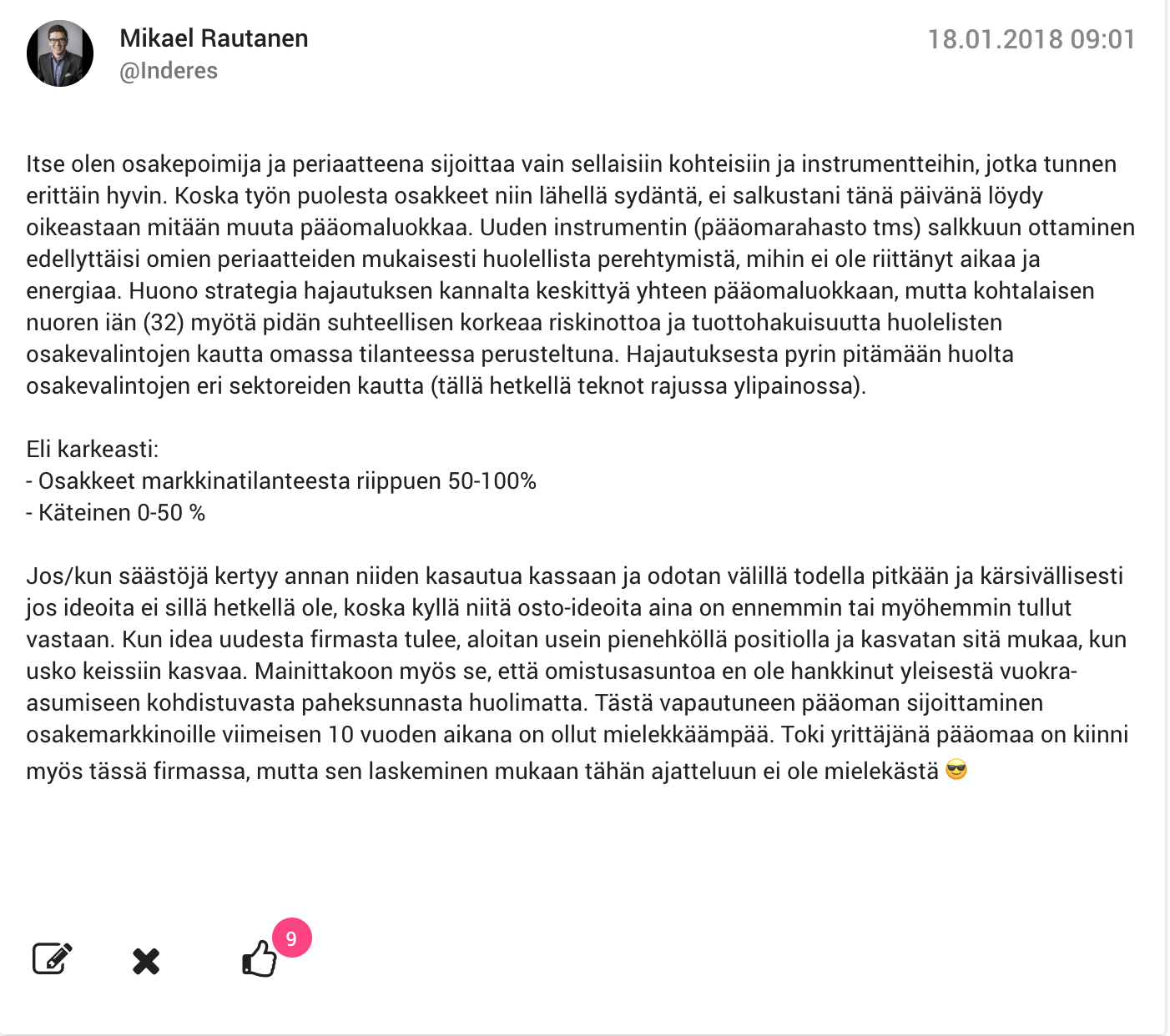
As a student without regular income, I keep a safe approximately 30% in cash so that the macaroni doesn’t run out of the table even if the stock market crashes. But if we look at the portion of assets that has been “set aside” in Nordnet for investments, it’s now at a full 100% equity allocation. And normally, it varies between 80-100%.
Allocations between P-A, Europe, Asia, Emerging Markets, and China, for which I carved out a small slice from the emerging markets portion for a few years
Quite a lot of different ETFs and funds have accumulated as new and better ones have been found over the years
10% in individual stocks
Here I get to implement my own ideas
It can rise to 20%, but then I won’t buy new ones unless I sell something to make space or wait for cash to accumulate and the share of stocks to decrease
It can also be well below 10% if no ideas come up
If an idea is only “good” in my opinion, I won’t buy, but trust that I’ll get the same return from an index
I aim to hold, but in the last couple of years, I’ve “had” to give up on a few as momentum has strongly grabbed them and the price has rocketed
This was really good. I hope you don’t mind, @Aston_Livingstone (and what can you do about it at this point anyway ), but I snuck these into my own, meaning I shamelessly copied them.
I invest because I want to get rich. I also want a buffer for retirement. I invest because this is an interesting hobby where you can develop, earn, and play.
Money is invested in stocks only from an investment account, and only with an amount exceeding the ppv buffer. The rest is for living, and the remainder in the investment account is the ppv buffer.
If you want to invest by speculating, do it. However, accept the fact that invested assets can be completely lost. This also applies to non-speculative investments. This is a fun game!
Only sell at a profit (or to balance taxation, which allows you to get rid of mistakes). So, never be forced into a situation where you have to sell when the market is bad or your own situation requires this particular asset.
Owning stocks in the medium term (1-5 years). Funds until retirement age (+25 years), long ownership in real estate investments.
Main focus OMXH.
Goal to generate excess return during ownership. At least above the index.
Stock picking, because we are looking for excess return. Leveraging fear/greed overreactions. Don’t be a lemming. Utilizing Inderes analyses in one’s own acquisition.
First, observe the company, read analyses, etc. Then, enter during dips or other market overreactions. The industry doesn’t matter, as it’s always nice to learn something new. Volatility in itself is not a risk.
No one can time the market; successes in it are accidents and beginner’s luck. Don’t regret or look back too critically. Analyze, learn from mistakes. Identify weaknesses caused by your own character traits (such as impatience).
Diversification in both stock choices and asset classes (now stocks (with good diversification), funds, hoarding cash in an investment account, and real estate investing).
If you’re bored, invest in volatile companies. 14. Only buy and forget stocks that yield significantly more. Otherwise, monitor the market.
Many equate investing in stocks with speculation akin to gambling. It doesn’t sound like something a responsible mother would do. This same comparison is also heard from investors: “why do you play the lottery when you could invest in stocks?” Parents remember depressions and stock market crashes. Losing one’s assets feels much worse than an equivalent gain. We are naturally risk-averse creatures, and even the last laggard only gets excited about stocks after a long upward trend, i.e., when no risks are perceived in the stock market. We are advised to diversify so that the portfolio’s volatility is not the same as a single company’s volatility, but market risk affects everyone. I argue that diversification is a way to prolong bubbles at the national economy level. It bothers me slightly that the success of stock markets is measured by the development of market value, because that only means an increase in demand for stocks. Those who join later pay for the sales of those who came before. Perhaps it’s just as well that most Finns’ money is in bank accounts. The stability of this society could look quite different if stock investing really got out of hand.
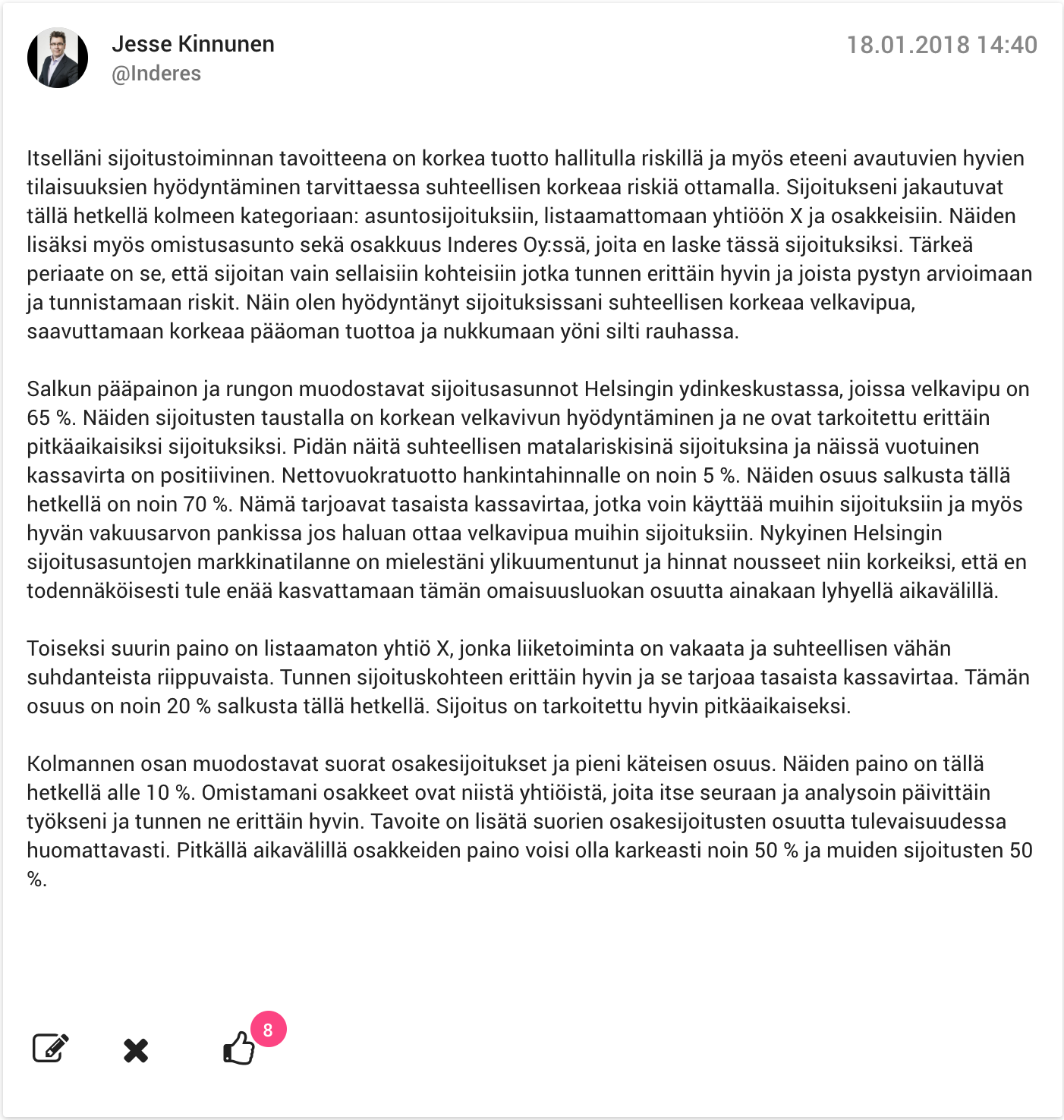
The main focus is on the Helsinki city center, but in the last two years, new areas were added to the portfolio, including new developments in Espoo, Vantaa, and Kirkkonummi. I sold the Kirkkonummi apartment early this year with a small profit, and I have not yet made a final decision regarding keeping the Espoo and Vantaa properties.
The debt leverage for housing investments is currently about 65% relative to fair value. The share of apartments in my investment portfolio is too high and will likely decrease in the future. Preferably, this would happen not necessarily by selling properties, but by increasing the amount of other investments.
I am still a co-owner in an unlisted company; this investment is long-term in nature, and I might not even be able to exit it at a reasonable price, at least not currently, even if I wanted to. Generally, housing has done well, but as user g3235286 noted, prices in Helsinki’s city center have risen in almost all apartments in recent years, and this has not required exceptional capability from the investor. However, my own investments are carefully selected, cash-flow positive, and easily rentable properties. Overall, I am satisfied with my current investments.
I’ve occasionally considered real estate investing based on a whim, but gradually my thoughts have always faded. Once, I even discussed a real estate investment loan with the bank, but it ended there. Maybe sometime in the future. I’ve almost come to the conclusion that buying one apartment as an investment is a bit too risky, even just concerning the tenant. Perhaps even 3-4 apartments would significantly diversify the risks. But that would require considerable leverage from my part. And this housing boom has been going on for quite a while, so I’ll just keep on contemplating it for now.




 But if we look at the portion of assets that has been “set aside” in Nordnet for investments, it’s now at a full 100% equity allocation. And normally, it varies between 80-100%.
 ), but I snuck these into my own, meaning I shamelessly copied them.