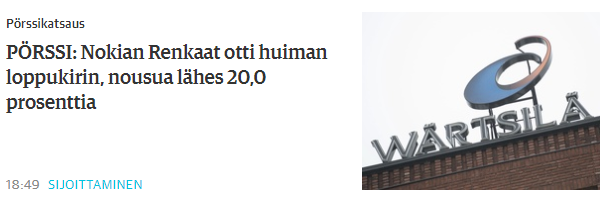
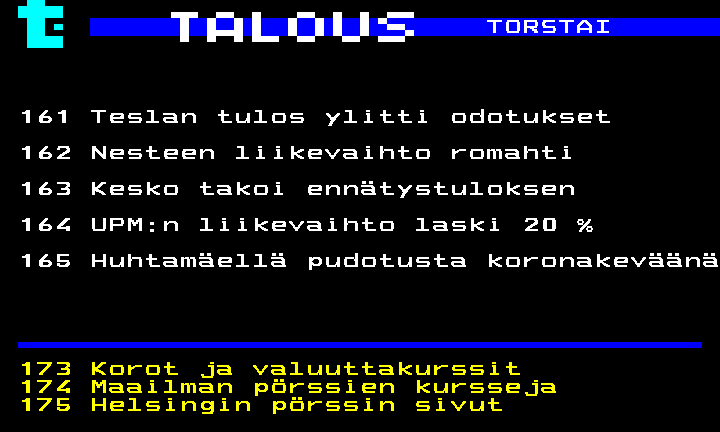
In my opinion, the most important thing about news is that it’s widely followed, meaning diversification should be implemented here just like in a portfolio. Preferably, diversify by country and also monitor stock exchanges, relating their events to the news. Then, a good dose of common sense – what do the news mean in each country and over what time horizon? And finally, what is the impact on your living environment, your finances, and your portfolio? It’s best to let headlines pass you by – unless you’ve invested in tabloid journalism in countries where mostly paper-based evening newspapers are still sold.
For example, every kiosk in Finland that distributes financial news offers this option. They don’t critically assess what the future might hold; instead, they tell you what happened yesterday (to put it crudely). If there’s information “you wish you had heard,” the question arises, why do you wait for someone’s “approval” to hear it? If you have an idea about a factor and want to benefit from this knowledge, don’t wait for it to become “public”; act on it. If you wait, you’re contributing to average returns. Of course, there’s also the risk of acting very wrongly beforehand, i.e., “rushing” in one direction or another.
Forming an overall picture is always a subjective view of that overall picture. What I mean by this is that even if 500 investors were given 100 news articles, we would likely see closer to 500 different overall pictures. Of course, if the topic concerns a single niche market, the dispersion decreases. If you believe you know an industry well and dare to generalize some phenomenon to affect the entire industry, you can certainly benefit from it, but you can also shoot yourself in the foot, and badly. For example, price competition for experts has certainly been a factor that some smart person was able to generalize to affect the entire IT services sector in time (afterward, it’s easy to shout, “I would have guessed that too!”). If something appears once in the operations of one company, I wouldn’t start generalizing it, but (surprise, surprise) if the issue becomes more widespread, one could also start generalizing it. It’s about whether you know the factor well enough and understand what it truly means.
From my perspective, it’s good to note the following things about financial news in general: most of it is history and “late information,” which can still help to understand the future. However, by the time you’ve finished your deliberations, professionals have probably already acted and made two moves forward. Despite this, at the end of the day, each of us builds our own view based on these news articles (or belatedly follows, for example, Inderes without making any assessments ourselves). In other words, don’t expect Kauppalehti to tell some absolute truth about matter x, after which you could react calmly: you’ll be late while the Kauppalehti journalist is still writing about it.
The amount of information nowadays is so vast that most of it is just famous noise. I think even professionals sometimes find it difficult to discern the “raw data” from this noise. Because equally, there are so many more peculiar, historically respected, and multinational analytical houses offering their own analyses, some kind of consensus must be formed from these as well. As long as humans are doing this evaluation and deliberation, the outcome will also vary.
But to the question itself, what information is essential for an investor: all the information that benefits your own investment activity, your own portfolio management, and the companies and markets you have invested in. It’s useless to try to create an overall picture of the entire world’s stock markets, because someone is currently doing their day job just trying to understand the Finnish IT services sector as a whole. Consider what information is factual and what is so-called hard data, and what are assessments, forecasts, rumors, etc., which can, of course, have a basis in truth, but reacting to them can be dangerous.
I admit that I largely follow this noise, but I try to find things in that noise that repeat or appear in several different sources. When the masses react to something, movement in prices also begins to occur. Individual opinions practically mean nothing yet.
I always emphasize the importance of checking the source of a news story and the facts behind it. I’d like to see sources when reading “news” on various forums as well.
Understandably, investors need to follow news broadly, but then the problem is the immense noise.
What would be essential information to get the overall picture? Could it be that it would be useful to see, for example, a summary of production, order book, or sales expectations? The world is full of opinions and expectations, but these are scattered across thousands of news articles that are difficult to find?
Or would it be more important to get a quick alert about important events?
One sometimes has to admire Kauppalehti’s (online) news for its confusing storytelling! For fun, I sometimes edit KL’s outputs, because my work is also close to editing. The result is usually a new paragraph division, chronological order, and a much shorter, more concise, and clearer message!
In my opinion, it would be quite essential for the facts to be in order even in financial news. Kauppalehti hasn’t been awake today:
On Thursday, Exel Composites, Aspocomp Group, and Uponor were among the top risers on the main list. The composites manufacturer’s stock rose 7.4 percent to 6.38 euros, the circuit board manufacturer’s stock gained 5.9 percent to 4.16 euros, and Uponor’s stock, which supplies indoor climate and piping systems, rose 5.9 percent to 15.56 euros.
The same text can also be found in tomorrow morning’s print edition. Congratulations to the editorial team!
This news will be a topic of discussion in the coming week and will also affect investments in its own way…
Nordea: We do not condone the use of the bank for money laundering
Nordea states in its statement that it does not condone the use of the bank for money laundering. The bank also says it has taken several measures since 2015 to improve the prevention of money laundering and other financial misconduct.
To the question of whether reports made by other banks have led to an official investigation of Nordea or its customers in the United States, the bank did not answer directly.
“Nordea is subject to both federal and state supervision in the United States. This means that we occasionally receive requests for information from US authorities. However, this information is confidential by law,” Nordea wrote in its response to Yle’s MOT editorial office.
Nordea also states that it always provides the information requested by the authorities.