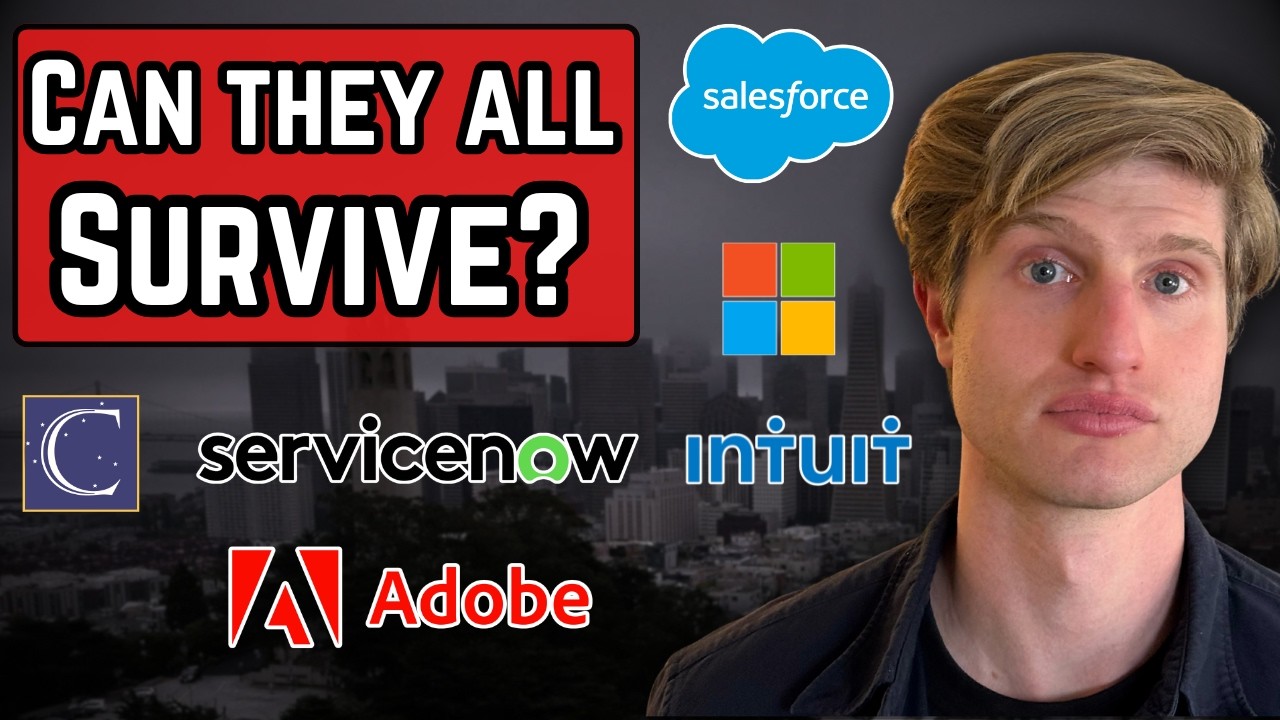
Here is a video by Drew Cohen on the threats generated by AI for SaaS companies. I recommend the channel in general. In my opinion, it features some of the highest-quality and most thorough company analyses on YouTube for the companies discussed in this thread, such as Adobe, Constellation Software, Intuit, Microsoft, Salesforce, and ServiceNow.
Below is a summary of the video. I take no responsibility for the accuracy of the summary. It may contain hallucinations from the author. According to Cohen’s assessment, software companies face the following six risks due to the AI disruption:
1. Disruption of the Business Model
The first risk discussed in the video is the death of the user-count-based (seat-based) billing model for software companies. As AI agents improve productivity, the need for labor decreases, and customers no longer require the same number of software licenses. Cohen does not consider this a significant risk, but believes that software companies can shift to usage-based billing or increase prices. One option is to bill for software at the entire enterprise level, where the price is negotiated on a per-customer basis. This offers customers better cost predictability than usage-based billing. Ed. note: In Finland, Admicom operates this way.
2. Customers Developing Their Own Software
The so-called “vibe coding” threat. Companies want to focus on their core business, not maintain applications. Code is complex, and self-made applications are prone to errors. Large corporations can find better areas for savings than external software costs. This risk is unlikely, as the integration and maintenance of software is difficult without specialists hired for the task.
3. New AI Startups as Competitors
AI enables the creation of new software very quickly and cheaply. Cohen points out that a cheap product alone is not enough. Established software companies have strong distribution networks, customer trust, and well-known brands that are difficult for newcomers to overcome. As examples, he cites Salesforce and ServiceNow, which have constantly faced smaller and cheaper competitors that have failed to gain market share. New startups have a better chance of replacing software offering point solutions and winning customers among early-stage companies.
4. LLM, Token Risk, and Margin Compression
As language models evolve, AI agents will be able to replace an increasing portion of human labor and become the part of the software that generates the most value for the customer. This could lead AI companies to raise the price for using their agents in software, whereby the rising price of tokens eats into the margins of software companies. However, Cohen believes that competition between language models will keep prices in check. Language models that become too expensive can be excluded from the software. The risk materializes if one of the language models manages to achieve a dominant market position.
5. Tightening Competition Between Established Players
In the video, this is highlighted as the most significant of the risks emerged so far. As software development accelerates and development costs fall, large companies are encroaching on each other’s territories and striving to become so-called centralized AI control centers. Signs of this are already visible, as Salesforce and ServiceNow have expanded their operations into each other’s core functions. Both companies aim to be an “AI Control Center,” used to manage the use of AI tools, define access rights, and prevent or fix errors made by them.
6. AGI - Artificial General Intelligence
A very speculative scenario for now. The timing of AGI’s arrival is difficult to predict. The risk for software companies is existential, because at this level, AI does not need software but can operate directly within databases.
I usually skip all messages that begin with “I asked my chosen AI language model about this…”, but in this case, since it relates slightly to the topic, here is Gemini’s assessment of the correctness of the video’s conclusions as a light closer.
Summary
1. Disruption of the Economic Model (Death of User-Based Billing)
- Cohen’s Claim: Companies will survive this by changing their pricing (e.g., usage-based or enterprise-level licenses).
- Assessment: Highly likely.
- Reasoning: The software industry has historically transitioned from one-time purchases (on-premise) to subscriptions (SaaS). Companies like Klarna have already reported replacing thousands of work hours with AI, but they have not stopped using basic software.
- Evidence: Salesforce and Adobe have already announced AI add-ons (e.g., Salesforce Agentforce) that are billed based on performance/usage, not user count.
2. Shift of Software Production In-house (“In-housing”)
- Cohen’s Claim: Unlikely, because companies do not want to maintain complex code and self-made applications are error-prone.
- Assessment: Partially wrong / Uncertain.
- Reasoning: Cohen underestimates the disruption of “low-code/no-code” development. While Nike might not code its own ERP system, it can use AI to code hundreds of small internal tools for which it previously paid external parties (so-called Point Solutions).
- Evidence: Gartner predicts that by 2026, 80% of software developers will use AI assistants, lowering the threshold for tailored internal solutions.
3. New Competition from AI Startups
- Cohen’s Claim: Startups will lose because they lack distribution and trust (distribution beats product).
- Assessment: Correct (in the short term).
- Reasoning: Historically, “incumbents” (established players) have integrated new technologies (like mobile and cloud) into their offerings faster than new players have gained market share.
- Evidence: Microsoft’s rapid GPT integration into Office 365 ate the market for many small “AI-copywriting” startups almost immediately.
4. Token Risk and Margin Compression
- Cohen’s Claim: Large Language Model (LLM) prices will fall due to competition and commoditization.
- Assessment: Very correct.
- Reasoning: “Inference costs” have fallen dramatically over the past year.
- Evidence: API prices for OpenAI and Anthropic have dropped several times (e.g., GPT-4o is significantly cheaper than the original GPT-4). Open-source models (Meta: Llama 3) are also pushing prices down.
5. “Cannibalization” Between Established Players
- Cohen’s Claim: The biggest risk is that large companies (e.g., ServiceNow vs. Salesforce) start eating into each other’s markets.
- Assessment: Correct.
- Reasoning: AI removes the need for specialization. If AI can handle both customer service and IT support, a company only needs one platform instead of two.
- Evidence: ServiceNow has expanded aggressively into customer experience (CX), which has traditionally been Salesforce’s core area.
6. Existential Risk (AGI)
- Cohen’s Claim: If AI can do everything, no software is safe. Markets do not know how to price this “all or nothing” scenario.
- Assessment: Speculative but logical.
- Reasoning: If AI can create user interfaces and logic on the fly directly on top of data, the traditional concept of an “application” dies.
- Evidence: Jensen Huang (CEO of Nvidia) has stated that in the future “everyone is a coder” because natural language is the new programming language. This supports the idea of the software layer thinning out.
Summary and Confidence Level
I am about 85% certain of Cohen’s general analysis. He is correct that the distribution and data of software companies are their true protection, not the code itself.
[/details]The biggest weakness in Cohen’s analysis: He underestimates how quickly AI can completely eliminate the need for “apps.” If I can ask an AI, “Analyze my sales data and make a forecast,” I don’t need the Salesforce user interface; I just need access to the data.