Foreign SaaS Companies

I was thinking of starting a general thread about foreign SaaS companies, alongside the “FAANG” and “Semiconductor Giants” threads. Domestic companies seem to already have their own company-specific threads.

I don’t currently own any SaaS companies myself, but I’ve been following several for a long time. I’m mostly an index investor who buys a few stocks a couple of times a year when an interesting opportunity/idea comes along.

Inderes and Mikael have talked about how IT service-focused companies build digital infrastructure. I believe that SaaS companies are this to a very large extent. Less and less do companies want to use their own development resources for components that can be bought from external companies that develop them scalably.

The problem, of course, is that there seem to be enough SaaS believers among investors, and valuations are sky-high.

The best SaaS companies are, of course, excellent high-margin businesses with “negative churn,” meaning existing customers pay more year after year, for example, because the number of employees grows, requiring more licenses all the time.
In addition, the best SaaS companies also embed themselves deeply into companies’ operations, making them very difficult to get rid of.

As an example, one can think of Salesforce or other CRM businesses that bill companies based on how many people use their tool and that tightly integrate themselves into various sales processes. One can also consider how easy it is to give up a Microsoft Office365 subscription once the entire organization’s emails, documents, calendars, etc., are built within Office365. Of course, both face the challenge of acquiring new customers in the long run, but there are a huge number of existing, self-growing customers to whom new features can also be continuously sold “as part of a bundle.”

A couple of questions about investing in these:

  1. Has anyone found an affordable ETF focused on SaaS companies? I would be interested in investing in one if there were a bigger dip in the market.
  2. Have you invested in foreign SaaS companies? What are your favorites?
3 Likes

There’s a big bunch of them there. I just can’t get over how absurd the valuation levels are. So absurd that my interest in even looking at them ends before I even start. The mentality right now is that the more growth we get, and the more losses we make, the better.

I’ve found a tiny bit of Salesforce there, more of Shopify (which, unfortunately, was mostly sold for a 400 percent return around 200 dollars), and the biggest one, Microsoft, which is now constantly moving to a subscription model.

1 Like

Hey, pretty good discussion, though very broad. For the past few years, I’ve been following and also own shares in a company called RIB Software. They make design software for construction companies. For example, YIT uses it and says it’s a very competitive software. The license-based model is called iTWO, but now they are rapidly bringing out a cloud-based MTWO model together with Microsoft. They probably already have 30,000 users, which was this year’s target. Next year’s target is 100,000 users, and so on. The company is making good profit, growing, is debt-free, and has a good cash position. It is certainly expensive, and the CEO is sometimes a bit unpredictable. So far, however, the guidance has held and even been exceeded. Sometimes also a heavily shorted stock.

Are there others here who have followed the company?

My shopping list now includes three different companies: Slack, Datadog, and Cloudflare.

Slack

  • growing rapidly
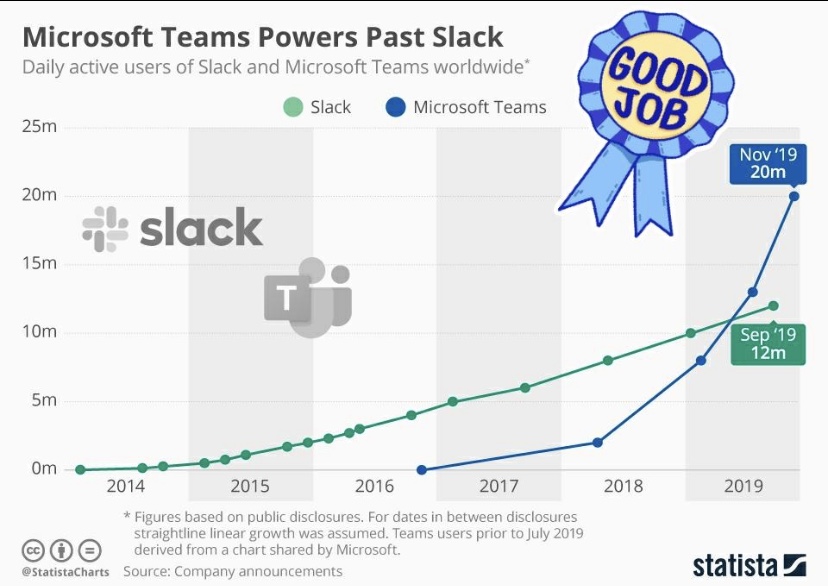
  • threatened by Microsoft Teams
  • Shared channels open up a completely new way for communication between companies and strengthen the network effect

Datadog

Cloudflare

It’s worth reading those linked articles. Both are “best in class” SaaS companies, not yet so big (max ~$10B).

All are expensive, but I bought Slack last week at $20.25. I intend to buy all of them for my small direct investment portfolio at some point.

2 Likes

I bought Hubspot around Christmas time for about 158€, if I remember correctly.

Its current valuation is around $7B. I’ve heard a lot of good things about the product and believe it has a lot of growth ahead. Growth also feeds itself as the number of integrations increases.

This is also a bit of an anti-Salesforce idea because I’ve been thinking, as a theme, that focused products will have room alongside Salesforce’s terrible UX.

I also put in an offer for Cloudflare for next week.
Little by little, I intend to build a SaaS index of global, fast-growing, SaaS-monetized platforms valued under $10B.

3 Likes

What are people’s thoughts on Adobe here?

Found MSFT and HUBS.

Microsoft is, in my opinion, on the border of BUY/HOLD at the moment. A bit expensive, but on the other hand, the outlook is excellent and the management is doing exactly the right things. The company has been very successful and I believe it will expand more and more from IaaS/PaaS to SaaS (O365, Dynamics), and may also acquire smaller SaaS companies and scale+integrate them into its current offering. Azure will likely become the de facto corporate side capacity platform, versus AWS’s more greenfield-oriented customers. The subscription/service model is, in my opinion, significantly better than a license-based business model.

Hubspot is also interesting because the utilization of customer data, inbound + digital marketing, is likely to be a strong megatrend in the coming decades. The partner-driven model is effective (as MSFT has shown) and I believe HUBS has both organic growth opportunities and a takeover option.

2 Likes

My portfolio includes:

Microsoft, which is charging ahead with its Azure, O365 & Teams combo. It’s becoming an incredible compounder as a company.

As well as Datadog.

And Hubspot, and today I acquired some Crowdstrike. Zendesk and Okta are on my watch list.

I can’t say any of these are particularly cheap, but in relation to the hot market, returns have been strong this quarter.

1 Like

Datadog and Cloudflare are truly best in class. I would also add Zoom to the same group.

Slack seems to remain a developer tool in the race with Teams. On the other hand, that might be enough to go very far. Microsoft has only just scratched the surface with Teams, and the hockey stick is already visible.

1 Like

It is true that Microsoft can only expand Teams’ user base by pushing it to all existing O365 customers. I believe that when it comes to actual product usage, teams will increasingly choose their own tools in a BYOD model, and in this, Slack is the winner. Even if Slack remains outside O365, the number of customers can still be multiplied many times over from the current figure. I personally don’t believe in Teams’ monopoly even among O365 customers.

Slack’s Shared Channels is a kind of bonus for me, which in the best case creates a situation where companies’ communication happens most easily by an O365 customer adopting Slack, rather than a Slack user adopting Teams alongside it (assuming Teams builds some kind of Shared Channels feature). Teams’ advantages from a user’s perspective are also primarily in its integrations with the O365 ecosystem, which fall away in a situation where Shared Channels are shared with a non-O365 company.

I’m no expert in the field, but even Office’s dominance was thought to be broken when free versions pushed their way onto the market. Well, how did that turn out?

There’s really nothing there that would shake Microsoft’s position. Superlatives fall short when talking about the company’s ecosystem.

1 Like

Yeah, in a way, both are about the same thing: using an existing monopoly to create a new one.

First, with Windows, which had a complete monopoly on PCs, Office was also given a monopoly position – its files were intentionally incompatible with any competitor.

Now, they’re trying the same thing by using the Office ecosystem to grow Teams.

However, Windows’ dominant position has disappeared from under Office, and Office’s market share is nowhere near what Windows had. Of course, Office has gained so many customers over the years that new products can be launched based on Office365 integration and bundling, and then sold to existing customers as part of a bundle.

Microsoft’s challenge, in my opinion, is how to sell to new customers who have many different options:
Office365 → G Suite/Slack/Airtable etc.
Dynamics → Salesforce and other CRMs
etc.

Microsoft is definitely strong, but not entirely invincible in everything it undertakes, especially concerning new customers who don’t inherit Office365 from the PC world.

Yep. On the whole, the majority of large corporations are still on their way to the cloud and O365 world, so the potential is really big as Microsoft has all the pieces to offer the entire package and ready sales channels around the world.

1 Like

Office is available for Mac and probably sells well.

In larger companies, Azure is already number one, and it also looks like Microsoft will win in the cloud sector. In even slightly larger companies, IT managers probably have no desire to start tinkering for small savings if compatibility is compromised in some way.

1 Like

What do you mean “in larger companies Azure is number one” when that can’t possibly be true? AWS is larger than Azure by all metrics.

Perhaps a bit broadly expressed, but I remember reading that Azure is more common, for example, when talking about Forbes 50 companies.

MSFT is a more neutral player in many industries than Amazon, which is a direct competitor in many retail, logistics, media, etc. sectors. I also believe that credibility and “stickiness” (e.g., through integrations, a more comprehensive partner ecosystem, industry expertise) on the corporate side is a competitive advantage for MSFT.

HUBS earnings presentation; Latest Technology Stock Investing Analysis | Seeking Alpha

Thoughts?

The partner deal with SAP last October will probably open up new avenues even further.

This is precisely what that setup boils down to. Every now and then, you see news about how especially larger companies decide to migrate their operations to Azure or Google’s services. It’s unlikely that any serious retail company should entrust its data to Amazon.

3 Likes

That was an impressive deck. In my opinion, it looks exactly how a growing and successful SaaS company’s deck should look. I especially liked the slide with the long-term targets and the long-term track record.

1 Like