Pexip [NO] – Strong SaaS growth on the horizon

Tervehdys. Sain inspiraation avata ketjun Pexip Holdingille kun luin @AktieEntreprenören Twitteriin linkkaaman analyysin yhtiöstä. Yhtiö listautui Oslon pörssiin toukokuussa 2020 käynnisti tämän myötä uuden vaiheen kasvustrategiassaan. Yhtiö julkaisi myös tänään hyvän Q4 2020 raportin. Luulen että tämän kasvuyhtiön luvut voivat kiinnostaa muitakin foorumilaisia. Jos sinulla ei ole aikaa käydä koko postausta läpi, niin listasin alle lyhyen yhteenvedon keissin pääkohdista, riskeistä sekä linkit eri lähteisiin.

PÄÄKOHDAT

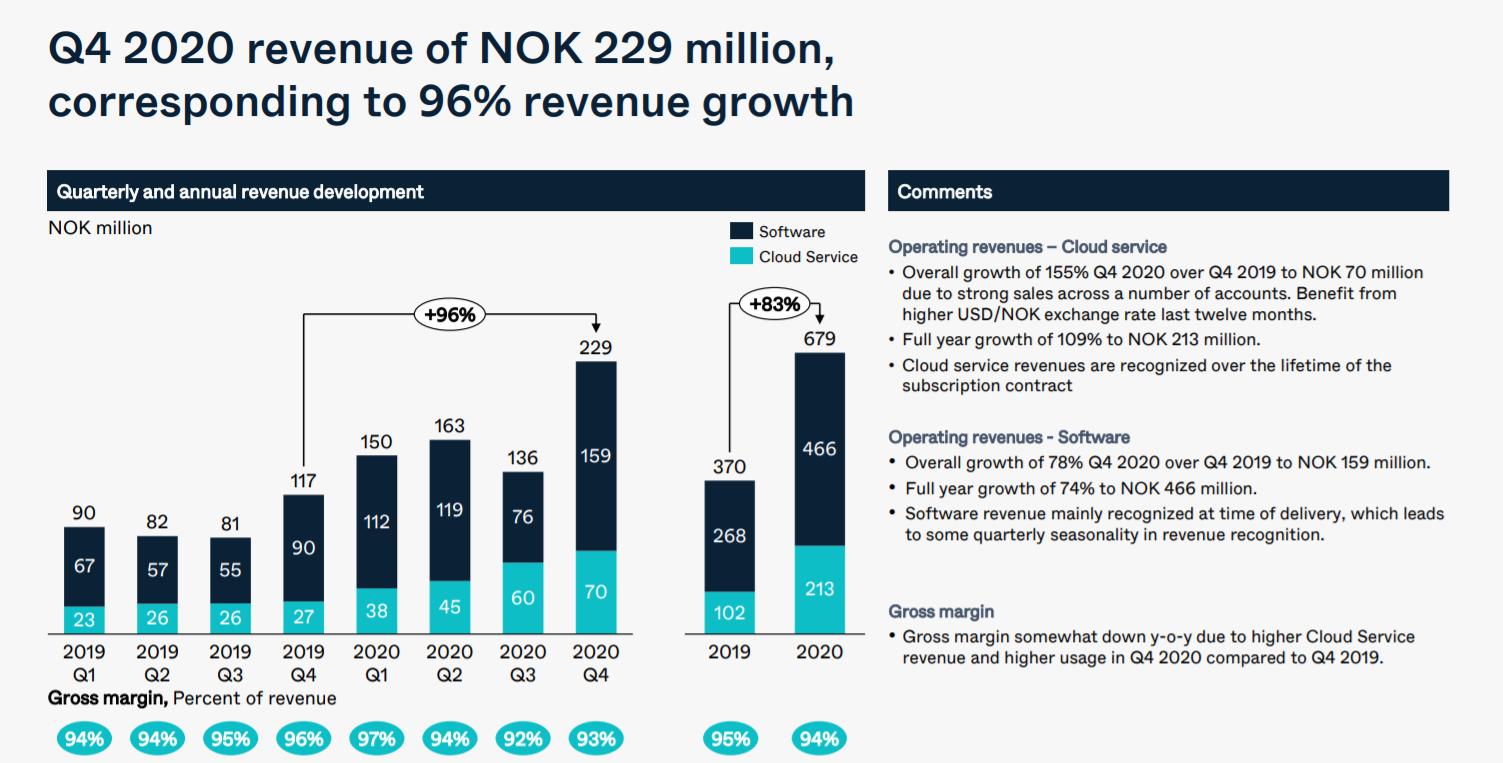
  • Videoneuvotteluratkaisuja tarjoava SaaS-yhtiö, liikevaihdosta 97% (Q4 2020 82 MUSD) on toistuvaa SaaS-liikevaihtoa (ARR).
  • SaaS-liikevaihto kasvanut vuosittain keskimäärin 70% (CAGR) jaksolla 2013-2020
  • Yhtiöllä vahva träkki kannattavasta kasvusta (EBITDA n. 25% tasolla) mikä rahoitettu pääosin omalla kassavirralla
  • Pexipin palvelut ovat arvostettuja ja yhtiö saa tämän takia hyvin pidettyä kiinni asiakkaistaan (Churn ~ 8% ja NRR ~100% tasolla historiallisesti)
  • Yhtiö on juuri laittanut käyntiin voimakkaaseen kansainväliseen kasvuun tähtäävään strategiansa ja pyrkii annista saaduilla varoilla kasvattamaan SaaS-liikevaihtoa 300 MUSD vuoteen 2024 mennessä. Tämä tarkoittaisi n. 3,5-kertaista liikevaihtoa vuoteen 2020 verrattuna. Q3 2020 vuosikatsauksen esityksessä tätä tavoitetta aikaistettiin 2025 → 2024
  • Yhtiötä hinnoitellaan selkeällä alennuksella suhteessa pohjoismaiseen verrokkiryhmään EV/S kertoimella mitattuna (13,5 vuoden 2020 liikevaihdolla laskettuna)
  • Jos yrityksen kasvustrategian tavoitteisiin päästään vuoteen 2025 mennessä (SaaS-liikevaihto 300 MUSD, >25% EBITDA) niin osakkeessa on huomattavaa nousuvaraa

AVAINKYSYMYKSET/RISKIT

  • Pystyykö Pexip haastamaan kolme teknologiajättiä videoneuvotteluratkaisujen markkinoilla (Microsoft, Google, Cisco)?
  • Onko yhtiön viimeaikainen voimakas kasvu ollut vain tilapäinen Koronasta johtuva spurtti vai onko kyseessä rakenteellinen trendi?
  • Miten yhtiön kunnianhimoinen 2025 kasvustrategia onnistuu?
  • Tuleeko markkinoille uutta teknologiaa, joka haastaa yhtiön vahvaa positiota?

LINKIT

Antiesite:

Q3 2020 osavuosikatsauksen esitys:

Q4 2020 osavuosikatsauksen esitys:

Yhtiön perustiedot:

@AktieEntreprenören analyysi Helmikuulta 2021:

------------------------------------------------------------------------------------------------------------------------------------

YLEISTÄ TIETOA

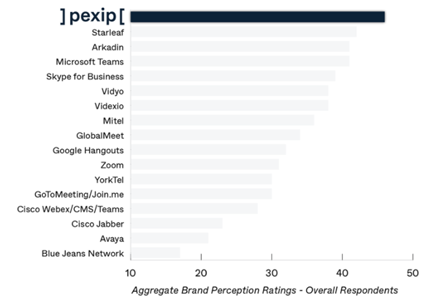
Pexip on globaali teknologiayhtiö, joka tarjoaa videoneuvottelratkaisuita sekä digitaalisen infrastruktuurin. Yhtiö tarjoaa joustavia käyttöönottomalleja, jotka vaihtelevat palveluna tarjotusta pilvipohjaisesta alustasta itsepalveluratkaisuun joko paikan päällä tai missä tahansa pilviympäristössä. Ratkaisut toimitetaan toistuvana tilauspohjaisena mallina (SaaS) mikä tekee tulovirroista tasaisia ja sitä kautta myös hyvin ennustettavia. Yhtiö erottuu muista toimittajista tarjoamalla käyttäjille mahdollisuuden osallistua samaan kokoukseen järjestelmillä ja laitteistoilla, jotka ei muuten ole yhteensopivia toistensa kanssa. Pexip on hiljattain saanut korkeimmat NPS pisteet 17 suurimman videoneuvotteluratkaisujen toimittajan vertailussa, mikä antaa positiivisen signaalin palveluiden laadusta ja asiakkaiden pysyvyydestä.
Yhtiön palvelut lyhykäisyydessään:

Pexip Meetings – Videoneuvottelualusta korkeilla toiminnallisuuksilla (tekoäly ja rajaton skaalautuvuus)
Pexip Room – Videoneuvottelulaitteisto kokoushuoneisiin. Yhtiö on juuri julkistanut merkittävän yhteistyösopimuksen Logitechin kanssa parantaakseen videoneuvotteluhuoneiden ominaisuuksia.
Infrastruktuuri videokonferensseille – Infra joka on pitkälti muokattavissa yrityksen nykyisiin ja tuleviin videokokousjärjestelmiin. Mahdollisuus yhdistää videokonferenssilaitteita, jotka eivät muuten ole yhteensopivia toistensa kanssa.
Pexip for Microsoft ja Google Meets – Mahdollistaa liittymisen Google Meets, Teams- ja Skype -kokouksiin eri toimijoiden laitteilla.

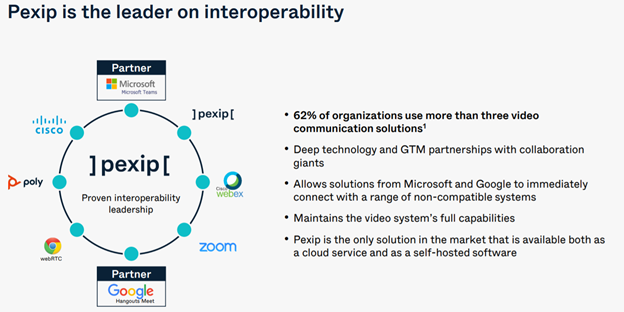
Pexip on siis Googlen ja Microsoftin sertifioitu kumppani, joka mahdollistaa yhteentoimivuuden eri teknologioiden välillä. Yhtiö on yksi kolmesta maailmassa, joka tarjoaa yhteentoimivuuden Microsoft Teamsin kanssa, ja ainoa maailmassa, joka tarjoaa sen Google Meetin kanssa.

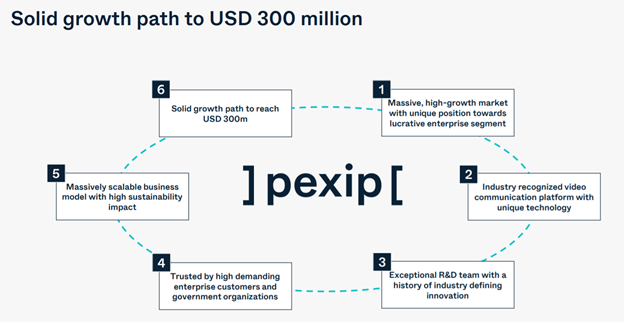
Yhtiöllä on todella vakuuttava asiakaslista: sillä on 20% Global Fortune 50 -yrityksistä ja 15% Fortune 500 -listan yhtiöstä asiakkainaan. Yhtiön asiakkaista suurin osa on suuryrityksiä tai yrityksiä joilla on korkeat turvallisuusvaatimukset videoneuvotteluratkaisuiden osalta. Mielestäni tämä kertoo että yhtiön ratkaisut ovat korkealaatuisia, yhtiöllä on vahva hinnoitteluvoima sekä hyvät lähtökohdat voimakkaaseen kansainväliseen kasvuun.
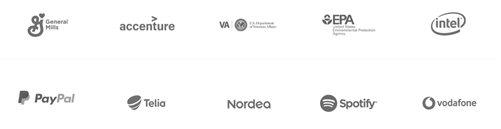
Pexip myy ratkaisuitaan globaalin jälleenmyyjäverkoston kautta, sisältäen 300 kumppania 75 maassa. Yhtiöllä on yli 3400 asiakasyritystä, joiden pääkonttori on 73 maassa ja käyttäjiä 190 maassa.

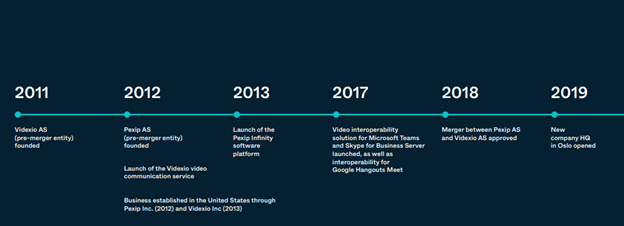
Nykyinen Pexip muodostui 2019 fuusiossa, jossa videoinfrastruktuuriin erikoistunut Pexip (perustettu vuonna 2012) ja pilvivideopalvelujen tarjoaja Videxio (perustettu vuonna 2011) yhdistyivät. Molempien yritysten perustajat ovat omien toimialojensa konkareita. Alla lyhyt tiivistelmä yhtiön historiasta.
MARKKINA JA KILPAILIJAT

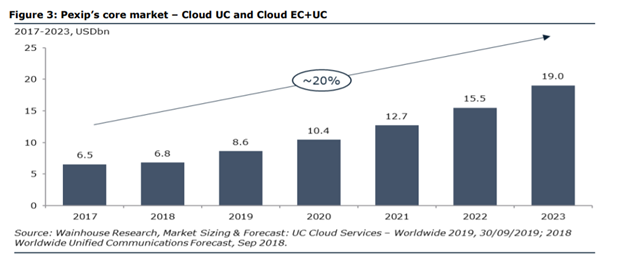
-Wainhouse research arvioi yhtiön core markkinan kasvavan keskimäärin 20% (CAGR) vuositahtia 19 MRD USDiin vuosina 2018-2023 (tästä arviosta voisi varmaan löytyä päivitetty luku).

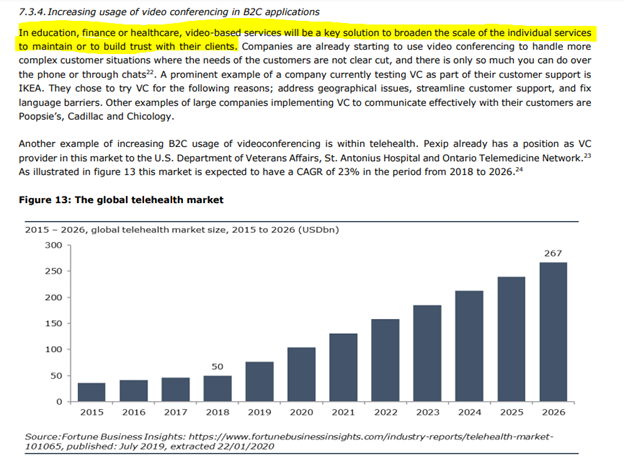
-Tulevaisuudessa yhtiöllä on mielenkiintoisia mahdollisuuksia B2C markkinoilla esim. videotapaamisten yleistyessä terveydenhuollossa. Tämän markkinan oletetaan kasvavan 23% (CAGR) vuositahtia 267 MRD USDiin vuoteen 2026 mennessä. Yhtiö kertoikin juuri Q4 2020 esityksessään uudesta yhteistyökumppanistaan Epicistä, jolla on 250 miljoonaa asiakasta heidän potilastietojärjestelmässään. Koen että tässä yhteistyössä on valtava potentiaali.

-Oma arvioni on että potentiaalinen markkina (TAM) ei ainakaan tule loppumaan kesken yhtiöllä. Kasvun mahdollinen hidastuminen tulee johtumaan yhtiön omasta heikosta suorittamisesta tai kilpailijan mullistavasta teknologiasta.

-Pääkilpailijat: Cisco, Zoom, BlueJeans, Microsoft, Google. Antiesitteen sivulla 45 napakka tiivistys pääkilpailijoista ja heidän tuotteistaan.
KILPAILUEDUT (MIKSI ASIAKKAAT VALITSEVAT PEXIPIN?)

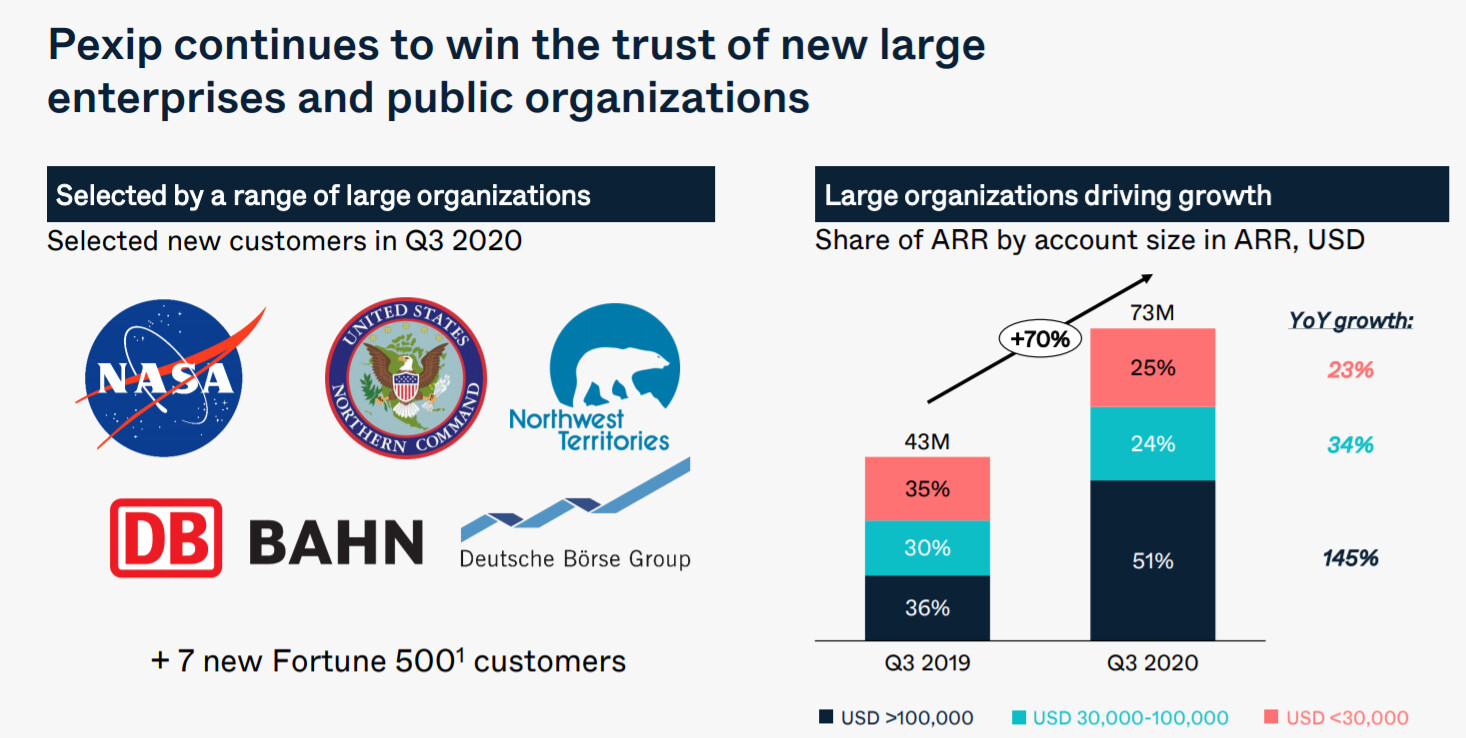
  • Kilpailijoita paremmat turvallisuusominaisuudet. Yhtiö kertoi juuri Q3 2020 esityksessään saaneensa NASAn ja USNORTHCOM:n (Yhdysvaltain puolustusministeriön alainen asevoimien sotatoimialueen päämaja) asiakkaikseen. Nämä ovat organisaatioita jotka varmasti priorisoivat turvallisuutta videokokousratkaisujen valinnassa.
  • Paras yhteensopivuus eri valmistajien ratkaisuiden välillä. Pexip kiteyttää hyvin blogitekstissään miksi eri ratkaisuiden yhteensopivuus on ensisijaisen tärkeää - kokoustamisen pitää olla mahdollisimman helppoa. ”..What John sees is a screen, a camera, and some kind input device like a remote control or a touch panel. He doesn’t care about the technology, the provider, or what kind of meeting it is. He cares about closing that deal, helping that customer, or hiring that new employee.”
  • Joustavat käyttöönottomahdollisuudet, joiden avulla asiakkaat voivat käyttää Pexipiä palveluna tai ottaa sen itse isännöityyn ratkaisuun joko paikan päällä tai missä tahansa pilviympäristössä, kuten Microsoft Azure, Google Cloud tai Amazon Web Services. Tuote on myös erittäin mukautuva asiakkaan tarpeisiin. Yhtiöllä on avoin API, jonka avulla asiakkaat voivat kehittää toiminnallisuuksia järjestelmän ympärille aivan kuten he itse haluavat.
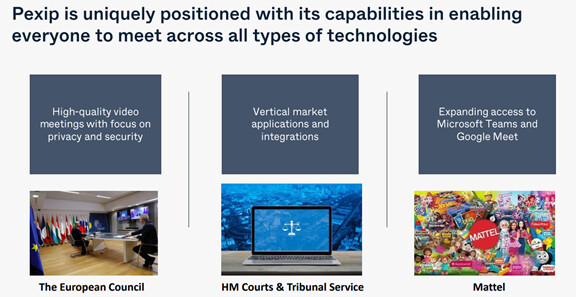
  • Asiakkaiden korkea pysyvyys Asiakkaat jotka valitsevat Pexipin, pysyvät myös pitkään asiakkaina (tämä on ehkä lopputulema kolmesta ensimmäisestä kohdasta).
TALOUDELLISET TIEDOT JA TAVOITTEET

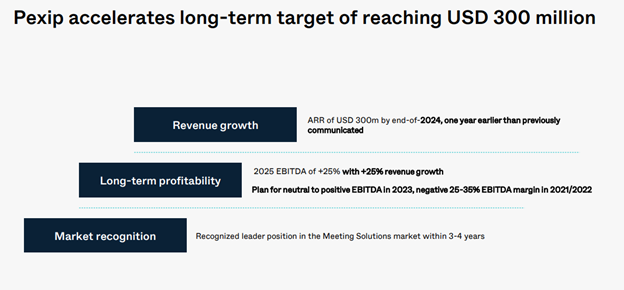
Yhtiö on asettanut kunnianhimoiset tavoitteet saavutettavaksi vuoteen 2025 mennessä.

-ARR liikevaihto 300 MUSD vuoteen 2024 mennessä. Q3 2020 raportissa tavoitetta aikaistettiin vuodella alkuperäiseen suunnitelmaan verrattuna. Antaa mielestäni todella vahvan signaalin yrityksen tämän hetkisestä iskukyvystä.

-Pitkän aikavälin kannattavuus: EBITDA > 25% yli 25% liikevaihdon kasvulla

-Markkinajohtajan positio 3-4 vuoden sisällä (tässä tarkoitetaan erityisesti isojen yritysasiakkaiden segmenttiä)
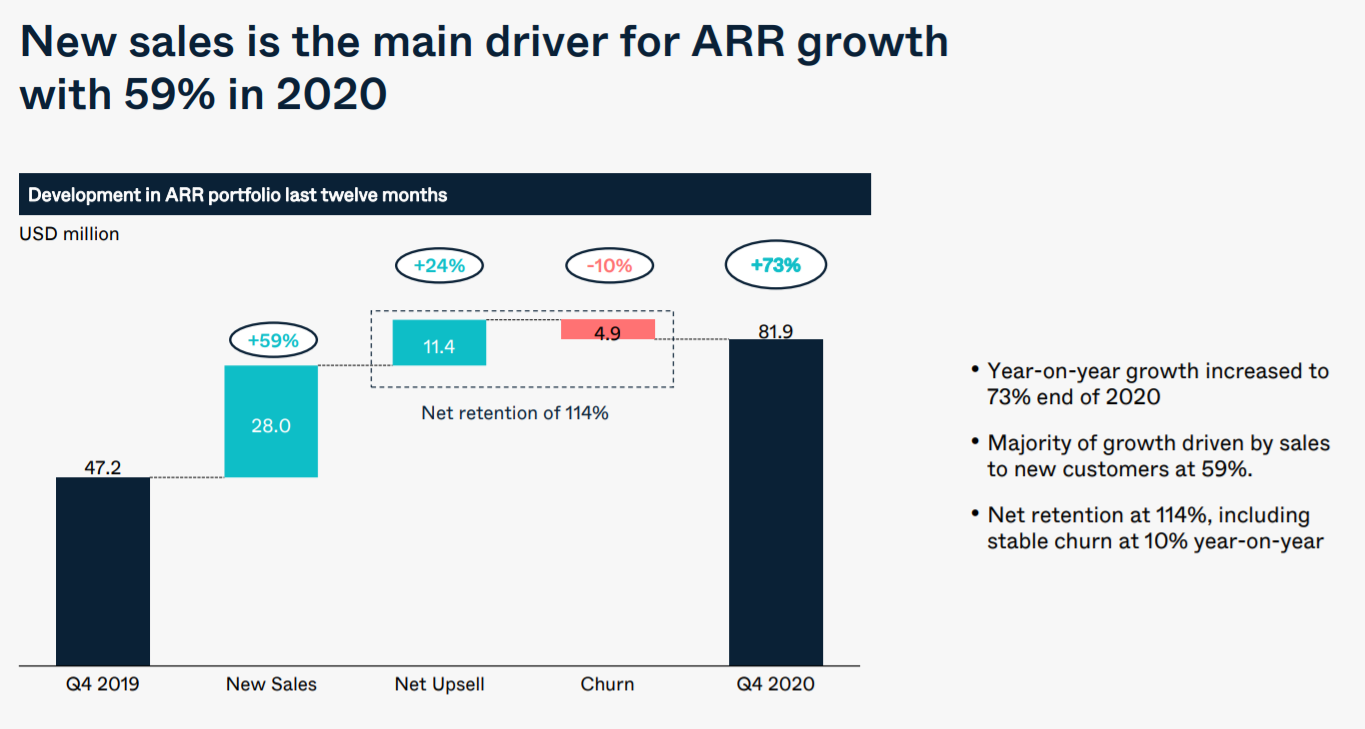
  • SaaS-liikevaihto kasvanut keskimäärin 70% vuodessa (2013-2020), tällä hetkellä 97 % liikevaihdosta on jatkuvaa laskutusta
  • USA ja APAC muodostaa ~90% liikevaihdosta, vahvaa kasvua kaikissa maanosissa
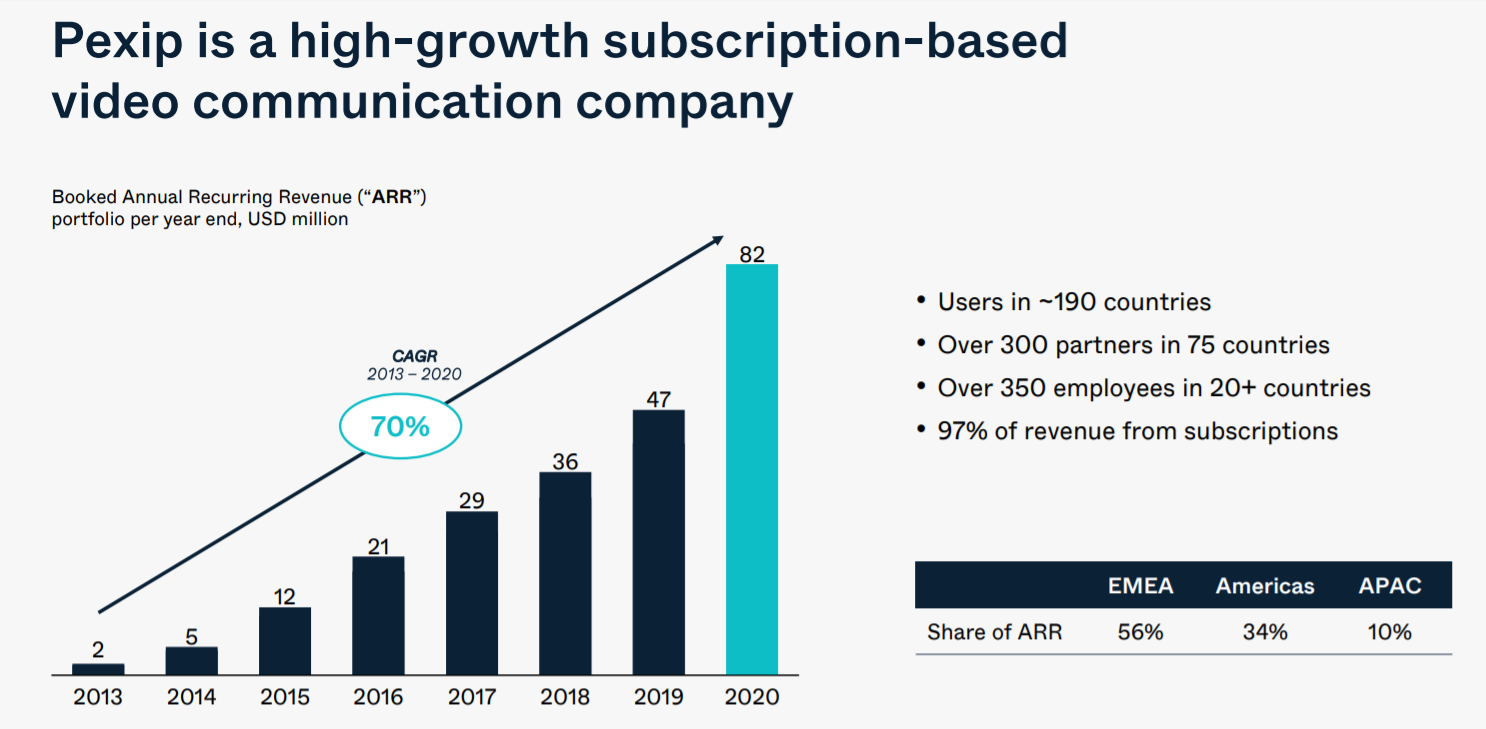

  • Yhtiön bruttomarginaali on todella korkea (~95%) ja antaa osviittaa skaalautuvuuspotentiaalista
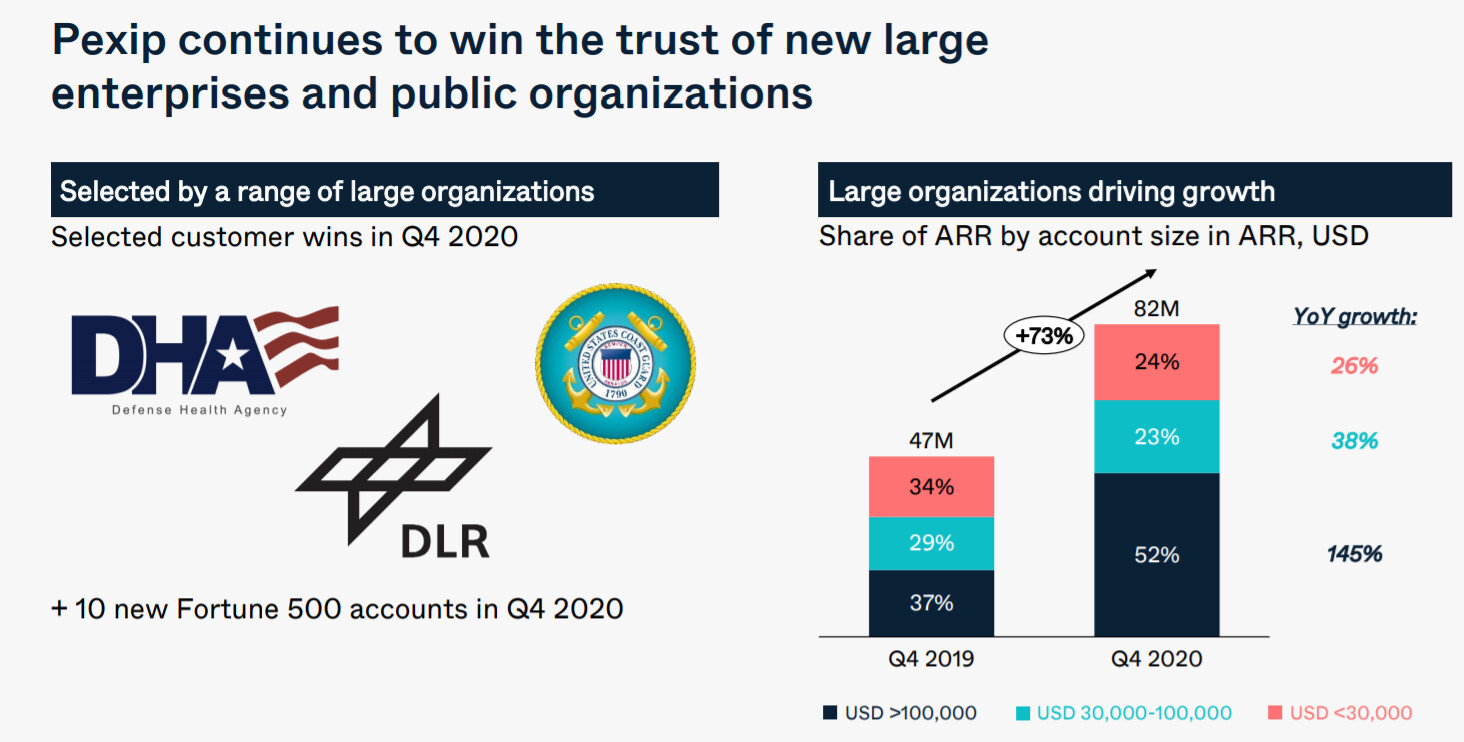
  • Pexip onnistunut saamaan 7+10 uutta Fortune 500 -listan yhtiötä asiakkaakseen kahden viimeisen kuluneen kvartaalin aikana (Q3 ja Q4 2020)

  • Yhtiön myynti suurille yritysasiakkaille kasvoi y-o-y 145% vuonna 2020. Tämä on mielestäni yksi tärkeimmistä mittareista seurata miten yhtiö pystyy haastamaan kolmea teknologiajättiä tällä markkinalla.
JOHTO / SISÄPIIRIN OMISTUS

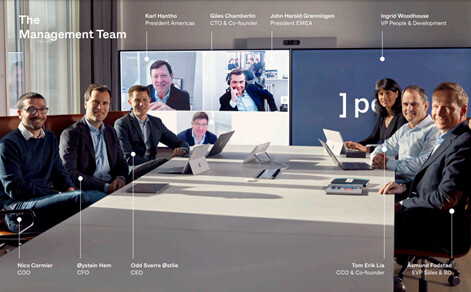
  • Johtoryhmä, hallitus ja muut sisäpiiriläiset omistavat n. 22% yhtiön osakkeista
  • Sisäpiiri tehnyt merkittäviä ostoja viimeksi syksyllä, kun osake kävi 60 NOK tuntumassa
ARVOSTUS / TUOTTO-ODOTUS

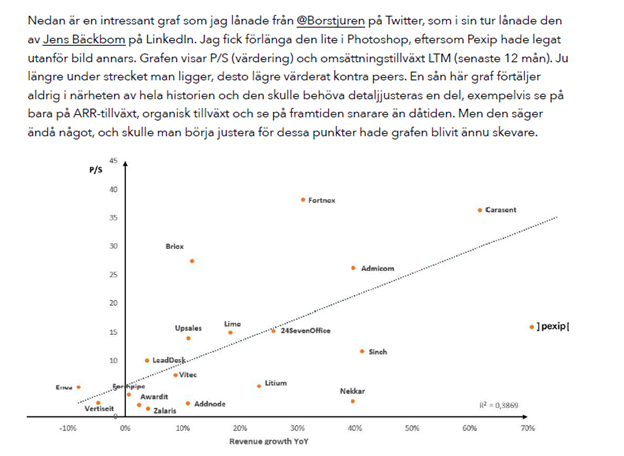
  • P/S ja liikevaihdon kasvua (LTM Q3 2020) esittävässä nelikentässä näkee että Pexip on selkeästi alihinnoiteltu suhteessa pohjoismaisiin verrokkeihin. Q4 raportin jälkeen vuoden 2020 P/S on 13,5, joten yhtiön paikkaa tulisi itse asiassa siirtää vielä pykälän alemmas. Tässä on hyvä ottaa huomioon Koronan yhtiölle antama myötätuuli vuoden 2020 aikana. Onkin mielenkiintoista nähdä että tuleeko yhtiön liikevaihdon kasvu “normalisoitumaan” tästä. (Kuva @AktieEntreprenören analyysistä)
  • Ohessa kuvakaappaus @AktieEntreprenören analyysistä, mistä saa hyvin osviittaa yhtiön tuottopotentiaalista strategian osuessa lankulle tai jos tavoitteet jopa ylittyvät. Tuotto-odotukset on laskettu 83 NOK kurssille, joten viime aikojen kurssinousu on jo syönyt (pienen) osan siitä. Base casessa oletetaan että arvostus (P/S) pysyisi samana kuin nyt.
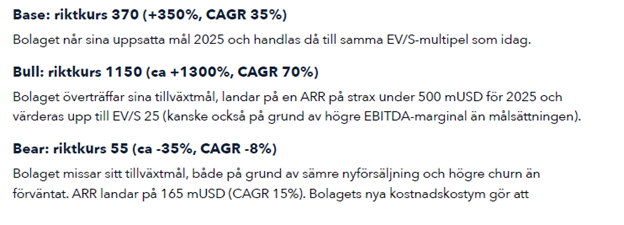
  • Tein vielä oman haarukoinnin havainnollistamaan osakkeen mahdollista hintaa (NOK) eri skenaarioissa. Jos kasvu alkaa hiipumaan niin kertoimet sulavat varmasti hyvin nopeasti paljon matalammille tasoille, mutta yhtiön onnistuessa upsidea on merkittävästi.

  • Omasta mielestäni riski/tuotto suhde tässä yhtiössä on erinomainen. Mielipidettäni tukee yhtiön vahva track record kannattavasta kasvusta, vakuuttava asiakaskunta, korkea asiakastyytyväisyys (ja sitä kautta pysyvyys) sekä mielenkiintoinen markkinapositio. Lopullisen vahvistuksen yrityksen tarinan etenemiselle saamme kuitenkin vasta koronaepisodin päätyttyä, kun selviää että onko nykyinen valtava kysyntä videoneuvotteluratkaisuille tilapäistä vai onko tässä alku pysyvälle, rakenteelliselle muutokselle (ns. hybrid työskentelymalli).

YHTEENVETO

Ostin itse ennen osaria yhtiön osakkeita (n. 5% salkusta) ja jatkan varmasti ostoja, jos yhtiön operatiivinen suorittaminen jatkuu yhtä hyvänä. Minun mielipiteitäni yhtiön tuotteista, tulevaisuudennäkymistä tai markkinapositiosta kannattaa lukea hyvin skeptisesti sillä en tunne teknologiaa/toimialaa tarkasti. Näkemykset ovat lähinnä yhteenvetoja yhtiön raporteista sekä jo valmiista analyysistä. Koen kuitenkin että etätyöskentelyyn liittyvien ratkaisuiden kysyntä tulee jatkumaan vahvana myös koronajakson jälkeen, ja Pexip on mielenkiintoisessa positiossa vastaamaan tähän kasvavaan kysyntään sekä yhä korkeampiin toiminnallisuuksiin liittyviin vaatimuksiin. Toivottavasti tästä summeerauksesta on hyötyä ja että tämä herättää kiinnostusta tutkimaan yhtiötä vielä tarkemmalla tasolla.
112 Likes

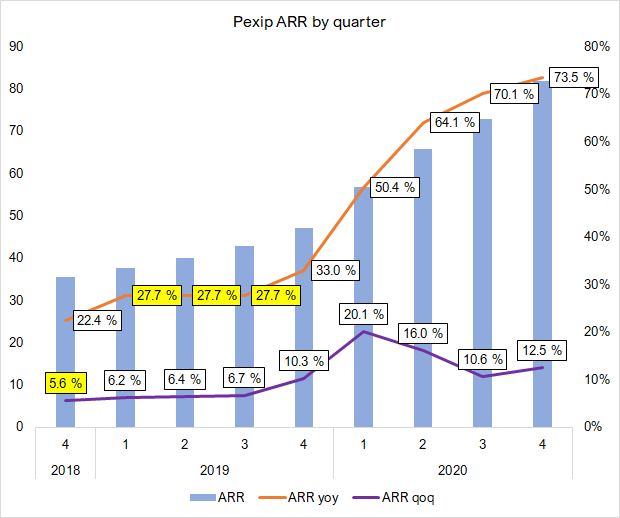
High-quality initial post! I did some number-crunching on the company regarding ARR growth. I went down to the quarterly level here to try and separate the growth surge brought on by the pandemic from “normal growth.” The company grew much more moderately during 2019, and Q1 2020 exploded, presumably boosted by the pandemic. After this, the ARR growth from one quarter to the next has slowed to “only” just over 10%.

One could assume that the pandemic year led to companies’ video conferencing investments, which also explains the high growth rate even in late 2020. So, the normal pace could be assumed to be under 10%. Additionally, it is inherently more difficult for a larger company to grow at equally high percentages. Achieving the 300 MUSD ARR target by 2024 would require a quarterly growth rate of 8.5% if we take the end of 2020’s 81.9 MUSD as the starting point. So, a slowdown from the current pace may occur, but a decline to 2019 levels would lead to failure in reaching said target.

Below is my Excel work on quarterly ARR growth based on Pexip’s materials (note: yellow growth figures are estimates as I could not find Q1-Q3 2018 data at the quarterly level). yoy=year on year, qoq=quarter on quarter

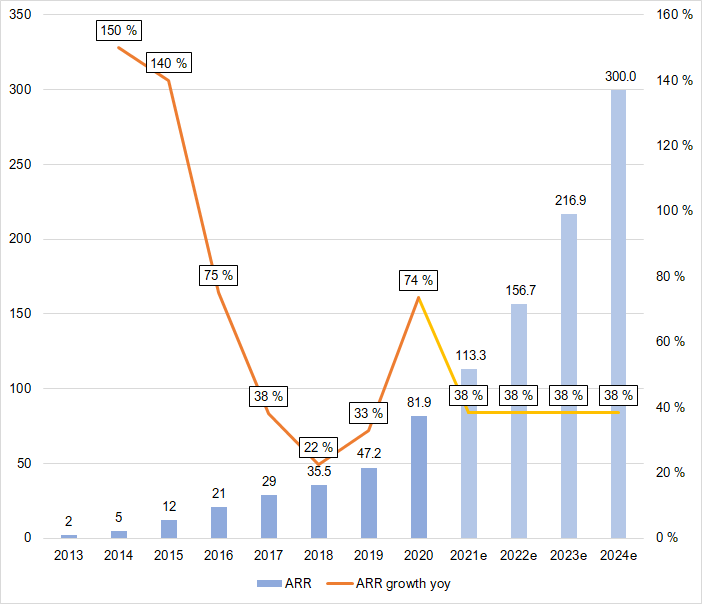
At the annual level, growth has historically materialized, and with a steady growth rate for the 2024 ARR target, it looks like this. Growth significantly slowed until 2018, after which acceleration actually began already in 2019. From this perspective, the 300 MUSD target in 2024 would seem easier, as over 38% growth could be expected for 2021 with high probability.

27 Likes

Interesting thoughts on the growth rate and what achieving the goals would concretely require on a yearly/quarterly basis. Indeed, a good comment on the acceleration of growth already in the pre-corona year 2019, which supports the assumption that the growth boost is not only due to corona. 2021 is indeed a very important year for the company’s future; they still have a lot to prove regarding the sustainability of growth. The starting level is indeed very low, and achieving the same percentage growth requires significantly more investment in the sales organization than before.

A few factors, in my opinion, support maintaining a higher growth rate compared to 2019’s growth:

  • In 2015-2019, the company grew solely on its own cash flow and wanted to maintain strong profitability (EBITDA 20-25%) alongside growth. Now, the company has openly communicated that it is putting all its efforts into growth and allowing the operating margin (EBITDA) to turn negative (-25-35%) for the next two years.

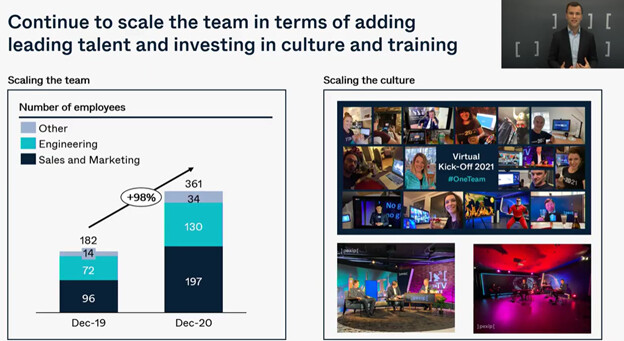
  • The company has a strong cash position after the offering, and they stated that they intend to use the cash for growth investments and product development. This supports the continuation of strong growth after 2020. Recruitment has started very strongly, and the number of employees has practically doubled during the year. This is a positive thing, but a large number of new hires in a short time also brings significant risks. The target was, if I recall correctly, 600 employees during this strategy period.

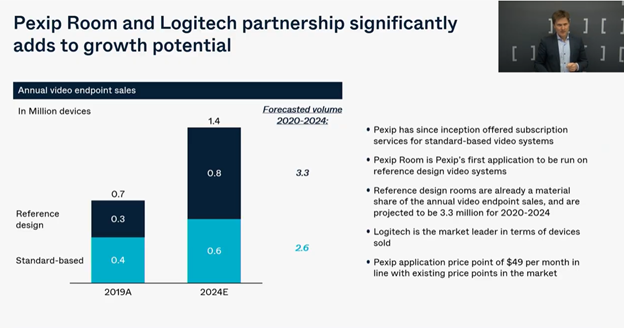
  • Pexip’s announced partnership agreements with Logitech and Epic also support sales growth, as the company’s solutions can be sold on a significantly broader front. The Logitech partnership increases growth potential, especially in the sales of the Pexip Room service, as solutions are sold in so-called packages. (Logitech supplies the hardware, Pexip the software). The Epic partnership may not materialize into sales immediately, but it opens the door to a completely different scale of the Telehealth market and is very positive in the long run.

  • Lastly, I would add the transformation of organizational working methods towards a so-called hybrid model. Companies will simply invest more in remote work and conferencing equipment, as well as in building various technical bridges between tools, to enable this model.
    image

10 Likes

What makes Pexip different from other software-based solutions? Is it that you can also join a virtual meeting via Teams or Meets? Or that Logitech has been able to do something special with Pexip so that their hardware works better with different network connections, maintaining high-quality video?

  • Generally, the problem with all of these is that if a large group participates in a meeting via video connection from different physical locations, the bandwidth often isn’t enough - forcing most people to use only audio.
5 Likes

2020:
Revenue 80M USD
EBITDA 12M USD
Market Cap 1.3B USD

2025 target:
Revenue 300M USD
EBITDA (25%) 75M USD

It’s hard to see clear undervaluation, but of course, comparables could be even more expensive.

3 Likes

Regarding the problem of bandwidth running out, I don’t think Pexip can differentiate itself from its competitors. All operators likely have the same problem. If image quality or other functionalities deteriorate because of it, built-in AI or video scalability probably won’t help :smiley:

However, Pexip’s solutions differ from its competitors in quality and functionality based on what I’ve read. Here are a couple of points:

  • Solutions related to product compatibility are, in my opinion, the company’s biggest competitive advantage. There are many different use cases.
    • Example 1 (compatibility with a customer): If a company uses Microsoft Teams, you can attach a Pexip integration layer (I couldn’t think of a better word) to it, which enables a virtual meeting with a customer who has, for example, Cisco equipment in their meeting rooms.
    • Example 2 (combining internal infrastructure): If a company uses Google Meets but has Cisco equipment in their own meeting rooms – Pexip enables the company to use Meets with their conference equipment.
    • According to Wainhouse research, over 60% of companies use more than three video communication solutions. If this figure is even close to the truth, there is likely a great need for “technical bridges” between systems and hardware.
  • Higher level of security. I cannot comment on this functionally or technically any further, but in my opinion, reference customers (e.g., NASA) speak for themselves here.
6 Likes

I myself have used cloud-based software directly for these arrangements, in which case you only need a small Windows machine and a display/screen in the meeting room.

  • What is the significance of Cisco devices here - do they replace the Windows machine - what is the benefit, are they cheaper? A Windows machine can be used for everything else in a meeting room. There are really small Windows-based setups like that.
  • If you use Teams and your neighbor organizes with Meets, you get a link in your email in the meeting invitation, through which you can join via your browser.
  • The security level certainly matters, but then the whole system is probably on its own server anyway.

I’m just trying to find out what the key here is - I mean, there are an annoying number of different software applications in large companies, as they have been acquired by different units and at different times. That’s clear.
Zoom has taken over these markets in the short term, Pexip probably has its chances, but the Norwegians must have some kind of distinct feature to conquer the world.

4 Likes
  • what is the significance of those Cisco devices here - do they replace Windows - what is the benefit, are they cheaper? You can use Windows in the meeting room for everything else. There are already very small Windows-based setups like that.

Cisco Webex was just an example of random conference equipment. My assessment is that Pexip’s product stands out precisely in large organizations where there is a large collection of different equipment. Many companies want a meeting room solution that is fast, easy to use, and that everyone can use without IT support. In practice, you come into a meeting room, there’s a touch screen on the table, you can send meeting invitations from different providers to that device, and join meetings with one touch.

  • if you use Teams yourself and a neighbor organizes with Meets, you get a link in your email in the meeting invitation, through which you can join via the browser.

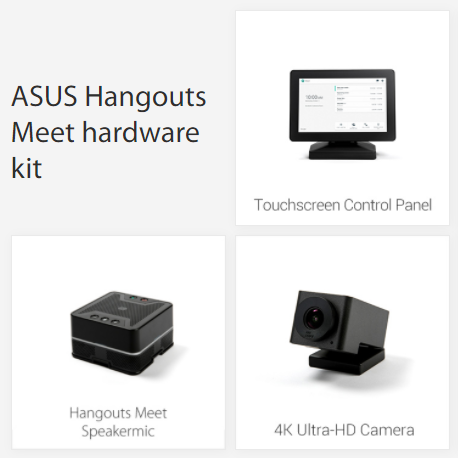
It’s true that an organization using Teams gets a Meets link in the invitation, but it cannot be opened directly without custom configurations on a conference device that is not Meets-based. Pexip customers, on the other hand, can connect to meetings without additional software or extensions via Pexip’s WebRTC client. For example, at my workplace, we use approximately the setup below + a large screen in many rooms – Teams links are not opened via that touch screen. In meeting rooms, someone always has to open the Teams link from their laptop and connect their computer to the larger screen. In this case, audio is often adjusted via a separate additional device as well. With Pexip’s software, the same device could directly join a Teams meeting.

Below are some reasons from reference customers why they chose Pexip. Also below is a link to their fairly comprehensive case study library. There, they dive deeper into the details; I brought some highlights here.

“We needed a secure solution where participants could join meetings without the need to download a plug-in and it was essential that we maintained total control over sensitive patient information and confidential communications. The solution was Pexip.” Helsinki University Hospital - The largest university hospital in Finland, and one of the largest hospitals in Europe.

“We have a huge on-premise deployment of Skype for Business and Cisco video conferencing systems. We chose Pexip because we wanted a product that could scale and move with us as we start our transition from on-premise to hybrid and then ultimately to having our entire deployment in the cloud.” Accenture - A multinational professional services company that provides services in strategy, consulting, digital, technology and operations

We then decided to try out Skype for Business, and in the process of trying out various other vendors over a year, realised we needed a platform that enabled Skype users to connect with those on other platforms as well — this became a key factor in our choice of vendor. That’s when we first came across Pexip. We tried it out for a month and our experience with the brand was wonderful. Amnesty International - A non-governmental organization focused on human rights.

I’m just trying to find out what the key point is here.

This is indeed a critical factor for Pexip’s long-term growth story. I can’t answer this yet, but I can take the question a bit further :smiley:

  1. Does Pexip’s software/architecture bring enough ease to larger companies that they choose their solution instead of their own meeting room-specific setups, or is Pexip’s product just a “nice to have” luxury item that companies willing to invest will buy?

  2. If the answer is that Pexip’s products are a luxury, a follow-up question immediately comes to mind: Is there a large enough market if they were to only profile themselves as a provider for customers who particularly emphasize security?

8 Likes

The company definitely has some impressive references. I added a small batch of this to my portfolio this week, and now I feel a bit more confident after checking through those customer references. =)

1 Like

An interesting company, to be sure. Competition with the big players is certainly tough. The acquired customer accounts, in my opinion, speak for the product’s functionality, at least for now. The COVID era is of course exceptional, but it nicely caught my eye that Q3 2019 < Q3 2020, particularly the number of large customer accounts, has grown strongly.

3 Likes

Of course, it’s very difficult to stand out from Zoom, Teams, etc. in this business, but even strategic differentiation and focus on certain segments might be enough.
What primarily and hugely interests me in this case is this Telehealth thing for these reasons:
From the IPO prospectus:
Pexip intends to expand in the following high impact segments: A) Selected B2C vertical markets, e.g. health care and finance. Pexip expects that enterprises/organizations increasingly want to include video into their B2C workflows – with some level of tailoring, branding, and other integrations to make it part of their overall customer experience. Pexip has already been embraced by several leading health care providers such as U.S. Department of Veterans Affairs, where Pexip’s video meeting platform is underpinning digitalization of their doctor-patient workflows. Similarly, several financial companies have
leveraged Pexip in their customer work flow

Fortune Business, by the way, writes this about Telehealth:
The global telehealth market size was valued at USD 61.40 billion in 2019 and is projected to reach USD 559.52 billion by 2027, exhibiting a CAGR of 25.2%

These are probably the big US army deals won during Q4. Last week, Talouselämä (Finnish business magazine) also mentioned that during the Corona era, remote visits in Finland increased by a factor of 40. Doctors on the forum, what do you think? @El_Nila was apparently in the field?

The company’s figures are, by the way, terrifyingly good. Half of the staff are sales people, so a pretty decent cash cow could be created immediately if they wanted to. They probably shouldn’t want to, as the development of remote meetings has only just properly begun!

4 Likes

These remote appointments have increased primarily in the private sector (Terveystalo, Pihlajalinna, Mehiläinen, etc.). Of course, these already account for a significant portion of public sector services in certain areas. So yes, they have increased quite significantly in Finland, though I can’t give exact figures right now. In the public sector (if the aforementioned companies are not responsible for service provision), there are hardly any remote appointments, unless phone consultations are counted.

5 Likes

The Epic announcement was likely the main reason for the strong surge on Friday. The ARR growth had already been announced in an earlier press release in January. I also did some digging into the telehealth market and the Epic deal:

  • Pexip estimates that 30% of doctor appointments will be remote by 2022.

  • “At Pexip we have worked with healthcare organizations and caregivers since 2013 to help extend their reach by providing secure, easy-to-join video visits for patients from any device or location. Epic is currently being used by more than 250 million patients worldwide and this integration makes it easier for patients and healthcare providers to conduct video visits that fit seamlessly into their daily workflow,” → New information for me that Pexip has been working with hospitals for almost 10 years now.

  • So, with Pexip Health for Epic, patients and providers can have a remote meeting directly from MyChart (which is used by over 100 million patients). As I understand it, other software doesn’t have a built-in remote meeting capability directly within Epic’s service. In this case, Epic’s hosting can also be done on their own servers → Higher security (very sensitive data is handled in healthcare)

Below are some notes from the Q4 webcast on questions regarding the potential of the Telehealth market in the Q&A section.

Please tell something about opportunities, lead times, business model etc. within Telehealth

  • There are more extensive customisations that customers want to do in systems in the telehealth market → This aligns well with Pexip’s capabilities (security and complex architectural solutions).
  • Deal sizes are therefore also bigger → The deal with the US Defense Health Agency last quarter, the company’s largest deal to date at approx. 2 MUSD ARR, is good evidence of this.

Which are the main benefits of Pexip Health for hospitals?

  • Customisations in the healthcare provider system are much easier to do, Epic has lots of predefined workflows and workflow support → Faster implementation and hospitals can get their telecare offerings to market faster.

All in all, it feels like Pexip is very well positioned for the demands of the Telehealth segment.

P.S. I hope this Epic deal has as much potential as Remedy’s previously announced Epic deal :smiley:

Pexip Announces Native Integration with Epic, the world's largest Electronic Health Record System provider.

3 Likes

Back in the day, these virtual meetings specifically had to be arranged with devices like Cisco, but when software moved to the cloud, I imagined this type of solution would fall into oblivion. But apparently not. However, back then, these required their own expert who would then handle the technical problems and updates related to them. Nowadays, these probably run on some Linux version?

But if Pexip gains market share from customers requiring stronger data security, then there will probably be enough of a revenue source for a global operator. I should start considering acquiring a share if the price consolidates. The stock has made a sharp rise since December.

3 Likes

Here’s more substance regarding Telehealth offerings and customers, from a CCO blog post published on February 9th.

Security and seamless integration with existing processes and systems are key.

Today’s healthcare organizations need secure, high-quality video that fits seamlessly into their daily workflows. Pexip’s video platform was designed with these tenets in mind, and is already powering more than 600,000 virtual visits a week for leading hospitals and health systems in North America.

A few notable mentions of organizations that are Pexip customers.
image

3 Likes

Pexip received recognition in the Frost & Sullivan international comparison today. This certainly isn’t a bad thing for a small Norwegian firm :smiley:

17th February 2021 - Frost & Sullivan has recognized Pexip with the 2021 Customer Value Leadership Award for the Global Video Conferencing Industry. This award is a testament to Pexip’s secure and flexible solutions which, combined with its strong technology leadership and customer-centric culture, are helping organizations around the world modernize their workplace collaboration.

Pexip Award - Frost&Sullivan Awared 2021.pdf (1.8 MB)

4 Likes

Benchmark has recently taken a position in Pexip and QT. Hopefully, they will also publish their own analysis of Pexip soon. They consider the company cheap relative to its peers.

https://twitter.com/GetBenchmarkCo/status/1363192882547609604

3 Likes

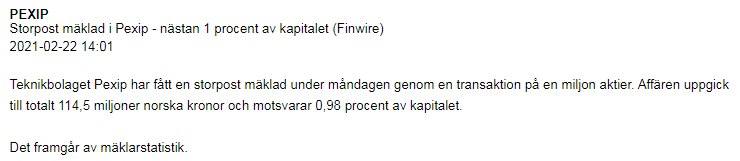
Someone bought a million shares today. The share price started a reasonably strong rise after that. Looks like there’s confidence!

1 Like

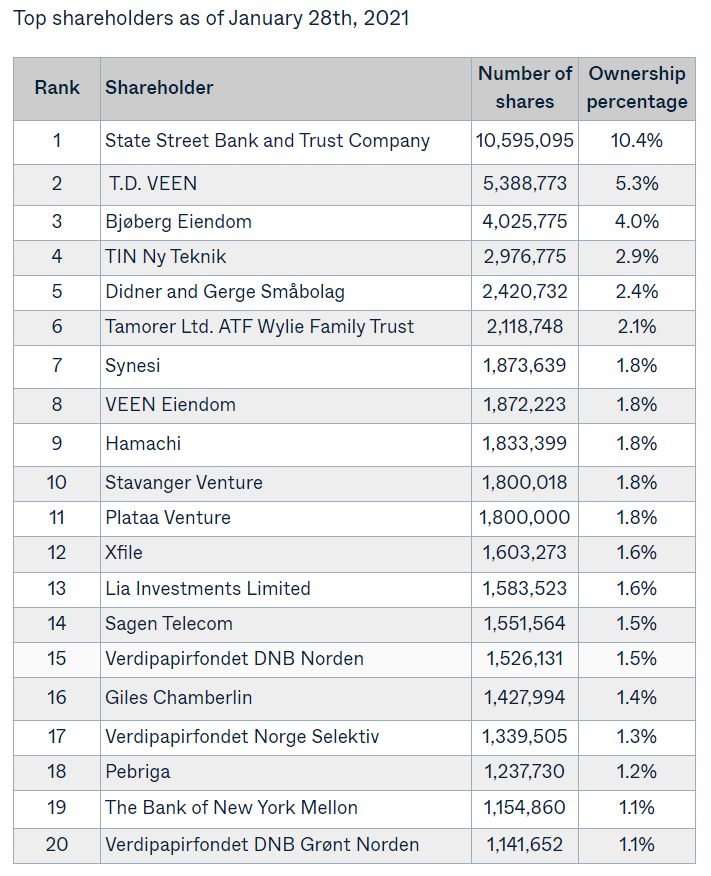
Oh! But I was looking last week and it seems like the institutions don’t have much of a slice of this yet. There was only one bank on the list of major owners. So it’s possible that other whales are still coming to the feeding grounds.

1 Like

Here’s a list of the largest shareholders at the end of last month. Let’s see how the list changes in February.

There aren’t many familiar names there for me either :smiley: