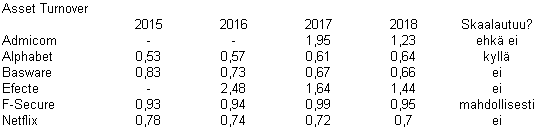
More than a third of my portfolio is in tech, but apparently, this thread mainly discusses software product companies, which I currently have very few of. I haven’t intentionally avoided them; I’ve just found what I consider better investment opportunities in the technology sector (mainly on US exchanges).
F-Secure is currently the only software product company I’ve deemed worthy of a place in my portfolio from the Helsinki Stock Exchange. I believe in the sector’s growth far into the future because soon it will be difficult to find a product that doesn’t have at least one computer embedded in it (with software and security issues within that software). F-Secure is a sufficiently large player in its field, has always had competitive products, and generally a good long track record. It is also sufficiently liquid (this condition alone can rule out a large number of Helsinki’s small tech companies).
At the core of tech firms is product development, which is a continuous race against others. Similarly, sales and marketing are ongoing activities. I don’t understand these narratives where either of these is treated as some temporary investment. If you slow down, others will pass you by.
Even if you’re first to market, it doesn’t necessarily mean anything. It doesn’t even necessarily mean anything that you dominate the market in the early stages. For example, Netscape made the first really good web browser. Netscape achieved over 90% market share in the mid-90s. Its market share in 2006 was 1%, as Microsoft and many others easily overtook it.
Usually, people only remember the winners. However, for every winner, there are long rows of failures in the graveyard of tech companies.
Having seen quite a few first releases of products, I can say that almost always the first release requires significant patching later. The more parallel releases/products to maintain, the larger the proportion of staff goes into maintaining the old and is away from developing the new. Then, to top it all off, you can add customers who demand customization.
Tech companies can easily become locked into a certain platform/technology, as happened with Nokia’s mobile phone division and Symbian. Apple didn’t invent the smartphone; they studied existing products on the market and made one that was many times better. They had no legacy burden and had done their homework exceptionally well (their first release is famously not rubbish - the exception proves the rule).
Especially large companies have the option that Apple used with smartphones and Microsoft with web browsers. They let smaller companies push a technology, and then either buy them out, litigate them out, or develop their own much better product for the same market.
The problem for small companies is that they have very small product development (and sales/marketing) organizations. A large company can put 10-100 times the same amount of skilled people to work and achieve the same level quite quickly. Similarly, a large company can easily find a bunch of patents with which to sideline a smaller player (Motorola attacked Nokia as soon as Nokia’s market share in mobile phones became “significant”). With small companies, litigation doesn’t even need to be won - it’s enough that it drains years of money and resources (which a large firm has, but a small one might not).
In my opinion, a tech company can achieve a sustainable moat only through large size. In such cases, they usually have a good brand, a large patent portfolio, a large product development department, a large sales/marketing department, and several successful products. That is, replicating something similar becomes difficult.
I don’t believe that all the new-era companies currently in the lead will still be with us as independent entities in 20 years. The same thing happened to most of those who were in the lead in 1999-2002 and survived the bubble (e.g., Yahoo is no longer an independent entity and, before ending up under Verizon’s ownership, began to be just a shadow of the power Yahoo was in 2000).
In addition, in the semiconductor technology sector, for example, the moat is deepened by production technical expertise and the fact that each generation’s production line costs more than its predecessor. Currently, we are at a level where even giant companies may not embark on building a factory alone.
Yes, good tech companies can be found, but I, for one, no longer believe in stories.
There must be evidence, size, and liquidity.


 many tech companies are still semi-unknown to me as well.