Verneri’s message in the “Pörssien suunta” (Stock Market Direction) thread prompted me to do some calculations.
NOTE! All figures below are very rough generalizations
If we assume an acceptable P/E for Zoom to be, say, 50 (it’s currently something >2000) for the year 2023, then the E component should be 2.6 Billion. Furthermore, if we assume that the average annual payment from one (paying) user would be 140 USD (Pro license list price) and the margin would be a whopping 50%, then there would need to be ~40 million paying users.
If we change the calculation so that the P/E is 20 and the margin is 30%, 155 million paying users would be needed.
30x P/E and 15% margin: 206 million users
In its quarterly results, Zoom reported the following about its customers: “Approximately 370,200 customers with more than 10 employees,” & “988 customers contributing more than $100,000 in trailing 12 months revenue” & “Zoom defines a customer as a separate and distinct buying entity, which can be a single paid host or an organization of any size (including a distinct unit of an organization) that has multiple paid hosts”
From these figures, one can conclude that there are at least 3.7 million paying customers, and more likely 2-5 times that number. It is worth noting that in Zoom meetings, it is often sufficient for the meeting organizer to be a paying customer for all features to be available. Not all users are paying customers, and for example, in my workplace, less than half have a Pro license, even though Zoom is in use. All in all, 40 million paying users seems realistic within a few years. But with what margin will that happen? And is 200 million realistic?
What I find particularly interesting about this company is that:
- Customers are mainly businesses
- Annual billing per user is in the same league as Netflix (but without content production costs)
- The business genuinely scales quite well, not as well as a basic software company due to infrastructure costs, but otherwise.
The threat, then, is that MS Teams will take users, as MS offers much more for the same annual price (the entire M365). But so far, Zoom is much better when you need to include users from outside the same organization in meetings/live events. Zoom also doesn’t have any real moat; a new player could gain market share in the same way Zoom itself did, by being just a little better (and cheaper).
Now that I’ve calculated this (at a very, very rough level), it kind of annoyed me that I didn’t do this in the spring and wasn’t on the buying side. Now, that price indeed feels high and is already based on many different expectations.
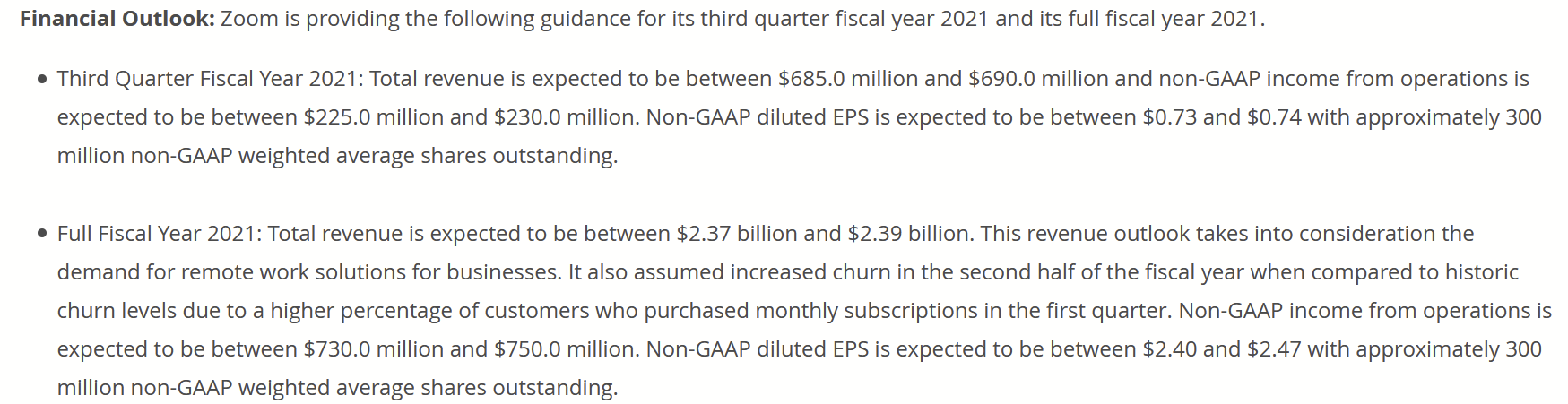
By the way, the guidance for this year in that Earnings report caught my eye. If only Finnish companies provided guidance with such precision…