Traditionally, an autopilot refers to automatic control that aims to maintain a specific heading (and speed) by adjusting steering in response to prevailing conditions. There can also be a pre-defined route where automatic turns are made at waypoints along the way. The latter, however, isn’t quite so simple in sailing, for example. Indeed, a traditional autopilot doesn’t typically care about obstacles; they are instead picked up by radar, which can be set to trigger an alarm. In this sense, FSD is a quite different system, as it is given a multi-dimensional task to handle in its “own” way.
1 Like
Many writers here have also noted that the challenges only really begin when we start talking about those nines after the decimal point. “Reality has a super long tail of complexity”. It’s great that Elon finally realized it too and didn’t start force-pushing unsafe cars onto the streets without supervision! Driving coast-to-coast along wide and quiet highways is a much easier problem than driving in urban traffic without supervision without killing people.
4 Likes
It’s a shame that Lepikko has a posting penalty until March.
Can @Kasleew come and tell us what this means? And how far is that “can” being kicked now?
13 Likes
This is encouraging news. Now time is just starting to run out, at least regarding Tesla’s European sales; these updates definitely need to be brought over to this side of the pond as well.
Traditionally, autopilot is known from aircraft, and the first Atlantic crossing using only autopilot occurred in 1947. This included automated takeoff and landing in addition to cruising.
Somehow FSD, especially if it refers to a steering-wheel-less car driving alone anywhere, doesn’t seem like a thing for the very near future.
Passenger planes obviously have more people on board than a passenger car, but the first functional autopilot was introduced in 1912, and here we are 113 years later and pilotless planes haven’t taken over the market. Following this thread, I’ve gotten the impression that FSD isn’t “full self-driving” but rather an advanced cruise control, an aid.
\[https://en.wikipedia.org/wiki/Autopilot\](Autopilot - Wikipedia)
This FSD thing is already starting to resemble promises of fusion power plants; has it been 30 years away for 50 years now? Or even longer.
Musk’s habit, though, is to promise things more like 30 days or three months out.
Yeah, I’ll leave the thread alone in the future; I just can’t understand on what basis Tesla is or would be a good/fast-growing company or a good business. There’s plenty of promises, hype, plans, and rocketing share prices, and it could certainly be a much better investment than any of the stocks in my portfolio.
I think it was Buffett who said that you shouldn’t invest in a company whose business you don’t understand. I try to follow this at least to the point where I only invest in things I at least think I understand.
16 Likes
I’ll try, although it requires a bit of a step up from the notion that self-driving FSD in city traffic is just an advanced cruise control.
Fred Lambert is oversimplifying things with his own anti-Tesla bias when he claims Unsupervised FSD is the same thing as a Robotaxi without a safety person and counts miles toward Musk’s comment. Musk’s comment reflects his view on the “long tail” of autonomous driving, where simulation models alone, such as those announced by NVIDIA at CES, wouldn’t suffice for safe autonomy without massive fleet data that includes human intervention and experience.
A Robotaxi is not “Unsupervised.” It is teleoperated, at Tesla just like with others. Waymo also confirmed that a teleoperator was driving when an empty Waymo was once cruising on a golf course. Therefore, the safety driver can be removed before any specific mileage target is met. Another point is that Unsupervised FSD allows the driver to surf on their phone or eat yogurt without any teleoperation. More details will be shared either before or during the Q4 earnings call.
2 Likes
“Tesla investors need to ask themselves: If xAI owns the intelligence behind the robot, what exactly is Tesla owning?”
25 Likes
Yle reminds that China is going its own way in autonomous driving:
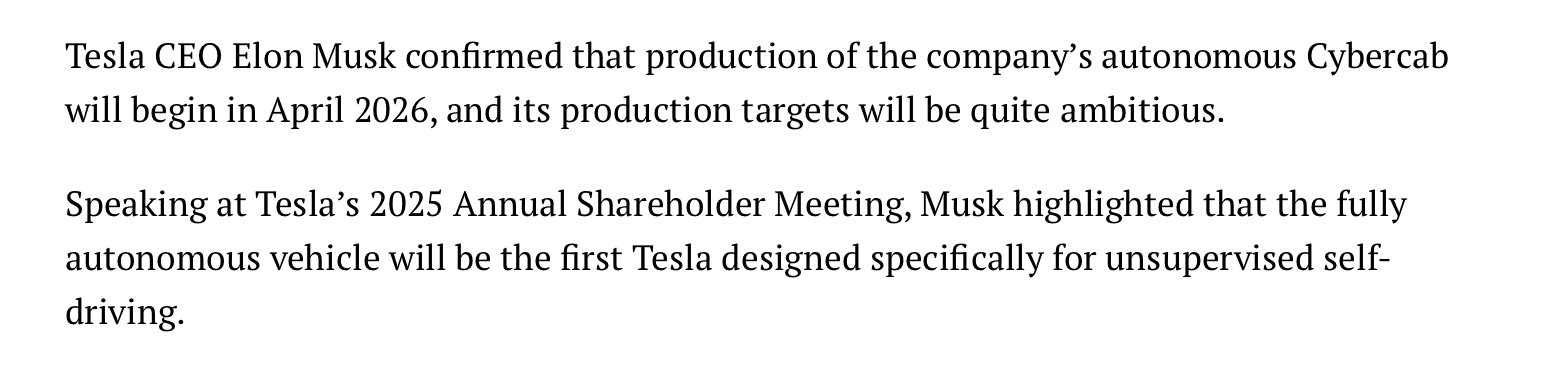
Last year, Musk gave investors advance information that Cybercab production would start in just a few months. Is the CEO once again telling a “modified truth”? 
15 Likes
Regarding this, we’ve seen video/images of the Cybercab production line testing, so in that respect, the timeline sounds realistic. It is a different matter when these will actually be allowed on the road and under what conditions. And that quote doesn’t really take a stance on that. They can certainly churn these out of the factory into inventory for a while if the software and/or regulatory approvals are still pending.
2 Likes
China is going its own way in everything else, too. Cities are already under surveillance.
3 Likes
This is an interesting question. Tesla has now introduced new Standard models, whose range relative to price is very competitive. In Europe and the US, there aren’t really other cars with over 500km WLTP range whose price is close to €42k (cf. corresponding US price). EVs in the same price range fall 100km short, and that’s why competition in the US is mainly with internal combustion engine (ICE) vehicles. In China, competition is fierce, which is why FSD approval would be important for Tesla. Chinese consumers value autonomy when purchasing a car, as the McKinsey study showed (link earlier).
By the way, lithium battery prices are still on a downward trend. The drop in prices depends a lot on what contracts and price mechanisms have been established. At the end of July, Tesla last bought $4.3 billion worth of battery cells from LG under a long-term contract, at a time when at least the spot price for lithium derivatives was low. The price war is far from over; Hyundai has cut EV prices in the US several times at the end of last year and early this year, by a total of nearly 20%, with leasing prices under $200/month.
Considering the expansions of Giga Berlin and other factories, I personally predict 1.7 million in sales for this year. As a numerical comparison, EVs account for only 11% of VW’s deliveries (and probably half of that in terms of profit — ICEs drive the numbers), while Tesla’s energy business accounts for 23% of its profit. In the future, the share of car sales in profit will decrease even further.
2 Likes
Could you provide a link to this incident? I don’t recall hearing about this, it would be interesting to read more.
1 Like
Apparently, it was unclear here whether a teleoperator was driving or if there was a safety driver at the controls.
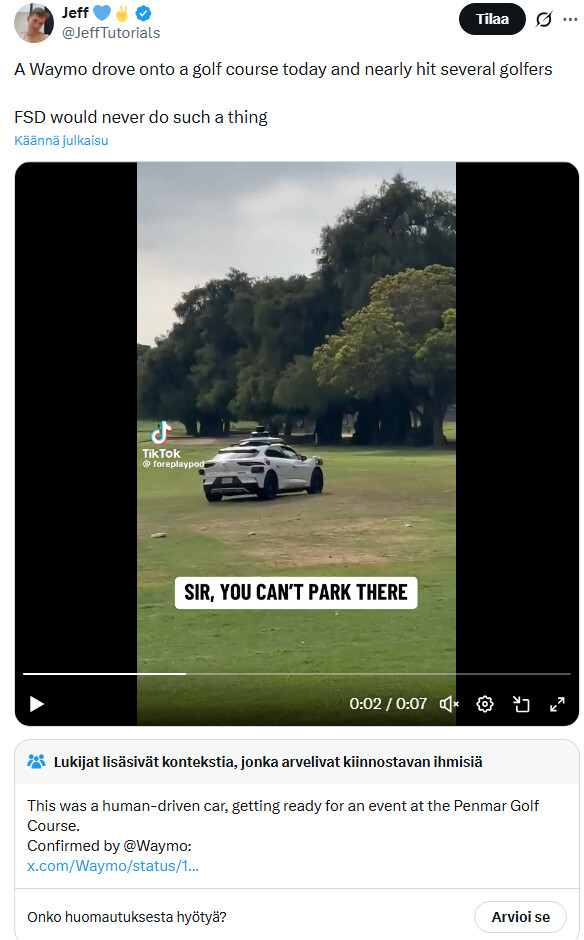
There’s nothing unclear about it, and since you linked that tweet, you surely saw the community note explaining what actually happened. It’s a bit tiresome when misinformation is spread intentionally.
Waymo
(https://x.com/Waymo)
Hey there, this was a human-driven car, getting ready for an event at the Penmar Golf Course.
In Finland, the Standard Model 3 is just under €38k; in the same price range and with over 500km WLTP, there are plenty of options, e.g., Ioniq 3, Kia EV3, Cupra Born, ID.3, the new Leaf, Scenic, Elroq, etc.
15 Likes
It’s good that you are paying attention to the details – I should have specified the Model Y segment, which I see as more important for sales.
So, if you meant that the Model 3 Standard will not significantly grow sales in Europe specifically, I agree with you. On the other hand, I see that the Model Y will grow sales this year, including in Europe, but especially in RoW (Rest of World) countries like South Korea. It remains to be seen whether the Model Y L, which is popular in China, will be coming elsewhere. Cheap RWD models are well-received by a large part of the world.
Well, the Model Y Standard is about €42k, and in the same price range, you can find at least the Enyaq, EV6, and Ioniq 5, all of which have over 500km WLTP and are in roughly the same price bracket.
Depending on how you want to interpret “comparables,” the Scenic and Peugeot 3008 are in the same price range (with much better WLTP figures, of course).
I don’t see this having a very large impact, at least in Europe, and when considering Tesla’s results, the Standard likely has the lowest margin and it will certainly cannibalize sales of the more expensive models.
9 Likes
We probably have a different understanding of market prices right now—either you get 430km for a bit more or over 500km for much more. Additionally, Tesla has a new model, the Standard RWD LR, which is priced at €49k and has a range of 657km. Well, the sales statistics will then show what sells best.
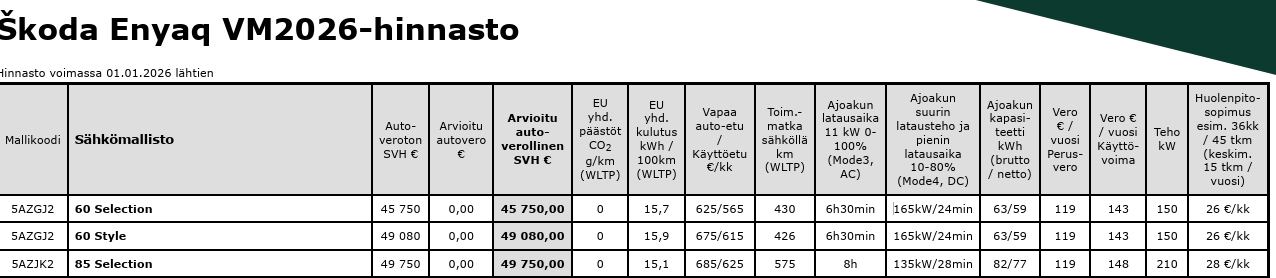

I couldn’t even find the price for the rear-wheel-drive Ioniq 5—the price list only includes all-wheel-drive versions at a higher price.
6 Likes
A quick check of the price facts reveals that this isn’t true either. In the entry-level price range of €37k, all of the aforementioned fall 100km or more short of the Model 3’s WLTP, which is 534km. For example, the Kia EV3

The Standard model hasn’t had much time to be delivered yet, so we’ll see in the future how it fares against, for example, the Elroq in Europe. A sedan is a somewhat old-fashioned model to compete with small SUVs, especially since range isn’t significant in European city driving. On the other hand, there isn’t much faith in the Elroq if it is never exported outside of Europe to compete, for example, with the Model 3.
The sales of the Model Y are more interesting. Incidentally, it’s interesting that there seem to be more and more market-specific versions of the Model Y. In the States and Europe, there is the Model Y Standard LR (the battery seems interesting) – now new as a 7-seater version. In China, there’s the Model Y L. It remains to be seen whether all versions will come to all markets. It certainly doesn’t look like development is stopping; instead, the car model is being developed and efforts are being made to optimize it for different markets. Now in the States, there are rumors that consumers are coming to stores specifically for FSD, just as autonomy has already been on the shopping list in China.
Those examples were requested from Grok; I didn’t check anything other than Tesla’s updated prices. And the prices were requested “in Europe”; they of course vary somewhat by country.
In any case, alternatives certainly exist, and when talking about Tesla’s results, that Standard model likely cannibalizes quite a lot of the sales of the higher-margin LR and AWD models.
1 Like
A good example of what AI shouldn’t be used for, at least not without checking the sources. Prices are easy to find directly from the sources. Gemini gave a long explanation that the $7,500 EV subsidies in the US should be taken into account when buying. AI or not, the situation is no different elsewhere in Europe; Tesla is clearly the cheapest car with over 500km WLTP range.
This repeated cannibalization theory and the margin percentages of individual models would require evidence to support them. Could you provide links stating that Tesla only competes with its own models and that better range is not a competitive purchase criterion compared to other cars in the same price range? Tesla has had various interest rate and other campaigns for the more expensive AWD models, so interpreting margin percentages could be interesting. Now that FSD bundle sales are being discontinued in the US, the monthly price of the FSD option will surely be pushed to Standard buyers as well. After all, this conversation started from sales volumes.
4 Likes