In the Hyzon thread, there’s quite a lot of BEV vs FCEV etc. discussion, which is, of course, relevant to Hyzon investors, but it’s also relevant to those investing in other companies producing transport solutions. In addition, sometimes the discussion expands to transport solutions that are not in the focus of the company in question. So I thought I’d create a new thread for discussions about transport powertrain solutions.
Tesla’s “Megacharger”, which promises to provide the Semi with up to 400 miles of charge in just 30 minutes . That’s more than enough time for a trucker to go into the truck stop, have a shower, grab a coffee and some road snacks, and get back on the road.
Now this sounds exciting, but it’s not surprising that this king of charging uses a lot of power. Tesla claims that the new Megacharger will have a charging output of “more than ten times the power levels” of its Superchargers. Those put out approximately 120 kilowatt-hours of energy, which means that the Megacharger could put out close to 1.5 MWh at peak load.
In other words, in the time span of the truck driver’s lunch break, the Tesla Semi will consume about as much electricity as the average North American home does in one month . That’s one truck, with one trailer, in one half of an hour.
This seems like a pretty heavy load on the grid during peak hours. One Megacharger might still be reasonably affordable, but what about when the power grid for a gas station needs to be upgraded? We’ll certainly see various station-specific battery solutions to handle peak congestion, but that, in turn, increases the cost of the charging infrastructure.
Was the purpose of this thread to discuss investment opportunities or technology in general?
Can you provide examples of companies and solutions that focus on this segment?
Here, I would focus not only on technical comparisons, but also on discussing the (political) atmosphere and (public) investments directed at different technologies. One can always mention relevant companies or funds, but I would downplay investment analyses between them.
I see that the development of powertrain solutions for transportation now concerns at least all manufacturers and operators of vehicles and refueling infrastructure. Both new and old. Hyzon, Everfuel, Volvo, Tesla, Nio, Hyundai, Toyota, Nobina…
Let’s bring up supercapacitors, which were also reported in Helsingin Sanomat last week.
The core idea:
“A completely new business is emerging alongside the battery industry. Supercapacitors can offer up to a hundred times more power compared to batteries, and they can be charged in just minutes.”
The downside is that they can only store about 1/10 of the energy that batteries can. Therefore, supercapacitors are used and will be used in conjunction with traditional batteries. Batteries provide range, and supercapacitors provide power peaks.
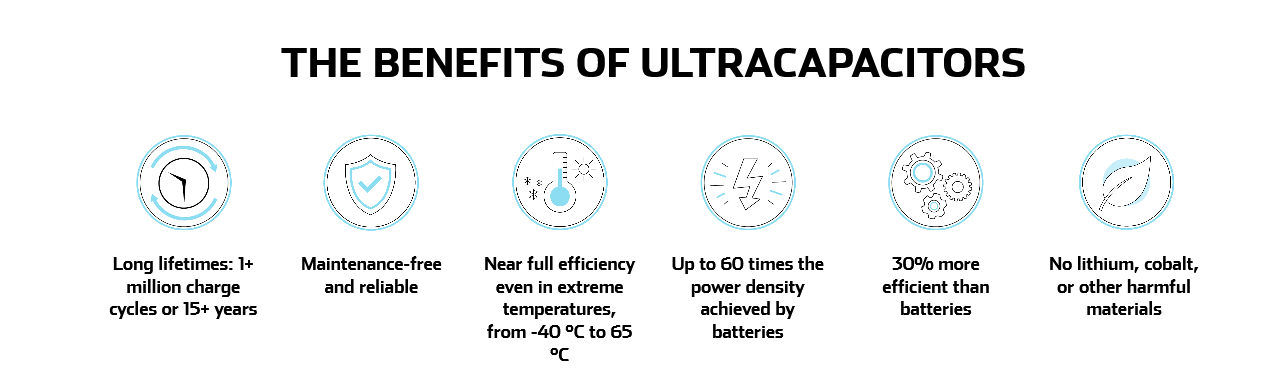
Supercapacitors also do not require rare and expensive rare earth metals; instead, their raw materials include, for example, nanocellulose and activated carbon. An opportunity for our domestic forest giants? Supercapacitors also last long.
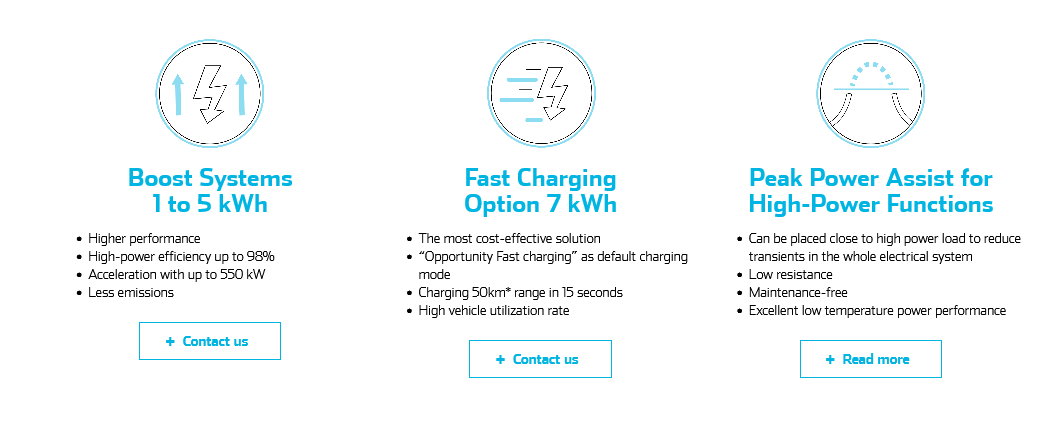
In certain applications, supercapacitors are completely superior to traditional batteries. For example, an electric bus can charge its supercapacitor at every stop in tens of seconds.
A key difference compared to batteries is that the charge can be discharged and recharged very quickly. In practice, this means that a supercapacitor can provide a lot of power when needed.
A couple of years ago, Tesla bought Maxwell Technologies, which manufactured supercapacitors, but sold it this year. Perhaps Musk or Tesla didn’t see potential in it, or something similar? Or did they get the patents they needed? I recall Musk was at least interested in these at one point, but perhaps that interest has faded.
Skeleton Technologies - Estonian Supercapacitor Company
It’s not listed on the stock exchange yet, but it definitely seems like a company worth following. I’ve come across this name a few times, but only now have I delved deeper into it.
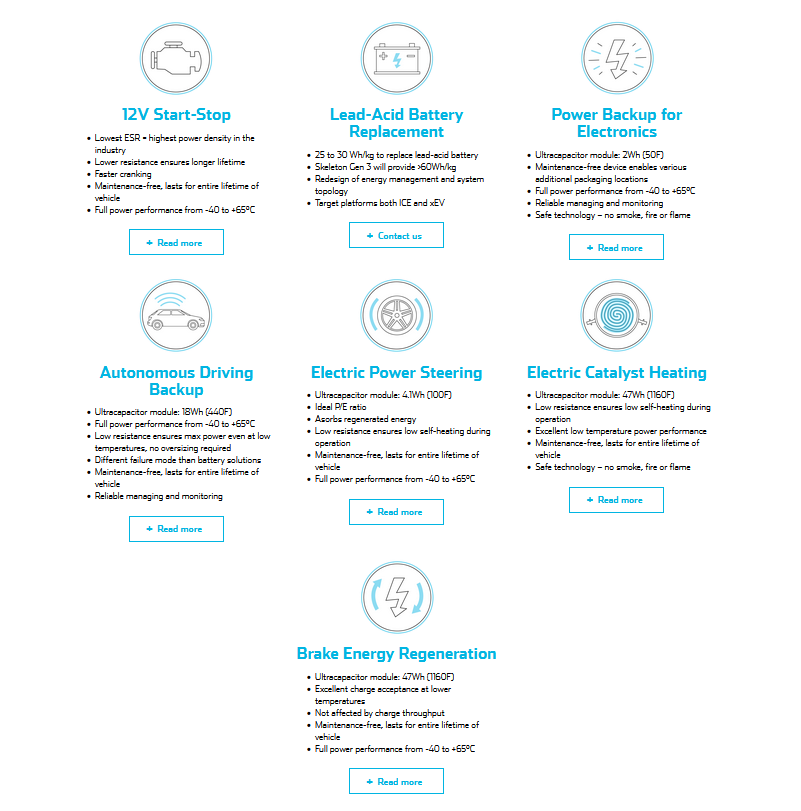
It really feels like supercapacitors would be ideal battery replacements in hydrogen powertrains, where the need is precisely for buffering rather than long-term storage of a large amount of energy.
It does away with the lithium-ion batteries you find in most electric cars available today, instead swapping them out for a hydrogen tank and super capacitors which not only weigh less, but can operate more efficiently at extreme temperatures and - Hyperion claims - the system is safer than lithium-ion counterparts.
The car has pretty good specs and its performance characteristics are better than the F150 Lightning.
A large Li-ion battery + a modern fuel cell certainly enable a pretty good peak power for a relatively long time. Of course, it increases costs and weight. Especially costs are a big challenge for EV motoring.
Can anyone say how supercapacitors currently compare to batteries in terms of price, in real-world terms?
The technical challenge with capacitors, unlike batteries, is that their terminal voltage is directly proportional to their charge. I’m not an expert on electric cars, but in almost all electronics, the voltage of the power supply is desired and assumed to remain constant. When a capacitor’s charge halves, its terminal voltage also halves. This can, of course, be compensated for with switching technology, but power electronics for such high currents are likely very prone to failure and expensive.
Of course, a capacitor can be connected in parallel with a battery, allowing a large momentary power output, but in that case, only a small portion of the supercapacitor’s charge capacity is utilized—the portion that the battery’s terminal voltage changes “give way to.”
In Finland, I could see this as a potential solution, for example, in the Helsinki metropolitan area for both trucks and buses, but you don’t have to go very far from the Helsinki metropolitan area before you’re driving on a pretty narrow forest road for 200km in the middle of nowhere. I doubt that, for example, the stretch between Lahti and Jyväskylä will be wired.
Yes, you are absolutely right; in a small country like Finland, it won’t grow into a big deal. But for example, in the United States or Germany, electrifying routes between large cities in that manner seems like a perfectly plausible solution.
On a global scale, these types of transports constitute the majority.
Yes, there are certainly gaps where this would be the most cost-effective solution. Perhaps in Finland, Turku-Helsinki-Lahti could be one such area. The only thing is, if this rolling stock were only slightly cheaper than hydrogen or full-battery rolling stock, and their infrastructure has to be built anyway because not everything can be handled with catenary-free vehicles, then is it worth installing catenary anywhere?
Indeed, this could be seen either as an accessory for a BEV (Battery Electric Vehicle) or as a setup where the lead car only has a small battery that allows for, say, 50 km of driving without cables. One could imagine that such a charging device would be significantly cheaper than, for example, 400 km of battery capacity. For BEVs, this would indeed reduce the waiting time for charging on suitable routes.
True, I had to watch a video to see what’s going on:
From 5 minutes onwards, it starts to get interesting.
In aviation, weight really matters; the question specifically for Hexagon Purus in the Zero Avia webinar was answered something like, “if necessary, a ‘square’ tank can be made, but a ‘bottle’-shaped one is lighter, and weight is crucial.”
Edit: This new thread is great; it gets pretty intense trying to follow the HYZON thread.
Edit:
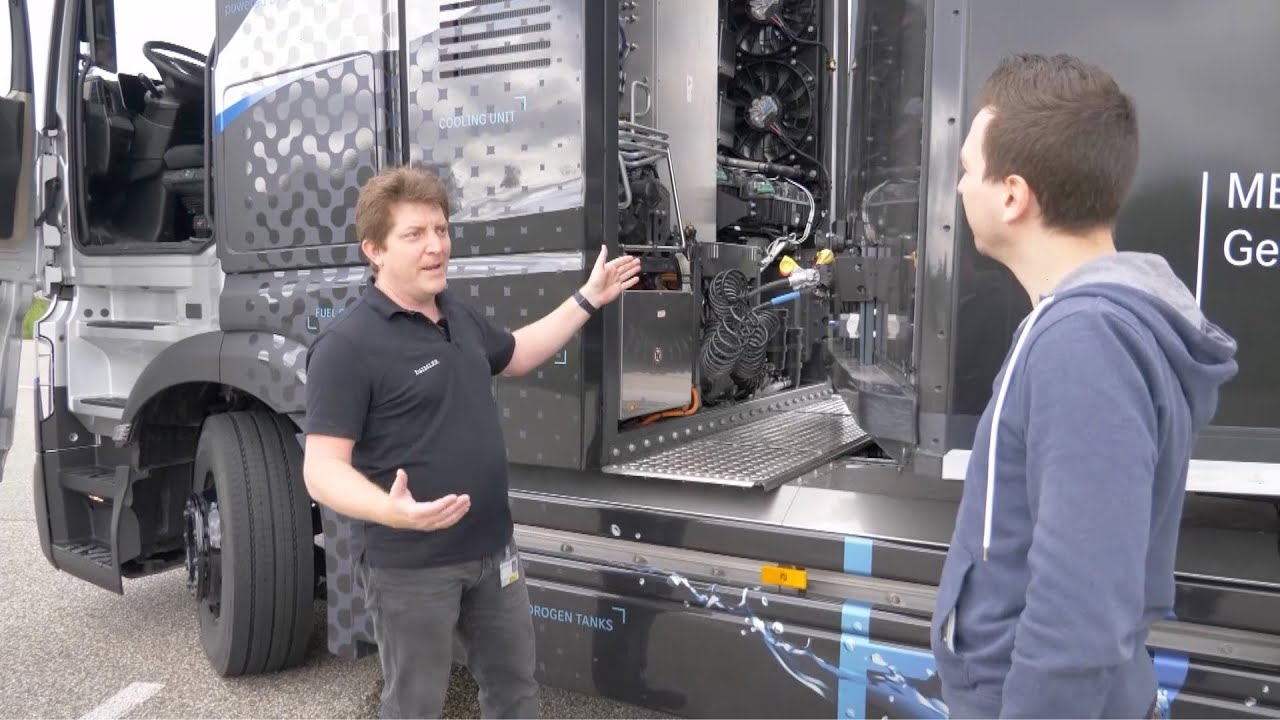
I just watched a couple of videos about Daimler.
Let’s make a quick segue to trucks
Daimler’s cells 2x 150kw = 300kw.
The video talks about maximum power.
Tests are the same as for Actros, meaning 25,000 hours and 1.2 million kilometers of driving.
2021 road tests, 2023 customer testing, and 2027 sales launch.
Wrong day to be working long hours. There’s been all sorts of good information and discussion, and I’ve only been able to glance at it. @uhrilahja, you really delve into the cell values reported by different manufacturers. It’s a real minefield because each manufacturer reports favorable values from their own perspective, and there aren’t yet standardized ways of reporting.
Was it that Hyzon reported only the cell values, but Hypoint reported the entire system?
Discussion about the rising price of batteries. The competitiveness of cars with small batteries is improving. Suddenly, Toyota starts looking like a pretty smart company because it has many different powertrains that work with a small (1.5-10 kWh) battery. Hydrogen vehicles, of course, as the spearhead of the future, both internal combustion and fuel cell. Who would have thought
To be honest, that battery price increase was a known problem in advance, but some car manufacturers didn’t care about the risks. Volkswagen, at least, might have problems ahead…
Here’s more news from the powertrain side. The result of cooperation between Toyota and Chinese operators and intended for heavy vehicles. A few interesting sentences:
“The “TL Power 100” is built on Toyota’s second-generation MIRAI fuel cell system and some of its parts are locally sourced in China. Through the local R&D in China that highlights domestic application scenarios for CVs, the new fuel cell system reaches a high power density of up to 711W/kg or 4.9kW/L (rated at 101kW), and a ultra-long lifespan of 30,000 hours.”
That was the conclusion reached from that. At least the cooling systems have been left out of the calculations.
I can’t say for Hyzon what all has been included in the tests.
It was mentioned above that it seems they are not yet ready for production.
Mea explained the operation of that cell well, it has a higher operating temperature, so more is required from the plates and the cell. When studying these, the automotive side uses operating temperatures of 60-90 degrees, and this would be something like 70-160 degrees.
Let’s monitor the situation, at least Hyzon has done its part now.
Yesterday I was still looking at Hyundai’s cells and truck:
X-cient Max. power 180kW (90kW stack X 2)
So two Hyundai Nexon cells in series
Max power 350kw electric motor/battery + cell.
So from this, one can deduce that manufacturers combine cells with each other, excluding HYZON as far as I understand, they only have one cell per car?
Edit: 30,000h is already enough for a lot… Manufacturers seem to have a rule of thumb of 25,000 hours.
That Gen2 Mirai cell is already good!