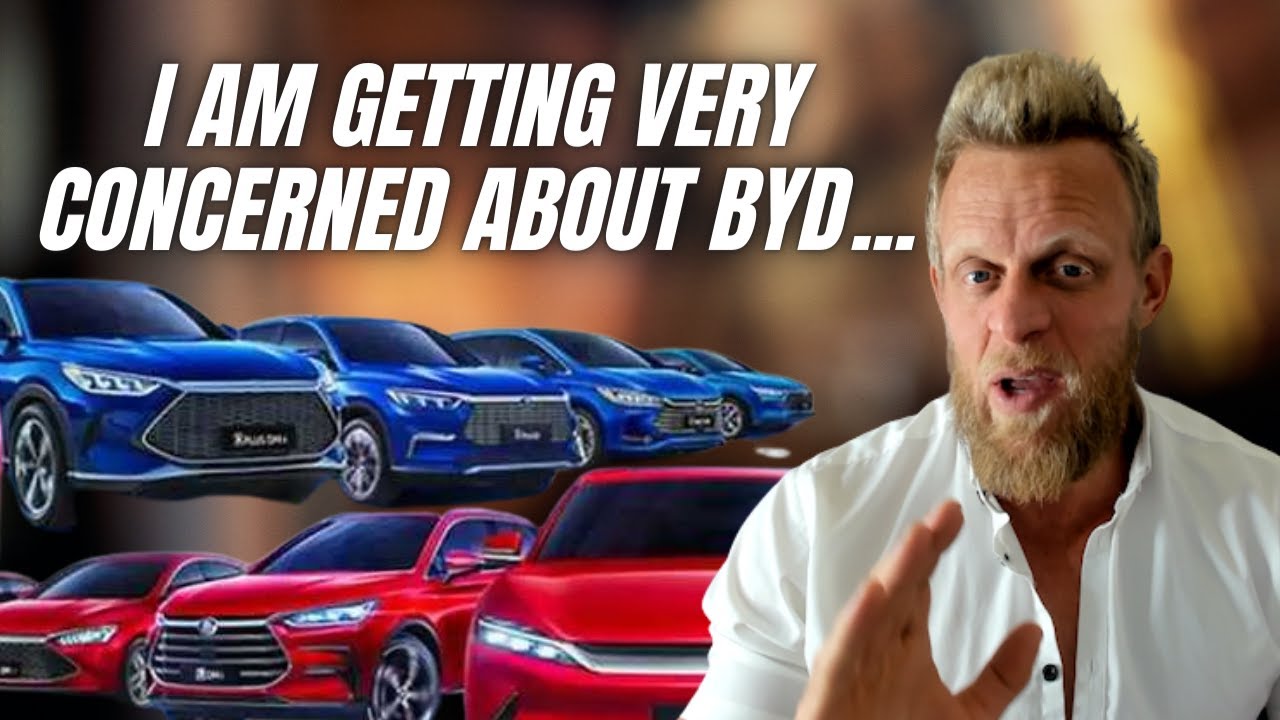
BYD’s latest electric car models are now truly starting to arrive in Finland, and at this stage, this perhaps strongest challenger to Tesla already deserves its own thread. Next, I’m eagerly awaiting to see when Tesla Model 3’s toughest competitor, BYD Seal, will start sales in Finland.
Competition is intensifying in the Chinese market, and at this point, many local manufacturers have the interest, resources, and capacity to accelerate export sales. Time will tell if a winning global duopoly led by Tesla and BYD will form in the electric car market. On the other hand, competitors also cooperate with each other, with Tesla using BYD’s batteries. In any case, this world’s second-largest electric car manufacturer will certainly carve out its own space in the Finnish market and bring offerings to new market segments, especially in the small and medium-sized car categories. We are living in interesting times in the electric car market!
As a continuation of the introduction, here are the reasons why BYD is in a league of its own compared to other Tesla challengers. In April, BYD sold a whopping 104,346 electric vehicles, representing a year-over-year growth of a full 82%. The vast majority of sales still take place in China, but the export strategy is aggressive, fueled by intense domestic competition, where BYD recently lowered the price of the Seal model, at least. BYD’s EV exports appear to be driven particularly by the Ocean series, in which the BYD Seal serves as a direct competitor to Tesla’s Model 3. The BYD Dolphin and BYD Atto 3 are smaller models that will compete with vehicles like the VW ID.3.
The vertically integrated BYD is now targeting export markets with a fresh lineup; as a side note, they are also investing in the Australian market and even in tiny Costa Rica, which could serve as a springboard for the Latin American market in the future. They are clearly playing the long game. It will be interesting to see how competitors (especially VAG and Stellantis) respond to BYD’s moves—whether they will protect their margins and lose market share to competitors, or launch a counter-attack by cutting margins.
In China, the price war in the electric vehicle market is now a reality once and for all. BYD lowered the price of the Seal and intends to at least hold onto its market share; more likely, the goal is to push out the Seal and the entire Ocean series as much as factory capacity allows. At the same time, the breakthrough of electric cars in the Chinese market puts traditional car manufacturers in a difficult position, and the sales statistics for the current quarter in China will be exceptionally interesting. BYD’s profitability is at such a level that they are capable of aggressive pricing and can challenge even Tesla’s leadership in the EV market, and not just in China.
Many years of visionary development work are now being rewarded, and BYD’s journey toward becoming a global automotive giant is only at its beginning. In the short term, margins will suffer as a result of the price war, and Q2/2023 may not necessarily be pretty reading, but in the long game, BYD has all the tools for worldwide success. We are truly living in historic times, and the price war in the EV market will inevitably impact the sales of internal combustion engine vehicles once a kind of “parity” is achieved between these powertrains. In these times, the management of many traditional automakers is facing a very serious, if not existential, crisis.
New figures from China regarding May. BYD delivered 119,603 electric vehicles, a year-on-year growth of 124%, and with these figures, they secure a clear pole position in the Chinese market. The gap to Tesla is large; Model 3 and Model Y deliveries in China during the corresponding period were approximately 75,000 units. Now, of course, it would be interesting to know what this strong growth has done to BYD’s profitability, as the fierce battle for market share is eating into margins in some places, and for some manufacturers, this could even become an issue threatening business continuity. Regardless, this is once again a very strong performance from BYD.
This is an important point. Personally, my finger has been close to the buy button a few times regarding BYD, but for ethical reasons (e.g., the oppression of Uyghurs, indirect support for Russia, the suppression of Hong Kong’s autonomy, etc.), I have refrained from buying. Furthermore, the political risk in China is of such a level that no matter how profitable the company may be, a Chinese invasion of Taiwan, for example, would be a catastrophe for this investment.
Here, Iltalehti has had the chance to test the BYD Dolphin, and the journalist was full of praise. The pricing looks attractive, and now it will be interesting to see how BYD manages to deliver the cars if orders start pouring in.
Alright, we now have the Q2 figures from the Chinese market. BYD is number one in all-electric vehicles, with 352,163 battery electric vehicles delivered in the second quarter. It will be revealed later how the deliveries were distributed by model. In any case, this is nearly double the figures from a year ago, and in this surge, competitors are clearly falling behind.
In contrast, in the European electric vehicle market, BYD is still very much at the starting blocks. The only country I found where anything noteworthy happened in Q2 was Sweden, where the market share was 1.7% and 523 cars were delivered. Of course, situations can change quickly and Q3 might already look completely different. One can only guess the reason for this slow start; perhaps it’s due to the somewhat high price point of BYD’s model range compared to its competitors.
China is coming on strong, with BYD being just one brand. Zeekr will certainly gain market share, along with SAIC’s brands, etc. SAIC is indeed in “cooperation” with VW, and Zeekr is part of Geely Holding, which also includes Polestar and Volvo.
Well, before getting too excited, a few facts. China’s own car sales are stalling due to the country’s economic situation. China itself admitted last week that the country’s economy has drifted into a state of deflation. In a large country, the scale of problems is always massive. China’s automotive industry is, either directly or indirectly, tightly tied to the Communist Party line (BYD CEO Wang Chuanfu is a member of the Central Committee of the Communist Party of China, which is not exactly an insignificant post). The Chinese state finances the automotive industry’s operations in Europe, just as it financed, for example, the purchase of Volvo from Ford. This is linked to the goal set by the country’s leader Xi Jinping in 2014 for China to be the leading automotive nation in Europe by 2025, while simultaneously aiming to bind Western countries to the Chinese supply chain, for example, regarding the battery industry. The influx of cars into Europe is also part of China’s larger so-called “Iron Belt” project in Europe. British newspapers, at least the Mail and the Telegraph, reported that the British security service had found an extra SIM card “hidden in the structure” plus something else in a Chinese-made car purchased for the British government’s use. The brand was not named, but the assumption is that the car was a Volvo S90. The car had been used to transport ministers and diplomats. The British security service is just as transparent as our own. You can’t pry information out of them even with pliers. The fact that China uses consumer products for spying is nothing new. After all, Chinese phones send data to third-party servers (Baidu, China Mobile, and China Unicom), including phone contacts, information on calls made and received, which apps were used and for how long, etc. Apparently, this massive amount of data is then screened by computers according to certain rules. Most recently, these were studied by a team from the University of Edinburgh.
We have experience from very recent history of how unpredictable a dictatorial leader + Communist Party can be when they gain power. But apparently, people aren’t interested, or memories are particularly short.
I don’t favor Chinese products myself. In the auto business, it’s always worth remembering that when their domestic market is around 20+ million units annually plus the rest of the world, they are a major player. Especially since no outsider can influence their state-led subsidy policies.
China’s problem is also that production is being moved out of the country. Apple announced it is moving production out of China at an annual rate of 30%, which also covers chip production needs. Apple is shifting production to Vietnam, India, and Indonesia. Apple has also announced that from the start of 2023, for example, all MacBooks will be made in Vietnam, and microchips will no longer be sourced from China. Google has moved the production of its new Pixel 7 phones entirely to Vietnam. The Japanese government banned Japanese firms like Panasonic, Toshiba, etc., from selling equipment and technology needed for making new chips to China. And US sanctions are already harsh as they are.
Apple leaving China is a big deal because Apple is a significant employer even by Chinese standards. Exports to Russia compensate for some of it, and because of that, this influx of brands into Europe has happened somewhat out of necessity. Europe is the easiest target. China’s dictatorship stays in power only by promising better conditions and a stronger economy to the people. What if this doesn’t materialize?
Indeed, it sometimes feels like these realities are forgotten here in Finland, Germany, and Europe. It was quite a surprise that even Terrafame has tied itself so closely to China that it ended up posting a massive loss. These lessons from oil and gas don’t seem to be sinking in.
This is true, of course, but on the other hand, China is at the world’s top in battery development. In the sodium sector, CATL is likely number one, but BYD is right behind them. I don’t know, however, how well BYD’s joint venture is faring in this race. Battery technology is currently advancing in giant leaps, and China will likely be the leader (or at least at the forefront) in this field for a long time to come. The climate will be grateful.
Indeed, when it comes to second-generation batteries—the solid-state batteries of the future—Japan firmly holds the lead. Toyota is the only one that has managed to implement second-generation batteries in practice, using them in the Japanese Endurance racing series. Major Japanese corporations such as Panasonic, Fujitsu, Mitsubishi, Toyota, etc., are investing in solid-state technology and hydrogen. In Toyota’s model, hydrogen is injected directly into current internal combustion engines. It has been proven to work. Major US truck brands, Kenworth and Peterbilt, have announced that they will bring lineups equipped with Toyota technology to market during the coming year.
Now you can actually go and see and test drive these cars at Autokeskus Vantaanportti. I went to have a look today… starting from €45k+. It wasn’t crowded.