This is a result of the end of US subsidy decisions in Q3. Tesla still got a nice boost to October’s figures as some orders were delivered only in October, but a “cold” November was fully expected.
Q1/26 is likely the first “normal” month in a while, meaning this quarter will still be digesting the Q3 demand pull-forward.
Why don’t I believe Tesla can achieve L4 with a vision-only solution?
The Tesla FSD tracker shows 99.4%. In other words, after 6 years, they are still far from the goal. Why are others already operating at L4 level? I can’t think of any other difference than the sensors used and geofence. In other words, L4 as a purely vision-only, no geofence solution is an order of magnitude more difficult.
Tesla’s strategy is to market FSD practically as L4, but Tesla leaves the liability for errors to the driver. Tesla has not even started the L4 regulatory approval processes, nor does it seem to have any intention of doing so.
Even on this forum, the debate about FSD’s SAE classification is ongoing. Some believe FSD is already L4.
The wipers have definitely improved. However, phantom braking is indeed a nasty problem, especially on winding roads. This is a big question for me personally, looking ahead. Otherwise, the Tesla is an absolutely brilliant car, no two ways about it.
Three things are needed to be successful in developing autonomous vehicle capabilities - data (fleet/mileage), compute, and algorithms (AI model).
If these were the critical success factors, then I think it would be a bad thing for Tesla. I don’t see how one could argue that Tesla dominates Waymo in these areas. Maybe still in theory regarding data, but certainly not in compute or algorithms.
SpaceX is rumored to be going public in the summer of 2026. Musk has previously talked about how Tesla investors, for example, should be favored in such a situation:
These could, of course, just be more of Musk’s typical ramblings, but Pershing Square hedge fund manager Bill Ackman made an interesting proposal on the subject:
X user Publius translated the proposal into plain language:
Ackman is proposing a clever way for SpaceX (currently private) to go public by merging with his special investment vehicle called SPARC (a improved version of a SPAC, but without many of the usual downsides).
Here’s how it would work in simple terms:
Free “rights” for Tesla shareholders:
Every Tesla shareholder would get free SPARs (special rights) based on how many Tesla shares they own, about 0.5 SPARs per Tesla share.
These SPARs give them the option to buy SpaceX shares at a fixed price when it goes public.
You choose what to do:
Use your SPARs to buy SpaceX stock at the pre-set IPO price (getting in at the ground floor).
Or sell the SPARs to someone else for cash if you don’t want SpaceX shares.
This rewards long-time Tesla investors by giving them priority access to SpaceX shares, instead of letting big Wall Street firms grab most of them in a normal IPO.
No big fees or extras that hurt shareholders:
Unlike a traditional IPO (where banks take huge fees) or old-style SPACs (with dilutive warrants), this has zero underwriting costs, no extra cheap shares for insiders, and SpaceX ends up with a clean, simple stock structure.
Guaranteed money raised: Ackman’s firm commits $4 billion of its own money at the same price.
The total amount SpaceX raises (from $42 billion to $149 billion) depends on the fixed price they set for the SPARs, they can adjust it to fit how much cash SpaceX needs.
Bonus perk: If you buy SpaceX shares this way, you also get rights for a future IPO of xAI (Elon Musk’s AI company).
Fast and certain: They could review everything and sign a deal in about 45 days, announcing by mid-February 2026.
Once signed, it’s locked in — no backing out if the market dips.
In short, it’s a shareholder-friendly, low-cost, efficient way to take SpaceX public that prioritizes Tesla owners, skips Wall Street middlemen fees, and gives SpaceX a ton of flexible funding for big goals like Mars missions.
What is the downside here, @elonmusk?
Tell me, the SPAC guys and gals of this forum, does this make any sense?
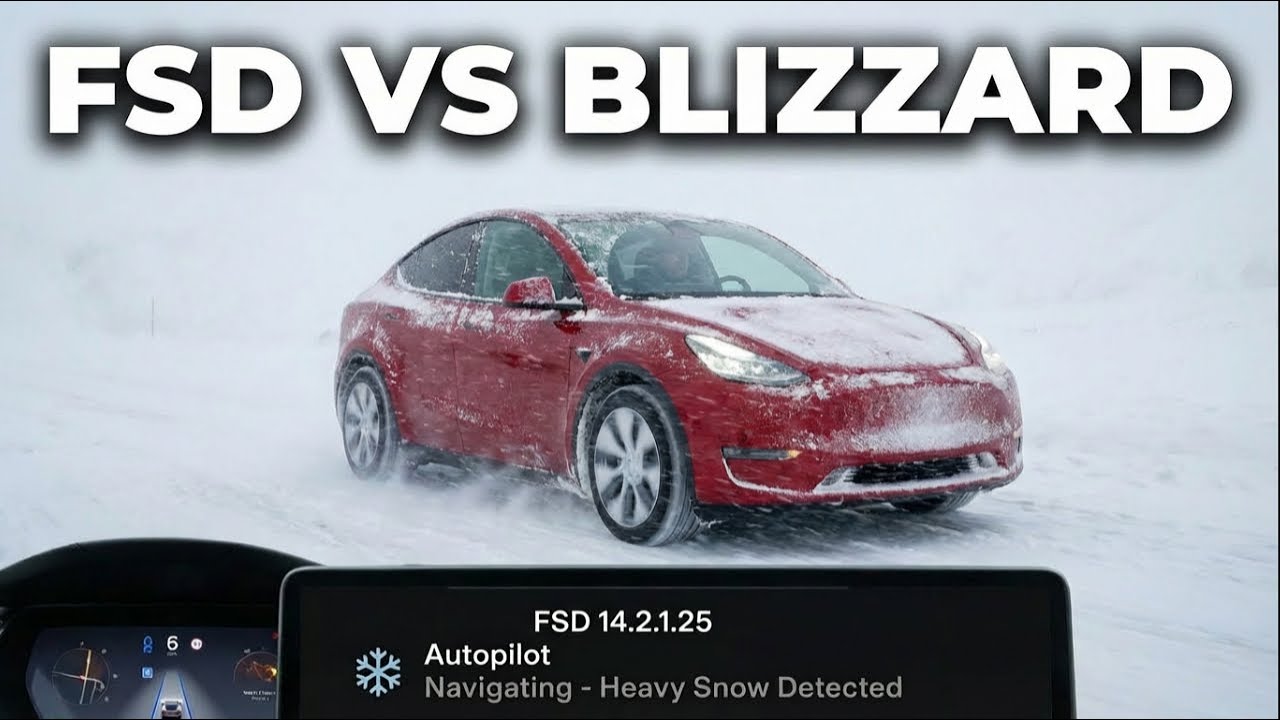
Since you completely ignored my request, let’s put one case here as an example. In Canada, FSD was put to a winter test, with Mad Max mode on just in case:
There are some difficulties, and it may be that those conditions still require a few more iteration cycles in terms of both hardware and software. It would be interesting to see Waymo in the same situations.
There’s still that same problem here: last time it was “this year,” and now it’s “in 3 months.”
There were a couple of videos above; the performance wasn’t very convincing, and it wasn’t even bad weather yet.
And yes, I have played around with Tesla with a normal middle-income annual salary. As mentioned, I don’t believe anything proper will come out of this autonomous driving. But that doesn’t change the fact that you can make money with this.
I strongly believe that on some level, in some area, the robotaxi will arrive, and the share price will rise. Then there will be problems that get massive news coverage. And then we go down. And hard.
I believe that in 3 months, the robotaxi will have been launched. Just as individual cars and in very small, restricted areas.
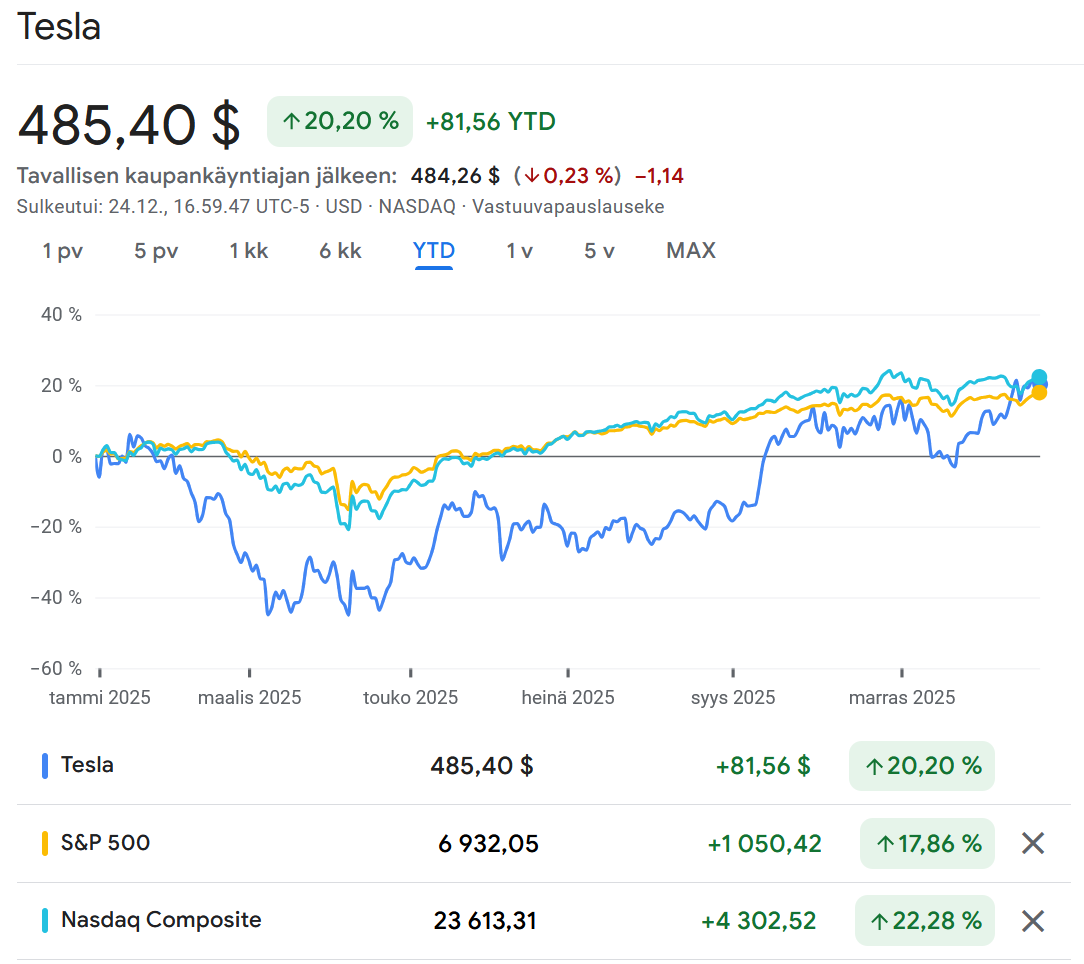
A few trading days are still left, but at the moment it looks like Tesla is roughly keeping pace with the indices for this year. A significant gap was closed during the year, given that at its worst in the spring, it was down -45% YTD and some quite dire scenarios were being painted here on the forum. I recommend every Tesla investor take a moment to go back and read those messages from March and April and reflect a bit, now that we know they were actually the best buying opportunities of the year.
Here is one example of a message from that time that captures the sentiment perfectly:
Just for fun, let’s see what the outlook is now…
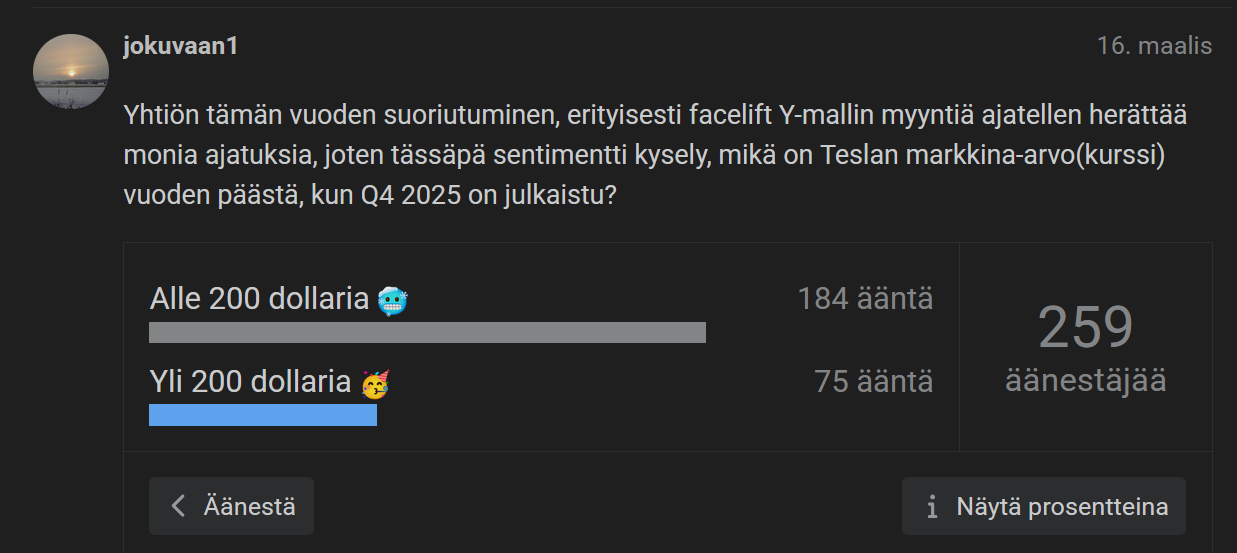
What will be Tesla’s market value (share price) once the Q4 2025 results are released?
Tesla does not have a single autonomous car on public roads in California; it hasn’t even applied for a permit for autonomous driving in California. Tesla’s operations in California are exactly the same as what Lyft, Uber, and all other taxi/ride-hail companies do there.
That’s why some power outage has no significance for Tesla’s operations, because there is a human in the driver’s seat at all times.
Hard to know what to believe, but on Reddit a few days ago, it was strongly claimed that safety drivers were operating the robotaxis during the blackout:
Officially, FSD is only L2+, and there is no sign that Tesla is removing the disclaimer regarding the driver’s responsibility to take over control of the car at any time. Tesla hasn’t even applied for a robotaxi permit in California, for instance.
On X, Musk and also Tesla’s official social media account are instead advertising FSD as if it were L3, meaning you can text while FSD handles the driving.
Quite a risk; Tesla is exposing itself to potential liability claims if and when an FSD car is involved in a crash. Misleading marketing has already been addressed in California.
If Tesla is already L4, where is the business model or the profits? At least L4 hasn’t boosted car sales.
In my view, the San Francisco power outage doesn’t tell us anything about Waymo’s or Tesla’s technical capabilities. Waymo’s blog clearly states that dark lights are interpreted “as four-way stops” and that Waymo is capable of navigating them, but not with the same certainty as traditional traffic lights. This led to an increased need for remote support, which in turn congested Waymo’s center, and the cars stopped for longer periods.
Anyone who has followed Waymo and Tesla likely agrees that Waymo has had a conservative strategy and Tesla an aggressive approach. This makes it difficult to compare their technical capabilities. As a thought experiment: if Waymo is 10× safer but requires a 15× larger safety margin than Tesla, the result could be a situation where Waymos stop and Teslas keep going, even though Waymo’s performance is better.
Additionally, Tesla still has it clearly easier because it has safety drivers to intervene if things go wrong. Once safety drivers are removed, cars can no longer drive into intersections with a “Jesus take the wheel” mentality, because someone else has always had the ultimate responsibility.
One could well argue that Waymo is too conservative, and it likely was in this case. But trust can be lost very quickly and is slow to rebuild. Reducing conservativeness, on the other hand, can be a matter of a few lines of code.
A clear request has come up to focus on accurate information in this thread. It would be desirable for posters to verify the information they share whenever possible, as incorrect information has been shared here at least occasionally. It certainly helps a lot if a post includes a source and/or a link for the information, so everyone can see where the data or claim originated.
Many, or even most, might not notice if incorrect information is presented, which is why providing a link or similar reference for information/claims is important. It’s understandable that mistakes happen by accident, but from what I understand, it has occurred in this thread more than usual. I personally am not familiar with the industry or Tesla (= I don’t easily recognize incorrect claims in this thread), so the aforementioned requests would be helpful for me and likely many others as well.
Thanks in advance and have a nice, peaceful Friday, everyone!
I wonder how many times an investor can be drastically wrong about the business development of the next 5 years without being completely off-track regarding the stock? This is exactly what has happened to you, even though you’ve been boasting here and hyping up whatever Elon has felt like pitching to his followers on social media. I believe you first weighed in on the Tesla discussion when Verneri Pulkkinen brought in the consensus forecast to support the debate in October 2021. Coincidentally, roughly 5 years have passed since then. At that time, the consensus forecast for 2025 was 115.4 billion for revenue and 18.5 billion for net profit. Here is your direct quote in response to Verneri’s message:
When looking at those forecasts for the coming years, they are at way too low a level.
Later, your primary counter-arguer, Seinäkadun_Keisari, managed to squeeze out of you what kind of net profit would be needed in 2025 to justify the 900 billion market cap at that time, in your opinion. You hedged a bit with a rational argument that a single year’s result doesn’t matter, but eventually, you gave a bit of a ballpark figure of your thoughts. Here is your direct quote:
But just to have a working figure, let’s say the profit should be at least 25 billion in 2025
Also, in Traders Club episode 107, you spent a lot of time arguing for Tesla’s excellence as a car manufacturer. By the way, in the episode, you showed Gary Black’s forecasts, where the net profit for 2025 was projected to be 45 billion. That’s an interesting piece of investment psychology. A trader arguing about a car manufacturer’s production efficiency factors.
Let’s see what kind of numbers are put on the table for Q4, but this year the company’s figures regarding these are something like this according to Marketscreener:
Revenue: ~95 billion
Net profit: ~4.5 billion
Market value now: 1.6 billion
So, in the previous five-year period, you were totally wrong about Tesla’s business development, and there’s no sign of the increasing manufacturing margins or even the volumes you argued for. It illustrates quite well that currently, car manufacturing is practically no longer considered significant for Tesla’s stock price at all; instead, new plot twists have been successfully woven around the investment narrative. 5 years ago, there was at least an attempt to form a picture around the existing business—car manufacturing—to justify the high valuation of the stock.
Fortunately for you, the stock has returned somewhat more than the S&P 500 index, so the market didn’t punish you for your incorrect assessment regarding the business development. This time. You are still very certain that your future vision of Tesla’s competitiveness and business is correct, even though, to me, it seems like the AI rally and the hype from Musk & Musk’s followers have kept Tesla’s valuation high, despite business figures having chronically missed the high growth expectations required by the valuation for nearly three years now.
I suspect that on this forum and among Finns in general, there are more people long on Tesla than short, so as a neutral observer, I naturally hope you hit the mark better with your future visions than before. The market is unlikely to be forgiving again if you are just as wrong about the business development over the next 5-year period as you were during the past 5-year period.
I can already hear you asking if there is any sense in digging up your old statements. Not necessarily, unless you were still presenting yourself as a well-known investment influencer so confidently regarding your business outlooks. Quite frankly, the words you write carry more weight than the words I write, so hopefully, those reading your words realize that you haven’t exactly been an impressive forecaster of Tesla’s business development so far, even if the market hasn’t punished you for your incorrect views yet.
Happy New Year in advance to Tesla bulls, bears, and other bystanders alike.
Not pathetic, but as I said, you are an investment influencer whose words carry weight in the Finnish investment discussion. At the same time, you seem blind to the fact that you’re trying to justify the valuation of a stock detached from fundamentals using fundamentals, even though your forecasts have been further off the mark than the analysts you criticized before. What makes you so confident that this time you can assess business development better than before?
I can’t help it if you don’t understand that the forecasts and arguments you previously used to justify Tesla’s valuation—and likely based your decision to invest in the company on—went off the rails, and other factors led to Tesla performing nicely as a stock during your commentary. In the long run, it’s hardly sustainable to be as far from reality in your forecasts as you have been.
As I understand it, this has no relevance to Tesla. Qt investors are still licking their wounds after stories of an overly rosy business began to drive the company’s stock price heavily. Certainly a good example of what usually happens when a stock’s story starts driving the price and at some point the market corrects the situation. This correction hasn’t happened yet for Tesla.
That’s what’s interesting here. How long will the market forgive making investment decisions based on wrong conclusions about business development? In a sense, it would be better if you were as wrong now about the future business potential related to humanoid robots and self-driving cars as you were previously about the car business, so we could bring this saga to an end and I’d get one more lesson in market psychology. Practically, about how long the market can be irrational with a stock if the story can be kept alive.
Unlike you, I am not very convinced by these future businesses currently used to justify the stock’s valuation. All the estimates I’ve seen so far regarding their potential have looked far too optimistic, which is why I might sound like a bear. Just like those car business forecasts looked back in the day. Time will tell if the estimates I saw were too optimistic again, or if I’m just missing an angle. I give a greater-than-zero chance to the possibility that I am too pessimistic. Do you allow for the possibility that you are predicting Tesla’s future business development too optimistically this time as well? Your delivery, at least, seems very certain.
Indeed, as I wrote earlier, assuming Finns have more money tied up in the Tesla long view, I hope you are right with your rosy future images. There isn’t too much wealth in this country, so regarding a stock where I have no money tied either way, I naturally hope for what brings more wealth to this country and try to learn from them as an investor, so I have an even better chance to grow my own wealth in the future.
Great! My perspective is that in the short term, the stock price can behave completely irrationally in one direction or another. In the long run, however, the business determines the company’s valuation. With a long investment horizon, I also believe the probability of successful investing increases when you are right about the future of the business more often than wrong. I believe that this current “long-term fundamental story” must also eventually start showing up in financial statements for Tesla, or the air will be let out of the stock. Tesla has already once shown it can partially bring the story to life in financial statements when it turned the car business profitable. Along the way, however, the car business story ran wild in terms of volumes and profitability, and in that regard, the bellows effectively emptied. Fortunately, there was still the story of FSD; it has been successfully seasoned for the market with humanoid robots. At some point, there must be evidence of actual business regarding the new business areas, and that evidence must be large in volume and significantly profitable for the current valuation to be sustainable.
I see a rather significant downside risk for the stock’s valuation: even if a significant part of Tesla’s profit was derived from these new business areas, their volumes and profitability might still not please the markets. Will Musk’s imagination still suffice at that point for a new story to support the company’s price, and will the market still believe it? Hard to say.
Your investment thesis was originally based on ruler-drawn estimates of Tesla’s car sales, sales margins, and Tesla’s profitability.
All of these estimates have been completely off the mark.
The stock price has performed quite well over the past year despite your fundamental analyses being completely off; that is, the stock price has risen through aggressive multiple expansion, not through the company’s earnings growth.
Perhaps what many find puzzling is how loudly you still declare things as certainties, even though your track record regarding fundamentals is, in a word, miserable. Perhaps a touch of humility would be in order, wouldn’t it?
And as for your jab at the Inde analysts, they have the guts to admit when their estimates and analyses have failed; so far, you haven’t shown that same ability.