Spotify - Music for everyone

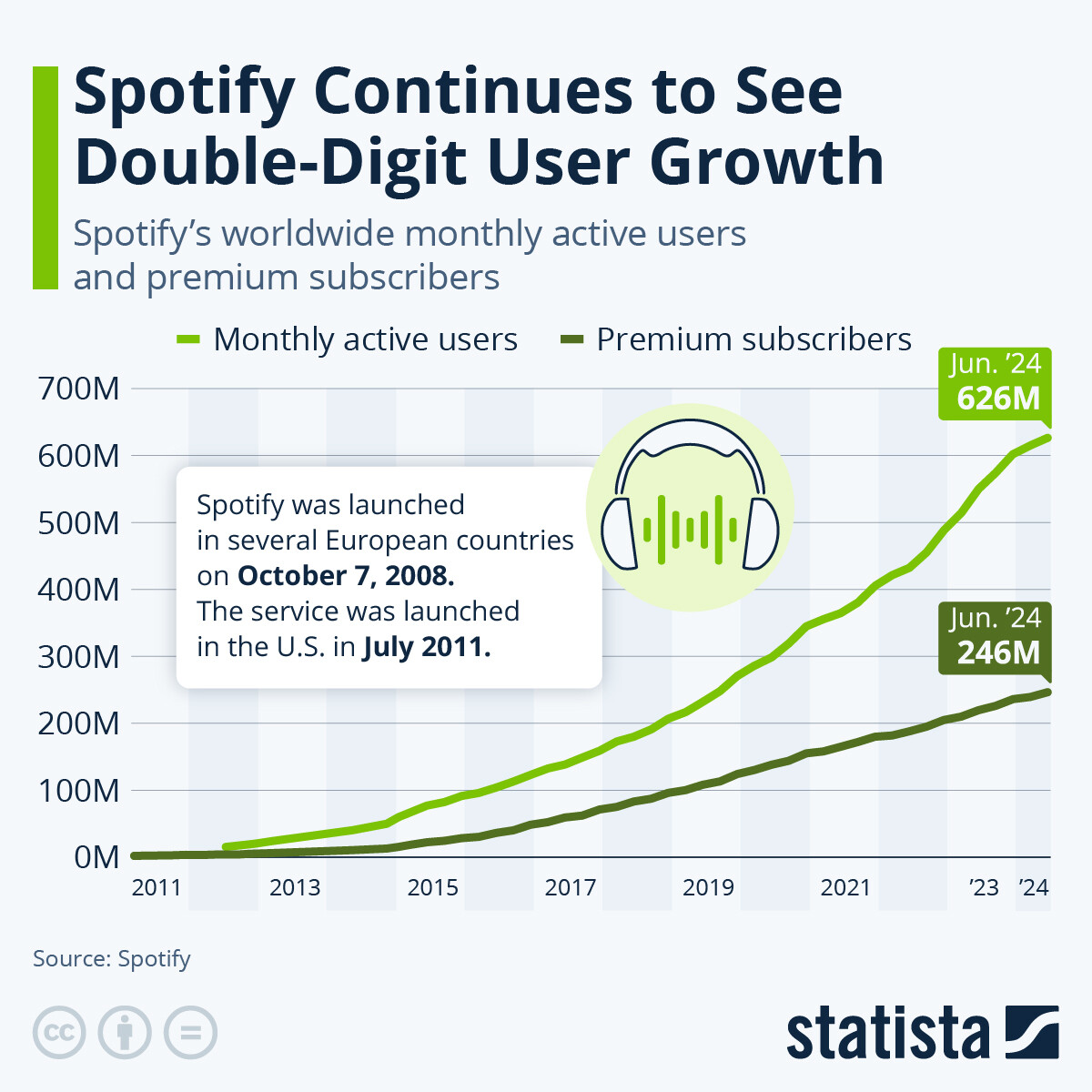
Spotify is a Swedish audio streaming service and media service provider, founded by Daniel Ek and Martin Lorentzon in 2006. It is one of the largest music streaming service providers in the world, with over 626 million monthly active users, of whom 246 million are paying subscribers (2024/6).

What kind of service

Spotify offers digital, copyright-protected audio content, and most users can find almost all the music they could wish for there. Spotify is available for free with ads, but additional features such as offline listening and ad-free listening are only available through a paid subscription. Users can search for music by artist, album, or genre, and create, edit, and share playlists.

2024: 100 million songs, 6 million podcast episodes, 350,000 audiobooks

Global availability

Spotify is available in most of Europe, as well as in Africa, the Americas, Asia, and Oceania, across a total of 184 markets. The majority of users and subscribers are from the United States and Europe, which together account for approximately 53% of users and 67% of revenue. Spotify is not present in mainland China, where the market is dominated by QQ Music. The service is available on most devices.

Royalty payments and such

Spotify pays royalties based on the number of artist streams relative to total listens. The company distributes approximately 70% of its total revenue to rights holders, most often record labels, who then pay artists based on individual agreements. While some musicians have criticized Spotify’s royalty structure and its impact on album sales, others appreciate the service as a legitimate alternative to piracy and for compensating artists for each listen.

Generally

Spotify is a huge player in the world of music and podcast streaming. The company has succeeded in continuous growth and is able to offer a wide range of content globally.


What an investor considers

Spotify is very popular, has a huge user base, and is still growing with plenty of additional potential to acquire new customers. According to many, the company has boldly invested significant sums in technology, which, especially in the long run, is expected to offer competitive advantages and deepen its moat.

There are many competitors in the market, and some of them have the money to invest and develop if they get enthusiastic. Making a profit has not always been easy for Spotify.

and about that Q2, which was strong:

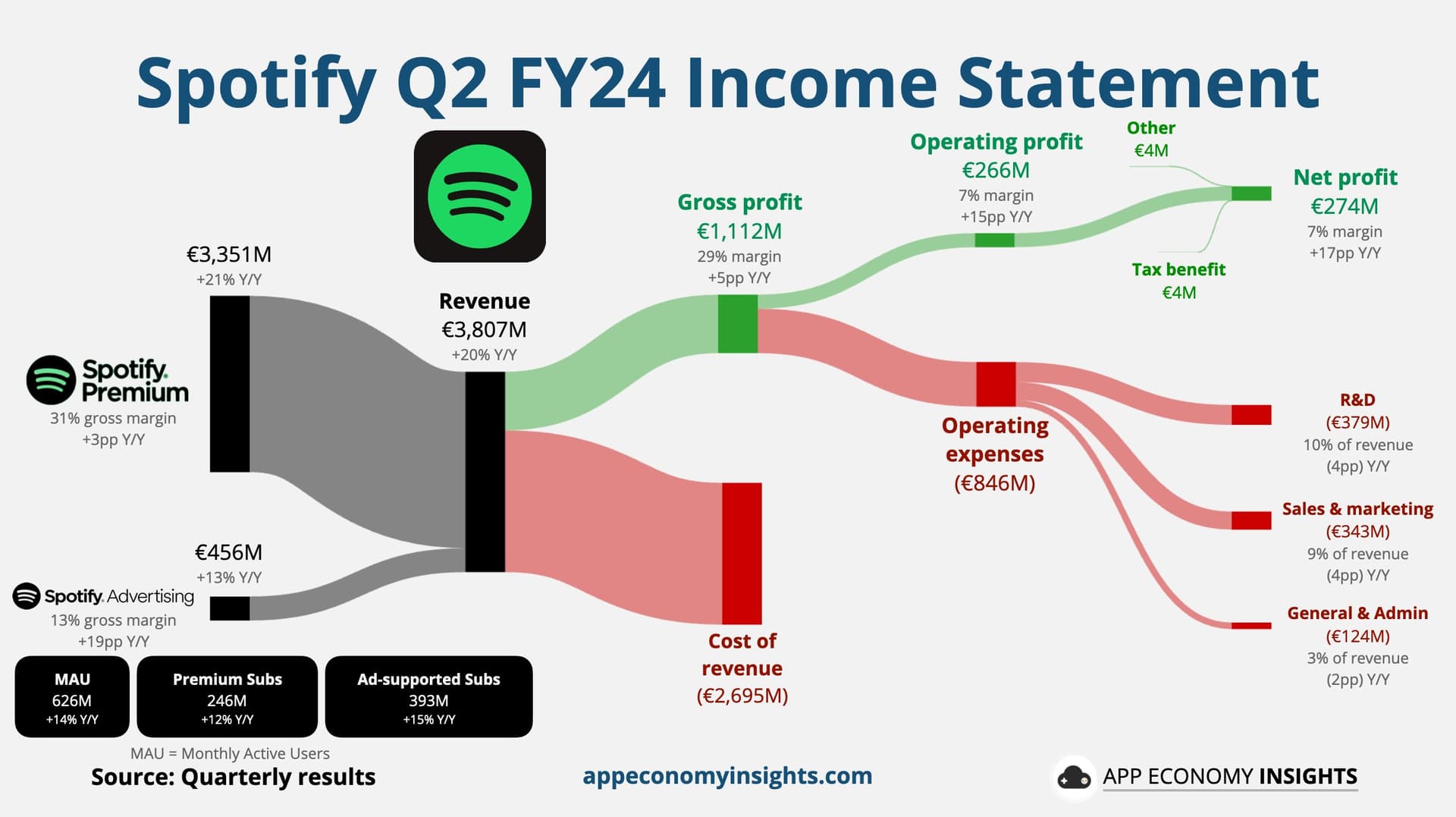
Spotify has exceeded analysts’ expectations for second-quarter subscriber numbers. The company has successfully grown its paying users by 12% year-over-year and has thus surpassed market forecasts.

The successes in the figures are due, among other things, to how Spotify has effectively reduced costs over the past year to improve profitability. Additionally, the company has raised monthly fees for the second time this year.

https://x.com/EconomyApp/status/1815750580457099458
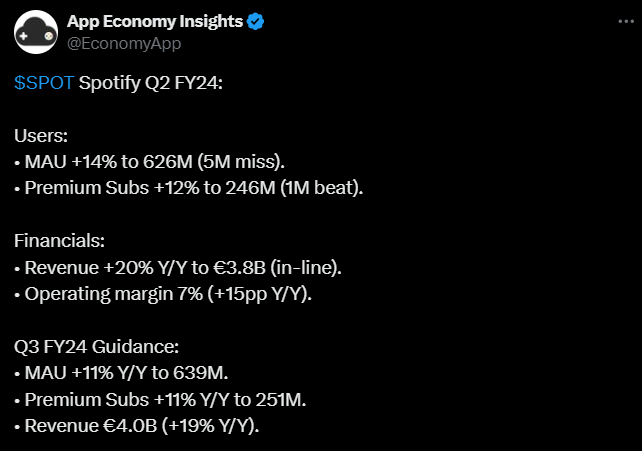
Then a few more figures.
And here’s much more, Spotify’s Q2 materials.

12 Likes

The copyright royalties paid are divided into two parts. Spotify disburses about 50% of its revenue to recording rights owners (record labels / artists). Additionally, roughly 10-15% goes to music creators, which in Finland practically means composers, lyricists, arrangers, and music publishers via Teosto.

Regarding royalties, Spotify introduced what I consider a somewhat questionable practice this year, whereby no recording rights are paid unless a work has been streamed at least a thousand times a year. It might sound like an insignificant update, but for large catalogs, this can actually be surprisingly significant in some cases.

13 Likes

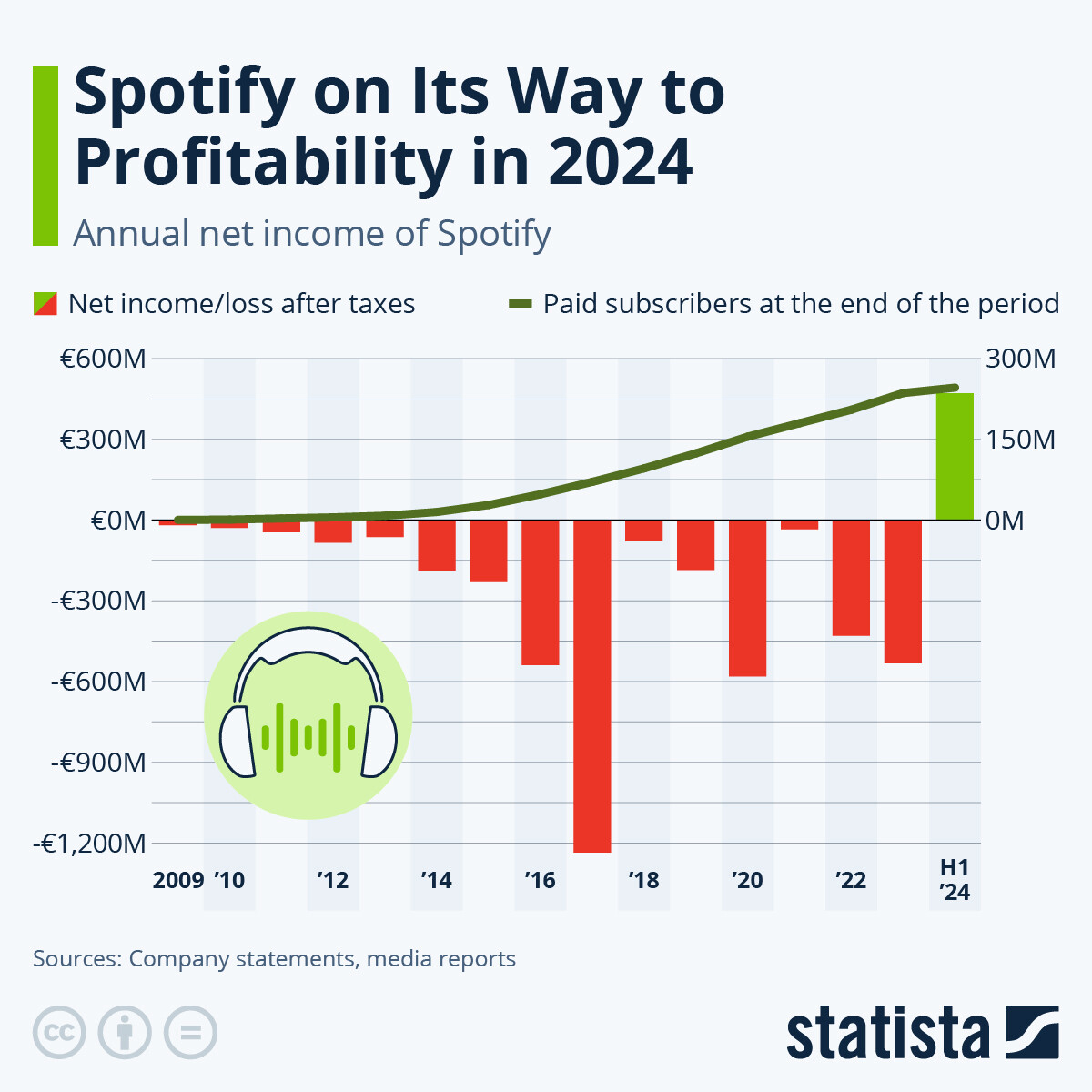
A few current charts on Spotify’s development. If the trajectory from the beginning of the year can be maintained through the final quarters, this year will be Spotify’s first profitable one. As @Sijoittaja-alokas mentioned in the first post, the drivers of improved profitability have been the growth in the number of paying users, price increases, and reduced costs. The headcount has dropped from 10,000 to approximately 7,400.

Spotify_2

Spotify appears to have more than twice as many active users as paying users. Spotify Premium ARPU for the most recent quarter was 4.62 euros (10% y/y). Based on the graphic in the quarterly info presentation deck, it seems that ARPU has been fluctuating around 4.50 euros for quite some time.

Spotify_1

6 Likes

I looked into this a bit over a year ago, it was in my portfolio for a while, but I eventually sold it. Regrettably, as the stock has gone up quite nicely :smiley:

Here are some miscellaneous reflections from back then:

  • I’m a long-time Spotify customer myself - the software is great and quite “sticky” - I wouldn’t switch easily anymore since all my playlists, favorite podcasts, and other data are there. The service itself is excellent, and I believe it can compete with Google and Apple, which alone is quite an achievement.
  • User numbers have continued to grow impressively, and I consider music a much better medium than, for example, streaming services. It’s not tied to what you’re doing or where you are, so people have many more hours available for listening than for watching. Competition with other pastimes isn’t as fierce.

Why I ended up selling, however:

  • Ultimately, Spotify isn’t very profitable and—perhaps the most important reason—I think it’s difficult to improve profitability significantly. The catalogs are owned by a few record labels (UMG, Sony, Warner), who must be paid a large slice of royalties. The bargaining position is also difficult—all the big labels are so large that they can’t really be excluded, as a third of the music offering would disappear. (Additionally, I have UMG in my own portfolio, so the growth of streaming is reflected positively in my portfolio anyway.)

I haven’t followed it for a while now, but it looks like profitability has improved through price hikes and cost cuts, which is a good thing. However, both of these have a limit.

I see the biggest potential in the possible growth of advertising revenue + better targeting, and the growth of podcasts and other content that isn’t label-dependent. That could further improve profitability. (AI music, anyone?)

In hindsight, the stock was quite cheap back in 2023 considering the number of users you could “buy” back then; the valuation was below 2 P/S. I’m not really that familiar with the current situation, so it’s hard to say how good a buy it would be now. In itself, I think the fundamental problem is profitability—there are plenty of users, their numbers are growing, and the service is good.

EDIT: let’s add one more negative factor that I always seem to run into with these growth companies. The share count is also increasing :slight_smile:

9 Likes

Olli went through this in the recent Earnings Week Summary; the link below should start at exactly the right spot.

Kannattaa tietty kuunnella koko podi alusta loppuun. :slight_smile:

https://www.youtube.com/watch?v=m0RoNflMzFM&t=466s


EDIT:

Adding this here as well:

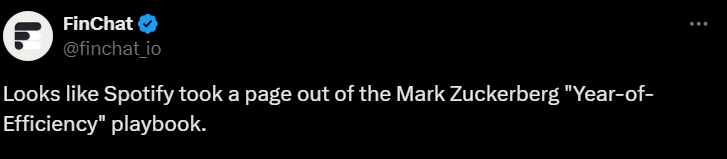
https://x.com/finchat_io/status/1816873135947530363

image

image

1 Like

On the other hand, isn’t Spotify gradually becoming such a large and dominant player in the industry that this could also be turned around: the bargaining position of the few record labels owning the catalogs is difficult because they can’t really leave their music off Spotify (anymore)?

3 Likes

Good point. SPOT’s share has grown quite large; I thought the share would be smaller:

https://www.statista.com/statistics/653926/music-streaming-service-subscriber-share/

But still, even though I believe the product is “sticky,” it’s unlikely to be so sticky that customers wouldn’t switch if the offering decreased significantly. And since these services are substitutes, it’s hard to see someone having multiple at the same time, for example. :thinking:

But yeah, you’d think Spotify has a better bargaining position than its competitors.

4 Likes

Additionally, there is a group of independent record labels. Represented through Merlin, they constitute the fourth major player.

Yes and no. In Spotify’s case, there are certainly commercially significant examples regarding individual artists; for instance, Taylor Swift once pulled her music from Spotify. Today, of course, the songs are available there.

A more significant example is YouTube. When Google didn’t want to pay creators proper compensation, music was absent from German YouTube for four years. Finland experienced a similar, albeit much shorter, episode.

It must also be remembered that the owners of master rights (i.e., primarily the record labels) are not the only party deciding what plays on Spotify. Songwriters also have a say in the matter. A Finnish example: When Jussi Hakulinen wanted the songs he had composed and written lyrics for removed from streaming services, many hits by the band Yö, for example, disappeared from Spotify and elsewhere, even though the performers and record labels would have wanted otherwise. Those songs were recently made available for listening again once the songwriter’s estate and the record label found common ground.

I’ll add a purely imaginative scenario: The truly large record labels have other forms of leverage besides pulling their production from a service. What if, for instance, the setup was that streaming services paying 5% more of their revenue to rights holders get access to material a week or two before everyone else? The streaming world is so centered on current hits that this would be a very significant factor.

3 Likes

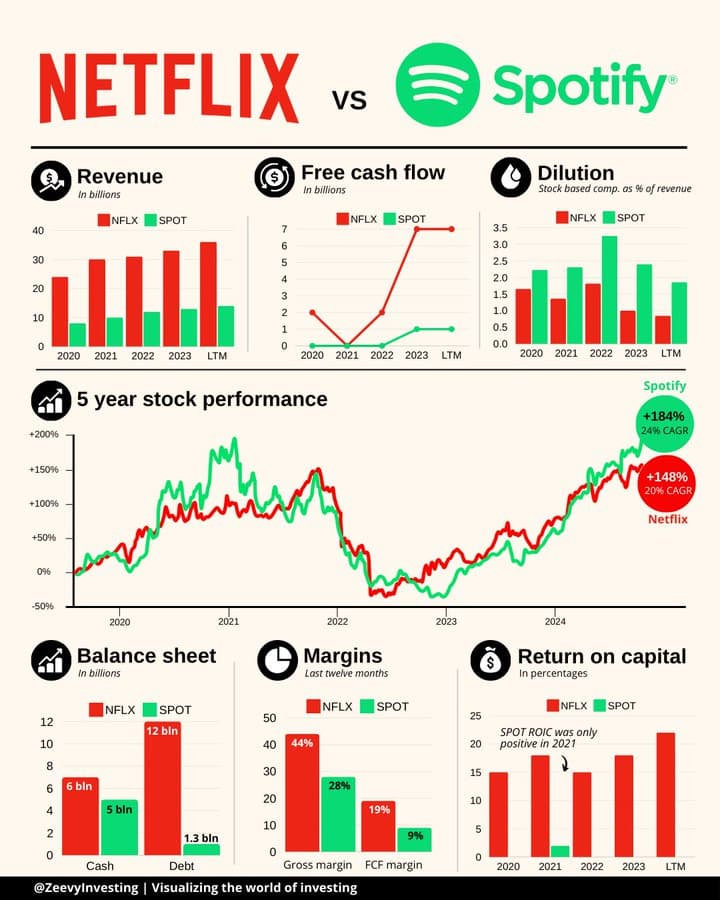
Here is a quick comparison of Spotify and Netflix. :slight_smile:

https://x.com/ZeevyInvesting/status/1839334289949053074

image

image

1 Like

Spotify’s performance has really been incredible; I would never have believed it at any point. :slight_smile:

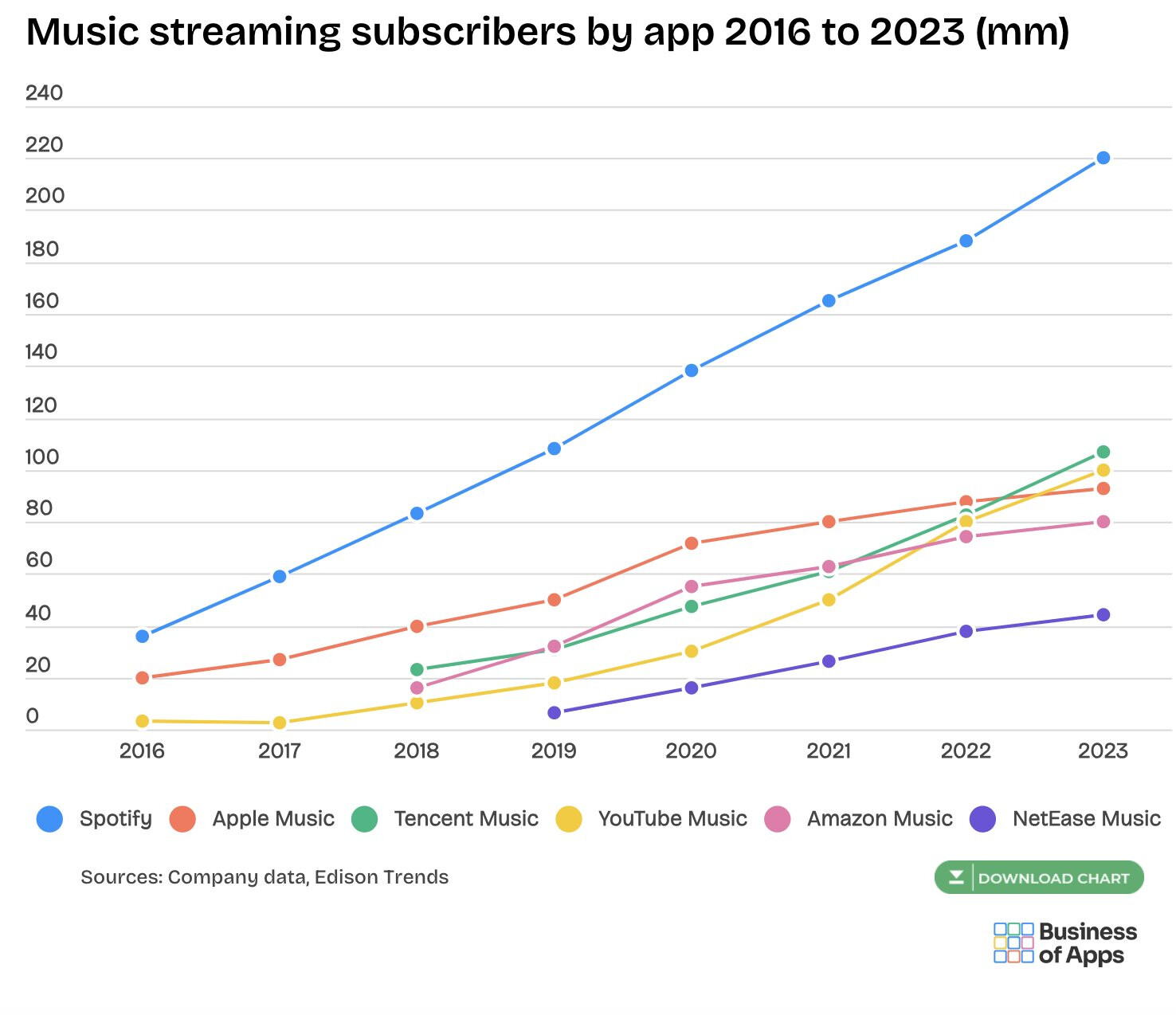
The growth of YouTube Music is also interesting.

https://x.com/aschmidt2930/status/1848094306273521826

image

image

3 Likes

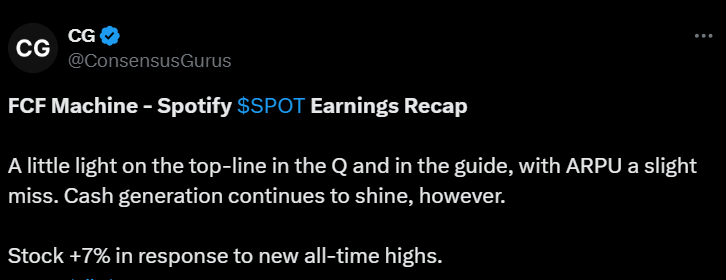
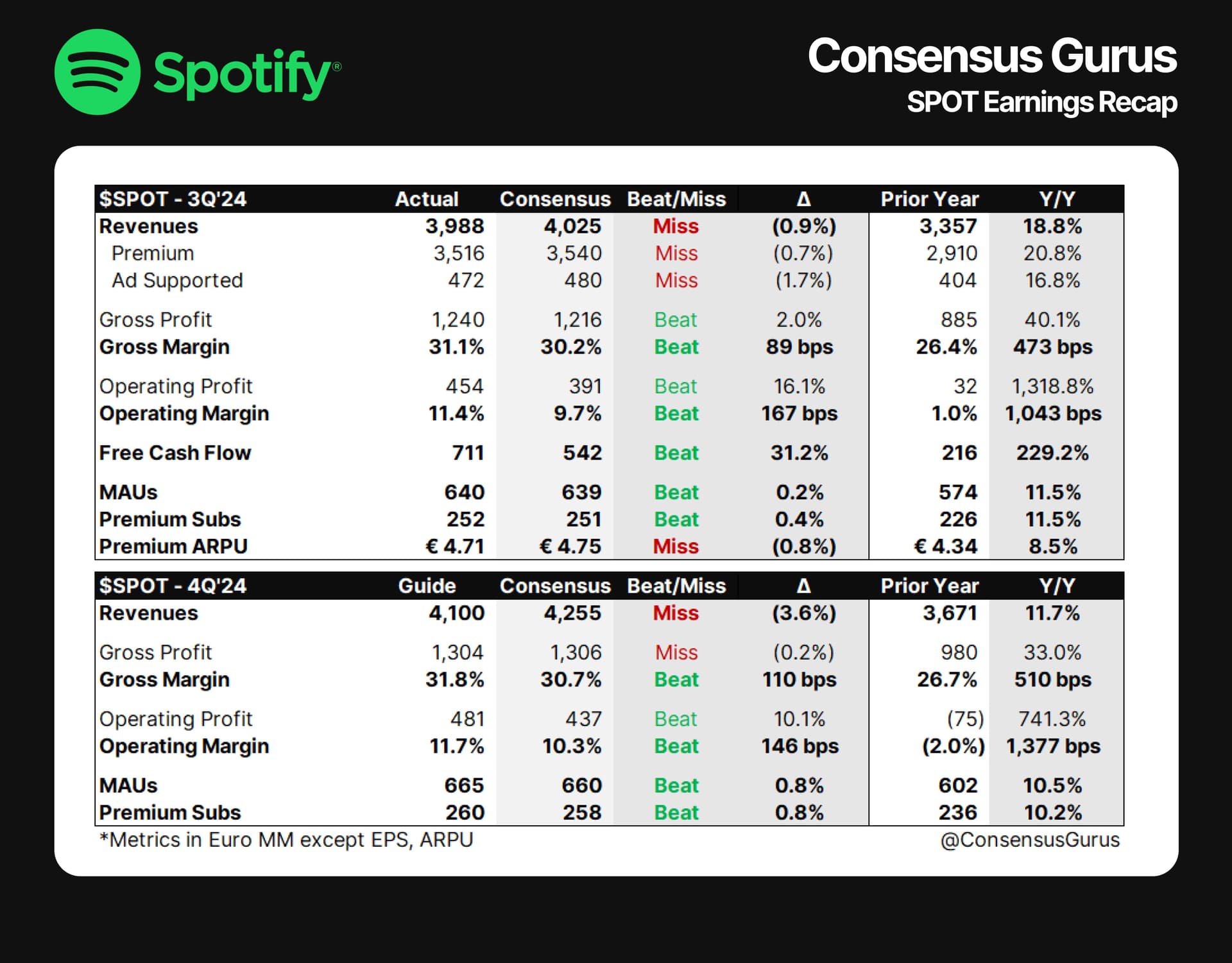
Spotify’s Q3 was a success. :slight_smile:

User and subscriber numbers grew more than expected; additionally, revenue increased significantly despite the impact of exchange rates. Gross margin rose to record levels and free cash flow was substantial.

Profitability improved and the operating result was better than expected, thanks to higher margins and lower personnel and marketing expenses.

The company sees itself in a good position to achieve its long-term growth targets.

https://x.com/finchat_io/status/1856446344065626547
image
image

https://x.com/ConsensusGurus/status/1856445672805020057
image
image

2 Likes

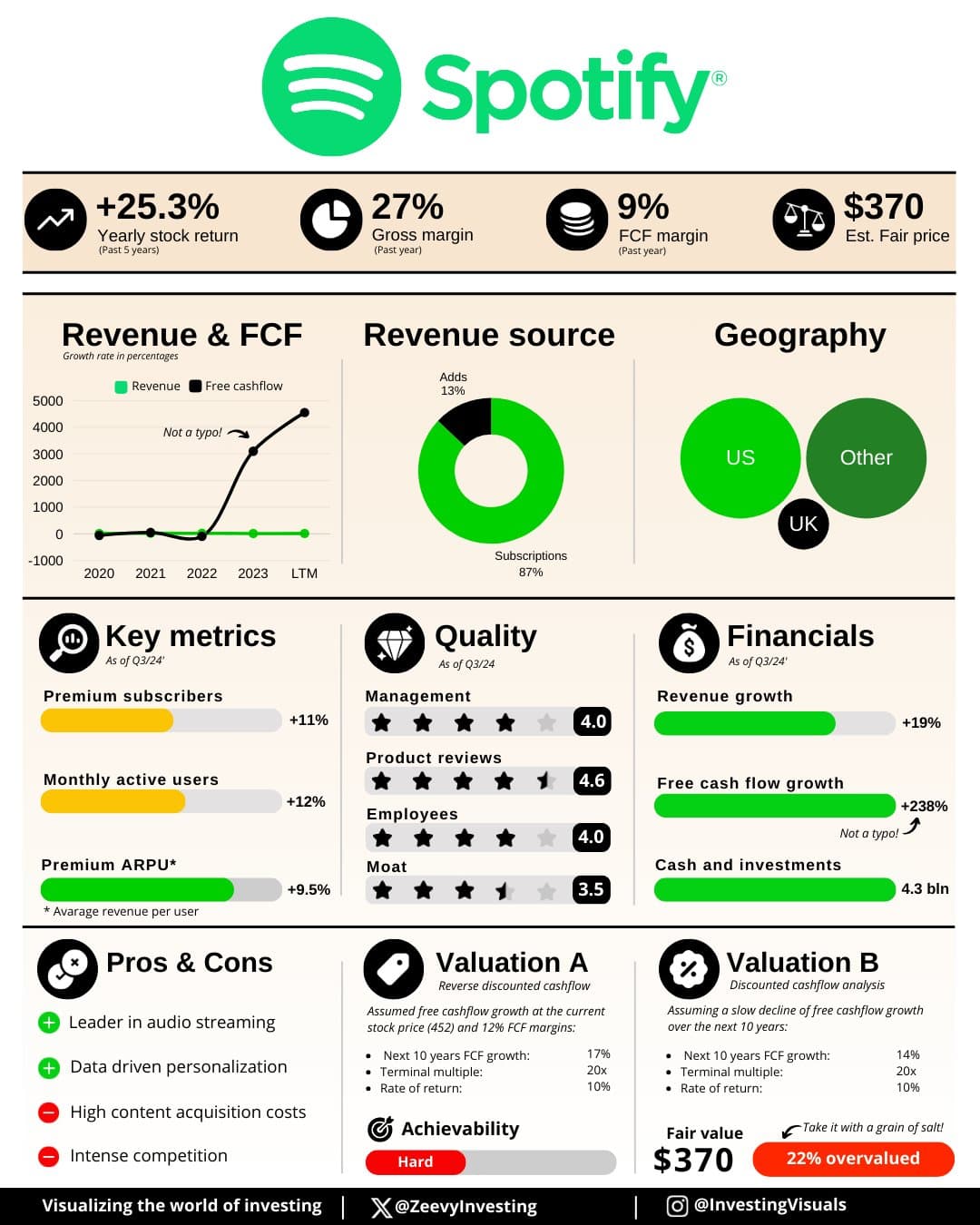
Here is another excellent summary of Spotify in tweet form right after Q3. :slight_smile:

image
image
https://x.com/ZeevyInvesting/status/1856717499330347134

1 Like

Olli spent just under seven minutes going through Spotify in the Earnings Week Summary. :slight_smile:

Of course, it’s worth listening to the whole episode anyway.

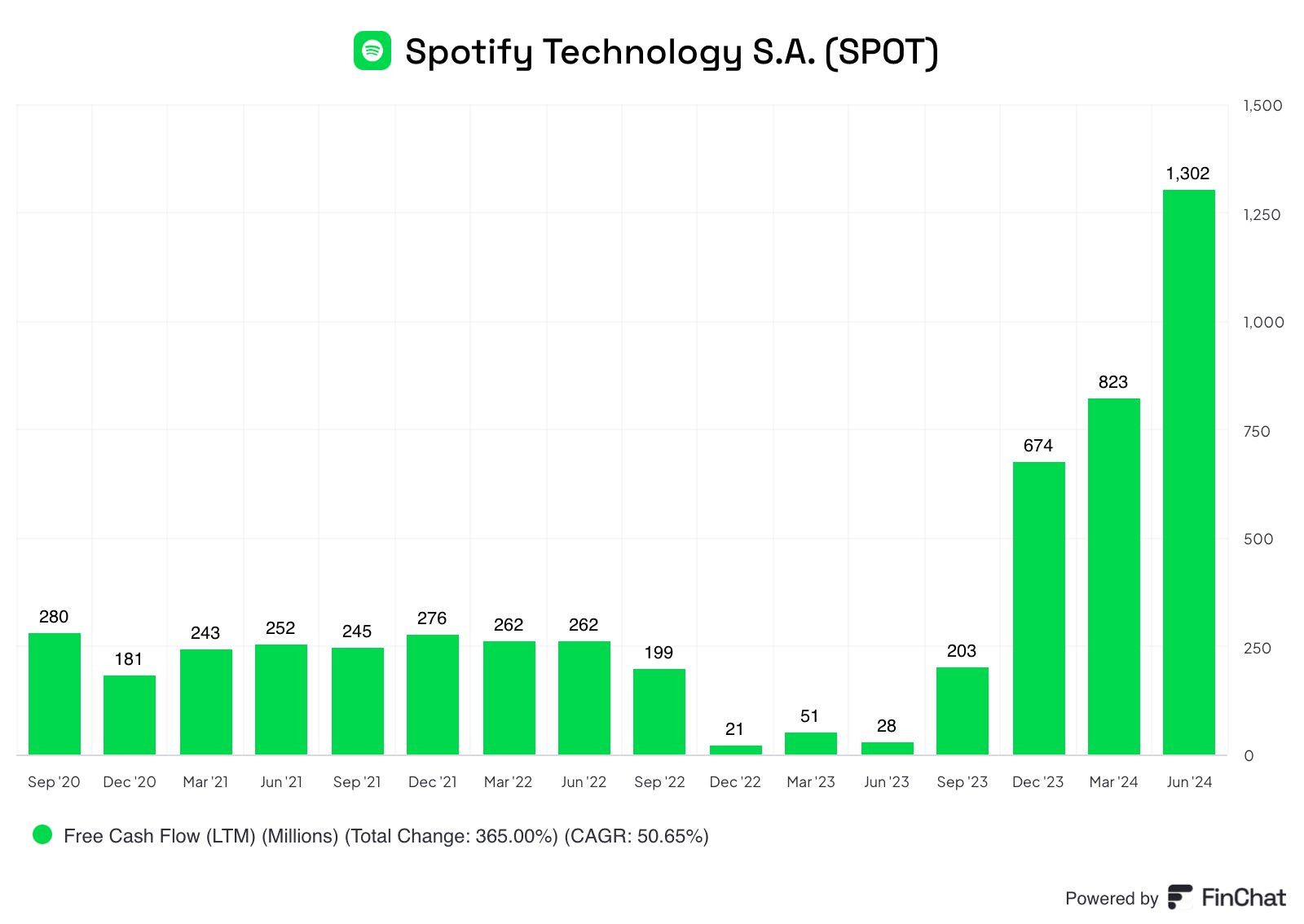
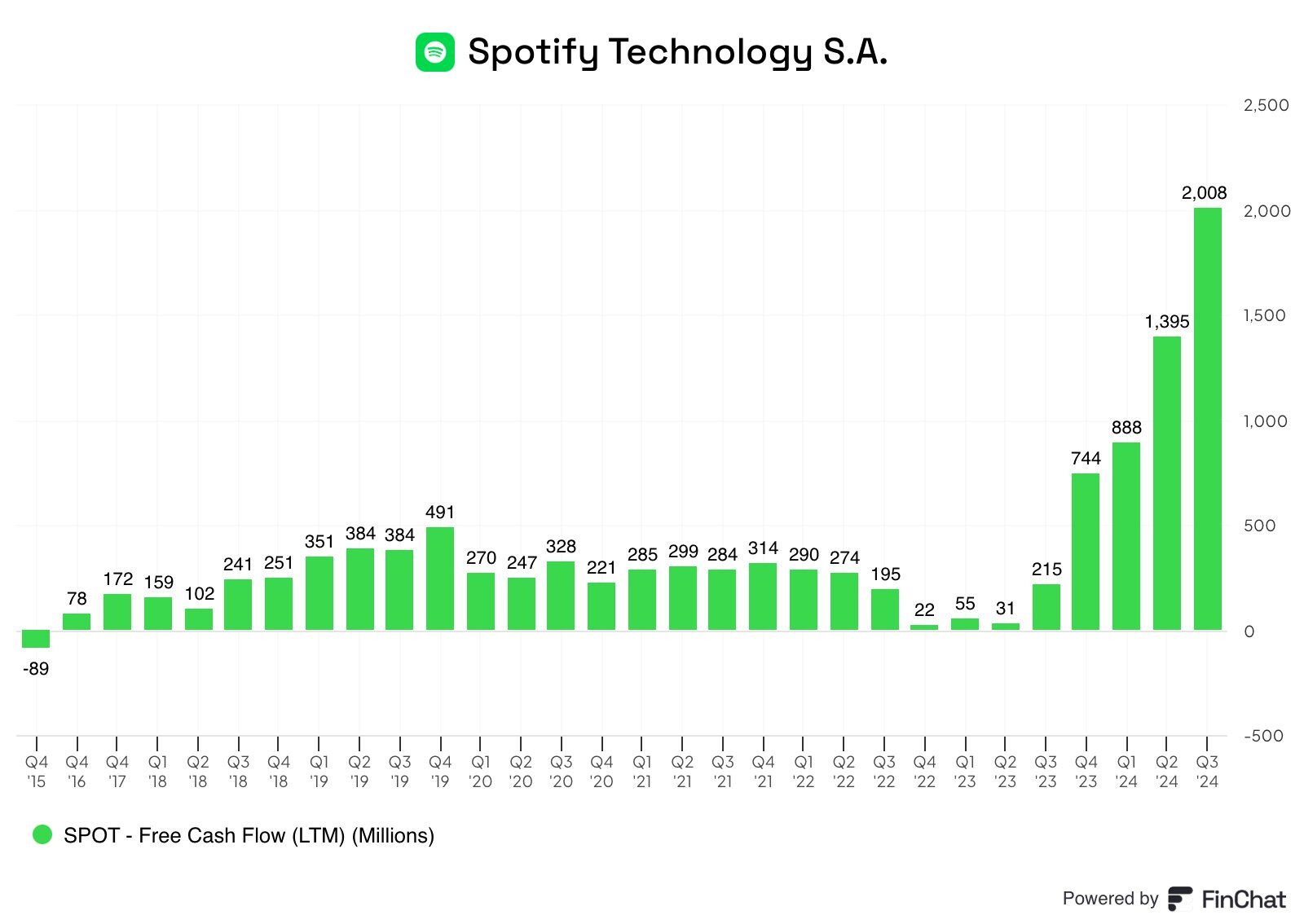
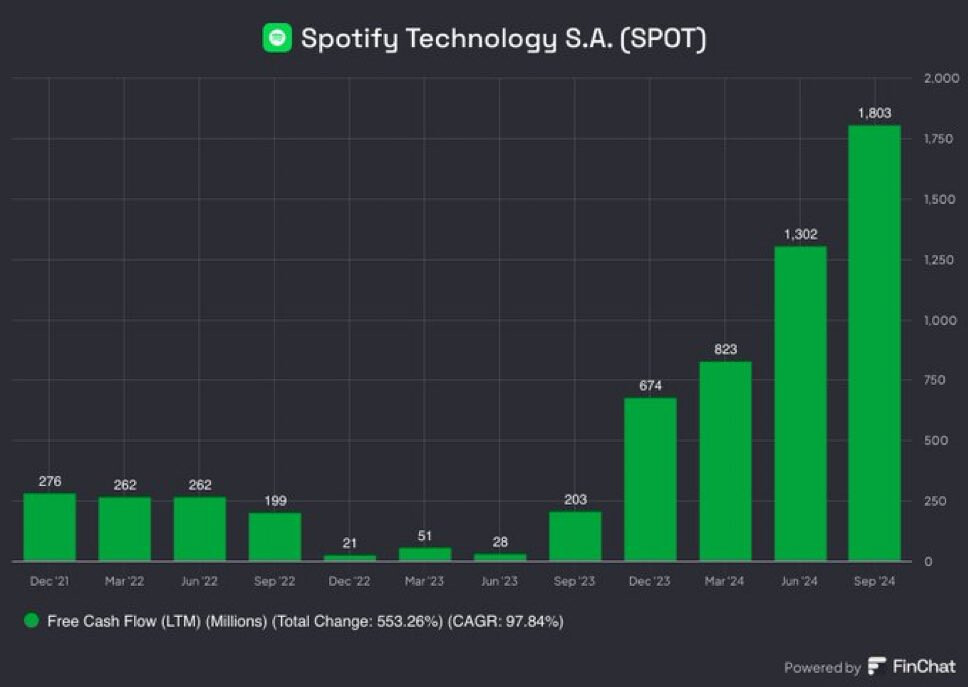
Spotify’s FCF has been quite interesting lately :), although it has already been noticed, but here is a very illustrative tweet about it. :slight_smile:

https://x.com/finchat_io/status/1865410974389547233
image
image

1 Like

Here is our Spotify initiation of coverage report. The report is freely available to read and is in English. There’s plenty to browse through, as the analysis is almost 60 pages long.

(And it should also be mentioned that Spotify is not a corporate client for Inderes.)

15 Likes

@jesper.hagman and Christoffer discussed Spotify. :slight_smile:

The video is in Swedish and has automatic translation subtitles, which are tolerable but better than nothing:

image

https://www.youtube.com/watch?v=7-YuJjAvOL8

00:00 Intro 00:18 Brief about Spotify 02:08 Number of subscribers 02:57 Freemium Model 03:56 Geographically 06:33 Competitive situation 09:35 How artists are paid 11:36 Profitable company 2024 13:19 Long-term goals 16:45 Our recommendation

This video can be found on the Inderes Nordic channel, which also has English videos. :slight_smile: You should subscribe to the channel for that reason too, so it reaches 1.5k subscribers soon. :cowboy_hat_face:
https://www.youtube.com/@inderesnordic

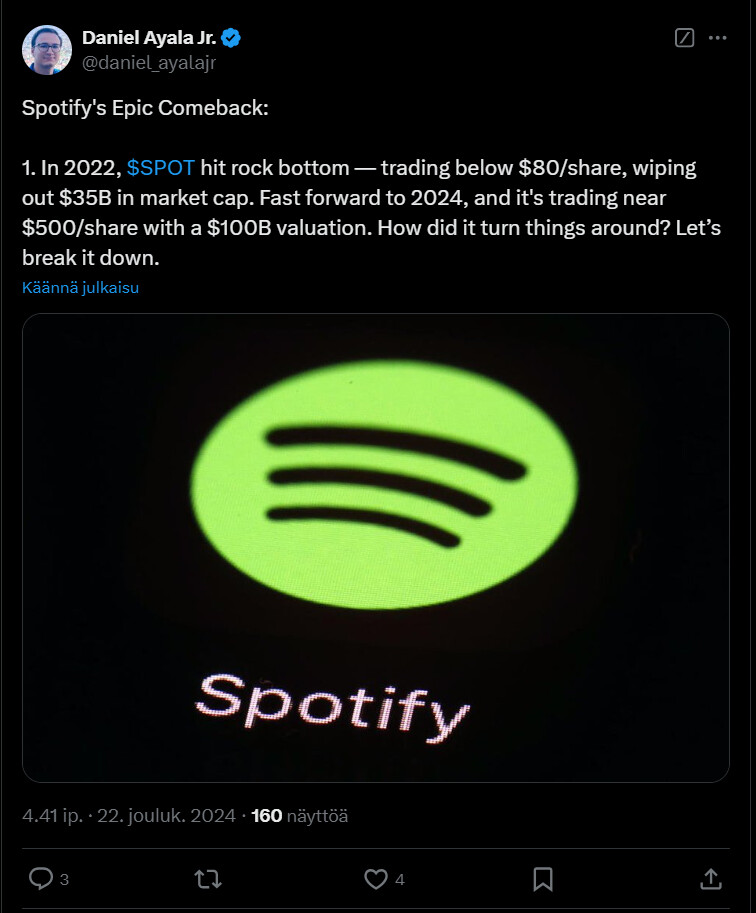
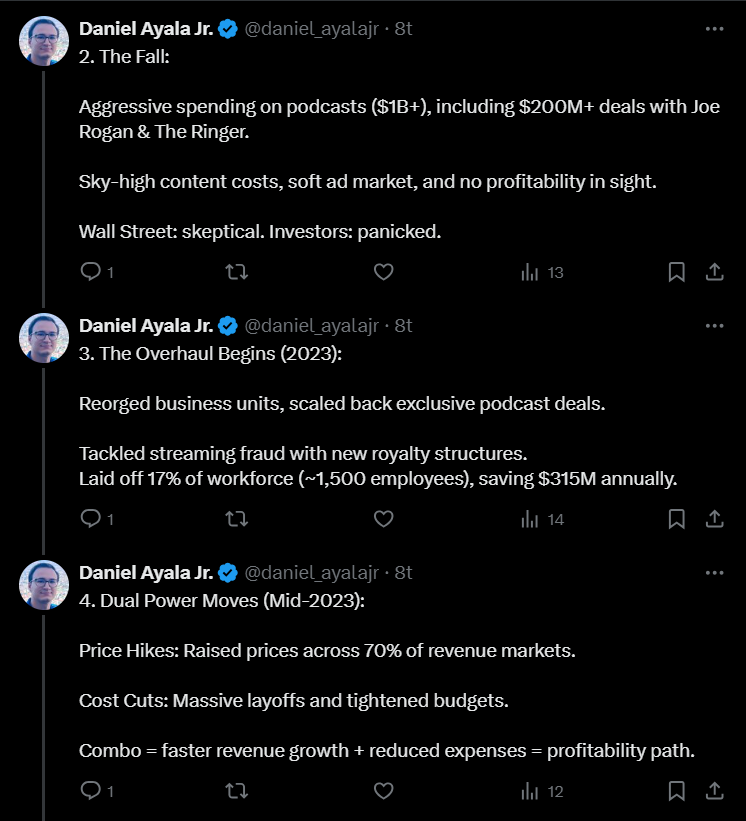
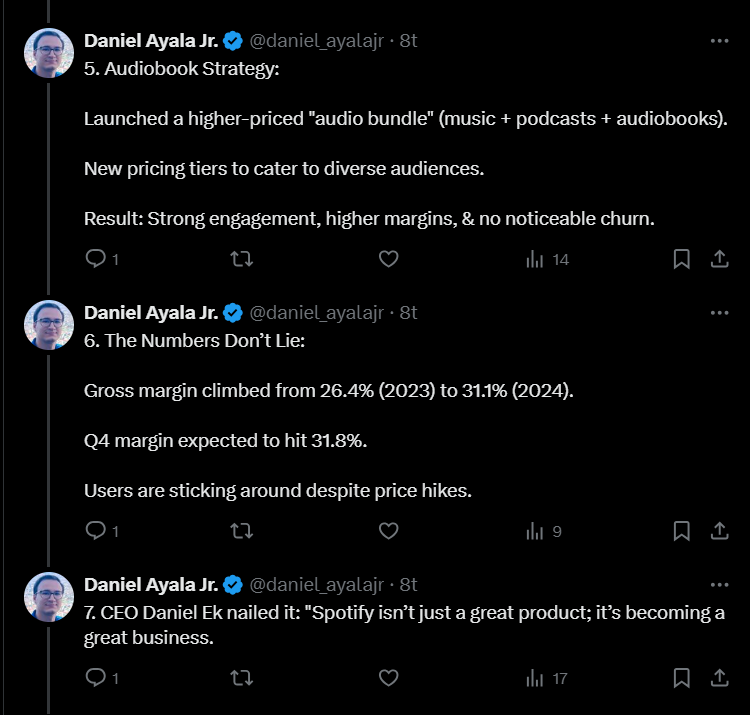
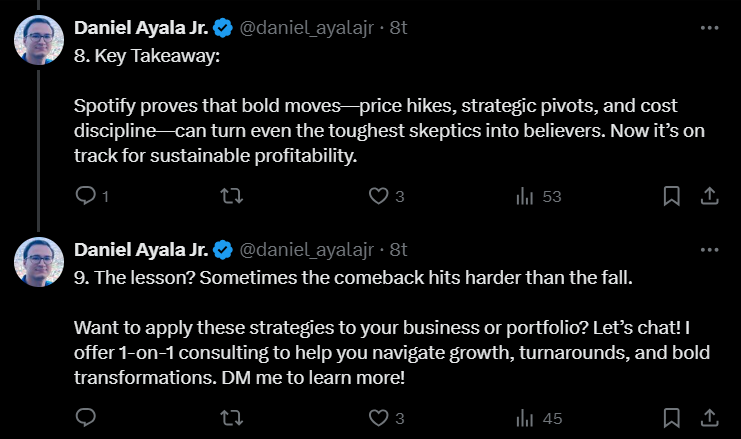
Here’s a tweet thread about Spotify. :slight_smile: Nothing too strange, a pretty okay package.

https://x.com/daniel_ayalajr/status/1870842123978948616
image

Rest of the tweet thread

image
image
image

1 Like

Inderes’ recommendation for Spotify is ‘reduce’, but at the beginning of the December 23rd morning review’s translation, the recommendation is marked as ‘add’. Should this be corrected? Tagging @Antti_Jarvenpaa for confirmation.

2 Likes

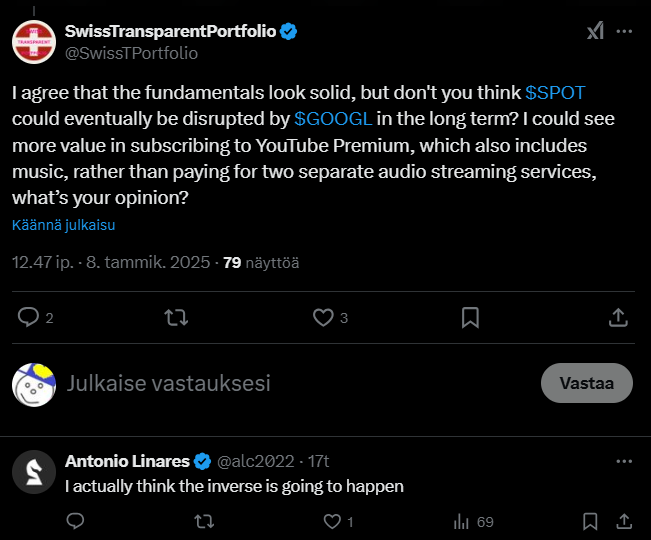
Will Spotify’s trend continue like this? :thinking:

https://x.com/alc2022/status/1876938778079613395
image
image
image


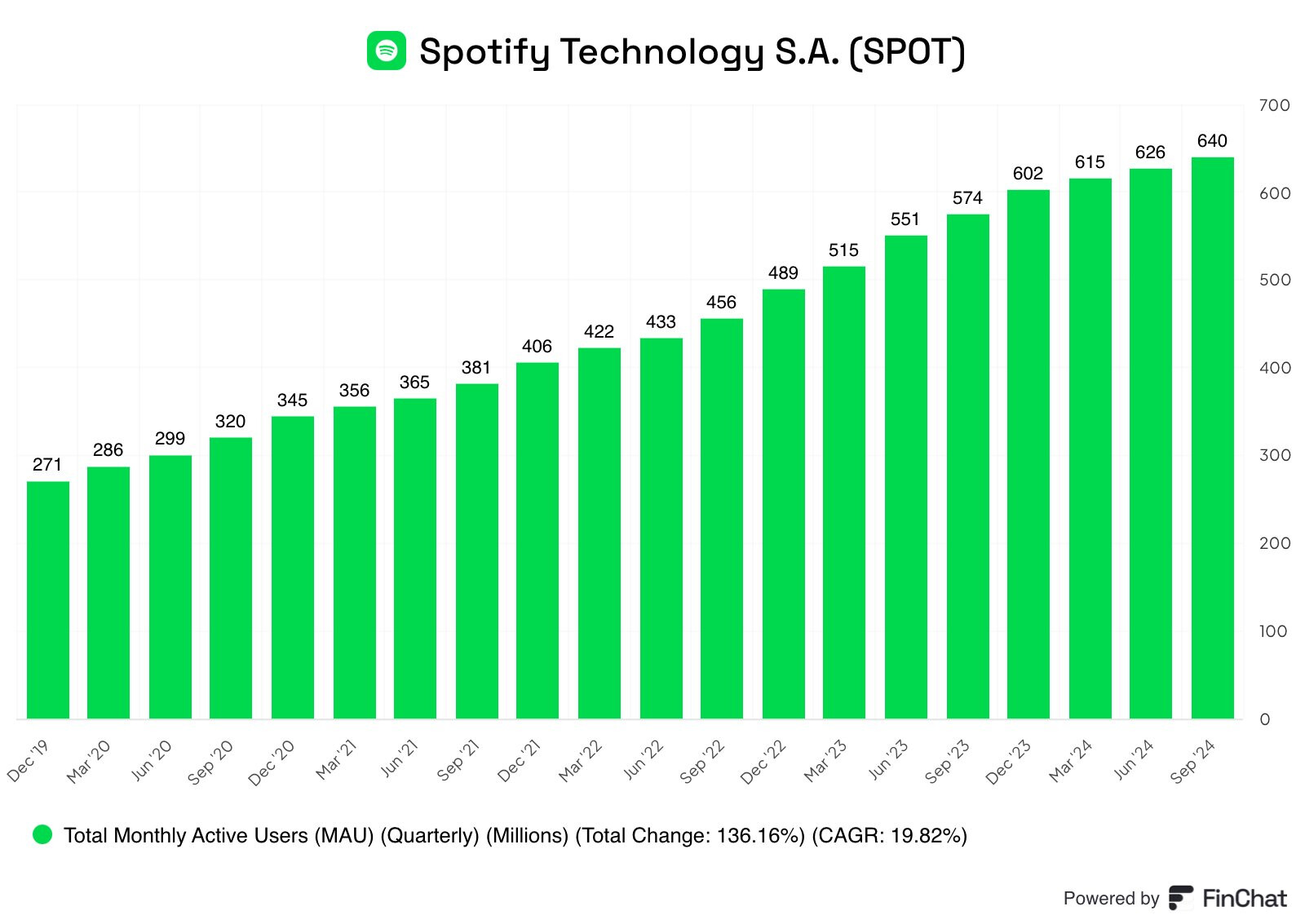
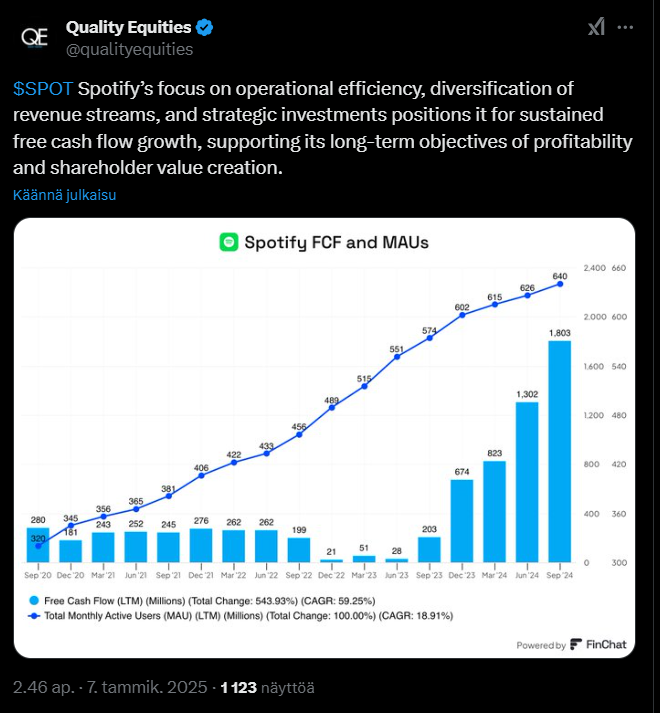
Here again is FCF, but also MAU (monthly active users), which is an important metric for Spotify.
https://x.com/qualityequities/status/1876430152894238904
image

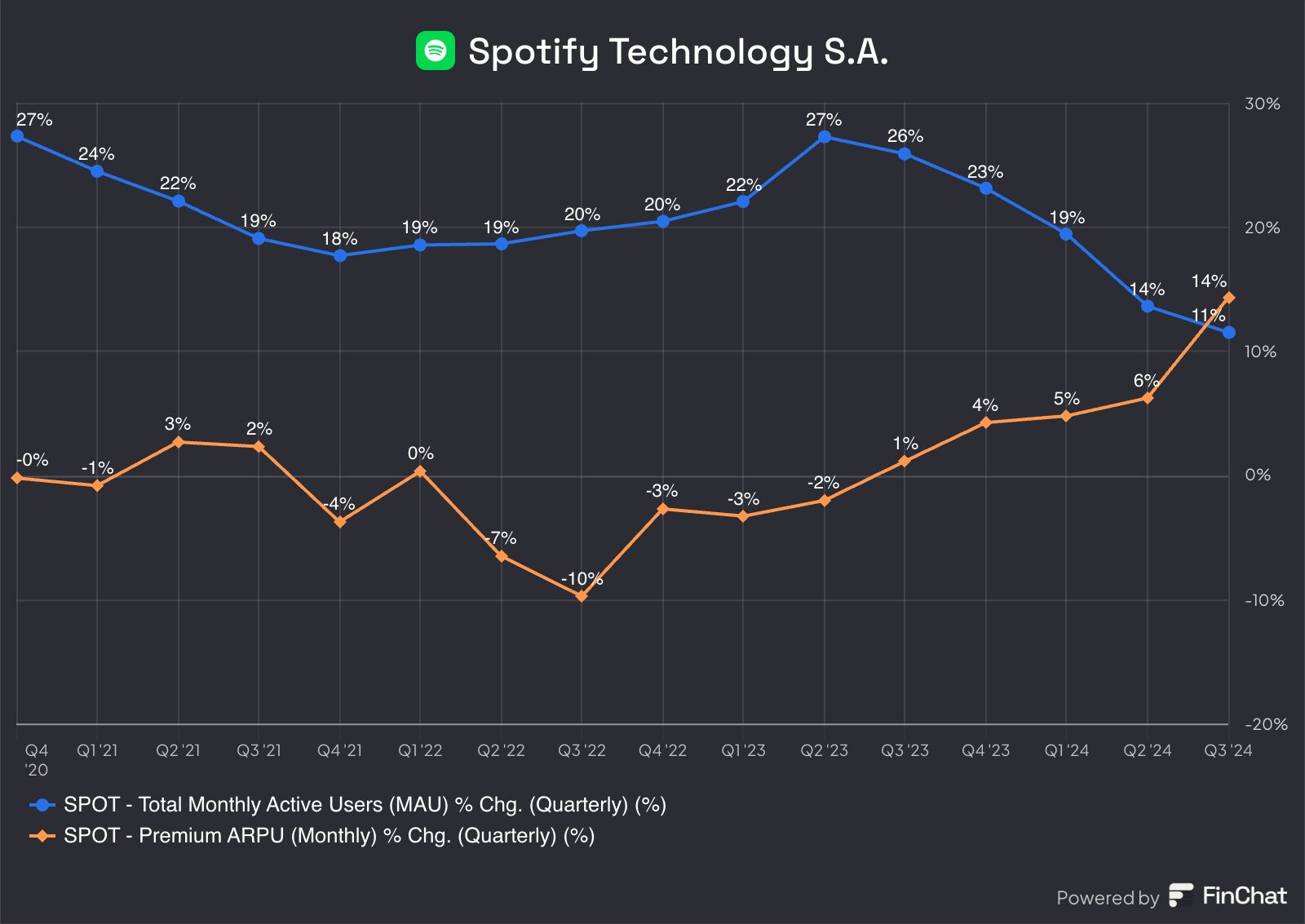
In addition to MAU, Average Revenue Per User (ARPU) is an important metric for Spotify.

https://x.com/QualityInvest5/status/1874797963513659458
image
image

3 Likes

Spotify and Universal Music Group signed a multi-year agreement that expands direct licensing agreements and introduces new paid subscription options. The agreement supports innovation and grows the music subscriber base globally.

More on the matter in the article below. :slight_smile:

https://www.cnbc.com/2025/01/26/universal-music-group-and-spotify-strike-new-agreement.html

1 Like