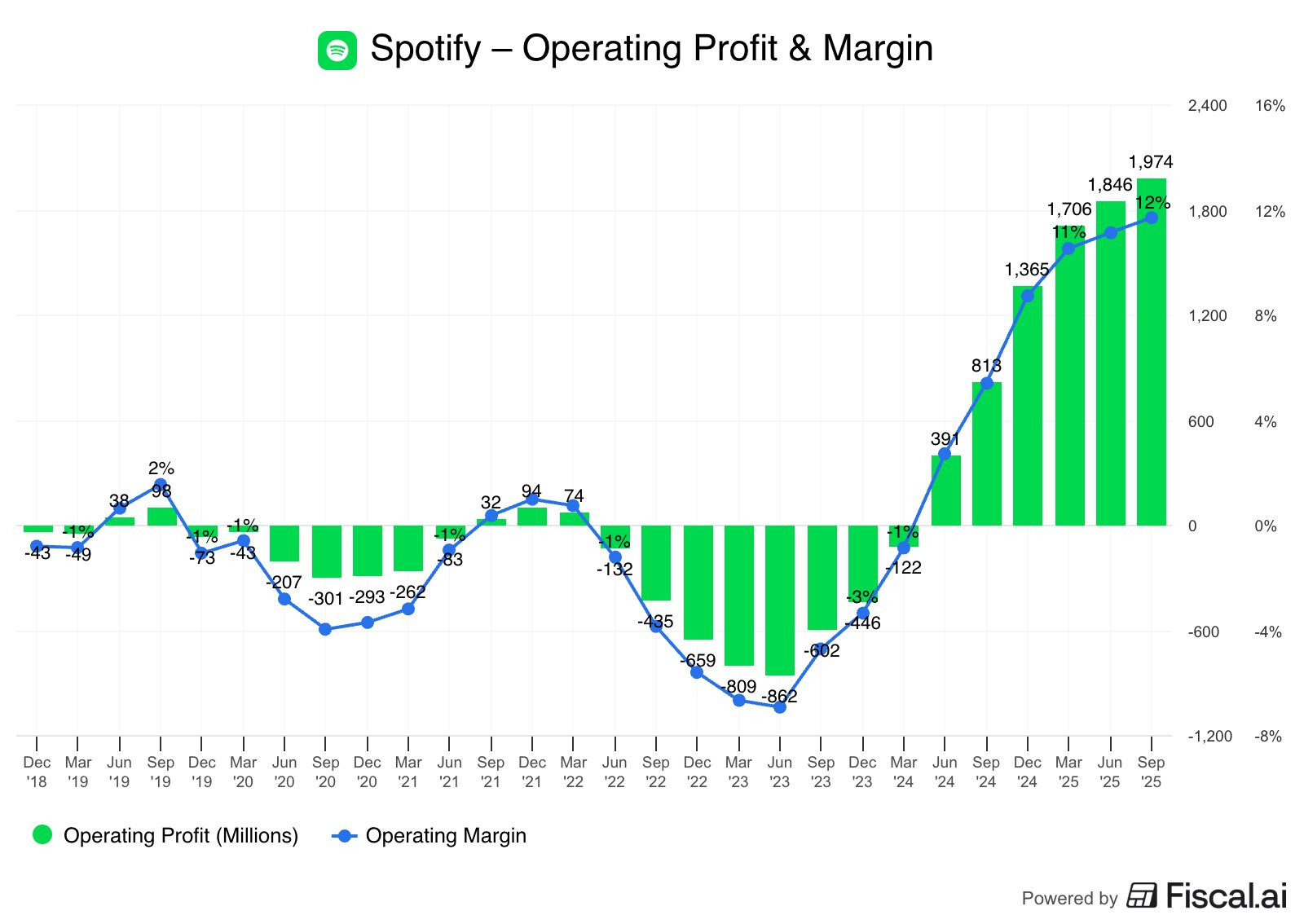
The tweet asks – will Spotify become a money printer? Or will it be hacked empty before then? 
https://x.com/QualityInvest5/status/2002815998400028772
The tweet asks – will Spotify become a money printer? Or will it be hacked empty before then?
https://x.com/QualityInvest5/status/2002815998400028772
Spotify is now raising the price of Premium in Estonia, Latvia, and the United States starting from the beginning of February. 
The streaming platform said its Premium plan will rise from $11.99 to $12.99 per month in the United States, Estonia, and Latvia. The change, which represents an increase of around 8.3%, will take effect from subscribers’ billing dates in February.
Christoffer Jennel has published a pre-earnings report on Spotify, which will release its Q4 results on February 10.
Spotify reports its Q4 results on Tuesday, February 10, before the market open. We do not expect major surprises regarding revenue and user metrics. However, we expect operating profit to exceed guidance, due to lower social costs resulting from the weakness in the share price during Q4. Following the recent price hike in the US and previous international increases, we expect investors to focus on management’s comments regarding churn, subscriber growth, and the broader pricing strategy leading up to 2026. In our view, the decline in the share price has significantly improved the valuation profile, and Spotify is now trading below our acceptable valuation ranges (EV/FCFF 26’: 23x, EV/EBIT: 28x, EV/GP: 12x). As the company’s fundamentals remain intact in our view, we are now more positive about the stock and see attractive risk-adjusted upside from current levels. We are therefore upgrading our recommendation to Accumulate (prev. Reduce), but lowering our target price to $590 (prev. $655) to reflect what we believe are lower justified valuation multiples due to the contraction of peer multiples.
Christoffer’s comprehensive quick comments on Spotify’s Q4 results.
Spotify’s Q4 report showed strong operational performance, and profitability exceeded our forecasts. User growth also exceeded our forecasts, primarily due to the strong development of ad-supported users. Although Q1 revenue guidance fell slightly short of expectations due to currency headwinds, the subscriber outlook remained unchanged. More importantly, the profitability outlook was significantly stronger than expected, supported by better-than-expected operational efficiency and the impact of smaller-than-expected renewed licensing agreements throughout 2025. Consensus seems to be focusing on the profitability and user growth beats, and shares rose by about 10% in the pre-market after several weeks of decline. Following the report, we see primarily upward pressure on our profitability forecasts.
@christoffer.jennel has published a Q4 update on Spotify. It’s an interesting report, I recommend checking it out. The valuation is certainly not cheap yet, but it likely won’t be for a long time. The company has taken quite a hit in the software sector’s AI crash, even though it’s harder to see such a clear disruption threat for the company imo. Of course, the share price had been rallying for a while, making a correction quite welcome.
Here is a link to the English report, which is free to read.
Spotify is investing in AI, such as ChatGPT integrations and personalized playlists, to retain its users in fierce competition with Apple, Amazon, and YouTube.
The goal is to improve music discovery and engage more users.
According to experts, AI can be a decisive advantage as music selections become more similar and easier to copy.
Key Points
- A new ChatGPT integration with Spotify and a “Prompted Playlists” feature are signals from the music streamer that investing in AI may be the best defense from threats including AI commodification of music and Apple, YouTube and Amazon competition for subscribers.
- Spotify, which has seen its stock price slump over the past year, says its interactive DJ, introduced in 2023, now has roughly 90 million subscribers and has racked up four billion hours of user time spent.
- “The catalogs at Amazon, Apple and YouTube are similar — nearly identical songs — to Spotify, just like Bing and Edge are nearly identical to Google,” says Michael Pachter, Wedbush Securities senior advisor.
https://www.cnbc.com/2026/03/22/spotify-apple-amazon-streaming-music-ai.html
Christoffer Jennel has written preliminary comments on Spotify, which will publish its Q1 report on Tuesday, April 28.
We expect the company to demonstrate continued operational development characterized by stable user growth and strong profitability improvement. While reported revenue growth still faces significant currency headwinds, we anticipate the underlying business to remain strong, supported by recent pricing actions in the US and a continued focus on AI-powered operational efficiencies. Our Q1 expectations are largely in line with the company’s guidance, although we have raised our EBIT forecast due to the impact of the negative share price development (-17%) in Q1 on social security contributions. Following the recent strengthening of the share price, some of the upside we saw has already materialized. Spotify is currently trading at the lower end of our acceptable valuation ranges (EV/FCFF 26’: 24x, EV/EBIT: 28x, EV/GP: 12x), which still leaves upside potential for the stock. However, due to the recent share price increase, we are lowering our recommendation to “add” (previously “buy”), leaving our target price unchanged at USD 595.
Spotify and Peloton are launching an extensive partnership by making over 1,400 diverse fitness classes available to Premium subscribers globally.
Through this move, Spotify is expanding into physical wellness, while Peloton seeks international growth by moving from hardware toward scalable digital content, leveraging Spotify’s network of hundreds of millions of users.
Key Points
- Spotify is partnering with Peloton to launch a fitness category with more than 1,400 classes available for Premium users globally.
- This is Spotify’s first push into wellness as it looks to boost engagement and unlock new monetization beyond music and podcasts.
- Peloton, meanwhile, is aiming to expand its international reach as it pushes beyond a hardware-centric model.
https://www.cnbc.com/2026/04/27/spotify-peloton-fitness-content-hub.html
Here are Christoffer Jennel’s quick comments on Spotify’s Q1 results.
Spotify’s Q1 report met our expectations in terms of both revenue and profitability, showing continued operational progress. However, Q2 guidance was mixed. While gross margin and Monthly Active Users (MAU) slightly exceeded our expectations, the operating profit guidance of 630 MEUR was approximately 10% below our forecast, suggesting significantly higher operating expenses than we had modeled. Consensus seems to focus on the Q2 operating profit miss and a modest 1 million subscriber miss compared to consensus, with the stock down about 12% in pre-market trading. Following the report, we see moderate downward revisions to our short-term profitability forecasts, while our long-term view remains unchanged.
And here is the company report, Christoffer style
Spotify’s Q1 results were in line with our expectations, showing continued operational momentum. However, Q2 guidance was mixed. While gross margin and user metrics (MAU) slightly exceeded our expectations, the operating profit guidance was weak and below our forecast, reflecting an increase in operating expenses related to elevated marketing, cloud, and AI investments. Importantly, however, management indicated that these elevated investment levels are expected to last for only the next one or two quarters before moderating, while reiterating that the full-year operating margin will still expand y/y. As such, we view the impact as time-bound rather than structural, leaving our medium-term thesis intact. In our view, the post-earnings market reaction therefore appears excessive and too short-sighted, creating an attractive opportunity for longer-term investors to take advantage of short-term noise at attractive valuation multiples. We upgrade our recommendation to Buy (prev. Accumulate) while lowering our target price to $570 (prev. $595) due to lowered forecasts.
Below is an article about how Spotify is building its next growth phase heavily on AI.
The company wants to make the service even more personalized—for example, AI-generated podcasts, remixes, and content tailored to the user’s daily life could be created. At the same time, Spotify is seeking more revenue from additional services, such as audiobooks.
But overall Spotify, which has previously gone through a number of cost-cutting measures, said it would be relying on greater efficiency through AI. “We’re no longer scaling by increasing headcount, we’re scaling by increasing the impact of the people that we already have,” one executive said.
Christoffer has written about Spotify’s Investor Day.
Spotify hosted its third Investor Day yesterday. In our view, the most important announcements were the introduction of an official 2030 financial framework, a significant generative AI licensing agreement with Universal Music Group (UMG), and a ticketing partnership with Live Nation. Furthermore, instead of a single “super-premium” tier, the company introduced a sophisticated monetization strategy based on niche add-ons. The market received the updates positively, and the shares rose 13% yesterday. We believe the day succeeded well in resolving several strategic disputes that have weighed on the stock in 2025 and 2026, while reinforcing our long-term investment thesis.
Here are Christoffer’s preliminary comments ahead of Spotify’s Q2 earnings report on August 4th.
Spotify will release its Q2 report on August 4th before the market opens. We expect the company to show strong revenue growth, driven by steady growth in the number of users and accelerating ARPU (Average Revenue Per User), while profitability is expected to reflect the previously guided increase in operating expenses. We expect attention to focus on the development of the ad-supported business, early updates on the strategic initiatives announced at the recent Investor Day, and management’s comments on the expected moderation of operating expenses in the second half of the year.
Here are Christoffer’s comments on Spotify’s Q2 results
Spotify’s Q2 report slightly exceeded our profitability expectations, demonstrating continued operational momentum, while revenue was in line with guidance and our forecasts. Premium subscribers slightly outperformed expectations and crossed the 300 million milestone, and the gross margin reached a new record. Monthly Active Users (MAU) fell slightly short of guidance, but we consider a stronger paying user base a higher-quality result. In our view, the main offsetting factor is the somewhat softer Q3 guidance. Although revenue meets our expectations, the gross margin and operating profit are slightly below our forecasts, as operating expenses remain high throughout Q3. The MAU and subscriber guidance were also slightly softer than our expectations, and the shares have fallen by approximately 4% in pre-market trading. Following the report, we see short-term headline forecasts remaining largely unchanged, as the Q2 operating profit beat is partially offset by the softer Q3 guidance, and revenue forecasts remain largely unchanged. We continue to maintain our long-term thesis.
And here is the company report from Christoffer as well.
Spotify’s Q2 results confirmed that operational momentum is continuing, as Premium subscribers, gross margin, and operating profit were all ahead of our forecasts and guidance, with revenue in line. Monthly Active Users (MAU) fell slightly short of guidance, but according to management, this reflected a conscious choice to prioritize monetization over raw reach, rather than weakness in demand. As announced in Q1 and at the May Investor Day, the growth in operating expenses remains visible in the near term, and Q3 guidance continues to include these costs. Importantly, management reiterated that these investments are time-limited and non-structural, and are expected to moderate from Q4’26 into 2027, with the full-year operating margin still expected to grow year-over-year. Therefore, we continue to view the impact as temporary, leaving our medium-term thesis unchanged. The excessive, short-sighted reaction we mentioned in Q1 has since partially unwound, and the shares have been repriced since the Investor Day, which we view as justified risk reduction rather than an overreaction. As near-term noise fades and the signal becomes clear, we reiterate our buy recommendation and target price of 570 USD, with our forecasts remaining largely unchanged.
I’m going to start a podcast soon too; Spotify is extending its partnership with Joe Rogan with a new multi-year deal. Its terms are reported to be similar to the previous, estimated $250 million contract, though the exact figure hasn’t been disclosed.
Here is Jenneli’s preview company report ahead of Spotify’s Q3 results
Spotify will publish its Q3 results on October 23. We expect revenue growth momentum to continue, driven by steady user growth and Premium ARPU expansion, while profitability will still reflect the guided increase in operational expenses. In our view, there are three key things to watch: whether subscriber growth remains steady despite added friction on the free tier, whether the advertising business will finally reaccelerate, and whether Q4 guidance confirms the expected moderation in expenses and a return to margin expansion. Ahead of the report, we have lowered our reported Q3 EBIT estimate due to higher social charges* and slightly trimmed our H2 revenue forecasts. We have also reassessed our longer-term forecasts: we lowered our MAU and advertising assumptions and slightly raised our expectations for Premium monetization. Our revenue estimates decrease slightly, but near-term earnings forecasts remain largely intact. As our longer-term forecasts now carry less growth risk, we raise our target price to USD 580 (previously USD 570), bringing it more in line with our DCF valuation. Following the recent share price rally, we downgrade our recommendation to Accumulate (previously Buy).
Here are Christoffer’s quick comments on the Q3 results
Spotify’s Q3 report was strong overall. Revenue was in line with our expectations, and operating profit slightly beat expectations thanks to a stronger gross margin and lower-than-expected cost growth. Just as importantly, the beat in subscriber numbers shows that adding friction to the free tier passed its first test without harming subscriber growth. The EPS miss was driven entirely below the operating line by finance and tax items, and in our view, does not diminish the quality of the quarter. We believe the most encouraging takeaway from the report was the Q4 guidance. The operating profit guidance of EUR 820m is well above our pre-Q3 forecast (EUR 785m) and points to a return to year-on-year margin expansion, supporting management’s message of moderating cost growth. However, Q4 revenue guidance fell slightly short of our forecast. Following the report, we expect our 2026 revenue forecasts to remain largely unchanged and our profitability forecasts to increase. In our view, the long-term investment case remains intact.
And here is the company report from Christoffer following Q3
Spotify once again demonstrated its strength in its Q3 report. Revenue was in line with our expectations, and operating profit beat our estimates thanks to a slightly stronger gross margin and slower-than-expected growth in operating expenses. The number of Premium subscribers exceeded expectations, suggesting that the friction added to the free tier passed its initial test without hampering subscriber growth. In addition, the advertising business returned to double-digit growth.
In our view, the most encouraging part of the report was the Q4 guidance: the operating profit guidance clearly exceeded our forecasts and points to margins returning to year-on-year expansion. This supports the view we have held since Q1 that the 2026 cost spike is temporary rather than structural. Following the report, our revenue estimates remain largely unchanged, but we are raising our operating profit estimates by 2–4% due to lower operating expenses. These adjustments place an even stronger emphasis in our forecasts on monetizing the engaged Premium subscriber base with expanding margins, which we consider a higher-quality and more sustainable foundation. We raise our target price to USD 635 (previously USD 580) and reiterate our Accumulate recommendation.