Spinnova - Finnish wonder fiber

Following the listings of various consulting firms, we’re getting a case that is, at least to me, more interesting: Spinnova.

Press release:
https://spinnovagroup.com/fi/itf/

KL news:
https://www.kauppalehti.fi/uutiset/spinnova-suunnittelee-listautumista-helsingin-porssin-first-north-listalle/a94537f3-f799-41ef-91d5-775d72028488

Textile industry company Spinnova is planning an IPO on the First North marketplace of the Helsinki Stock Exchange.
The gross proceeds to be raised through the share issue are expected to be approximately 100 million euros.

60 million euros of the funds will be used to expand the production of wood-based fiber. Approximately 40 million euros will be used for other business development, such as expanding production capacity for leather-based fibers, research and development, hiring new employees, patents, and business commercialization.

The planned Offering will consist only of new shares issued by the Company.

Certain funds managed by subsidiaries of Aktia Bank plc, certain assets managed by WIP Asset Management Ltd, certain funds managed by DnB Fund Management, Ilmarinen Mutual Pension Insurance Company, certain funds managed by Pareto Asset Management, and certain funds managed by Sp-Fund Management Company Ltd (together the ”Anchor Investors”) have collectively, under certain customary terms, committed to subscribe for the Company’s shares for 55 million euros in the planned Offering, assuming that the pre-money valuation of the Company’s entire share capital is at most 275 million euros.

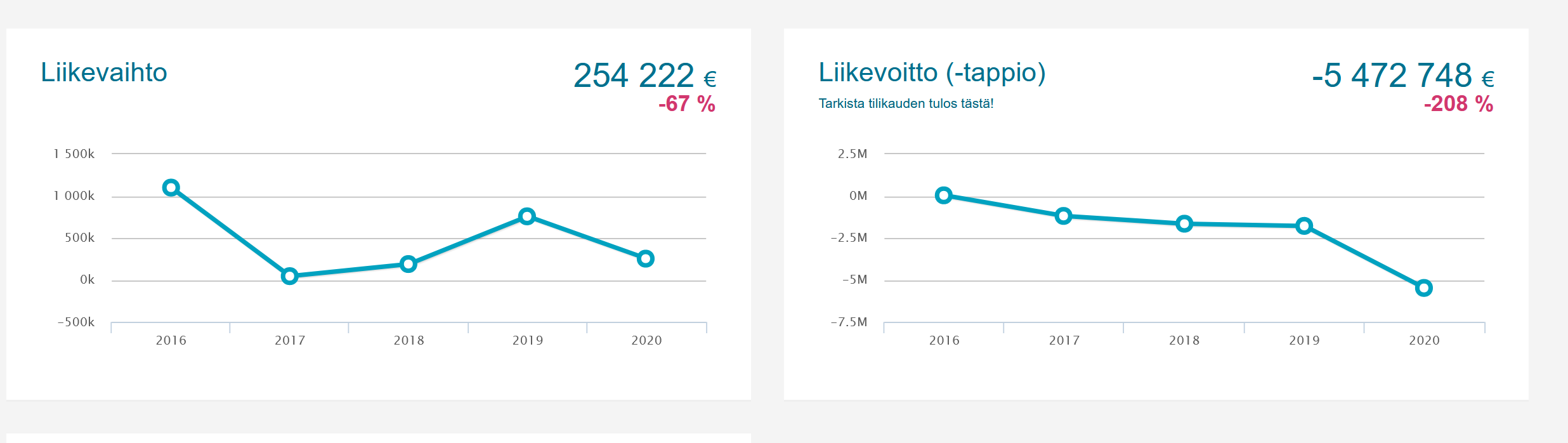
The offering certainly has some size to it, considering the figures below (taken from Asiakastieto):
image

41 Likes

This is interesting. This is partly a kind of missing link in waste management. Currently, there is no industrially scalable process for chemically separating cellulose, which cotton fiber fundamentally is, from textile waste. Spinnova’s methods make it possible to create a closed loop for textile fiber that is partly comparable to paper, where new products are made partly from recycled fiber. It is probably common knowledge how many environmental problems are associated with textile production at any stage of the chain, from cotton cultivation all the way to the lack of proper recycling. I will follow with interest.

50 Likes

This is already such an interesting company and product that I feel like participating in the offering just to support the operation.

At this point, it’s actually pointless to look at past figures, as the revenue so far has likely come mainly from pilot operations.

A couple of quotes from the announcement:

Having completed the main phase of research and development, the Company is initiating its global commercialization phase.

The Company’s technology platform has been proven functional in the Company’s industrial-scale pilot production facility in Jyväskylä, which has been in operation for over two years.

Timo Soininen, Chairman of Spinnova’s Board of Directors: the deficit of cellulose-based fibers is estimated to be approximately 45–60 billion euros by 2030

In brief:

  • Aiming for a slice of a market estimated at 45-60 billion euros by 2030
  • Manufacturing technology piloted and tested as functional on an industrial scale
  • Share issue seeks capital for commercialization
  • The product is excellent ESG/sustainability/environmental awareness/durability material
  • A host of convincing partners
    – Valmet - manufacturing technology
    – Adidas, H&M - customers
    – Suzano S.A., KT Trading AG (ECCO’s sister company) - distribution/manufacturing partners

In other words, the business engine has been built and tested. Now it’s time to truly start it up, and then hit the gas.

45 Likes

So the focus is on production technology, which is what is “paid for” here. Very interesting, but it immediately raised questions.

What is Spinnova’s moat? The company has patents, but is the company’s value and competitive advantage in them? What prevents others from doing the same? What is the share of the trendy industry in market value estimates relative to the technological moat?

9 Likes

You are right; I somehow didn’t finish writing that thought out. My point was that this offering is again quite impossible to evaluate directly based on numbers, and one has to rely heavily on estimated potential, as it is, in a way, an early-phase startup.

Hopefully, the investor/offering materials will concretely explain the production plans and so on.

7 Likes

Damn, there are too many interesting IPOs coming at once now. I wouldn’t have thought that Spinnova would be next.
There was an article about this in Keskisuomalainen a while ago, and it seemed really interesting then. This would now offer a genuine risk investment for someone who wants one. The potential for a product that can replace cotton in an environmentally friendly way is colossal in magnitude.
They are building a pilot plant in JKL, where the process will be tested on an industrial scale. If it succeeds and works, then wow. The pilot plant is being built with Suzano, and the necessary pulp is being hauled from Brazil at this stage, as I understand it. I would guess it’s related in some way to the properties of the pulp needed. There should be nothing to prevent the necessary pulp from being domestic at some point.

18 Likes

This is interesting news. I’ve been following its progress from time to time ever since I read about it a few years ago. I haven’t checked the following recollections, so I recommend verifying them.

The background is a method developed at VTT (Technical Research Centre of Finland) and apparently strongly patented, which allows spinning yarn directly from pulp. The process reportedly takes place completely without chemistry and intermediate steps once a certain type of pulp is available. The pulp, however, can be both long- and short-fibered. So, it seems very straightforward.

The potential is huge; half a percent of the fiber market is already a few billion. We’ll see what the offering will be like and what the overall situation looks like now. Even though there’s potential, the offering itself will determine whether one wants to participate or not.

There are other companies in Finland attempting to produce wood-based textile fibers, such as Ioncell, which bases its process on ionic liquids. Finland’s advantage is its very long expertise in wood-related research and a globally significant research ecosystem. There’s easily room for several players in the market.

18 Likes

Here’s an interesting comparison of competing methods: Ekologisia tekstiilikuituja Suomesta – missä mennään tällä hetkellä? - Suomen Tekstiili & Muoti

This is a combination of chemical wood processing and the circular economy, creating a completely new overall process. The aim is to leave far behind environmentally harmful cotton cultivation and viscose spinning based on highly dangerous chemicals from dissolving pulp. These are over 100-year-old methods, so it’s high time for innovation.

The market is so vast that there’s a slice of it for many players. It’s difficult to predict which production methods will prove to be the most competitive overall. What inspires confidence in Spinnova is especially that the entire value chain already includes players from every stage: the pulp industry, fiber manufacturer Lenzing, and apparel industry players.

26 Likes

Spinnova came onto my radar from the podcast 92. Lotta Kopra, Spinnovan kaupallinen johtaja: Nauti kasvumatkasta tekijältä Leadcast

The Spinnova section begins at 12:10. Partners were highlighted as an important part of the growth strategy, with Marimekko, Touchpoint, and Fortum being mentioned. Spinnova’s roots are in research work that began 11 years ago, so it has been a long journey to commercialization. I don’t know how strong of moats the partners and extensive research work (in-house expertise) create, but at least patents offer some protection.

It is undoubtedly an interesting company. I see potential for significant growth, and they have laid a good foundation before listing. Nevertheless, at such an early stage, the risks are commensurate.

9 Likes

MetsäGroup is integrating its textile fiber factory with a pulp mill alongside its partner. Could this be a winning concept in the long run? Another winning concept could be close to the textile markets.

13 Likes

In these offerings, you usually only get to subscribe for a small portion of the shares you want… I’ll have to start following those pulp producers. They’ll get extra income if and when fiber can be sold to the textile industry in the future.

2 Likes

I’ve been following Spinnova for several years now. The fiber development seems to be in a very good phase, and scaling up production has also been tested, as far as I understand. The company’s technology even seems suspiciously good: processing pulp into textile fiber without chemicals and with very little water. As I recall, all competitors (Metsä, Renewcell, Ioncell) use methods where pulp is first chemically dissolved and then extruded back into fiber form.

As far as I know, one of the company’s founders still serves as the CEO. However, I would hope that he would be replaced by someone with more experience in scaling production and strong growth. The offering seems really interesting, and I’d be keen to participate in it.

12 Likes

I found this 55-minute video. I recommend watching it to get a good understanding of the company’s operations:

Video description:

13 Likes

It seems like the anchor investors didn’t bring any benefits other than money, right? It’s been in development for a long time, but production, sales, etc., need to really gain momentum. This requires, among other things, the right people in the right positions. Otherwise, it might take a while for the revenue to truly grow. A couple more spools of yarn need to be sold… Otherwise, at least initially, this is quite interesting.

5 Likes

Hmm, have I misunderstood these things slightly, or how is it?

Renewcell has its own somewhat forgotten thread here https://keskustelut.inderes.fi/t/renewcell-ab-making-fashion-sustainable/10704/22

But as I understand it, they don’t actually make new fiber from wood fiber but from textile waste.

There, as I understand it, you are describing Renewcell’s process, claiming that such a thing doesn’t exist? And with Spinnova’s method, wood fiber is precisely the main raw material, not textile fiber :grinning_face_with_smiling_eyes:

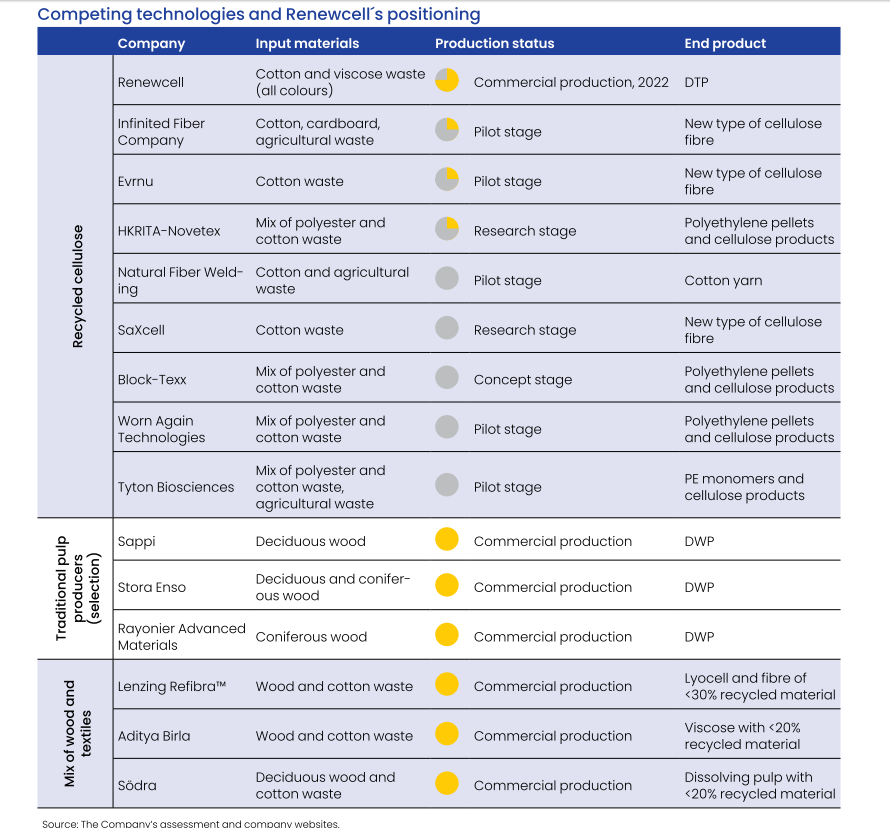
Let me also include the image @jaska1 posted in another thread about competing technologies.

When you start thinking about these things and see that although H&M has collaborated with many, and even owns 10% of Renewcell, the future and the pricing power of fiber manufacturers inevitably come to mind.

  • Yes, clothing chains want to make more environmentally friendly clothes.
  • No, they don’t want to pay more for the fiber.

Currently, collaboration collections are being made with several partners, but once the best fibers become clear, a fierce price war will begin. Clothing chains have the power to say that if the price doesn’t drop, they will use the other fiber in the future.

Regarding patenting, all these fiber manufacturers naturally advertise their own patented technology. I no longer see them as significant moats, even if they are unique, as it has been shown that fiber can be made in so many different ways already. Additionally, patents in both mechanical and chemical fields are not very generally protective. If another company develops its own chemical X to replace patented chemical Y, the process might otherwise be the same as the neighbor’s. Furthermore, in the process side, suitable flow changes or equipment changes can be made, so the end result does not change even if the process is partly different.

25 Likes

It’s a really interesting addition to the Helsinki Stock Exchange (FN), with megatrends in the background and a genuine need for the product. I’d love to hear more opinions on the moats?

5 Likes

How about Infinited Fiber Company? They have something similar planned, but maybe more for recycling cotton clothes, for example? I think I even own it indirectly through Fortum, as Fortum supposedly invested in it a few years ago. Fortum also seemed to have a collaboration with Spinnova, which I don’t consider a bad sign.

In any case, Spinnova is a very interesting company. Clothes are close to people, and their durability and ecological aspects are very important criteria for many of us. I eagerly await reading the listing prospectus. The video mentioned above gave some idea of their operations.

1 Like

Currently, they use virgin pulp in their pilot, but if you read the company’s website and linked materials, you’ll notice that they at least advertise that they can also use recycled textile fiber as a raw material.

The difference between Renewcell and Spinnova, as I understand it, is that Renewcell makes pulp from textile waste, which can be used like ordinary pulp for whatever pulp is used for. Spinnova, on the other hand, is a new textile fiber made from pulp. Pulp is also used to make, for example, viscose (a 100-year-old invention and process), but Spinnova’s thing is that the manufacturing process itself puts as little strain on the environment as possible.

It’s worth reading @Kolothos_Apollonia’s linked review of Finnish textiles and fashion: Ecological textile fibers from Finland – where do we stand currently? (here’s the link again: Ekologisia tekstiilikuituja Suomesta – missä mennään tällä hetkellä? - Suomen Tekstiili & Muoti)

It thoroughly covers at least the Finnish competing technologies, including the Infinited Fiber you mentioned. Of course, there’s no information on what’s being developed abroad, but as I understand it, Finns are at the forefront in this field even on a global scale.

A couple of quotes from the article for the lazy:

Pulp-based textile fiber innovations will replace the use of traditional materials such as cotton, viscose, or polyester in textile products in the future.

These new textile fibers have a lot in common, but they differ in their manufacturing methods. However, the goal of all these fiber innovations is to develop more environmentally friendly manufacturing methods utilizing sustainable raw materials.

SPINNOVA ® fiber is made by mechanically grinding pulp into microfibrillated cellulose (MFC). Spinnova currently uses FSC-certified wood pulp as the raw material for its material, but textile waste containing cellulose or agricultural waste such as wheat or barley straw is also suitable as a raw material.

The closed-loop manufacturing process does not require any harmful chemicals or solvents, nor does it generate waste streams. The method is significantly more environmentally friendly than the production of cotton or viscose.

14 Likes

Yes, I read that, and that’s why I wrote that the main raw material is wood fiber and the Suzano collaboration is the spearhead right now. Textile waste will come later.

3 Likes

You should read the Renewcell thread; it covers many of the same topics that concern Spinnova. I also noted that Renewcell is currently valued at a P/S ratio of 714.


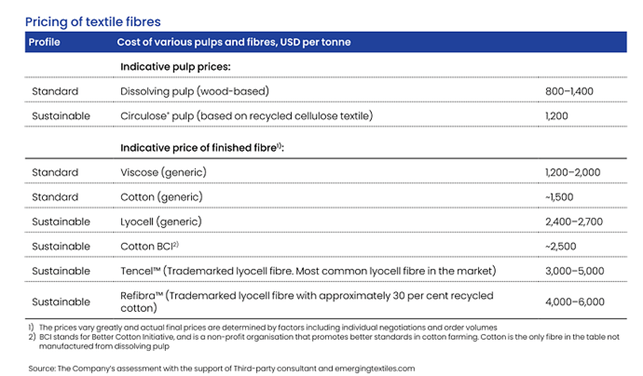
I want to highlight this price table from there. Where will Spinnova’s product position itself in terms of price among these textile fibers? Personally, I’m a bit skeptical that mere ecological friendliness is a sustainable sole selling point for a product in the long run. In the long term, Spinnova’s pulp textile fiber should also be able to compete in price with cotton, polyester, and other clothing fibers, because consumers will always buy the cheapest rag when ethical concerns are forgotten, at the latest, at checkout. Therefore, a price premium will not last in the long term. The CEO commented on this in today’s Helsingin Sanomat (Hesari) Suomalaiskeksijät kehittivät ratkaisun, joka voi mullistaa vaateteollisuuden – ”tuotteen pitäisi olla kilpailukykyinen puuvillan kanssa” | HS.fi

ULTIMATELY, the most important competitive factors in the market are the fiber’s price and properties. New fibers compete, for example, with already established lyocell in the category of environmentally sustainably produced fibers.
Spinnova’s Poranen estimates that the product from the factory currently under construction will already perform well in the price competition against lyocell. The largest costs in Spinnova’s production come from the energy required for grinding the raw material and drying the fiber.
“But when we reach truly large volumes, the product should be competitive even with cotton. The goal is to increase production to one million tons per year during this decade,” he says.

The company’s goals are indeed ambitious. It aims for 50,000 tons of textile fiber by 2024 and one million tons of fiber by 2031. So, the goal is at least to grow extremely aggressively, as production would need to increase by 53% annually from 2024-2031 to reach that target. However, they seem to be serious about this goal: Keskisuomalainen reported yesterday that Spinnova and Suzano are already planning a second factory, to be commissioned in 2024, with a production capacity 50 times that of the one currently under construction.
If the price of Spinnova’s textile fiber is indeed the same as cotton’s current price in 2031, then one million tons would generate 1.5 billion USD in revenue. And if the price is at the level of Lyocell in the coming years, the 2024 target of 50,000 tons would generate 120-300 million USD in revenue, depending on how large a premium people are willing to pay for the product. It should be noted that this still lacks consideration for how these factories will be financed and whether there will be buyers for the product, and what kind of margins will actually be achieved in the end. The return on capital could, of course, be very poor after several funding rounds, production ramp-up, and price competition.

Furthermore, I haven’t quite grasped yet whether there are any real differences between fabrics made from Spinnova/Infinna/Ioncell/Kuura/Bio2™Textile/Biocelsos fibers, or if it’s only the manufacturing method that differs. Some leading fiber and textile expert from the forum could clarify this. If all these fibers can be marketed to consumers as ecological and sustainable, and all fabrics made from them meet the technical criteria of clothing manufacturers, then garment giants will probably choose the cheapest option. All these methods currently being developed solely in Finland will certainly not become established in use.

What has not yet been brought up in this discussion is whether the company’s technology platform could also enable the recycling of wool and leather textiles, and perhaps all other natural fibers, with a completely mechanical process, if I understand correctly? As I understand it, Renewcell and all other comparable recycling methods chemically separate the cellulose from the recycled cotton t-shirt into dissolving pulp, and dissolving pulp can then be made into new textile fiber using the desired method. However, this does not work for wool and leather, which are protein-based. In Spinnova’s technology, the t-shirt or leather jacket is merely shredded into sufficiently small granules, which are then pressed back into new textile fiber (there might be some other intermediate steps). The difference here is that what Spinnova does is more about physics and apparently based on rheology, while the technologies of other manufacturers are more about chemistry. This, in my opinion, is a significant difference because Spinnova’s technology is more broadly related to textile fibers and polymers in general and bypasses the hemicellulose dissolution step, whereas the other methods are, as I understand it, essentially tied to cellulose-based products and always recycle back into that dissolving pulp form. Introducing Respin: Spinnova and ECCO leather partner KT Trading create new circular textile made from leather waste | Spinnova // https://patents.justia.com/patent/20200362474
Here is the company’s original patent, which explains the operating principle, and it is also worth familiarizing oneself with: http://patent.prh.fi/pubserver/documentpdf.jsp?iDocId=71874&sDummyParam=.pdf
52 Likes