Solar Foods Oyj - global protein production innovator

Finnish protein production innovator Solar Foods Plc is planning a listing and applying for its shares to be admitted to trading on the First North Growth Market maintained by Nasdaq Helsinki Ltd.

Solar Foods in brief

Solar Foods is a global pioneer in sustainable protein production, founded in 2017, which solves the global food production problem by offering a completely new alternative to current animal and vegetable proteins.

Solar Foods’ first product is the naturally occurring single-cell protein Solein, which can be used as a high-protein food ingredient. In the long term, Solein production improves global protein availability and increases the price and quality stability of food ingredients by decoupling food production from agriculture.
¨
The company page can be found here, so go ahead and follow it :slight_smile: Solar Foods - Inderes

Verner’s interview can be found here :star_struck: :video_camera::

Topics with timestamps:

00:00 Pasi Vainikka

00:53 What problem is Solar Foods solving in the world?

02:20 Business in practice

03:38 Microbes

04:50 Customer base

06:08 Business phase

09:00 Sales

10:05 Competition

11:20 Cost

12:50 Target market

15:00 Strategy

15:55 Own production or licensing

17:08 Financial targets

18:25 Funding situation

20:40 Shareholder base

71 Likes

Here is the briefing starting on 21 August 2024 at 10:00: Tiedotustilaisuus

10 Likes

When I first heard about the company, the first thought that came to mind was why is such a company even necessary? If humanity reaches a point where protein must be produced in laboratories instead of on farmland, we are doomed. Is the goal to help regions that lack their own agricultural land? Desertifying areas are like this, but a combination of desertification and poor transport links means these areas will no longer be inhabited.

The food industry is extremely competitive. Food processors can switch their protein sources to another as food prices change. The CEO said the company’s goal is to achieve cost parity compared to other protein sources. If an advantage isn’t gained in the price, it must be gained as a one-time investment cost. I’m still wondering why anyone would go for this.

edit:
I’m listening to the press conference. At least “total addressable market”, “winner takes all”, and “AI” (tekoäly) have been mentioned. Right.

11 Likes

I wonder where one could find the amino acid profile for Solein? It’s not available on the company’s website at least, and that is quite essential if the goal is to truly replace proteins produced by agriculture. We already have plenty of plant-based proteins, such as wheat gluten, which, due to its amino acid profile, is in no way suitable as a sole protein source.

23 Likes

Revenue 5K
Loss nearly -7M
No financial targets whatsoever, no revenue target, and a constant need for funding.
Will be loss-making for years.
Not even a real market yet; who will buy the product and what will be made from it? Ideas and guesses sure, but nothing concrete.
Solar Foods is quite a cobbled-together startup that’s waving numerous :triangular_flag: :triangular_flag: :triangular_flag:

“Using others’ balance sheets” yeah, right.
Reminds me a bit of Spinnova, with the difference that Spinnova had some kind of plan. (Which also failed)

8 Likes

More detailed information there regarding, for example, the cash position, factory investments, and this listing in general.

@Yu_Gong, the link to the company page in the opening post is broken, at least for me?

5 Likes

I’ll fix it :slight_smile: this is the right one: Solar Foods - Inderes

3 Likes

Good, good, those who participated in the crowdfunding now have an exit opportunity. With Injeq, the same thing misfired, and we all know how that ended.

In large-scale production, the Company estimates that the cost of Solein will be competitive with any other protein.

The company might be an ESG golden boy, but ultimately the most important guarantee for a product’s success is the price, and the snippet quoted from this morning’s release is the most essential part.

If I understand correctly, most of the product’s price consists of energy costs – specifically in large-scale production – and the electricity price needs to be locked in with long-term contracts. Therefore, there aren’t many potential investment countries for Solar Foods’ own “gigafactory,” unless some Saudi Arabia buys itself an image-building tool after getting bored with football.

I don’t know if “competitiveness” refers to production costs or the final price from, for example, a food manufacturer’s perspective. For a food manufacturer, a stable-priced protein source would be valuable in itself if the market price of soy were to jump due to difficulties in primary production or freight. Hedging costs would decrease, and capital turnover might also speed up if goods can be purchased at the pace of production/demand.

EDIT: I also submitted a question to the press conference. I understood the cost to be the end-user price, i.e., “cost of use.” The CEO’s answer was a bit hard to interpret, so don’t shoot me if I got it wrong.

I’m skeptical of the company’s direction until I better understand how the target price parity, or even something close to it, will be achieved. Right now, it’s like Columbus – the vision and the goal are known to the financiers of the venture, but how and where they finally end up could be something else entirely.

Still – welcome to Hesuli; there’s room here for earlier-stage companies alongside the mere bond substitutes. (And having said this, my post will be flagged in a virtual stoning by the dividend-faithful.)

37 Likes

If money is needed for investments, then why wasn’t there an IPO offering?

This just smells like an exit for Springvest; the justifications don’t really hold up.

An interesting company and there’s surely some demand, but whether it’s a good investment—I can’t say. Will follow.

14 Likes

Interesting company and product, but as an investment, it inevitably brings to mind the likes of Oatly, Beyond Meat, and other ESG food companies, along with their dismal performance on the stock market. From the video, I understood that Solein products are currently only on the market in Singapore? Before investing, I would definitely want to “Lynch” the product.

4 Likes

In my opinion, as an invention, this is absolutely incredibly great and a huge deal for humanity. I feel like this is such a big thing that many don’t even begin to understand it.

Think about if you could invent anything you wanted. It doesn’t sound bad at all: making nutrient-rich, non-allergenic food out of thin air with practically no raw materials. Without the need for farmland and water! It sounds so utopian that no one would even dare to dream of it.

The company material mentions a ton of problems this solves, so I’ll just highlight a few that I think are the most central:

  • Production is not tied to a location. There is no need for fertile soil and large amounts of water. Production could be done in Africa, for example, where there is a shortage of food and arable land. What else would solve the problem there? There are countless similar places.
  • The protein is nutritious and versatile for different foods due to its mild flavor, and it’s non-allergenic. So it suits everyone.

In a long-term scenario, production costs can be brought down so low that the price per kilo is competitive with soy protein.

So, in my opinion, very positive long-term drivers.

Whether this is a good investment case depends, in my view, on the financing. So far, it has quickly raised large amounts of capital, so at least in the eyes of investors, there is something unique and great potential here. It will need a lot of money to build its own high-volume production facility, and since there are no sales yet, the sustainability of the cash position until food permits and production volumes are in order is key.

At the moment, the production cost is high because they want to use green hydrogen, which the company produces itself with an electrolyzer using green electricity. This brings us to what I would do differently as a start-up that is not yet profitable:

Right now, this is being marketed heavily on its greenness—how food is made emission-free—and they are apparently seeking ESG money with that.

Production needs hydrogen. Is producing hydrogen the core business of such a company? In my opinion, no. They should start by making Solein with purchased gray hydrogen, which would immediately lower investment and production costs. You can still market it by saying that Solein production is possible emission-free with green hydrogen. And then let the customers produce the hydrogen as they wish or buy it for their own licensed Solein factories.

Solar Foods’ task has been to prove that Solein can be produced through hydrogen fermentation. Everyone understands how hydrogen can be produced—green, blue, or gray—even if Solar Foods doesn’t do it themselves, and through that, they understand the product’s potential with green hydrogen as well.

And in my opinion, the best (because it’s the most capital-light) solution would be to license the production method to food manufacturers who would build their own factories.

I see a massive and wonderful innovation here that has no limits :smile:. I cannot predict how well future funding rounds will succeed and if there is enough money to reach break-even. The potential is huge, and if successful, it will be a world-changing thing.

There is risk here, however, and the stakes should be set accordingly. I own, in accordance with the risk.

31 Likes

An interesting company in terms of its product, but it is precisely these missing steps toward profitability that are concerning.

A lot of grandiose visions are being painted, but concrete examples of where the product could work rely entirely on how different food manufacturers are able or even willing to utilize this protein.

The first batch is apparently going to consumers, and it would be interesting to hear user experiences on whether the product is truly competitive: New Solein-powered products launched in Singapore - Solar Foods

Inevitably, the same problems that Oatly and other similar food products have had come to mind, as other forum participants have already mentioned. Even if the idea is good, implementation is difficult, there are challenges in finding markets, and achieving positive cash flow is a distant goal. Usually, in these companies, one or two funding rounds are not enough; instead, they will be making losses for years, which is reflected negatively in the stock’s valuation trend.

On a positive note, I would see that if the products made by that Japanese company gain popularity, marketing will be easier in the future and there will certainly be interest in developing new products from elsewhere as well.

1 Like

Oatly and Beyond Meat don’t really belong in the same bucket as Solar Foods. They are in the food industry, but that’s where the similarities end. These companies produce meat-free and/or dairy-free products from raw materials (“old-fashioned” ones) produced by others. E.g., from oats or soy. Solar Foods has brought to market a protein produced in a new and more climate-friendly way. Oatly and Beyond Meat have countless competitors. Solar Foods has one, and even that one isn’t really on the same playing field.

Of course, there are still some challenges with production costs, but overcoming them is by no means impossible. I’m a bit afraid that someone will buy this off the stock exchange before it really gets up to speed.

I already have a bit of this in my portfolio, and now that trading is starting, I will likely buy more. Especially if the price dips.

16 Likes

I am quite sure that in 100 years, people will wonder why so much of the world’s surface area was wasted on cultivation and livestock farming throughout history, and why humanity, through its agriculture, polluted the Earth’s waterways and climate and destroyed biodiversity. It may still sound like a utopian idea that food is produced in a laboratory and protein is sourced from the air, but sustainable development is inevitably moving in this direction.

It is a completely different matter whether Solar Foods will be the winner here and whether the timing is right, but I personally am following the company’s development with great interest and might even be ready to invest a certain stake using a buy-and-forget strategy. Let future generations see if my thinking was correct.

40 Likes

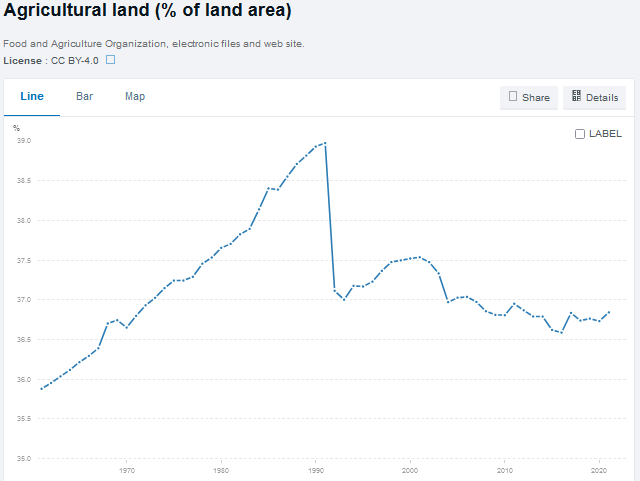
You raise some good points. I checked that according to World Bank statistics, in 2021, 36.8% of the Earth’s land area was in agricultural use. The figure has increased by about one percentage point since the 60s. Since the population has simultaneously grown from 3 billion to 8 billion, this must have been a result of increased agricultural productivity. These have a causal connection known from biology: a better nutritional situation leads, ceteris paribus, to population growth.

Regarding agriculture, there have been concerns about the fate of certain areas, such as biodiversity-rich rainforests and coral reefs.

I can’t say why producing food from the air would be extraordinary. As plants grow, they sequester atmospheric carbon dioxide with the help of sunlight and water. Carbon is the source of plant mass. I have heard that there are also modified microbes that can, for example, decompose plastic or use methane as a food source, which is also a greenhouse gas. Solar Foods replaces natural sunlight as a power source with human-produced electricity. That is why I asked whether this way of producing nutrition is truly necessary compared to, for example, producing plant protein using traditional methods.

9 Likes

It didn’t really become clear in the CEO’s interview how they intend to make money with this. The solution is technically impressive, but what exactly was the customer problem being solved here? You can’t pay out dividends for slowing down climate change, at least not for now.

You can get pork neck for €8.50 per kilo and dark soy crumbles for €1.60 per kilo at the store. Are they competing with these on price? Will they win a price war against France’s (and in the future, Ukraine’s) EU-subsidized agriculture? Every nation in the world has political incentives to keep food prices as low as possible, so these subsidies will never disappear.

https://www.lidl.fi/p/reilu-vijlapossun-kasslerpaisti/p10005949

With taste? If the product is some kind of MSG of protein, then it will surely sell at a higher price per kilo, but I’ll only believe it once an Inderes analyst gets to taste the product and finds it addictive.

Special diets? Hospital food? Some niche like that could probably be found, but visibility on this is currently poor.

A technical listing means they aren’t even seeking growth funding from investors, so it seems they are now setting the stage for a first-day share price crash and freezing the Hesuli (Helsinki Stock Exchange) IPO market for another couple of years, as other IPO candidates get spooked by the negative treatment of the newcomer :man_facepalming:

30 Likes

You can get pork neck for €8.5 per kilo and dark soy mince for €1.6 per kilo at the store. Are we competing with these on price? Will we win a price competition against EU-subsidized agriculture in France (and in the future, Ukraine)? All nations in the world have political incentives to keep food prices as low as possible, so these subsidies will never disappear.

Yes, the CEO clearly said in the interview that the aim is to win the competition on price https://youtu.be/zsKo4d4wo8c?si=0TE6MNHYTI_sY3EW&t=680. Admittedly, the examples you gave sound difficult to beat. They aren’t direct competitors, though; the intention was to sell the product for further processing. That doesn’t change the fact that competition with alternatives is tough there too if we are going by price alone.

At least for now, you can’t pay out dividends for slowing down climate change.

No. However, it can likely be used to sell more ice cream, which for some reason was brought up several times in the interview as a processed product.

4 Likes

This is the meat of the matter. Or the veggie sausage, if we’re being modern harbingers of plant-based living.

Solar Foods’ greatest hope would be to get a share of the same kind of emission trading revenue streams that Tesla, in particular, has enjoyed at the expense of more established car manufacturers. Agriculture accounts for 10-15% of CO2 emissions in the EU area.

Agriculture is not yet part of the EU’s Emission Trading System (ETS), and as Eka noted above, any upward pressure on food prices is anathema to politicians. As for the effects of the recent LULUCF (Land Use, Land-Use Change and Forestry) on emission trading, I have no idea—I doubt the EU has one either.

The CEO should still hire lobbyists and writers for sufficiently large-scale EU-funded project plans. Solar Foods is exactly the kind of green transition figurehead that political actors want to ride the coattails of to score PR points.

13 Likes

You can get pork neck for €8.5 per kilo and dark soy crumbles for €1.6 per kilo from the store. Are we competing with these on price? Can we beat EU-subsidized agriculture in France (and in the future, Ukraine) in a price competition? All nations in the world have political incentives to keep food prices as low as possible, so these subsidies will never disappear.

Pork neck has about 30% protein, and soy has about 15% protein. Solein has 60% protein. Pork neck and soy require significantly more space and resources than Solein production. Currently, the price per kilo for Solein is high, but if I remember correctly, the production cost target was somewhere around €6–7 per kilo.

Solein is one possible protein source for food manufacturers. It is not a meat substitute itself, but a raw material for those who produce meat substitutes.

I sense strong resistance to change in your comments. :smiley:

25 Likes

As a radical liberal, I don’t identify with those resistant to change. I have also previously invested in a stock that produces protein ice creams and made money on it, so I have some exposure to this topic through that as well.

It was, by the way, the company itself that chose to make meat substitution and the prevention of climate change by curbing agricultural CO2 emissions the cornerstone of its communication. Land requirements and resources are not actually relevant to an investor in themselves; only the final product’s price, properties, and composition matter.

This could very well work for various dairy-based products, provided the price is right. For example, in Creme Bonjour, cream was recently replaced with cheaper buttermilk, so clearly manufacturers have a willingness to experiment with their products. Perhaps a more likely outcome than a food revolution is indeed some dairy ingredient niche, like protein ice creams, where that cheap Solein could be used. First, however, the price needs to be brought down low enough to be able to compete on price at all. This presumably requires significant additional funding and investment to reach a large enough production scale.

18 Likes