Software eats the world: whose side are you on?

Software will eat the world and, along with it, your portfolio companies if you’re not prepared.

Better software already consumed Nokia’s phone business many years ago. Those who have invested in Qt here know that the automotive industry faces the same choice next: transform into a software company or remain a dumb piece of hardware running on Google’s Android? Another example: it’s telling that in Finnair’s ROAST, former CEO Pekka Vauramo called Finnair a software company that operates airplanes! Think about the mindset difference when he sees it that way.

Most recently, Amazon yesterday again released a slew of new Basics products, and what stood out most was a microwave oven equipped with Alexa (virtual assistant)! Software is now also entering the kitchen.

What unites all of this is that agile software companies have a massive advantage over the traditional behemoths of various industries. Fewer and fewer industries are safe from this revolution. Mikael has often said that the old rules no longer apply, and this thesis becomes more relevant every day.

Marc Andreessen’s old article from 2011 on the topic is still relevant, actually more relevant than it was then (in 2011, symbolically for this change, Apple surpassed Exxon Mobil as the world’s most valuable company…) https://www.wsj.com/articles/SB10001424053111903480904576512250915629460

Where are your bets? :wink:

7 Likes

In a way, isn’t it interesting that Amazon seems to be the only major company that doesn’t develop its own graphical user interface (GUI) libraries? If I had the choice, I’d often use voice control instead of fiddling with a small device.

Of course, GUIs won’t disappear completely as long as people have eyesight, but I think the trend is that device screens have gone away and moved to mobile phones. A simple example: Bluetooth speakers typically don’t have screens because the screen is on your phone. Will future cars need anything more than the user’s phone?

In the shorter term, I’m fascinated by what will happen around 5G and IoT (Internet of Things). I hope that virtual SIM cards (eSIM) become more common, which would mean devices could be connected to the internet more effortlessly. In an ideal situation, a device bought from a store would already be connected to the internet because there’s nothing to set up. That will be truly revolutionary when you no longer have to think about how to connect a device to the internet.

I own Nokia, but sometimes the thought has crept into my mind that perhaps some other 5G manufacturer might be better at thinking about software and service things than Nokia. Maybe there’s no need to panic just yet.

1 Like

A brave new world is coming. Have you registered yet?

Many of these things are hyped up, but the numbers and concepts don’t support the story. Do you remember when your grandmother’s washing machine lasted 25 years? Would you replace it with a more expensive model whose circuits burn out in 7 years due to planned obsolescence? What problem does a voice-activated microwave or a motion-sensor lamp solve? The Internet of Things (IoT) means that consumers will soon be buying a €20/month security package to use their freezer safely, and this is a truly defensive sector.

Our logs show that you visited our site with Apple’s latest flagship model, so you’re probably wealthy, and we’re raising our prices just for you. More personalized service. A clever algorithm recommends products that the internet user has already recently bought. We still have a long way to go to mind-reading. We don’t ask you for payment or consent for new features, because they benefit us, not you.

I’d rather stand with a company that wins consumers’ hearts with ethically sustainable operations. One who follows the times is always behind them.

3 Likes

All the smart microwaves and toasters in the world are somewhat extreme examples of tech indulgence, but I do believe that smart home devices will become more common. I’ll jump right into automating lighting and heating as soon as I move out of my rental apartment :smiley: The internet is almost more important to me than running water. You can carry water home from the store, but you can’t get a continuous internet connection without a purchased subscription. The internet is the new electricity.

Speaking of Finnair, it made me wonder: when will the first home builder do the same and say they are a software company that also builds houses? You could conveniently get an apartment from Elisa’s website, now that they even have home appliances there.

Masse recently read a master’s thesis on cybersecurity threats to the Finnish manufacturing industry up to 2022. And at the very top of the list was, surprise, surprise, IoT!

I can still tolerate a carjacking, but if some devil maliciously burns Masse’s everyday toast to a crisp, then I’ll lose my temper…

4 Likes

This is a good opening. I’m in the industry, in a startup, and I see the same phenomenon: software eating hardware. At least the margin is shifting to the software side… This was one point that woke me up to this: Hardware is easy to copy, and design is easy to copy. (One of Nokia’s biggest problems in China…) But software/operating systems or an ecosystem, built upon ways of working and applications, cannot be copied. For example, no one builds a new Linux and destroys it…

4 Likes

I agree with Juippi on that, and most likely, socially/environmentally sustainable companies will succeed better this century.

Thanks. This phenomenon is familiar to you, but I think for many investors it’s not yet set in stone, and even now positions might be built in companies that are on the wrong side of this trend. One must be constantly alert and challenge one’s own and the company’s imagination.

Edit: today’s Ponsse report reminded me that IoT and software are going into the forest too: Ponsse is investing more and more in these areas.

“In the future, timber harvesting technology and related services will continue to digitalize strongly. Growth areas will include 1) satellite- and drone-based data acquisition from forests; 2) the “Internet of forests,” i.e., real-time data acquisition and transmission for the entire supply chain; 3) sensor technology, robotics, and remote-controlled forest machines; and 4) data analytics (forecasts, simulations, artificial intelligence, decision-making support systems). With this in mind, Ponsse’s goal is to build partner networks to deliver reliable technology to customers cost-effectively. Partnering is already underway, and, for example, external employees have been leveraged through the partner network for software design and maintenance, in addition to Ponsse’s own software professionals.”

2 Likes

As an old nature lover, I am certainly pleased that forest felling permits still go through (long) processing by elected officials, so that internet-powered intensive forestry leaves at least something for future generations.

You mentioned in that media sector podcast that the strength of global social media giants from an advertiser’s perspective is the sheer amount of data. The opposite is true in print media, where you can’t be sure how many people see an advertisement. I also like numbers. However, one must be careful not to start thinking that only measurable things are real. Qualitative and cultural factors are difficult to reduce to a number. What do you think about a company whose existence is one website and a bot that chats with customers? Suspicious? Or generally, a company that has no vision of its own, but relies on optimizations based on behavioral data for all its decisions? This is, of course, a caricature.

Having seen many failed websites, my suspicions are raised by the following:

  1. If something is new technological infrastructure, is it automatically good business? (cf. utilities sector companies, dot-com bubble)
  2. Will one industry truly crush everything else, and will you, as a software company, gain a stranglehold on companies in other industries as well?
  3. Investors’ consensus on the superiority of the technology sector is reflected in stock prices, and agreeing with the consensus does not earn money.
  4. To what extent is it a question of the popularity of a few large players, which cannot be generalized due to qualitative factors?
3 Likes

Good points, Juippi! I agree that strong numbers don’t tell the whole truth; often, soft values also influence a good product and service.

A good example is Facebook, which tried to optimize its news feed based on numbers and showed users content, or similar content, that they watched for the longest and most intently. In reality, these were just cat videos, which created no real value for users in the big picture. (Not relevant content) At one point, Facebook was merely a giant cat video service until they learned and improved their algorithms.

2 Likes

Completely agree. I belong to the school of thought that emphasizes qualitative and cultural factors, especially in businesses where people are at the core.

The numbered points are also good. Railways, cars, radio, and the internet all experienced severe overpricing when the impacts of new technologies (railways were truly the “internet” of the 1850s/60s) were drastically overestimated in the short term. In the long run, they have revolutionized our lives on Earth, but they haven’t necessarily been good businesses: railways were capital-intensive, and it took a long time to find winners; initially, there were hundreds, if not thousands, of car brands, but today there are only a handful of car companies, and for example, among American brands, only Ford (and Tesla…) has never gone bankrupt in its history.

Therefore, as I stated on the podcast and would like to emphasize here, not all “software companies” will be automatic winners, and increasing competition and the multi-dimensional nature of competition will mean that challengers will likely come from unexpected directions. For example, platform businesses are very risky when young, but once they achieve a winning position, it can be difficult to take the crown from the winner (e.g., compare Google a couple of years old vs. Google today, or FB in 2008 vs. FB today).

However, it’s safe to say that those players who put software and a continuous change mindset at the heart of their business will perform better in any industry than those who stick to old models. For example, Ponsse is apparently digitalizing its own industry instead of waiting for someone else to do it for them.

This is an interesting question, does it yield returns? Right now, you would have made significant excess returns in recent years if you had followed this “consensus” (see, for example, the development of the e-commerce index). This fact may not have been as much of a consensus as one might expect. Now that almost all of the world’s 10 most valuable companies are platforms, the situation is starting to be different.

3 Likes

Help a man up the hill, not under it. This statement, I think, applies well to investing. When you temporarily finance a company in need of funding, you can receive a generous reward for your assistance. Investing in a company that does not need funding and to which everyone else gives plenty of money anyway, on the other hand, yields a low compensation for its risk. Those who believed in the forest industry when everyone thought it was a sunset industry made a good investment. Those e-commerce packages are cardboard. Those who bought Nokia when it was at the top of the mobile phone world had to witness the change in trends. Keywords contrary to current trends could be locality, depth, or encounters.

In the short term, stock prices are a voting machine, and in the long term, a scale that weighs a company’s true value. The growth of companies and industries is an interesting topic, about which I started a thread elsewhere, but it didn’t really gain momentum. Many people come to this forum asking where to invest their money and which way the stock price will turn next. However, it’s good to understand the fundamentals of business and the laws of economics. I can’t place long bets on these seemingly worthless cannabis stocks and cryptocurrencies. Succeeding by chance is treacherous.

1 Like

I’m mainly thinking about software delivered via the internet, especially companies that in some way create networks/platforms/ecosystems.

I’m looking for these because they often have the opportunity to form competitive advantages and scalability.

Lack of scalability rules out so-called consulting firms like Vincit, Siili, and others for me. I’m not saying they couldn’t be good investments and I might even invest in them, but they’re not really what I’m looking for.

Many new services are revolutionizing the world, but which of them are good businesses?

The effects of FB, Google, and other consumer-oriented digital services and network effects have been widely discussed.

Among newer services, Spotify revolutionized music distribution, but it doesn’t own its product and pays its profits to record companies.

Uber revolutionized the taxi industry, but controversies have given Lyft and local competitors the opportunity to displace it or catch up in network size.

Food delivery is definitely a rapidly digitizing industry globally. I don’t know enough about it to assess how much pricing power a winning network has. They don’t just compete with other apps but also with local grocery stores, etc. And on the other hand, a restaurant, like an Uber driver, can install all competitors’ apps. So Wolt and Foodora primarily compete for customers based on driver availability (speed) and price. The product, i.e., the restaurants, are the same for everyone.

Certainly, many other industries can be turned into networks and put on an app, and I’m keenly awaiting to see what kind of players emerge there.

Although there are other interesting things on the consumer side, such as payments, I’ve recently focused on researching SAAS (Software as a Service) services. I’m particularly interested in those operating in large markets.

I don’t know Finnish companies very well, but I’m skeptical about how successful their internationalization efforts will be. However, it is a key factor in long-term growth.

Good examples of foreign companies include large (and expensive) Salesforce, Workday, and ServiceNow-style companies whose moats are partly based on the number of integrations. For example, Salesforce’s Mulesoft acquisition was based precisely on growing this moat. If Facebook brought social media managers, these companies are changing what sales, HR, finance, etc., do within a company.

One interesting newer phenomenon is “microbrands” operating through Instagram, Facebook, and Amazon. Much is said about Amazon and e-commerce, but the microbrand phenomenon could revolutionize product sales in a way comparable to Amazon. Microbrands market through Instagrams, etc., and sell using Shopify or a similar platform.

Shopify would definitely be a company I would invest in at the right price. It leads its market, sells a scalable service, and the number of its integrations and plugins is growing faster than its competitors, which brings a competitive advantage.

2 Likes

The big Hack - How China used a tiny chip to infiltrate Amazon and Apple

Trump is widely blamed in the trade war. This is due to, among other things, the strong liberal-conservative polarization and the connections of US media to politics/financiers.

In my opinion, this is more evidence that Trump is not trying to protect his industry without good reason.

Edit: Cases like this could even be the trigger for why Trump wants to hit back at China.

1 Like

An interesting podcast interview about the innovation economy and capitalism:

https://soundcloud.com/rhodescenter/doing-capitalism-in-the-innovation-economy

Featuring experienced veteran Bill Janeway. Bill argues, quite provocatively, that true innovation requires “waste” in the form of bold experimentation, even if it leads to inefficiency and many failed attempts. But that’s how real breakthroughs are made. It doesn’t matter if the waste is in a private company’s R&D funded by investors or in state research, as long as there’s spending. If innovation is tried to be squeezed into certain economic frameworks, it’s difficult to create something truly new and revolutionary.

This brought to mind the tech giants that are really going for it with that philosophy in developing new things, perhaps Google’s Other Bets as a prime example.

Another point that can be taken from there is that even though China has an ambitious “2025” project to be the most developed technology hub in the world, being at the forefront also requires cultural and institutional change where failure is encouraged and accepted. As long as you’re just copying others, there’s obviously no visible benefit from failure. :slight_smile:

2 Likes

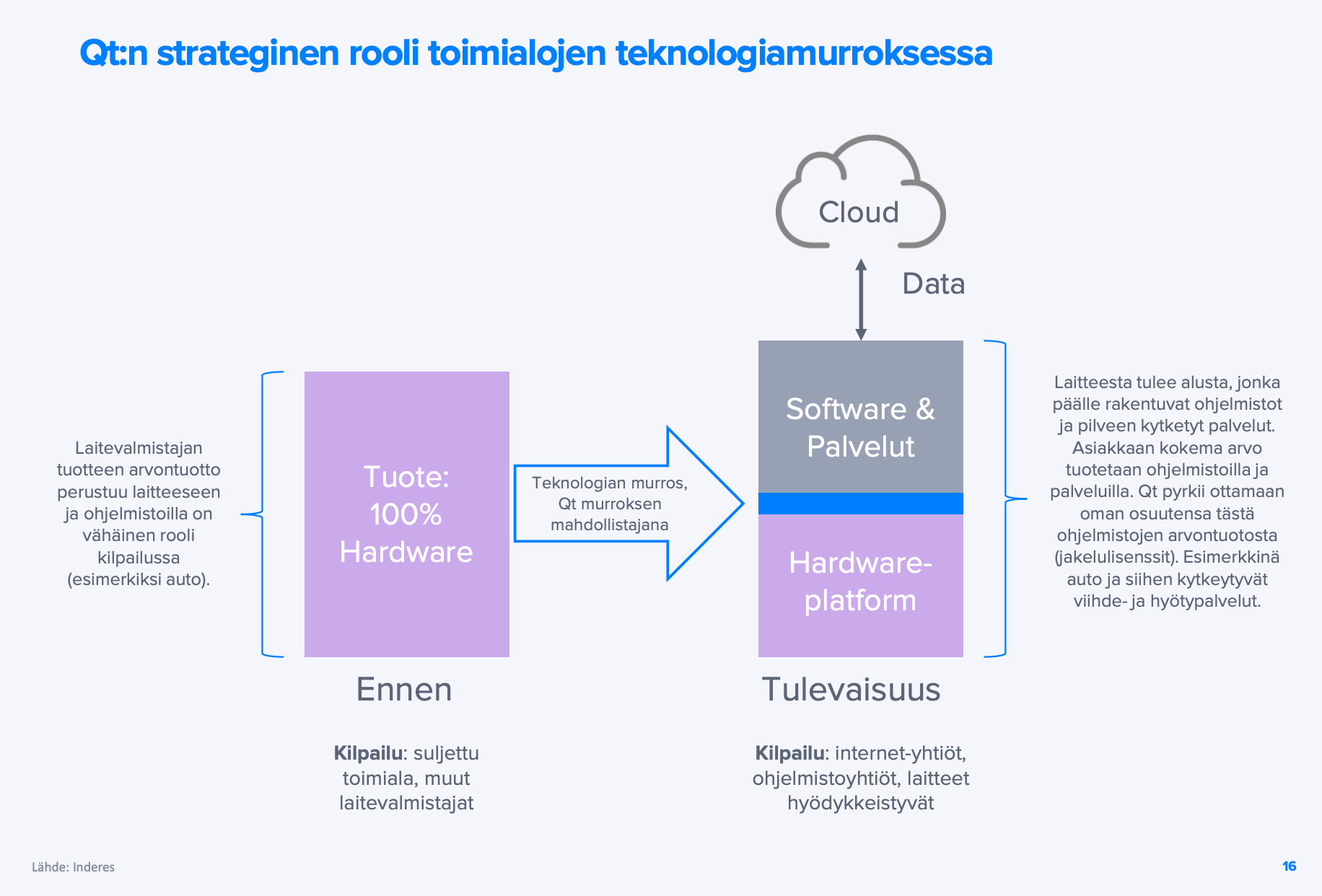
The “Software is eating the world” theme also emerges in Qt’s extensive report: technology companies are pushing into hardware, from coffee makers to cars.

We also went through this in the video, especially at the whiteboard part:

2 Likes

Honestly now, have you ever looked at a coffee maker and thought it was bad because it couldn’t access Google? A coffee maker’s job is to make coffee, and all other factors are disadvantages: susceptibility to error, power consumption, weight, slowness, price, size, etc. What on earth added value does digitalization bring to home appliances? Coffee makers are coffee makers and computers are computers.

3 Likes

The real added value is the data the device manufacturer gets… for the consumer, it’s nothing but harm

Dear Juippi,

It’s of no use, but history has shown time and again that all new technology is always adopted immediately when it’s technically possible – and preferably economically viable. The sensibility of the endeavor has always been secondary.

Uncle Masse, by the way, seems to be on the same level as Verppu and the CEO in this kind of techno-historical philosophizing. That was quite a surprise even for me :blush:

1 Like

Haha, you’re right about that; it doesn’t really affect things (yet. I have a years-old Moccamaster, and it still works great). But for example, Amazon is bringing microwaves, etc., to the market with integrated Alexa. These are part of a smart home where all devices are connected to the network. It could also well be that these are years ahead of their time. All the same, that doesn’t change the picture that software will come to the forefront and enable tech companies to spread in one way or another to the hardware sector.