Mikael’s talks on digitalization really resonated with my investment mentality.
Perhaps I wouldn’t say that digitalization alone is the path to happiness, but rather that all kinds of innovation and its central position are good for a company. Digitalization is, in a way, an easy way to innovate because it changes from day to day, but one must remember that innovations can also be of other kinds, non-digital products and service concepts, etc.
Kotipizza is my favorite stock, which is not a digital spearhead, but it has a clear vision to create the best pizza. If a company doesn’t have the guts to communicate that it wants to be the best at something, then innovation is unlikely to succeed for it. Another successful pick in my portfolio has been Finnair, which seems to have clear plans for improving services and digital aspects. And Atlassian, whose shares I regret selling
This probably sounds silly, but one of my investment criteria is to “sense” the company’s atmosphere on social media. If I don’t find a good atmosphere there (or in the worst case, employees who have lost hope!), then I don’t invest in the company.
Digitalization is an interesting phenomenon. It reminds me of the tech bubble in the late 90s, where every company capable wanted to be online because the internet offered unlimited market potential. However, fundamentals eventually caught up, and it was understood that there’s the same amount of customers and money in the world whether or not the internet is used. If a tech company can’t offer added value compared to alternatives, its existence is at stake.
Tech companies usually have excellent return on capital, which is based on their use of innovations and infrastructure that are not on their balance sheets. The “capital” generated by social media is its users, whose extracted data is leveraged for advertising. Customer flows are fast-moving – a product can become world-famous in an instant and fall out of favor just as quickly. This is difficult for investors to predict.
Digitalization itself, however, does have value. I’ve walked in a shopping mall and thought, “I wish I could press CTRL+F here and see which store has what I’m looking for.” In contrast, the value of a single SME’s data analytics (“do they click the blue or green button more often?”) seems to be mostly patching up poor website design. A company’s offering should be huge for customer segmentation to be meaningful. Customers can find what they need themselves. A profiler’s dream would be to isolate a customer in a bubble where prices are anchored to directly match their ability and willingness to pay. A latte just costs 4.95 a cup.
Digitalization is a reality, but I don’t see it as a Midas touch that doubles any company’s revenue. There’s a time and place for this as well. It’s good to periodically review one’s business idea and consider whether digitalization can enhance one’s operations.
Smart thoughts, and I’ll adapt them! Just a couple of years ago, companies defended themselves against development by mentioning technology investments, etc. Fortunately, nowadays, concrete understanding and adaptation are already required.
I remember reading about several companies that mentioned and treated digitalization as a threat instead of looking at it with fresh eyes as a challenge and becoming pioneers. When passion and thus the courage to innovate disappear, many good businesses probably fade into history?
From a work perspective, I consider digitalization on a larger scale, meaning at the level of the entire national economy, and its potential from a productivity standpoint is immense. Of course, it’s a different matter how this potential is put into practice. In some sectors that are large contributors to GDP, the adoption of new technologies is slower (e.g., healthcare), so I don’t believe it will lead to quick miracles in short-term economic growth. However, I am confident that over time, digitalization will break through, and in my own investments, I try to focus specifically on these pioneers of digitalization.
I’d like to ask Marianna about macroeconomics. If I’ve understood correctly, GDP can be broken down by sector. Different sectors can grow or shrink faster than GDP. A company that grows faster than its operating sector can only do so by gaining market share from its competitors. However, is the sum of all growth ultimately equal to GDP growth? Does digitalization, understood as increased operational efficiency, have a growth-enhancing or growth-weakening effect on trade? I have the impression that all costs are ultimately someone’s salary or capital income.
How does the use of services from foreign tech giants (like Google) reflect in Finland’s current account? I’ve attributed the anemic GDP and inflation growth of the past decade precisely to digitalization and efficient online services – they reduce the need to purchase domestic services.
Hey there! I see the effects of digitalization on productivity through the lens of how many goods can be produced with the same working hours. In this scenario, the total volume produced across the sector can be increased without (labor) costs rising. Naturally, companies that adopt new technologies faster can be early pioneers and gain market share, but the assumption is that the entire sector will eventually grow with new technologies.
It’s true that digitalization and the rise of e-commerce, for example, have somewhat lowered the price level of consumer electronics and thus affected inflation figures. However, I don’t see this as harmful to economic growth; rather, I view it as a contributing factor.
The share of digital operations in the business landscape is expanding and bringing added value to all sectors. Digitalization accelerates GDP growth and also accelerates the growth of other sectors, so digitalization does not diminish the share of other fields but only grows relatively more.
The expansion of tech giants’ operations does not directly subtract from Finland’s GDP; instead, it merely offers an opportunity to grow faster. A prerequisite, of course, is that Finland and Finnish companies keep up with the development and create products and services that will be in demand in the future.
A crucial question for economic growth is also the employees’ competence in a changing environment. If there are not enough qualified employees to use digital tools, then theoretically, digitalization would only replace people, meaning the potential for economic growth would not be utilized. When more suitable employees are brought to the market, digitalization will enable stronger growth in the long run.
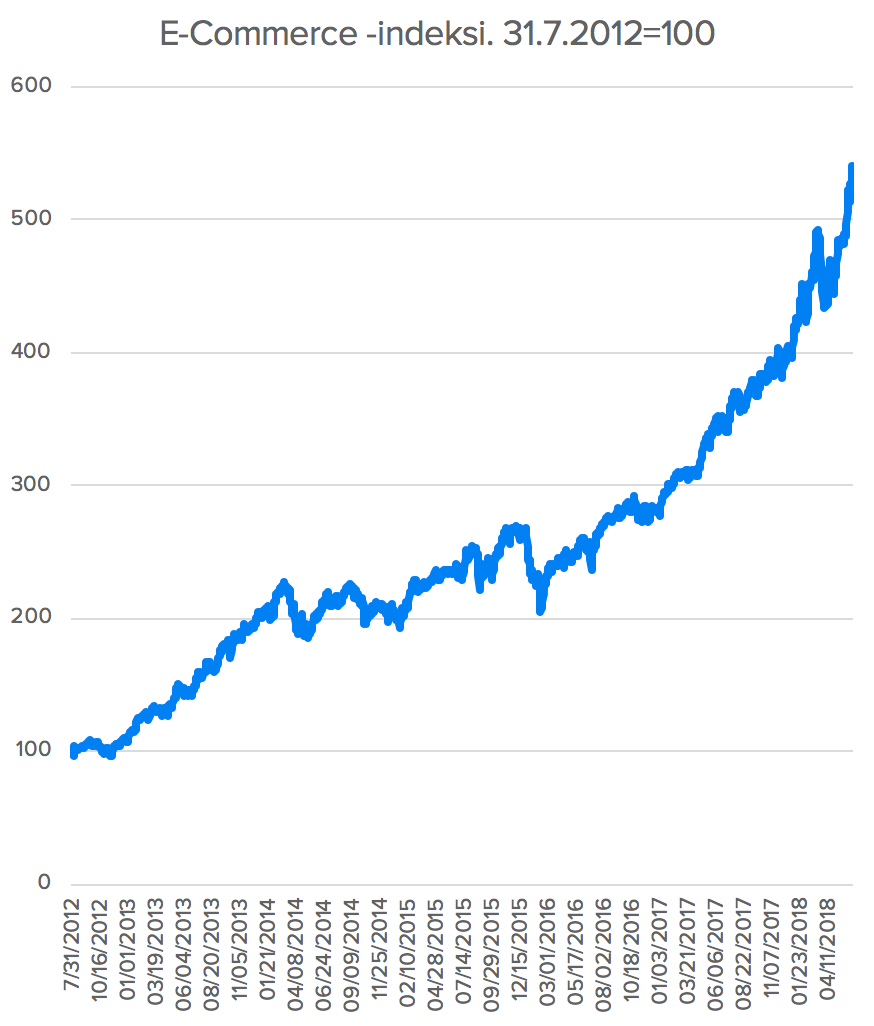
Looking at how the value of the e-commerce index, which includes Amazon, Netflix & co., has developed, it seems the market is pricing in some new world order…