Magnificent 7 companies and their future prospects

Create a separate thread for FAANGs. FAANGs are the stars of the bull market: Facebook, Amazon, Apple, Netflix, Alphabet (Google’s parent company, if anyone hasn’t noticed yet).

There’s already a thread for Facebook here, but one hasn’t been opened for the others yet.

FAANGs evoke admiration in some investors and rage in others: they are disrupting an increasing number of other industries (commerce and media being the foremost), and their grip on consumers is completely unprecedented. In addition, they are constantly strengthening their positions by buying out young competitors with their hefty cash reserves or literally driving dinosaur competitors into the ground.

An interesting aspect of several of these companies is their ability to nimbly spread into new areas (e.g., banks’ territory), which increases market potential. Furthermore, they have remained in excellent shape and have been able to build parallel platforms alongside old ones (case QQ and WeChat, etc.), thus staying afloat in a changing world, which is often a challenge for large companies. As one commentator noted, these companies are “structured” as moonshot launchpads.

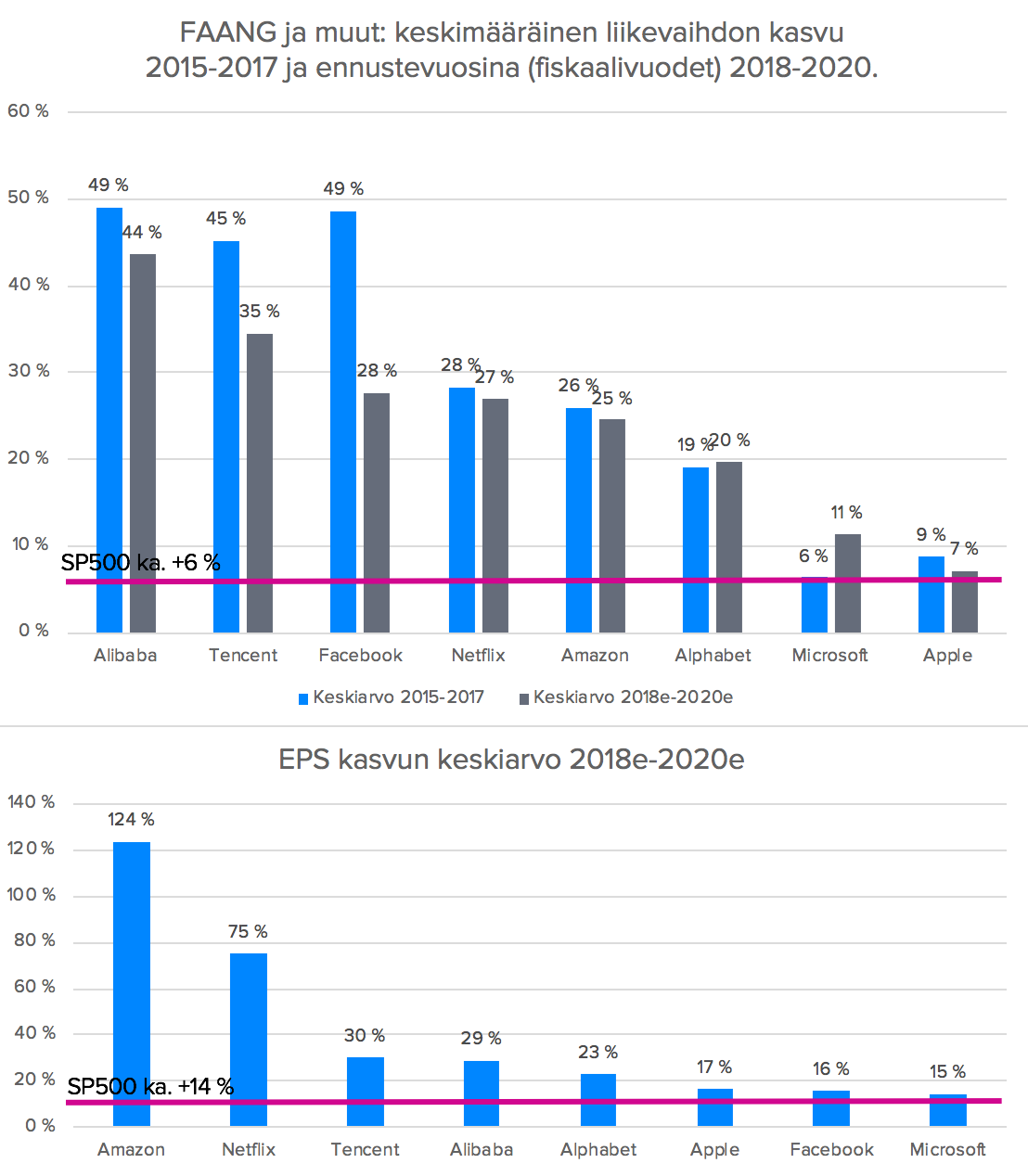
To provide some substance to the opening, I created a simple chart showing the average revenue growth of FAANGs from 2015-2017 and for the forecast years (source: Capitaliq) 2018e-2020e, as well as the average EPS growth for the same period. In addition, I included Microsoft, a trusted friend of all office workers, and a couple of Chinese internet giants, Alibaba and Tencent, for comparison. The red line from Inderes marks the average revenue and EPS growth of the SP500 index during the same period.

Their growth and growth prospects are almost entirely in a different league compared to “average companies,” but a lot of good has also been baked into the prices: P/E ratios are moving around 23-35x for the coming years.
45

Some believe these are a full bubble, while others think it’s a must to be on board with them. Regardless of your opinion on these as investments, it’s worth following these companies and their movements. Do you have FAANGs in your portfolio? Does this group of companies spark any thoughts?

Psst! This is not an analysis or investment recommendation :wink:

2 Likes

For many Finnish consumers, these companies are certainly a part of daily life. These companies, in turn, have encroached on the territory of many Finnish companies (e.g., Nokia, Verkkokauppa, Alma Media, and Sanoma).

1 Like

Thanks Verneri! Good opening. I’m invested in Facebook and Google with a small stake, but I only joined last year. I believe these companies will continue to dominate the world for years to come, as I don’t see how anyone could challenge them anymore. If someone does challenge them, they’ll just buy them out. The next race, in my opinion, will be for the winner of AI, and that winner will be the one with the most data collected and the ability to simulate the world with it. Who do you think will win that?

4 Likes

FANG is a fun term, I hadn’t heard it before. It’s interesting because they are from different industries, but what unites them is extensive digital pioneering and the platform economy. What other platform economy companies do you follow? Or even own.

While they come from slightly different starting points, they compete against each other in many areas: many consumer-focused companies simply compete for the same people’s time (cf. Netflix, whose mission is to capture as large a slice of your day as possible), in cloud services, ecosystems, who collects the best data on their users, video services, etc. In addition, their threshold to jump into “the neighbor’s” territory is relatively small; cf. Apple and Amazon in content production vs. Netflix and Alphabet’s Youtube or Facebook Watch, etc. In China, Alibaba and Tencent are competing head-to-head in many areas, etc.

The point I would like to add to the introduction is that these companies usually have a formidable “reinvestment moat” that brings a sustainable competitive advantage, but at the same time, the ability and potential to invest their cash flows with very high returns in the future, which further strengthens their position. Cf. many companies in our region that pay out all their profits as dividends “because there is nothing to invest in.”

Apple is growing like a “start-up” despite its gargantuan size https://www.apple.com/newsroom/2018/07/apple-reports-third-quarter-results/

Services are also growing strongly, and in total Apple has 300 million subscribers to various services (its own or third-party) through its devices. In the long run, Apple may be perceived more as a services company than a hardware/software company.

Its market value is approaching the trillion (one thousand billion $) mark; we’ll see if it breaks that with these results.

What are these subscriptions on Apple? Do you mean iTunes purchases or something else? :slight_smile:

iTunes, Apple Music, etc., or third-party subscriptions through Apple, as I understand it.

1 Like

Good article on tech:

Key points in brief:

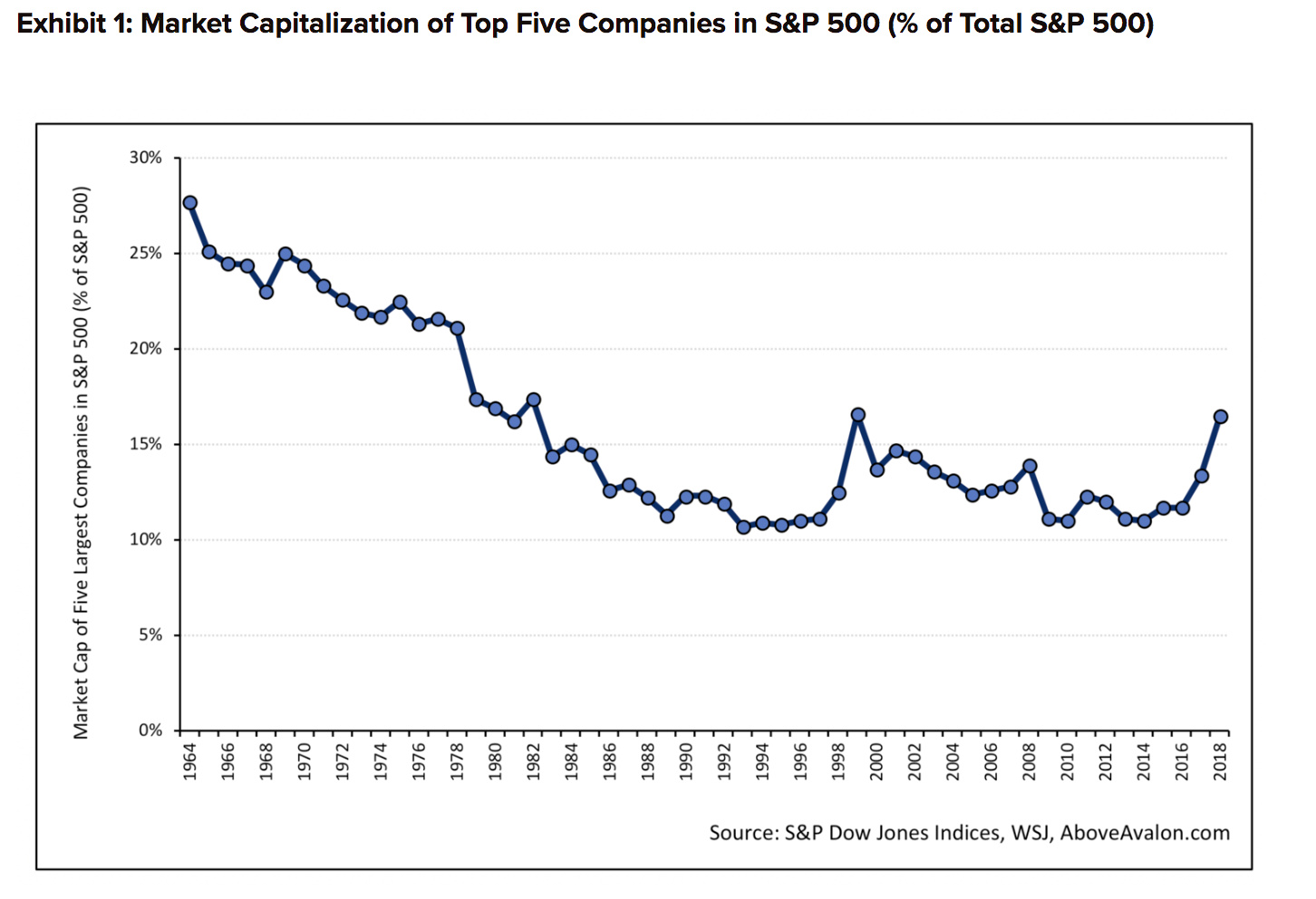
-Concerns about the market being too “top-heavy” are not new: Apple & Co. now account for ~17% of the SP500 index’s weight, but historically, the top group’s weight has been even higher:

-Although Apple, Google, and others seem to compete in the same areas and with the same raw material, data, their core focus is still in different areas, from phones to retail.

-When these companies, plus Alibaba and Tencent in China, are already so large, is the only way down? Massive war chests, loyal customers, and a large amount of data have given these companies the ability to remain relevant for a long time. These companies can afford to spend such amounts on R&D (product development) that others cannot. In addition, they are at the forefront of AI and many other future technologies.

-Despite these advantages, they also have a continuous need to remain relevant, and as their scale grows, the need to keep their culture up-to-date and fresh. Apple is still largely synonymous with the iPhone, Amazon is building a technology company and logistics on top of a legacy e-commerce business, Google is largely a search engine, etc.

What do you think will happen to Apple as the trade war worsens? Apple has a big market in China, and manufacturing takes place there. The stock price hasn’t reacted much to this yet.

I found a fairly recent news article on the topic: Apple’s suppliers are already suffering https://www.ft.com/content/fef6256e-9560-11e8-b67b-b8205561c3fe

The iPhone likely has parts from hundreds, if not thousands, of different suppliers, meaning it’s quite vulnerable to a trade war. The company’s latest quarterly report (10-Q) already comments more on trade barriers in its risks:

“International trade disputes could result in tariffs and other protectionist measures that could adversely affect the Company’s business. Tariffs could increase the cost of the Company’s products and the components and raw materials that go into making them. These increased costs could adversely impact the gross margin that the Company earns on sales of its products. Tariffs could also make the Company’s products more expensive for customers, which could make the Company’s products less competitive and reduce consumer demand. Countries may also adopt other protectionist measures that could limit the Company’s ability to offer its products and services. Political uncertainty surrounding international trade disputes and protectionist measures could also have a negative effect on consumer confidence and spending, which could adversely affect the Company’s business.”

Of course, all possible scenarios are added to these points =) But as an interesting curiosity, the word “tariff” is mentioned 5 times in the Q3 report, compared to once in the Q2 report.

It’s really difficult for the market to assess these, and in the big picture, Apple is an excellent company with huge competitive advantages. The trade war would have to escalate very strongly for this to change.

Dear Verneri, an interesting opening to the discussion. FAANG (and Kiia’s BAT) are companies with many interesting features.

Let’s take something learned from school: small companies are agile, large ones are slow. The reasoning is valid; as size grows, complexity increases, and integration becomes a problem. And generally, this is true. For example, in the case of banks, new solutions and services often originate from startup companies, which is understandable. You can’t really move a Nordea with over 30,000 employees at the same pace as a small startup with a few dozen people.

However, Amazon manages to stay at the forefront of development continuously. This is despite having around 540,000 employees on its payroll. And what’s even funnier is that an explanatory factor for this outlier situation can be found in its scalable structure. They don’t just happen to be at the top by some black swan-type chance.

3 Likes

Amazon is brilliantly structured: a disciplined retail operation with the majority of employees. At the same time, the “mother ship” itself is like a “moonshot launcher” that can constantly try new applications, services, and products with low downside risk, but with a payoff of 10x or more at best. Very few companies have managed to create such a structure for themselves. In Bezos’ words, Amazon is the best place to experiment and fail.

In Finland, a culture of failure has been nurtured by Supercell, among others; I’m not sure about others.

2 Likes

The term “moon shot” is brilliant. Are there any companies on the Helsinki Stock Exchange that have the potential to be a moon shot platform? Sanoma? It’s easy to develop other businesses on top of media.

That’s a good point about making mistakes. Keeping up with change involves several technical challenges, but they can be brought down by mere risk aversion. A startup, as it were, has nothing but opportunities to succeed, and things must be done to achieve that. There is no reputation yet.

Then, the big company, on the other hand, has a reputation to lose. Trust gained from customers. Stable cash flow. Employees, in turn, have good and stable salaries. You get to keep your job as long as you don’t mess up too badly or as long as the market doesn’t churn.

Kristo Ovaska of Smartly summarized this basic problem quite well a few years ago: “We have two kinds of companies. Group 1 a) get to see the data b) understand the data c) clearly understand what should be done based on the data d) make the necessary changes. Group 2 a) get to see the data b) understand the data c) clearly understand what should be done based on the data d) do nothing.”

Sanoma and Alma Media have various digital ventures, but it’s another matter whether their potential (e.g., the small size of the Finnish market) is enough for a true “moonshot.”

Theoretically, gaming companies could be considered potential moonshot platforms: Rovio or Next Games could, in theory, hit it big if a game succeeds beyond expectations (the market potential is global). Remedy makes rather niche games, but on the other hand, it’s a significantly “safer” bet in this regard. Cargotec’s NAVIS was supposed to hit it big ages ago; I probably wouldn’t give it such a grand title.

Of course, there are many growth companies in Finland that constantly create new products alongside older ones to support growth, but they don’t explode 10x in a short time (e.g., Talenom, Revenio, and many others).

No others come to mind at the moment.

1 Like

Gaming companies are a good pick for the moonshot category. As an example, Steam is a powerful platform for launching moonshots. They launch both their own and other games into space :smiley: If you want a game to succeed, be on Steam. All of Steam’s own games, for example, succeed because the moonshot platform gives them a little more boost than competing games, ensuring their success. I need to start researching if Steam could be a potential buy, if it’s even publicly traded.

4 Likes

Steam is a gaming platform and benefits from the success of both its own and other games. I confirmed with Ate that it takes its own 30% cut from games. So it benefits from a) increased gaming and b) downloads through its own platform, and c) in addition, it has its own games that can be moonshots :slight_smile:

The surest winners in the gaming industry are platforms that benefit from the increasing number of players and game purchases (Google, Apple, Steam, EA, Steam i.e. Valve, or Tencent, for example).

Unfortunately, Steam, which is Valve Corporation, is not publicly traded.

3 Likes

Yeah, that’s how I found out that Valve is behind Steam but you can’t invest… too bad… Welcome to Salkunrakentaja, by the way! It’s nice to see companies here in the forum bringing their insights.

2 Likes

Netflix, which burns >$10 billion annually on content production and marketing and whose mission is implicitly to take up all your waking hours, is experimenting with ads at the end of videos (initially only ads for its own content).

I’ve always been skeptical about how Netflix will ever manage to become profitable: a bigger user base requires even more content, which costs more. On the other hand, price increases have gone through without a hitch so far… Netflix also doesn’t have network effects like, for example, Facebook, and communication with the user is one-sided. On the other hand, for the average viewer, all material that underestimates aesthetic taste buds seems to be acceptable.

tenor

2 Likes