The Psychology of Investing

Early this morning, I read about a cognitive bias called the break-even effect. I’ll provide a brief overview of the topic here, as I think it’s highly relevant to investing.

Break-even effect = People seek risk when they are at a loss (if they have a chance to break even).

When a person is at a loss, they:
a) prefer small bets that offer a chance to break even.
b) avoid large bets that do not offer a chance to break even (even if they are less risky than the bets in point a).

When at a loss, people do not want to take risks if there’s no chance to break even.

This is seen, for example, in:

  • In horse races or similar events, the odds for the worst horses decrease in the last races of the day.

  • Portfolio managers who have underperformed the index take exceptionally high risks towards the end of the year.

What was interesting was that large bets (i.e., a high stake on a single bet) do not attract investors/bettors, even if they offer a more probable and less risky way to break even. Apparently, it’s quite difficult for people to lose large amounts more when they are already at a loss, so they start “playing a game of chance” by placing small bets on potential long shots. It sounds quite logical; after all, one often reads on this forum about attempts to recover losses by placing increasingly risky bets.

People who are threatened by large losses and have a chance to break even are unusually willing to take risks, even though they would normally be very risk-averse. Beware of them (or yourself in such a situation)!

A quote from behavioral economics Nobel laureate Richard Thaler, though I took the liberty of adding the part “…them (or yourself in such a situation)”.

35 Likes

Good point! This is an interesting phenomenon, and it’s certainly true that people tend to increase their risk level and take more risks when they’re playing from “behind” for one reason or another. This is likely related to people’s natural desire to stay on the winning side and avoid losses at all costs. This is also probably why losses and setbacks typically sting more than equivalent successes bring joy. Losses typically generate strong activity in the lizard brain, which blurs logical reasoning and thus impairs one’s ability to make sensible decisions.

In connection with this, I’ve also noticed a kind of bias. I’ve observed that the more wealth a person accumulates, the lower the threshold they have for taking proportionally greater risks. In a way, one could think that the greater a person’s wealth, the easier it is for them to detach themselves from the ownership of this wealth and start treating it coldly, unemotionally, and calculatingly. I’ve also experienced this bias personally, as my wealth has slowly grown, strong changes in investment wealth, in one direction or another, no longer feel like anything, unlike in the past. In a way, even if all my wealth were to vanish into thin air at once, it wouldn’t cause any particular emotional outbursts, which is a bit strange. It’s probably guessable that this has also caused some challenges in terms of risk management due to my fundamentally changed attitude towards my wealth. This may, of course, be solely my personal bias, and therefore it doesn’t necessarily apply to investors in general, but it would certainly be nice to hear if, for example, someone on this forum has made similar observations.

11 Likes

Thank you so much for this thread! This is my absolute favorite topic, and I want to explain its importance to a “tuulipuku” investor (a casual, everyday investor).

Traditional financial theory has two assumptions that would enable efficient markets:

  1. All investors have access to the same information.
  2. Investors act completely rationally.

It’s probably clear to everyone that neither of these assumptions holds true. At the same time, this offers, in an exaggerated way, two methods to gain an edge and achieve excess returns in the markets:

  1. Gain an informational advantage and analyze a company’s fair value more accurately than the market, based on fundamentals.
  2. Identify psychological factors influencing the stock market/company valuation, such as cognitive biases, and profit from them.

I would assume that most people on this forum are stock pickers and investors seeking excess returns. I’ve been involved in this hobby for a year now, and I can confidently say that I have no chance of achieving excess returns through point 1, at least not yet, or possibly ever. Fortunately, Inderes’ analyses have helped with this :wink:

Through point 2, each of us can gain an edge in the markets. Identifying and analyzing market sentiment and prevailing biases offers opportunities for excess returns. Some of these factors have already been discussed in the messages above, and to keep it from becoming too much chatter, I’ll talk about one bias that I notice strongly affects me.

The endowment effect means that one prefers a commodity they already own over a commodity offered for exchange or purchase.
In other words, this means “falling in love with a company.” We tend to hold onto companies we already own, meaning we accept a lower expected return for them than for a company we do not yet own.

24 Likes

That was an interesting way to approach the matter, and a slightly external stimulus led to the following reflection; I don’t know if it’s of any use.

That same information is indeed a flawed assumption because there is no absolute correct information. There is only human behavior. And when you add to that fact that no one is entirely rational in their actions (apart from some fictional characters, Spock perhaps being the closest to that ideal), the soup is pretty much ready.

I will now try to dissect the above statement:

  • The operations of all companies depend on the choices made by individual consumers (I, for one, cannot think of any business that is not ultimately dependent on ordinary people and their choices).
  • Furthermore, the operations of companies are also largely dependent on decisions made by people, whether we are talking about executives, employees, subcontractors, partners, or competitors.
  • As @Pyoratar previously pointed out, everything involves both individual and group-level phenomena (psychology).
  • Despite all of the above, collectively, markets can reasonably accurately predict things correctly. And in any case, markets are ultimately just about what choices we make in our various “roles” (i.e., whether we are consumers, employees, investors, etc. - most of us have several “roles”).

With the above, I only want to point out that ultimately, it is impossible to know what the future holds, and thus everything is about human behavior. This means that point 1 is also about human behavior.

Of course, as a collective, we may sometimes know more than we think, but even then, we don’t always hit the mark. And this also seems to be the core of the ‘Black Swan,’ i.e., unpredictable phenomena whose consequences can be radically different for the markets than what could have been imagined based on previous information.

Much has already been discussed above about the various means by which one can minimize the effects of these various biases and thus increase the rationality of decisions. But what if the actions of others are less rational? From the perspective of the outcome, it is essential to assess which direction others are going rather than being absolutely right about a certain issue (whether it concerns technologies, assumptions about valuing a company, etc.)?

10 Likes

It’s really important that a thread like this has come to the Forum. Even though the importance of investment psychology is often stressed, it has been discussed very little in general here, in investment media, etc. I’ve written a few messages about this topic and spoken about its importance, but what have I done about it myself… well, very little. :frowning_face: Thanks to Mauri for starting this thread. I hope it stays active, and so far, the content has been of very high quality. :slight_smile:

I asked Mauri for a bit of permission to write about this rather mundane earthly worry of mine, especially since I’m not a very talented writer. I got Mauri’s permission; the content is what it is, but I’ll try my best:

I am a passionate investor, and if I had to classify myself, I’m primarily a holder, but perhaps not the “worst” kind. :slight_smile: I’ve been investing for about 3.5 years, and for 2 of those years, I’ve done it with great enthusiasm… slowly, it has become almost a way of life. I live alone and work remotely, so the importance of investing is further emphasized.

I have five monitors in front of me, and I easily sit in front of them for over 12 hours a day. On one screen, either Nordnet or Inderes’ pages are constantly open. There’s nothing wrong with that… they’re just open in the background. But… that Nordnet “Overview” and the F5 button… it doesn’t take long to see how the situation has updated for a couple… maybe seconds.

My last investment year wasn’t very good, at least in my opinion. The index was almost constantly ahead, and almost every day I felt frustrated. The frustration was always less when the markets were closed and on weekends. It’s convenient, isn’t it, to keep Nordnet’s “Overview” open and press the F5 button easily over 100 times a day. When the markets opened, I felt frustrated, and when the US markets opened, even more so. So, throughout the day, I was frustrated, calculating if it was falling, falling even more, or if I was catching up to the index too slowly, etc. This didn’t take much time, and I could always continue working after each glance, but it did affect my mood, causing great frustration, bad feelings, stress, etc. Because I glanced often, I constantly had a somewhat unpleasant feeling. It eased up when the markets closed, and on weekends, or when I couldn’t check the situation.

I have loved ones in my life, training takes an hour a day, work is 9 hours a day, but I spend at least 4 hours a day on average on investing-related things. It is a way of life, as I have often said, but slowly I have begun to wonder what it is doing to me when I check the situation so often and almost always feel frustrated. It feels tough and I get really frustrated when things don’t go as I want… I know very well that it’s “just” investing, etc. :slight_smile:

Lo and behold… a simple solution helped this a lot, a whole lot. I can still follow investment matters just as much, and my well-being regarding investment matters is much better than before. The solution was that I visit Nordnet rarely compared to how often I used to… I still don’t visit rarely – a few times a day. The mental burden is much lighter, and in a way, I can think more long-term. Somehow, that constant checking of Nordnet strangely burdened me mentally, even if it might sound crazy to some and like unnecessary complaining, which I guess it is. :slight_smile:

Long text, and I know I could have discussed my other issues more, but I wanted to share this specific experience of mine, how easily I was able to significantly reduce my mental burden. Of course, I still have a lot of work to do in the field of “investment psychology,” but for me, it’s really great how such a small solution significantly improved my well-being.

If you have had the same problem as me, such a small change might significantly lighten your mental load, which can surprisingly affect your mind. :slight_smile: I didn’t benefit from constantly monitoring the “situation,” so this is good. I will follow this thread with particular attention and have read these previous messages several times. I hope someone found something to think about and some help from my story, even if it didn’t contain diverse, quality analytical thinking, but was just text about one aspect.

Investing should generate well-being! :slight_smile:

60 Likes

I largely agree. I was just trying to sharply separate two factors that are ultimately intertwined. I see it as psychological factors distorting fundamental analysis, which in turn guides psychological factors → a self-reinforcing loop. George Soros calls this “reflexivity.”

There is no absolute correct information, but I believe that when analyzing the market, it’s easy to start with the assumption that the market is reasonably efficient, as this avoids overconfidence bias. Therefore, proof is required to show that you are right. The market does not need to prove anything about itself, because it is reasonably accurate.

This then leads to the idea that when considering an investment decision, it makes sense to think: “Which psychological biases/which factors in market sentiment are on my side?”

3 Likes

Somehow it crossed my mind that this corona era is apt to reinforce the behavior you described. I recognize myself in that, with the difference that I “check” the portfolios’ situation only once a day.
I have found other things to do, but sometimes I spend “too much” time on these investment things when I don’t understand anything anyway. I would assume that when corona loosens its grip on the world, so-called normal activities will also take up more time, including from investing.

Besides, constant portfolio monitoring also leads to more trading and thus is more likely to result in losses for the average investor. If I have interpreted what I’ve read correctly, that is.
Stay strong, this miserable time will end someday too.

5 Likes

Edit. It went off way too early :roll_eyes:

Yep, the intention was just to continue and expand on what you started.

For me, it’s precisely the truth defined by the masses in how these markets function that is the most challenging part. Contrarian (I’d like to call it independent) thinking is natural for me, and that’s why I want to emphasize the role of other players.

@Sijoittaja-alokas, a great example! This truly seems to be a field where less is more. It’s worth noting that many successful investors have found the same, i.e., less information leads to better results.

4 Likes

I also recommend this to everyone from my own experience. Watching investments affects one’s psyche surprisingly much and it easily causes addiction. In addition, it takes time and focus away from more important things. First, one can reduce daily log-ins, then even skip a day, and before long, one can take a whole week off from the stock market. :slightly_smiling_face:

I haven’t opened my portfolio today. I glanced at the general index once and that’s enough. :slightly_smiling_face:

18 Likes

It’s a big deal when you understand these mentally self-harming things and make decisions that are good for you to solve them. I made a somewhat similar decision by hiding all numbers related to courses and money sums in an Excel file. I left visible the things that matter in the long run: fundamentals and position sizes in the portfolio. It might seem like a small thing, but cumulatively it can have a big impact if you can gradually lighten the emotional reactions brought by investment activities.

10 Likes

An excellent, instructive story from which many should learn.

This brings to mind many observations. Firstly, what you do, see, or think tends to be reinforced. So, if you constantly follow market prices, your portfolio, or performance graphs, it becomes a habit that you slip into more and more automatically. It’s important to recognize these harmful habit development curves early and make conscious changes.

Some time ago, I wrote on Twitter about Commitment Strategy = Limiting/facilitating your own choices to prevent self-destruction. This refers precisely to the measures mentioned by Alokas (beginner) that make good habits easy, fun, and automatic, and bad habits difficult, distant, and unpleasant.

For an investor, it might mean deleting broker apps, losing portfolio credentials, blocking certain stock price websites from your browser/phone, or generally talking publicly about being a long-term investor committed to not selling their best holdings (even if this isn’t true for you yet, such talk can still be a small and wise step towards the identity of a long-term investor). Additionally, it’s worth avoiding following the most audacious doomsday prophets. If you read Malinen’s pronouncements every day, doubt can eventually creep into your own mind. And I don’t mean that one should block out all negativity and talk about risks, but it’s worth considering whose stories you listen to and whose clickbait news you read. And in the stock market, optimists seem to have a slight tendency to perform better, at least in the long run.

https://twitter.com/Salkku_Mauri/status/1470727270402830338?s=20

In a commitment strategy, you can also automate or reinforce good habits. For example, automate savings, investments, or at least monthly bank transfers from your salary account to a a stock savings account (OST)/securities account (AOT). Familiarize yourself thoroughly with the companies in your portfolio, so your conviction holds even when the market is experiencing general turmoil independent of the company or only marginally affecting it. Or if you are an index investor, read books and research on index investing that will enhance your confidence that staying in the stock market is probably a better solution than constant trading. You can also create different scenarios for how you will act if a certain event occurs (simplest: “if stock Y falls with the rest of the market due to macro reasons, but the business is completely on track according to quarterly reports, I will hold my owned shares regardless of price movements”).

And hey, one more great tip: make investing fun! What motivates me a lot in investing now is that my analysis and commentary generate (positive) discussion. Few things motivate as much as learning new things, getting to discuss what you’ve studied with others, and finally perhaps even being part of inspiring someone else or helping them learn something new. What’s great about these investing circles is that the discussion is polite, positive, and constructive feedback is given back and forth. Good feedback, at least for me, makes me even more committed to using quality sources, critical thinking, thorough analysis, etc. That’s why community and fun are, in my opinion, an essential part of a commitment strategy.

I myself have learned habits such as only checking my portfolio on Nordnet when it’s at an all-time high (ATH) or near ATH. If I know that prices have fallen, I might stay out of the portfolio for months if necessary, excluding situations where I decide in advance to buy new shares (and then I buy them at the price they are immediately available).

I also don’t really look at stock charts, even though, for example, on the Inderes front page, the companies I follow are visible. I’ve somehow gradually managed this so well that even though it’s hard not to encounter stock charts or price discussions, I often estimate the day’s price for, say, Incap, Harvia, or Revenio wrong by as much as ten euros.

If you really want to commit to an upcoming delicious dinner, remove the nut bowl from the coffee table before dinner and tie yourself to the mast.

Increase the cost of succumbing to temptation. If you want to quit smoking, write a large check to an acquaintance that they can cash if you smoke.

29 Likes

Here’s an excellent podcast recommendation for the weekend:

It’s good for investors to consider their own values and how they could live a life more aligned with those values. Perhaps it’s primarily worth reflecting on one’s values and life in general, but investors should also live according to their own values. Whether that value is learning, kindness, honesty, or trustworthiness, one can strive towards it in investing too. Or if the value is family or health, then pursuing financial security can certainly be an activity in line with these values. :slightly_smiling_face:

7 Likes

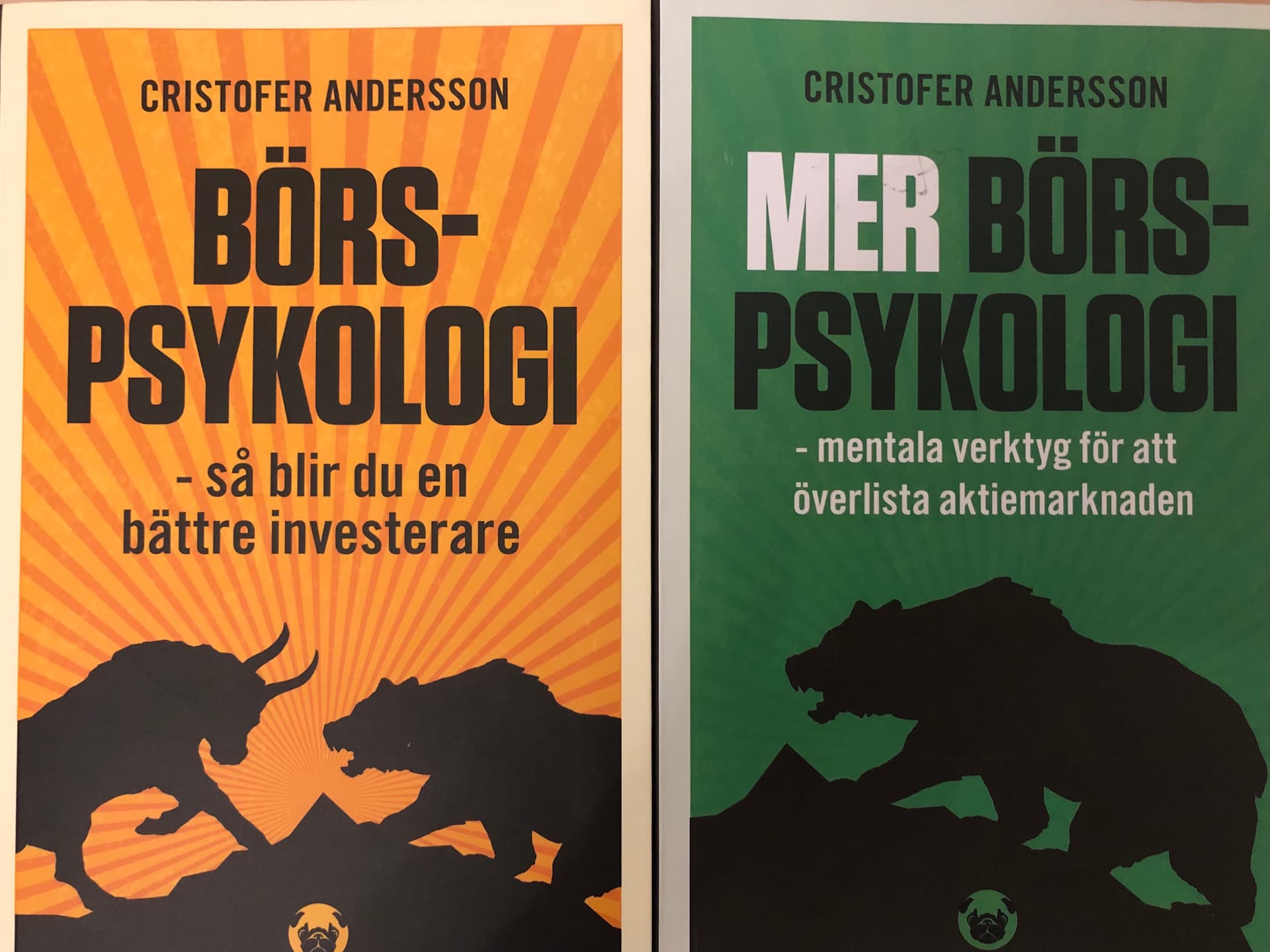
I’m currently working my way through these books on stock market psychology. Absolutely fascinating information and stories. I can recognize myself in many parts of them :grinning:

Hopefully, I’ll have time to write a book review on these at some point?

13 Likes

Thanks for the good answer and thanks for the encouragement, good luck to you too! :slight_smile:

I have fortunately managed to avoid tinkering (for some, these also work, not for me), I have thought that tinkering generally suits more experienced investors better, and I believe this observation has saved me euros. :slight_smile: Almost all my stocks have been chosen for the long term, so individual fluctuations shouldn’t affect my decisions much, so why would I check the situation over 100 times a day. Yep.

Almost everyone has been forced to reduce socializing, so I believe the mental well-being of many will improve when this time ends. Indeed, “other life” besides work and investing is very important now and always.

Thanks for the compliment! :slight_smile:

One thing that also influenced my good decision to not visit Nordnet so often was that a friend in the investing world, whom I respect, told me he checks his portfolio every couple of days, and even that sounded like he was doing it just for fun. And of course, this doesn’t mean that someone couldn’t have good reasons to check more often, and if it’s fun for them and they don’t feel it’s harmful, then why not. :slight_smile:

Exactly, it really affects a lot, and if I only focus on investing stuff, it only does harm to me. Nordnet’s “overview” and the F5 button have been the object of my addiction, fortunately I’ve only glanced and continued doing things, but the strong disappointment lingers in my head.

I spend more than a couple of hours a day on the forum, I follow news and other sources besides just Inderes, so I know that if something big happens… I don’t need to check my portfolio. :slight_smile:

Thanks Hades!

Your solutions also seem like small things in a way, but they can have great positive effects. Perhaps in some way, I’m imitating your solutions.

A good friend of mine actually suggested earlier that I visit Nordnet less often because he noticed these things affecting my mind. I didn’t fully believe him then. Fortunately, I looked in the mirror and admitted my mistake; I had to send a separate message about this to my friend as well.

Thank you, Mauri!

Your message (again) contains so much good content and food for thought that I will read it multiple times. I have now removed Nordnet from my phone’s home screen and moved it to a folder; this is already having an impact.

That “having fun” point is excellent. I remember when I owned Lion E-Mobility AG -company, it was awful to follow everything that happened then, but the community spirit and shared humor of the “lion club members” played a really important role, at least for me. I don’t recall those times with ill will, but still with humor, which was reflected in the card I made for Pohjolan Eka. :slight_smile: Image from the bottom of the card:

And then generally:
Without this Forum, I would be a worse investor and less educated, but this Forum, with its community spirit and friendliness, has made me a happier investor. It’s great to be able to share thoughts and experiences here; this is perhaps a more important place for many than they realize. I don’t think this should be taken for granted, but let’s hold on to the good things and develop this in a good community spirit. Especially threads like these move us and the Forum forward! :slight_smile:

28 Likes

Now that the market has seen quite a lot of volatility in recent months, and currently, at least many of the most talked-about stocks on the Inderes forum are on a downward trend, it’s probably a good time to ask about people’s feelings.

Let’s assume that the average forum member has a significant portion of their assets in stocks, and their portfolio is currently trending downwards (at least in some of their holdings). Which of the following best describes your attitude:

  • Anxious, pissed off, scared
  • Neutral / “Oh, have the prices dropped?”
  • Excited, interested, curious
  • Show results
0 äänestäjää

Let’s also assume that the average forum member has some kind of investment plan (even if only in thought). Which of the following best describes your behavior in relation to your investment plan:

  • I am proceeding according to my plan
  • I am considering deviating from my plans
  • I have already deviated from my plans
  • Show results
0 äänestäjää
10 Likes

I would have liked to choose more than one of the answer options.

1 Like

The poll might have been a bit messy, as I just quickly threw something together. Next time I’ll have to think a bit more carefully about what kind of answer options and poll types would be best.

3 Likes

My stock weighting is practically 100%, and my reaction to a market downturn, and to the eventual upturn, is “Oh well.” I passed my own stress test during the corona dip, and my reaction to the market downturn then was: “Oh well.”

I realize my goal is far in the future, and I’m not selling my holdings, no matter how much they might drop or even if they were to double this year. In addition to the distant horizon, my strategy also includes buying companies, not just the stock price. In my opinion, my portfolio contains 11 companies that are just as good as they were when the portfolio hit all-time highs last autumn, actually even better.

Mostly, I’m just annoyed that I don’t have cash to add more as needed. But if my aunt had balls, she’d be my uncle, maybe, or something along those lines.

36 Likes

I confess I’m absolutely terrible at understanding market logic. Or rather, I feel there’s no short-term logic to them. X times a month, the discussion turns to whether it’s crashing permanently now, only for the next day to prove otherwise. After that, the media tries its best to concoct stories that support the current stock market sentiment. At the same time, lists of top stocks for the year are made, from which a quick glance at collecting everything might lead you to believe you own half of the companies on the Helsinki Stock Exchange.

I feel this extra noise is ultimately just harmful. The result is getting buried in a jungle of details that may not have any relevance to one’s own actions. Compare it to a beginner at the gym training with a 4-split program, buying every marginally beneficial supplement because a professional does so. In reality, the greatest benefit would come from grinding basic training with a 1-split program progressively, and simple traditional home-cooked food, with an eye on protein intake, would suffice. Monitoring recovery would simply mean ensuring sufficient sleep.

Additionally, most people don’t have bottomless cash to buy every dip, even though in a buying spree it often feels that way. Usually, it means practically selling something else at the same time, believing another stock is a better choice. The result is a lot of speculation and trading costs, putting you already behind the version of yourself that would have just sat on their hands.

Yesterday, I ended up selling Tokmanni @€19.04 (average price €18.77), Harvia @€53.9 (average price €54.45), and TietoEvry @€26.64 (average price €25.88). I knew when selling that this move would likely have some kind of opportunity cost. Since the average prices were so close to the selling price, I considered this a tolerable solution for myself rather than speculating on a very uncertain future with 100% stock exposure. Originally, the plan was to sell these direct holdings off over the year. The reason: my own strategy with target prices, and the fact that I own Tokmanni and Harvia anyway through the Evli Suomi Small Cap B fund.

The reason I wrote down my rambling here is to understand my own actions and their reasons. The best way to do this is by writing them down, allowing me to revisit them later.

So that this rambling isn’t completely useless to others, I’m including a good podcast about investing at the end. Mikko Sjögren shares tips for getting rich and talks about his own failures during his career. In my opinion, the content fits the topic of this thread well.

Väkevä elämä - viisaampi mieli, vahvempi keho - Mikko Sjögren - Paremmalla raha-ajattelulla ja tunteella kohti vaurautta | Supla

27 Likes

Here are many interesting phenomena related to the psychology of investing. The company in question largely achieved all the goals that were discussed at the beginning of the year: a massive order for i3 batteries was secured for 2022, a top-tier development project for its own battery, and a BMW deal is imminent. Yet, people were left with a bad taste in their mouths regarding the company, certainly mostly because a matter unrelated to the business, the share price, fell sharply last year.

However, many were involved in this out of a herd mentality or as part of a community, or simply to have fun. This harbors a psychological trap, because humans are social animals and generally want to act in the same way as other investors. This can lead to buying stocks that one would not normally choose and holding stocks in their portfolio longer than they should.

When Lion started its irrational antics and the stock price plummeted, many (including myself) sold the company’s shares. Here lies another psychological trap. It is often incredibly difficult to buy a company from which one has lost a lot of money, even if there might be a reason to. It should be easier to return to owning a familiar company because a lot of fundamental work has already been done and the company’s history is clear, but people don’t like pain, and simply seeing the stock’s name can already trigger painful memories of losses, preventing a purchase decision.

There is also a third psychological trap: if one has lost money on a stock, they tend to become pessimistic about the company’s business. This is often particularly noticeable in turnaround investments, where those who have followed the company with a negative attitude for a long time may not see the forest for the trees and are unable to view the situation from a neutral perspective, even if the company’s business has improved significantly from previous years.

No one is immune to psychology, but one can learn to partially understand and, to some extent, control their own psychology. Since investing is a decision-making business, every excellent investor is inevitably also some kind of student of human psychology. Read psychology and make good investment decisions!

69 Likes