If the amount of the loan exceeds the amount of investments, the portfolio is 100% bought with debt. Repayments have nothing to do with it.
@Zizzler
If I understood correctly, in your thought experiment, an apartment has no value, purely as a fact. Neither real nor indirect. So if you have a 30k loan on a 300k apartment and a 15k stock portfolio, you see this as 200% leverage. This doesn’t compute for me.
13 Likes
Yes, in my opinion, an investment is bought with debt unless the money comes from your own pocket. If you take out a lump sum loan, it doesn’t matter what you buy with it; everything is acquired on debt. Leveraging with debt is profitable during low-interest periods if stock values rise similarly to last year (2021), but in normal times, you really need to be clear about where to invest the borrowed money.
@Mauri, a personal investment psychology question.
You don’t have to answer if you don’t want to, but I’d be very interested to hear how you practically achieved this performance from a mental perspective?
- What made you, and what continues to make you, believe that these are the companies worth holding in your portfolio?
- What kind of thoughts have you had along the way?
- Do you look around, do you follow the companies in your portfolio - and if so, what keeps your fingers off the buy/sell button?
And @Warren_Noutopoytatar, thanks for the good video links!
2 Likes
You could pay off €15k of the loan by selling €15k worth of shares even today. If you don’t sell the shares and pay off the loan, but instead keep the money in shares, meaning you have €15k used for shares and a €15k loan, that’s a 100% debt leverage. Are even forum members investing heavily based on emotions..?
Do you think investing with emotion belongs to psychological investing?
I somehow think it does, even though I can’t justify it with any facts yet.
2 Likes
Lately, I’ve been listening to Munger and videos about him quite a lot. I think he has said that he made his fortune by just sitting on his backside. Buffett has aptly said that investing is simple, but difficult. In the videos, I’ve come across one titled with Munger’s face saying “It isn’t hard” and then another video, “It isn’t simple.” It’s somehow comical, and the interviews might even be almost the same. My own conclusion on the matter is that the difficult part is human psychology behind it. A good example of this is Munger’s investment in Alibaba. The company’s stock has fallen, and Munger is buying the company. Many who bought or were interested in the company have now given up. Munger and Buffett say one should focus on the company’s business, not politics or interest rate decisions, etc. How many of those who have now sold Alibaba have you heard justifying it with something related to the company’s business, rather than moves by the communist party or VIE (Variable Interest Entity) related trade policy issues? Monish Pabrai sold Alibaba, but didn’t justify it with Alibaba’s business, but rather that Tencent’s business/capital allocation is better in his opinion.
I have learned that in investing, good decisions are often made when it’s difficult, and bad ones when the decision is easy. Currently, buying Baba is difficult. The decision to sell is easy. Buying an index with monthly savings is quite difficult most of the time. The Shiller P/E is high, and there are many reasons for a crash. There’s plenty of belief in beating the index and guessing correctly, but how many have reviewed the success of their predictions? When it eventually comes true, then “I told you so” will be heard.
Profiili - Wondadog - Inderes forum wrote: Regarding “loss aversion,” I remembered an empirical study (n=1) I conducted last year, during the early stages of my investing career
I only got over a €50 loss when other stocks had risen by €500. It was also interesting to note that a new stock falling to a -5% loss after purchase was annoying, but when a previously bought stock had first grown by 20% and then fallen by 10%, it hardly evoked any feelings.
That’s an excellent observation. I have intentionally created a small “play portfolio” for myself where I buy and sell stocks, and even though they are a small part of the total, for some reason they are more interesting, and being in the red bothers me. Then, a larger drop with a bigger sum in the green doesn’t bother me.
Munger often talks about “fiddling around,” and I do a lot of that myself, and it’s extremely difficult to focus on what’s essential. I have those number-crunching Excel sheets and I use technical analysis. The best investment opportunities are clear. Yet, I should have the patience to sit on my backside and wait for an opportunity and focus on the best ones. Still, I look for something better and easily fall for something that, upon short review, is no better than what I’ve found before. I know that in my case, it’s the fast thinking mentioned in the thread. It comes from following the stock markets and “we’re at the bottom” or I assume the investment will start a “strong ascent.” I read somewhere that some investor places all their orders outside of stock market hours, and that’s not a bad option at all. You can actually trade with that too. You just set your orders in advance, and as long as you don’t move them, it works out well. Traders say that trading is about sitting on your backside, waiting for a spot and a move.
Ultimately, these things are about managing emotions and rationality. I have read research that human purchasing decisions are usually made emotionally. We buy something because we feel it’s good. How often have you encountered someone who just bought a car and says it was a bad purchase? It’s only admitted years later, after running it to the repair shop. The next car is always better for one reason or another.
In investing discussions, one can easily find the short-termism and distrust that then emerge in those behavioral studies. A good example on the forum is the discussion between Sampo’s dividend/share buyback. Share buybacks are not accepted as profit distribution; people want dividends now, immediately. It’s not accepted that one might get more dividends in a year or two, and especially more dividends for the next 20 years. Now, there’s concern about FED interest rate hikes and ECB interest rate hikes. I can tell you that over the next 20 years, the FED and ECB will raise and lower interest rates multiple times with high probability. In few forum discussions is there even an attempt to estimate earnings five years from now. These have been outlined in Inderes reports, but hardly anyone considers them.
17 Likes
Yes, 100%, I don’t know why I wrote 200%.
I really don’t understand what you’re getting at, and how this relates to investing with emotion. Or rather, I understand that you’re talking about the debt-to-asset ratio of total wealth, but you’re somehow separating stocks into a distinct entity, which are then compared to total debt. If an apartment bought with borrowed money is worthless in your thinking, then don’t stocks bought with borrowed money fall into exactly the same category? That’s quite harsh, as stocks, in this way of thinking, are always leveraged if one happens to have other loans.
Can you clarify what you mean by psychological investing? Emotions are an important part of human psychology, so it’s not necessarily purposeful or correct to consider these two as separate issues. Therefore, contemplating investing with emotion is contemplating the psychology of investing.
It’s good to note that often when talking about investing with emotion, it refers to strong emotions that sufficiently adapt a person’s experience and cognitive abilities. In other words, it refers to such emotions that are perceived to change investment behavior quite immediately at some level. In my opinion, however, these discussions should be a bit more precise and note that emotions are always present in investing at some level.
“Don’t invest with emotion” does not mean that investing should not be done with a good feeling. Instead, the phrase means: “Don’t let strong emotions cloud your thinking when investing.” Generally, positive emotions can even improve decision-making ability, as they are often thought to have an expanding effect on human cognitive capacity, while negative emotions have a constricting effect. One should not get carried away into too much ecstasy, but looking at things as rationally and neutrally as possible with a positive mindset might be the best starting point for investing.
6 Likes
Additionally, one could sell some of their internal organs to pay off the loan. 
2 Likes
-This is precisely the fact that very few investors, for example, those who have taken out a mortgage, acknowledge, for psychological reasons. Denying the use of debt leverage, in my opinion, very strongly indicates an emotionally driven decision-making process.
2 Likes
Similarly, a car (even bought with cash), food, and all other consumption are done with borrowed money if you have a housing loan 
7 Likes
In my opinion, debt should be considered through the investor’s balance sheet. From this perspective, an investor’s balance sheet might look like this:
Assets:
Apartment €300k
Stocks €100k
Liabilities and Equity:
(Apartment) debt €200k
Equity: €200k
In this case, it doesn’t really matter (as long as the apartment doesn’t need to be liquidated) that the loan is specifically for the apartment. And then, as a private individual, it’s natural to examine indebtedness through the equity ratio, which in this example would be 50%.
And I believe an investor should be aware that they are investing with borrowed money when the alternative would be to pay off debt.
18 Likes
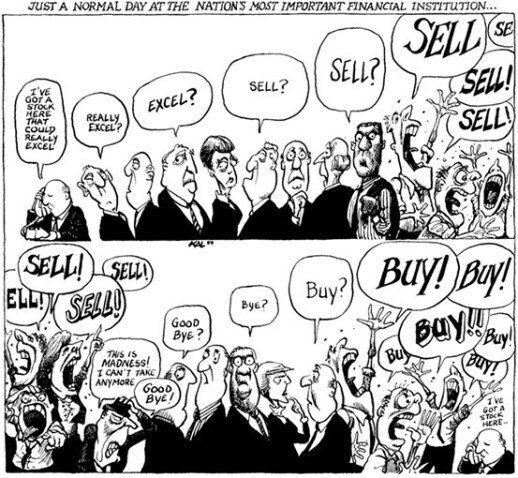
Pushing emotions aside is, in my opinion, the most important and, at the same time, the most difficult thing in investing. For me, learning this skill has taken almost ten years and is still ongoing. Gradually, I’ve reached the point where I think I can place myself ‘outside the market’ and reflect on the share price development of companies purely through fundamentals, without letting the current market sentiment influence whether I consider a given company a good or bad investment. During the worst of the COVID-19 dip, it was eye-opening to realize that a double-digit percentage drop in a company’s share price caused no greater emotional reaction than perhaps the greed to buy more if the company’s fundamentals supported it.
By emotions, in this context, I mean things like fear (of missing out on the train, of being wrong, of standing out from the crowd), love (“I bought Bittium in 2016 because next year it will skyrocket…”) or envy (“friends on the forum are making amazing returns with company X, I must buy even though its P/S ratio of 50x looks expensive…”) which are generally poor justifications for successful investment decisions in the long run. I have been guilty of all the above myself at some point, as have probably most fellow investors.
Emotions, and consequently herd behavior, largely dictate the direction of the markets daily (with Wall Street acting as the shepherd), but if one can rise above the herd into the role of an outside observer and understand how/why the markets function at any given time, I argue that in the long run, this ‘emotionless’ investing can generate excess returns compared to selling/buying according to the prevailing market sentiment.
17 Likes
Interesting discussion about leverage and how to define it. I would define it based on where the financial risk brought by leverage is directed and whether it is active. In the case of a mortgage, the leveraged instrument would, of course, be the property, where leverage is used. In this case, I would only consider the property leveraged, because by realizing it, the leverage risk also materializes in one way or another. At the same time, I would not consider a person’s other investment assets leveraged unless they are linked in some way to the leveraged assets. Also, in the case of a direct investment loan, I would only consider the portfolio leveraged when the leverage is in use, not when the risk arising from the use of leverage is not active. A person can also have leverage in reserve without active risk, in which case I do not consider the assets actively leveraged.
6 Likes
Well, loan euros are not marked in any way, as if the money for a car, apartment, or food were different.
-But buying food with a loan is a different matter because it does not involve risk; the same applies to some extent with an apartment.
-However, in stocks bought with a mortgage, the increased risk level of the loan investment is often not considered, even though it is considered in an investment loan, as if they were different kinds of money, even though they are the same.
Excellent opening @Mauri! Munger also came strongly to my mind, and he has written a fairly long chapter on the subject in his book, Poor Charlie’s Almanack. In it, Charlie gives some background on his journey into the world of psychology and lists 25 biases/human tendencies he has identified. Below is a link to that chapter, a strong recommendation for evening reading, and why not the whole book as well.
11 Likes
Here too, I’ve now delved into that psychology. There are different views, and from these, one must find a suitable thought world for oneself. For example, Trader Tom presents perfectly valid arguments for the “buy the dip” claim.
In short: Add to rising positions to increase profits. Sell when falling to reduce losses. He presents arguments why one shouldn’t reduce risk.
1 Like
@Mauri, interesting opening post! I felt compelled to write about your post from the perspective of a novice investor.
Investor psychology, the psychology of investing, the psychological factors affecting an individual’s investment decisions, group phenomena affecting investing, and whatever else there is.
You rightly mentioned, @Mauri, that “investing is X percent investing and Y percent psychology, and Y > X. You can decide the percentages yourself.”
Let’s add that Y is divided into individual psychology and group psychology.
In my opinion, the psychological factors of investing could also be considered from the perspective of social psychology. While waiting for traffic lights to change, it’s rare to find someone who waits alone for the green pedestrian light when 19 others start walking against a red light. Or few of us would walk against a red light when a kindergarten group with their teachers is standing next to us, waiting for the light to change.
I don’t know, but it feels like studying group phenomena could bring something to the study of investor psychology.
“Social psychology is a science positioned between psychology and sociology that examines the individual as a member of a group and the influence of the social environment on the individual, the individual’s influence on their environment, and internal and intergroup processes.” (Wikipedia)
I’ve also wondered, could it be that an investor controls their behavior, emotions, and thoughts better when reading analyses and making decisions alone? Would they succeed in getting better returns and avoiding wrong types of risks by acting this way? However, by acting alone, they would lose the wisdom of other investors, diverse perspectives on matters, and the observation of environmental reactions. And what then, when an investor, in all their solitary wisdom, tries to be moderate and logical, and the markets don’t act so rationally? Is it still wisdom - not to react to the actions of the surrounding group?
The calmness and wisdom brought by experience vs. the uncertainty and hasty decisions brought by inexperience.
With experience, knowledge also accumulates, and decision-making becomes easier. Or how did that go? So, from a psychological perspective, does this mean that novice investors cannot practically succeed as investors except by incredible luck?
How long are we considered novice investors - making hasty decisions and trying to draw conclusions from the wise writings of others about what might be the right solution in any given situation?
As beginners, we don’t lazily follow others or FOMO (Fear Of Missing Out), but simply try to keep up with the market when our own knowledge is not yet sufficient.
For example, I am a quite calm and rational type of person, who always in everyday life thinks before feeling, and whose behavior is quite controlled and restrained. My temperament, in my opinion, suits an investor well  .
.
But this, at least initially, has had little to do with my success in the world of investors. I strongly feel that the lack of KNOWLEDGE and understanding when making decisions has been so inadequate.
Over the past year, I have learned so much from this forum that next year I will surely be much calmer and wiser when making decisions. What a great investor career will unfold as the years pass? And when can I move out of the category of novice investors? Would 5 years of active learning be enough? Would enough knowledge accumulate in that time for the individual psychological factors influencing investing to emerge?
19 Likes
It’s great that this thread has gotten so active. Clearly, there’s enough demand for discussion on this topic.
Omavaraisuushaaste (Self-Sufficiency Challenge) already responded to some extent, but let me add a few more thoughts.
One factor is certainly that there are different kinds of people in the market at different times. When stock markets are down, prices are low, and investing is unpopular, there are presumably fewer investors, and they are less active. When the economy is booming, people have plenty of money, and stock prices are rising, investing starts to interest a wider audience. So, if you look at two points in time—a period of low prices and a period of high prices—these observation points likely have very different compositions in the market. This forgetting or ignoring of observations that fall outside the sample (in this case, people who don’t invest during bad times) is thoroughly discussed, for example, in Taleb’s “Fooled by Randomness,” but also in many other non-fiction books published by Terra Cognita. I’m not an expert in the field, but this is likely closely related to survivorship bias.
In practice, if you scroll through a list of different cognitive biases, many of them can contribute to the amplification of this phenomenon:
-
Consensus effect = everyone says now is the time to invest and be in stocks, so you start to believe it too, even if the odds are astronomical.
-
Halo effect = various investors achieve good returns, and they start to be seen as gurus who gain many followers (which, in turn, brings new investors into the market during times of high prices).
-
Confirmation bias = 1. I invest in stocks, 2. prices rise, 3. “I’m a genius!”, 4. I invest even more in stocks.
I guess most of us struggle with this to some extent, whether consciously or unconsciously. It’s probably quite characteristic of humans to prefer immediate rest and quick pleasures over delayed gratification and wise choices. But one can always try to make small improvements little by little, and it helps to make good habits easy, fun, and attractive. And bad habits difficult, unpleasant, and hidden.
Of course, I can answer this. But it’s worth noting that this is just my own assessment, which might contain some hindsight bias that deviates from reality.
First, there are a few factors in my background and thinking that have led to a rather passive investing behavior. I believe these have had an impact:
-
My early role models as an investor were very passive monthly savers (e.g., Pasi Havia and his “Towards Financial Independence” blog).
-
I am involved with a very long investment horizon, which is practically perpetual.
-
I live a rather modest life materially; I don’t need more money in my daily life, at least not right now.
-
I know the companies I own reasonably well.
-
Many hobbies and projects have taught me to delay gratification and trust the long game.
At this point, it’s probably good to say that such a time horizon, in my opinion, doesn’t tell much about an investor’s competence yet. It’s possible that the entire portfolio will melt away in the coming years, and I’ll just sit idly watching it. And perhaps, in my case, this has been more about psychological competence than investment competence. It might even be that a lack of expertise in investment matters has protected me from making unfavorable decisions. Since I don’t understand the fine details in the numbers so well, I’ve been able to focus on simple fundamentals, which generally work quite well.
With the largest portfolio companies, things have gone something like this:
- I superficially browse different companies, for example, from the morning review or here on the forum.
- I buy an initial position in an interesting company, after which:
a) its subsequent interim reports exceed expectations, so I aggressively buy more shares of the same company.
b) its subsequent interim reports fall short of expectations, so I immediately sell my small initial position (however, I usually continue to follow the company and am ready if my expectations are met later).
I believe this is a good rule of thumb that helps to keep/increase winners and keep the proportion of losers in the portfolio small. I started with exactly the same positions in Qt, Incap, Avidly, Kamux, and Innofactor, but due to the aforementioned rule of thumb, Qt and Incap are now on the portfolio’s TOP-3 list, but Avidly, Kamux, or Innofactor are not.
And it is, of course, possible that my portfolio companies are not the ones that should be held in the portfolio now. One thought that keeps me holding on to my company selections is the following:
(Acceptable) valuation multiples are, in one way or another, the market’s opinion of a company’s value. It is really difficult to try to predict which way this opinion will change in the future. Instead, predicting a company’s earnings growth outlook is slightly easier, and earnings growth is not affected by the opinions of other investors. Therefore, I try to focus on the company’s future development instead of focusing on the development of other investors’ opinions.
This can, of course, lead to me not noticing egregious undervaluation/overvaluation in valuation multiples, but I am willing to accept this.
[quote=“Kelpieracer, post:24, topic:27734”]
What thoughts have you had along the way?
[/quote]Of course, there are certainly many different thoughts and feelings. In some way, the most interesting times are when you take an opening position in a new company, start to browse materials about the company, and as things start to accelerate, you continuously increase your share count. On the other hand, some great earnings report days, for example, with Harvia, have been such that you do quietly cheer a bit and look for a slightly better treat from the store to go with your morning coffee. Still, I never get the feeling in these situations that I should sell because I’m profitable. On the contrary, the thought of buying more comes to mind, and in my opinion, adding to winners on good news is a perfectly sensible way to act.
I can tolerate negative emotions quite well too. For example, during the corona crash, I was perhaps more amused or incredulous than anxious or scared. Of course, at that time, the portfolio was much smaller than it is now, but still, the drops were quite significant given my income and wealth level. At that time, I wrote down some thoughts in a diary-like manner, and looking back now, those writings seem to indicate that I was more curious about the event that was taking place. I have never lost sleep because of investing. Or, in fact, sometimes falling asleep might be difficult, but that is only because I am so enthusiastically pondering some company or phenomenon related to investing in my mind.
I primarily follow the companies in my own portfolio. I read everything I can get my hands on about them, especially analyst reports, investor presentations, interim reports and other releases, as well as, of course, forum/Twitter gossip and rumors. I am committed to staying invested if the company’s business develops as expected or beyond. Then I don’t have to think about whether to sell or not. Remember that hesitating is the hardest part, so it can be good to decide certain things categorically rather than moment by moment.
Of course, I also follow the market a lot, investment phenomena, and other companies. And I have to admit that at times I have also wondered if I should play around with meme stocks or jump into crypto frenzies. However, I am fairly well aware of the limits of my own expertise and the risks of such an adventure, so I have stuck to my current strategy. Since I don’t crave getting rich quickly, I prefer the path that is slower but more probable.
In fact, about a year ago, I opened an OST (savings account for securities, a Finnish investment vehicle) for myself with the idea that I could trade more often within it if I wanted to. But it immediately settled into the same strategy as my main portfolio.
37 Likes
Great opening! A couple of good books that touch on the psychological aspect of investing, but aren’t solely about it, are Howard Marks’ “Mastering the Market Cycle” and George Soros’ “Alchemy of Finance.” From Marks’ book, I particularly remember one part where Marks discusses the markets with a portfolio manager or similar during the depths of the financial crisis. Marks tries to initiate a conversation about investment opportunities, but the portfolio manager’s words only convey that the situation will only worsen and there’s no hope. This, in my opinion, is a good example of someone who has been mentally broken by a prolonged bear market. He can no longer see anything positive or turning points, but is completely locked into the prevailing trend. If we think contrastingly, when the stock market is rallying and everyone is having fun, one should try to look for potential dangers and signs of over-optimism. Conversely, at the bottom, one should actively look for signs of excessive pessimism and turning points for the better. That part in the book at least helped me tremendously to understand how different market phases easily impact an investor’s psyche if the investor is not aware of their effect.
31 Likes