Investor Communication and its Regulation

This thread discusses investor communications of (listed) companies and related regulation such as laws, decrees, official regulations and guidelines, as well as practices developed by the industry itself.

Shortcomings related to communication and regulation are suitable topics for this thread.

It is also interesting to hear why a company has been particularly successful in its investor communications.

Development proposals can be initiated here, and active participation from companies’ IR personnel in the discussion is hoped for.

@Mikael_Rautanen @Petri_Kairinen @Emmi_Berlin1 @Ville_Tolvanen @Mirko_Sampo_IR @Harri_Sieppi @Mikaeli @Markus_Myllymaki @Tomi_Pienimaki @Sanna_Rasanen1 @Pasi_Hiedanpaa @Paavo_Koivisto @Kari_Vyhtinen @LarseNi @Timo_Laaksonen @Yrjo_Trog_Norrhydro @Santeri_Korpinen @Timur_Karki @KaroliinaLoikkanen @Metsamika @Kati_Kaksonen @Mikko_Tahkola @Juha_Varelius @Olli_Nokso_Koivisto @Aspo_CEO @tatu_paavilainen @Mika_Saarinen_Raisio @Erkka_Salonen @Hanna @Jari_Pirinen_Pohjanm @Paivi_Juolahti_Harvi @Kristian_Tammela @Siri_Markula_Taaleri @tomi.lindell @Minna_Sillanpaa @Juho_Pakkanen_Heeros @Pauliina_Tennila @Otto_Pukk @Mikko_Karvinen_Nexst @Petri_Roininen @Ville_Himberg @Kiira @Laura_Pulkkinen @Karoliina_Malmi @Rosskopf @Anne_Kuokkanen @Tommi_Manninen @Jan-Erik_Lindfors @Alpo_Luostarinen @Teemu.Pynnonen @Jussi_Majamaa @Pekka_Kuusniemi @Sanna_Rasanen @Ben_Selby @Antti_Ollikainen @Ville_Ranta @atteh @ilari_koskelo @Laura_Stromberg @Satu_Mehtala @Nordec_Group @Mari4 @EsaHarju @Paula3 @Elisa_IR @Elisa_Forsman

35 Likes

(46) Silent period | Inderes: Stock analyses, model portfolio, stock comparison & morning review

Is this silent period based on some law, regulation, or a rule set by an authority?

10 Likes

Thanks @MoneyWalker! This could well become a useful forum for both companies and investors :slight_smile:

21 Likes

Now that all the company representatives on the forum are here, let’s post the results of this poll here for visibility in case it was missed.

P.S. The poll is still open and you can participate here

13 Likes

Hi, in this response, I’ll try to reflect on the matter on a general level based on my experience.

The principle of the silent period is indeed that, as a rule, there is no discussion with analysts, investors, or the media. An even more central point is that during this period, no comments are made specifically regarding matters related to financial results or the outlook. Sometimes a company may be required to disclose inside information during a silent period, and in such cases, this (and only this) topic is usually also commented on. Similarly, a silent period may sometimes coincide with an interview request that is unrelated to the results or outlook and cannot be rescheduled, and which is in the company’s interest to answer. However, these decisions are preceded by very careful consideration on the company’s part and are not made lightly.

A good basic principle—and fundamentally clearer for all parties—is that discussions on investment-focused forums take place when genuine dialogue with investors can occur. On the other hand, if a company releases inside information during a silent period that is being commented on elsewhere, such as in the financial media, the company could, in principle, engage in related discussions on investment forums as well, in the name of fairness.

As I understand it, the silent period is not based on AML/MAR regulation but is a practice adopted in Finland without a regulatory requirement. In the US, I believe this is part of SEC requirements and has subsequently been adopted here as part of disclosure practices. Consequently, there is reason to reflect on and challenge this practice and the related operating models from time to time as the world changes :slightly_smiling_face:

23 Likes

This was a good discussion starter, thank you.

13 Likes

Great opening @MoneyWalker :+1:

In Finland, a 30-day silent period becomes part of almost every company’s communication policy almost automatically, but in my opinion, this practice should be re-evaluated. Nowadays, companies often try to build a kind of earnings report spectacle, where investor communication is minimized before the interim report, and then they try to maximize “eyeballs” during the report presentation, which is too often held on a Thursday morning. This creates a significant point of discontinuity in the efficient price formation of the stock and causes a lot of price volatility at the time the interim report is released. Increased price volatility, in turn, raises the stock’s risk level and thus, unfortunately, also lowers the share price level, as the increased volatility must be priced into the company’s stock price.

Of course, I understand that there are opposing viewpoints. Management may find it stressful for the company to be under a constant magnifying glass, and a long silent period naturally provides peace of mind for operational activities. Additionally, a long silent period minimizes the risk of a potential scandal regarding interim report information being leaked to someone in advance. However, from the perspective of investors and the share price, more active and transparent investor communication is more of a positive than a negative thing.

Here are a few suggestions for those responsible for investor relations on how the IR experience could be improved:

  1. Shortening the silent period from 30 days to 14 days. The speed of news cycles and the pace of the world have increased over the years, and a month is now starting to be far too long a time to go without practicing investor communication. By cutting the length of the silent period to two weeks, you gain as much as two extra months of investor communication days per year!

  2. Releasing preliminary quarterly data before the interim report. There is no obligation to withhold business information held by the company until the interim report; preliminary data can be published beforehand. This reduces share price volatility on the report’s release day and the risk priced into the stock.

  3. Publishing monthly reports. If business processes allow for it in any way, the best solution for investors would be to move to monthly reporting, which would minimize the number of unexpected business surprises and thus also share price volatility. You can follow the example of Gofore, for instance, which very nicely publishes its monthly revenue and headcount on its website: https://gofore.com/sijoita/taloustieto/kuukausikatsaus/

20 Likes

More on the importance of investor communication and reporting.

I threw out a casual comment in a certain company thread.

Comprehensive reporting creates transparency, transparency creates trust, and trust leads to higher valuation multiples.

Casual because it was just my own opinion, and I don’t really have any actual proof of it. However, I strongly believe in its validity.

It occurred to me, I wonder if there has been any academic research on the subject? Since there are people dedicated to the field in this thread, it would be interesting to know if you have come across any papers.

I’m also tagging @Marianne_Palmu, as I understand you have studied such communication matters. Although, as I understand it, more on the central bank side.

I did a little googling myself this morning and found something like this, for example.

Taffler.pdf (73,2 Kt)

In summary, we find firms nominated for IR awards, which proxies for effective IR strategies, have higher market values. We conclude that, consistent with information and agency cost theories, effective IR has clear market impact. We believe this is the first study in the literature to have demonstrated this.

Additionally, I came across this lighter piece, which talked more about internal corporate communication.

How to Qualify and Quantify the Value of Corporate Communication

However, I’ll include this citation with a reference from there:
"Furthermore, quality external communication can entice potential investors, leading to more equity (Zerfass & Volk, 2018). "

Generally, I am of the opinion that investor relations in the Finnish stock market is at an “avot” exclusive superior level. In my view, reports are neutrally written, strategies are realistic (edit. quite a few failed strategies did come to mind afterwards), and the presence of IR on a forum like this is probably unique even on a global scale. I thank you for that! :folded_hands:

However, valuations on the Helsinki Stock Exchange are languishing and foreign investors have vanished (edit. quite a strong expression), so something needs to be done. At least after I’ve first loaded up my leveraged portfolio with Finnish companies.

13 Likes

Here is an example of completely failed investor communication:

F-Secure Corporation | Inside information | 08.09.2023 at 21:15:00 EEST

Inside information, profit warning: F-Secure lowers its 2023 outlook for revenue and adjusted EBITA

A profit warning should be issued immediately and without undue delay once it is realized that the guidance will not be met. It is completely pointless to try to explain that someone was crunching numbers in Excel at a bar on a Friday night and noticed that revenue and EBITA would fall short of the previous guidance. Of course, it is somewhat understandable that in communication there is a “dark side” temptation to time negative news for Friday night, so that it receives as little media attention as possible while market participants are away for the weekend. This, however, always backfires, because such cowardly behavior always signals low self-confidence from the company’s management, as well as a lack of respect for the owners.

12 Likes

On the other hand, I guess this is slightly better than negative profit warnings issued at 6:20 PM. Now everyone has the chance to digest this over the weekend and fairly slaughter the stock on Monday? :sweat_smile: Sigh, as a shareholder, this really made my weekend…

10 Likes

That certainly ruined the analysts’ weekend, at least.

7 Likes

There really should be a clear and uniform time window for issuing these profit warnings, as certain companies clearly disregard the current “immediately” requirement whenever they feel like it.

Personally, I could support a system where warnings are announced either, for example, at 09:00 on weekday mornings or 19:00 on weekday evenings, always in the next possible window. The basic idea would be that announcements are not published during trading hours unless it is absolutely necessary.

The change wouldn’t necessarily guarantee that a company reports guidance changes immediately, but at least it would prevent them from “pulling a Kamux” (releasing a bulletin at 18:20—seriously, guys) or hiding a profit warning by publishing it around Saturday midnight like F-Secure did. But then again, no model is perfect…

10 Likes

This IR regulation certainly feels quite unclear, it must be admitted. There seem to be various “rules” circulating as tacit knowledge, but (at least in investor circles) it’s not really known what they are based on.

Let’s say I become an IR Director at a large company; what are the key laws, regulations, and IR regulatory guidelines (e.g., from the FIN-FSA) that I should know like the back of my hand? In which documents can one find concrete information or guidance on, for example, what constitutes inside information? Or how guidance is defined (e.g., these notorious “revenue will grow significantly” quips)?

I don’t doubt that the law, regulations, and the guidelines derived from them allow for even quite arbitrary interpretations, but surely there must be plenty of existing best practices, failed practices (and perhaps warnings or legal precedents resulting from them), and authority-recommended procedures for these matters?

And if there is no playbook or guidance, wouldn’t there soon be a significant market niche for some fundamental and investor-friendly IR legislation consultancy?

Could an IR expert, for example, shed light on their go-to documents or the logic typically used to resolve these questions? Who in Finland is asked for help if one’s own expertise is not enough?

10 Likes

I’m not an IR expert, but CG (Corporate Governance) is familiar enough.

Määräys- ja ohjekokoelma - Sääntely - www.finanssivalvonta.fi (regulations are binding according to the FIN-FSA’s view)

I would say a good starting point for a listed company is also the listing manual, which covers general matters as well as corporate governance and the financial calendar.

Listed companies often have both internal and external lawyers. Those legal experts can be reached by phone if needed to explain how things work. As you can quickly notice by browsing the FIN-FSA regulation page, the amount of regulation is very extensive. This is why large law firms have their own capital markets teams, whose lawyers are familiar with these intricacies.

The Securities Markets Act is at least good to know, and unfortunately, the regulatory package I linked from the FIN-FSA should be mastered to some extent. Sektorikohtainen sääntely - Sääntely - www.finanssivalvonta.fi there you can find sector-specific regulatory sets.

By the way, some companies disclose what phrases like “significant growth” or “decline” mean in terms of percentage ranges in their communications. Otherwise, there isn’t much set in stone. Regarding vague adjectives in regulations, the euro limits for the content are often established through case law.

Regarding inside information and other abuses, the Market Abuse Regulation (MAR) is quite heavy. It’s legalese, of course, but that’s where inside information is defined:

  • information of a precise nature, which has not been made public, relating, directly or indirectly, to one or more issuers or to one or more financial instruments, and which, if it were made public, would be likely to have a significant effect on the prices of those financial instruments or on the price of related derivative financial instruments. (MAR Article 7.1 subparagraph a)

Of course, the matter is further clarified there to some extent, but not surprisingly, there is quite a lot of regulation.

8 Likes

I’m commenting here since there are investor relations professionals present.

Even better if these were open to everyone from the start. A solution already exists:

https://www.inderes.fi/fi/tiedotteet/inderesin-uusi-ratkaisu-mahdollistaa-kaikille-avoimet-analyytikkopuhelut

Thanks, by the way, @Hoyhoy for your previous comments.

I believe the possibilities exist.

However, I somewhat doubt how much high-quality legal expertise is on the payroll of very small companies, for example, or how much money is spent or wanted to be spent on such outsourcing. Regarding large-cap companies, I wouldn’t be as concerned, as resources are vast, processes are refined, and internal control is working.

That’s how it goes, although I think this is a really strange cat-and-mouse game with investors. Verbal guidance is like a brain teaser that can only be solved once a certain amount of figures or guidance changes have been released.

For example, Revenio Group’s previous CEO interview was really awkward squirming when the analyst asked a bit about the guidance: “Analysts and investors can then ponder for themselves what the guidance actually means.”

Juha quite deservingly countered with something like “Well, there was a lot of talk, but no substance,” and I think the majority of investors agree.

In my opinion, Incap did a very straightforward thing when they started using actual numbers in webcasts to explain what the verbal guidance means, so no one has to guess anymore. Next year they could move entirely to numerical guidance, although I’m a bit afraid that some regulation probably prevents such a large numerical guidance range, since they aren’t used more often.

Of course, guidance that is as cryptic as possible is a great competitive advantage for a deeply analytical investor, but there’s nothing else good about it.

17 Likes

Here is a tweet thread by @Antti_Jarvenpaa about investor communication.

I’ll quote a point from that thread that is important to me:
Not everyone is fluent in English, and even if they were, at least in my experience, absorbing information is easier in one’s native language.
I don’t really know much English, and investment matters are difficult enough for me even in Finnish. I use translation software a lot, but it’s not the same as getting information in your native language. I have skipped researching companies if there isn’t enough information available in Finnish. :slight_smile:

I miss almost everything if I have to listen to investment and financial English. :frowning:

https://twitter.com/antti9arvenpaa/status/1716816260070314180

4 Likes

Target vs. Guidance

As I understand it, this thread is mainly addressed to company representatives, but I decided to deviate from the pattern and address this post to investors as well, since I couldn’t think of a better place for these thoughts.

In these times of falling share prices and earnings, many investors get excited about criticizing companies for the guidance they provide and the targets they set. There is a seed of development in criticism, I admit, but it often feels like investors forget the difference between a target and guidance.

Searching Google, a target is defined as follows:
“A target describes the state of affairs or change that one wants to achieve through action, rather than the action itself.”

I personally latch onto the phrase “wants to achieve.” I’ll approach this with an anecdote:

Here in Luxembourg, an American coach—who later made an impact in Finland as well—joined the national hockey team. He wrote as the title for the plan presented to the federation: “Olympics 2026 and how we’re gonna get there.” As the team manager at the time, I recommended he wipe a certain part of his body with said paper, but being a jovial person, I reminded him that it might be wise to first take his head out of that same place. Regardless, I think his point about creating a ridiculous target and starting to build a strategy for it also had merit. Even if Luxembourg hockey achieved only 1% of that target, it would be progress. In the end, I think it was already great to be part of the Olympic movement and organize the qualifiers in our home village, where Kyrgyzstan bitterly took the advancement spot from us. However, the house was full for every game, the TV cameras were there, and the guys on the team were damn committed.

Anyway, enough about that.

How this relates to investing: a target is a target. As @Harri_Sieppi mentioned, as a company, they want to set high targets instead of playing it safe. Now, as a public company, one has to consider what is a good public target and what is an internal one. I’ll return to ice hockey. I would argue that in the Hockey World Championships, there are about 4–6 teams that set a target of winning the gold every year. To me, it’s absurd to claim that 3–5 of them fail every year. It wouldn’t make sense for the Finnish national team to set a target of “places 2–3,” even though they are more likely. Also, if the Finnish national team wins the championship, say, twice in four years, I don’t think it can be said they failed in their targets.

I drifted into hockey again. I’ll try to get back to investing.

Let’s pull a name out of a hat, “Norppa,” for a growth-oriented company. Norppa sets a target of 20–30% revenue growth for the coming years. Does that mean the company will achieve this target every year? In my opinion, no. Does it mean the company will have achieved 20–30% growth after n years? In my opinion, no. The company has set a target, a sort of dream scenario. The same dream scenario would happen if the Finnish hockey team won the championship every year.

It is therefore important to remember that a target is not guidance, and an investment decision should not be built based on a target.

Guidance: “The Finnish national hockey team’s guidance for 2024: The team will achieve places 1–4 in the World Championships played in Czechia. The guidance may be revised depending on the number and quality of players available from the NHL. The group stage matches and success in them may also affect the accuracy of the guidance.”

Target: “The Finnish national hockey team targets the world championship in the Ice Hockey World Championships to be played between 2024 and 2027.”

As a final note, it should be mentioned that for limited companies, exceeding a target is not always desirable. As an example, a comment from CEO @Mikael_Rautanen. I remember him mentioning that too much growth would no longer be manageable and could degrade quality when the organization can’t keep up.

23 Likes

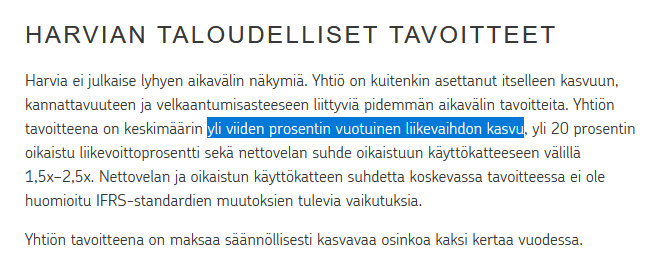
Great post! As an example of a company that communicates its targets poorly to investors, we could take Harvia, for instance, whose target for a long time has been an annual revenue growth of over five percent :grinning:

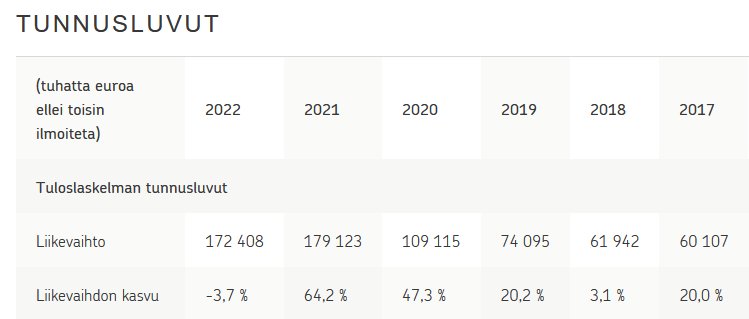
When reflecting that target against these actual revenue growth figures, it is indeed hard to understand who this target serves and why it exists :confused:

14 Likes

Great post and a good point!

Additionally, from the company’s perspective, it’s worth remembering that guidance is not a promise, and a target is even less so. In this role, I have sometimes received feedback that ”since those promises were made”… the use of this word in connection with business forecasting makes my hair stand on end. If you consider guidance or a company’s target level to be a promise, you shouldn’t invest in any company.

Setting targets is an interesting task, as for a listed company, it involves so much different external and internal dynamics.

21 Likes

Harvia’s revenue has grown by over 16% per annum since 2018. That ‘target’ of the company has certainly been easily exceeded, but at the same time, those two exceptional years of growth (47.3% and 64.2%) clearly went above that average, and because of them, the average growth has otherwise been somewhat distorted in recent years. In my opinion, Harvia’s way of expressing its targets/the target itself is rather successful, clear and above all realistic. If investors during the Covid years had understood to rely on the company’s own target growth and believe in the “premature demand” mentioned by the company, we likely wouldn’t have seen such a massive overshoot in extrapolating growth far into the future as we did. Harvia’s target is, after all, based on realistic expectations where the sauna market growth has been taken into account, so perhaps it should be “respected” a bit.

And likewise, every company should take realism into account when defining financial targets. That’s why using ice hockey as a comparison might not quite fully work, even if it is a good example.

Of course there must be ambition, and one must define that ultimate goal (hillotolppa) around which to build the strategy. Admicom has defined a vision for itself: “The number one choice as a partner in the European construction software ecosystem.” There’s ambition in that, there’s a hint of realism, it’s a great foundation for building the future, but as a vision, every investor surely understands it’s not a promise. Management should hardly waste much time on impossible things.

5 Likes