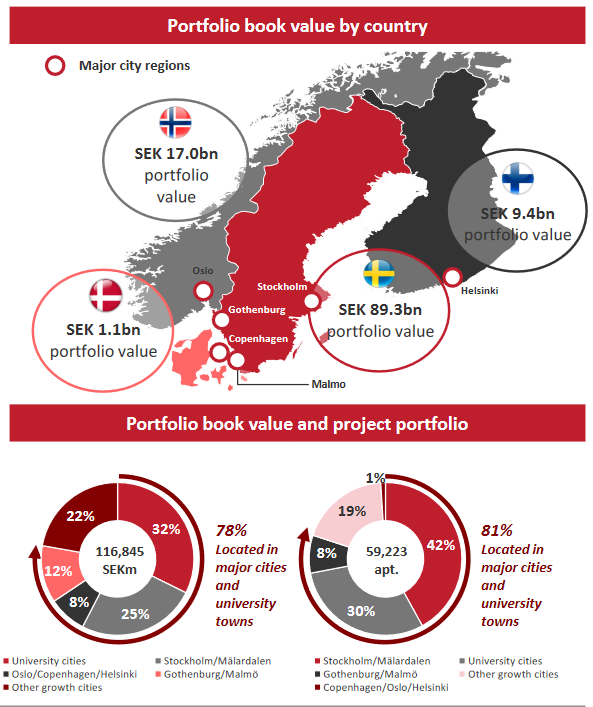
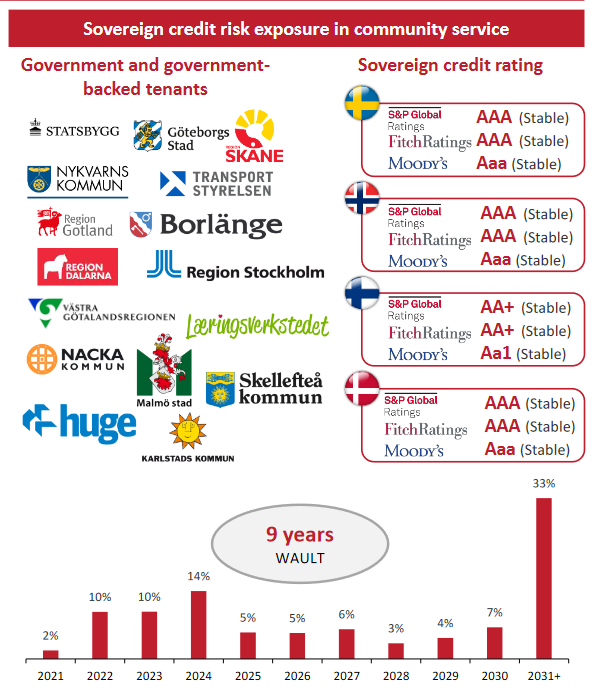
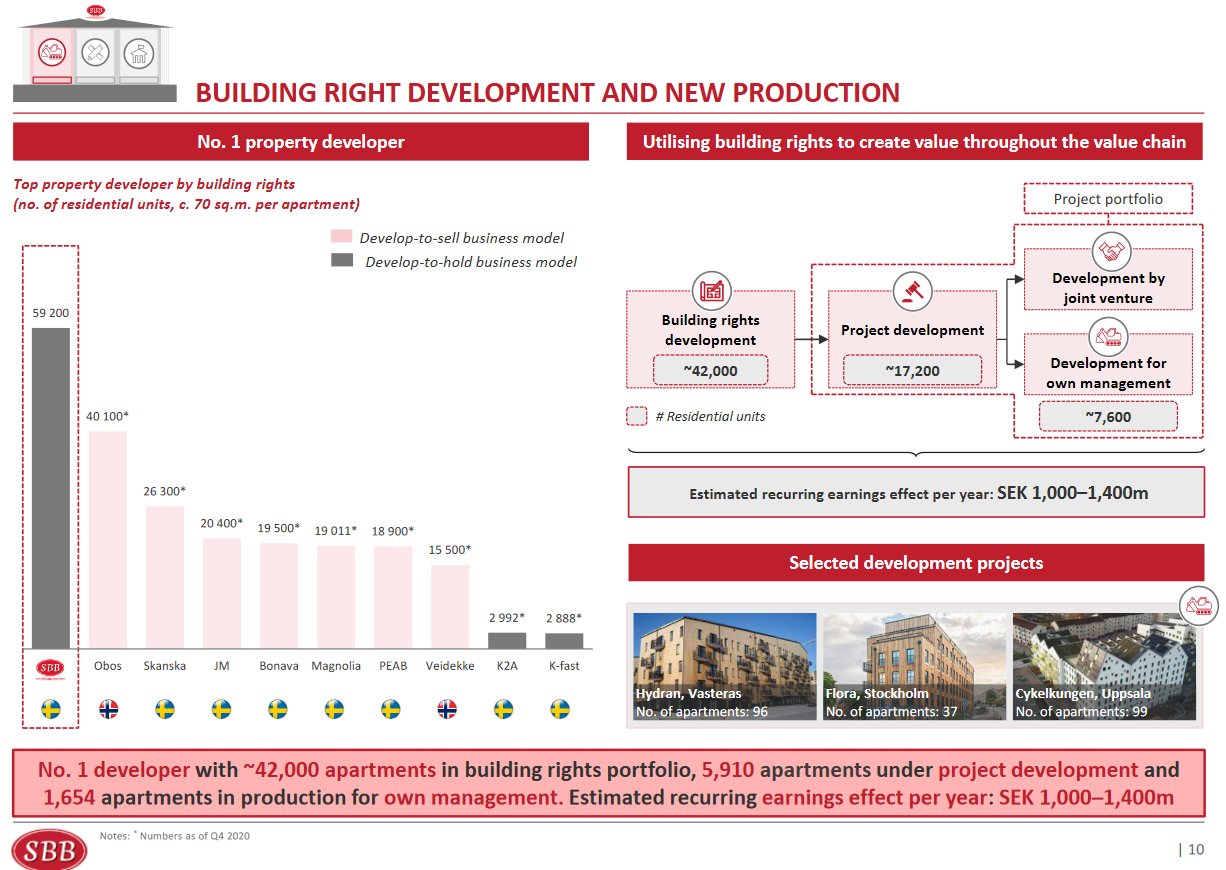
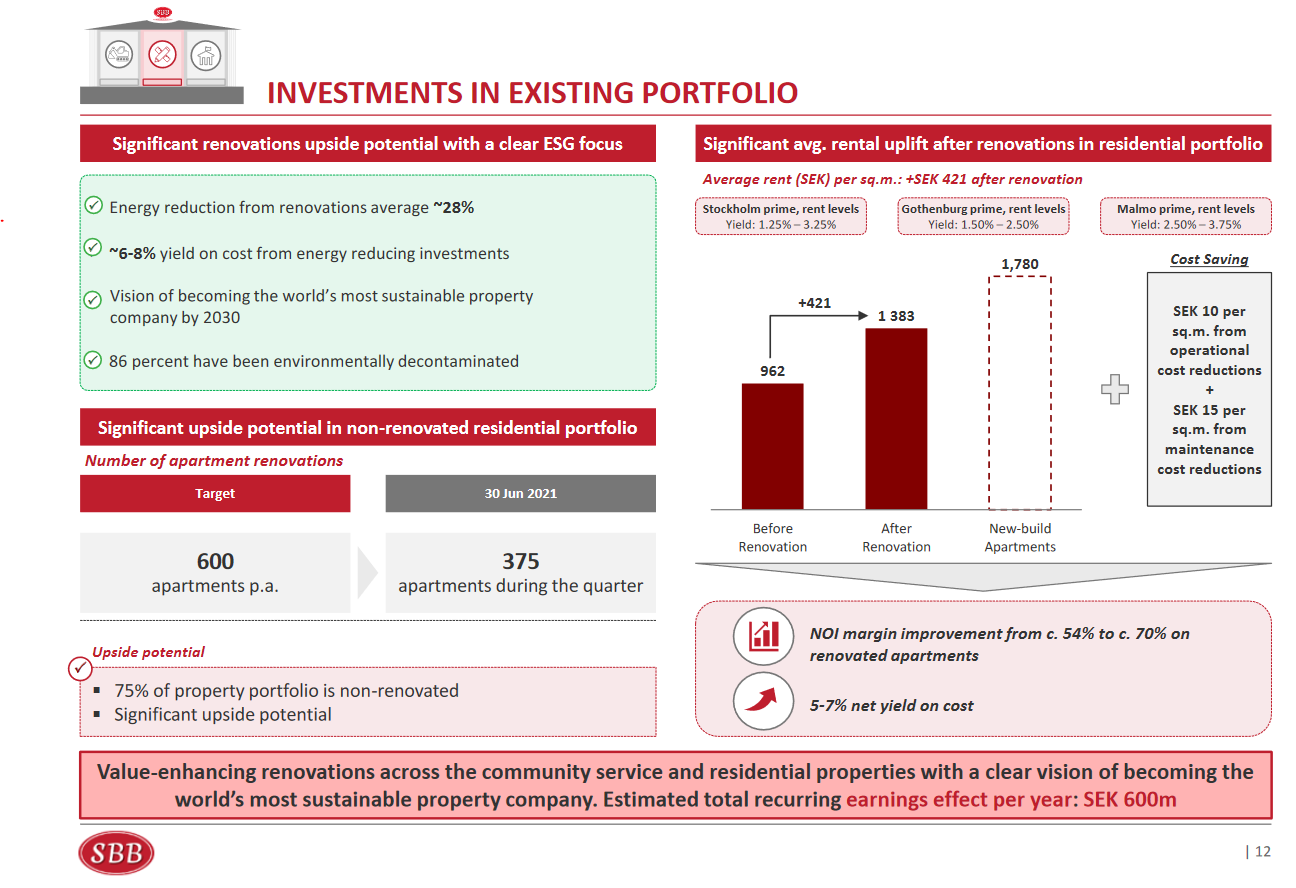
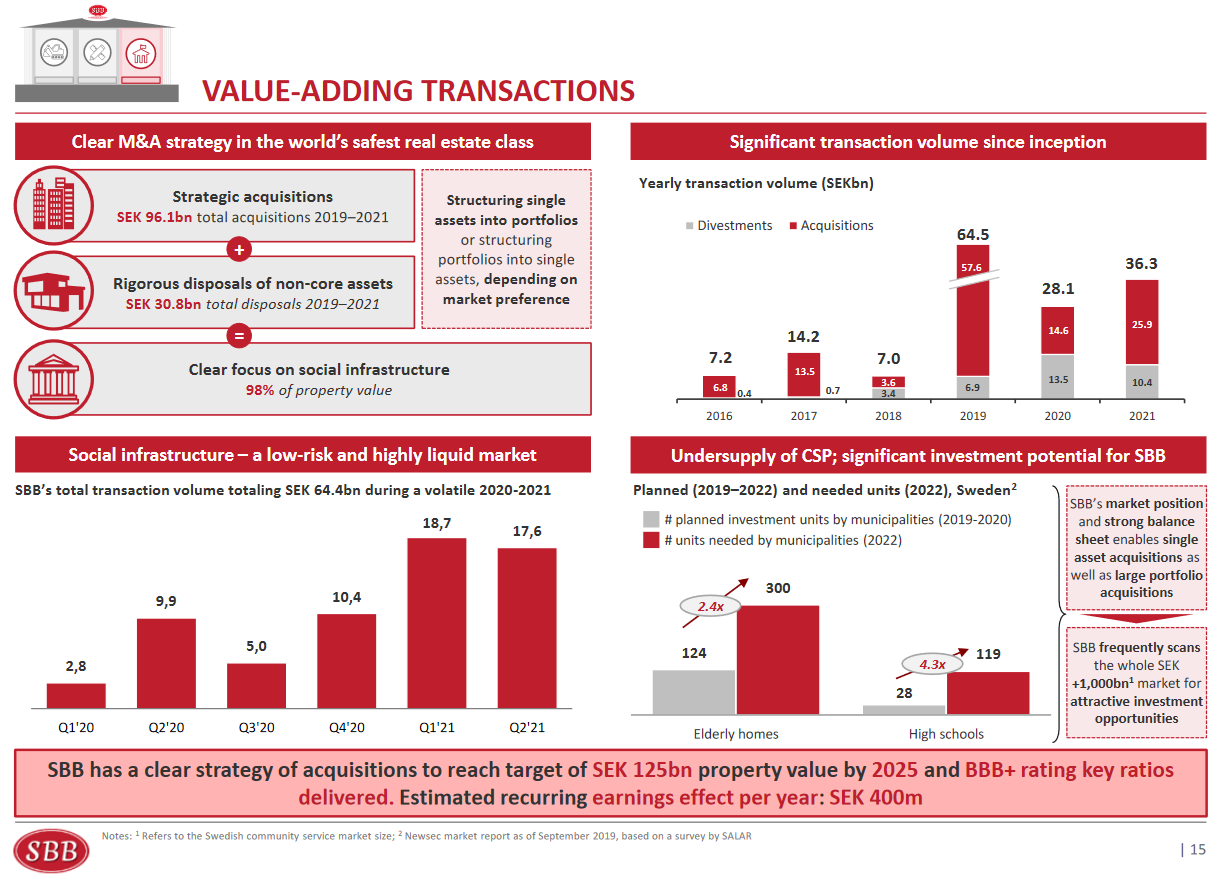
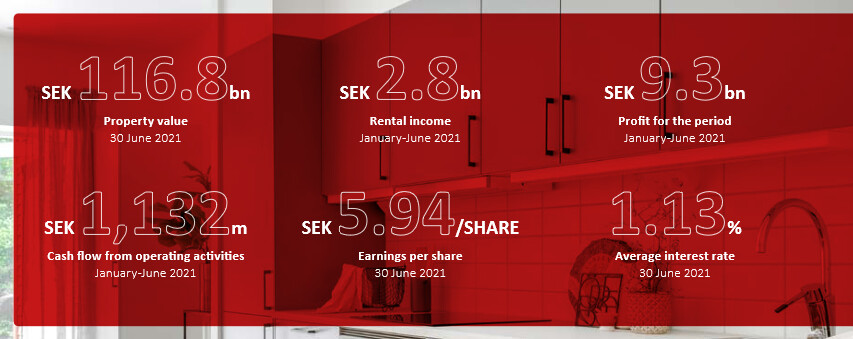
SBB invests in Nordic properties , where tenants are government-funded or highly regulated in Sweden, such as schools, police stations, and health centers. The company’s weighted average unexpired lease term (WAULT) is currently 9 years.
It’s a bit unfortunate that the company has Class A, B & D shares, so one needs to be careful with them! The company is holding a CMD (Capital Markets Day) this coming Friday, September 10, 2021.https://corporate.sbbnorden.se/en/capital-markets-day-2021/
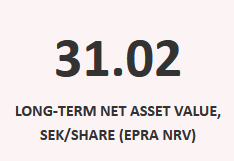
Due to the recent rise in stock price, the company is valued at a rather juicy premium compared to property values. [50 SEK vs EPRA NRV 31 SEK Q2]. The undersigned owns a small position in SBB B-class, alongside Cibus and Citycon.
The target for the size of SBB’s property portfolio has been adjusted to amount to SEK 300 billion in 2026. The target for earnings from property development has also been raised to an average of SEK 2.0-2.5 billion per year on average over a 5-year period.
The Board of Directors also has the ambition to propose a dividend of SEK 1.32 per ordinary share A and B, divided into twelve monthly dividends, to the Annual General Meeting 2022.
In connection with the Capital Markets Day on 10 September 2021, SBB will also present an updated Vision 2030 where the entire business shall be climate positive by 2030.
So, as a companion to Cibus next year, monthly dividends will begin, and the dividend was raised by 32%.
Expansion outside the Nordic region is also hinted at;
Ilija Batljan, Founder and CEO of Samhällsbyggnadsbolaget I Norden AB, comments on the new goals and ambitions for tomorrow’s Capital Markets Day:
“Since our Capital Markets Day in June 2020, we have continued to grow our portfolio, and we are already close to reaching the previous target of SEK 125 billion in property holdings by 2025. To underline our ambition to eventually become Europe’s largest real estate company in social infrastructure we are therefore raising the target sharply to reach SEK 300 billion in holdings by 2026. We also see great potential in scaling up our platform outside the Nordic region.”
Tomorrow we’ll see what the market thinks of this in its entirety
EPRA NAV increased; “Long-term net asset value (EPRA NRV) calculated in accordance with EPRA’s new guidelines for net asset value calculations was SEK 49,296m (37,505), corresponding to SEK 34.55 (28.21) per share.”
The closing price already has a 75% premium, yuck!
The average interest rate continues to fall; SBB’s average interest rate has decreased from 1.41 percent at the end of Q3 2020 to 1.11 percent, resulting in a decrease in total financial net and contributing to an increased interest coverage ratio to 5.7 times (3.7).
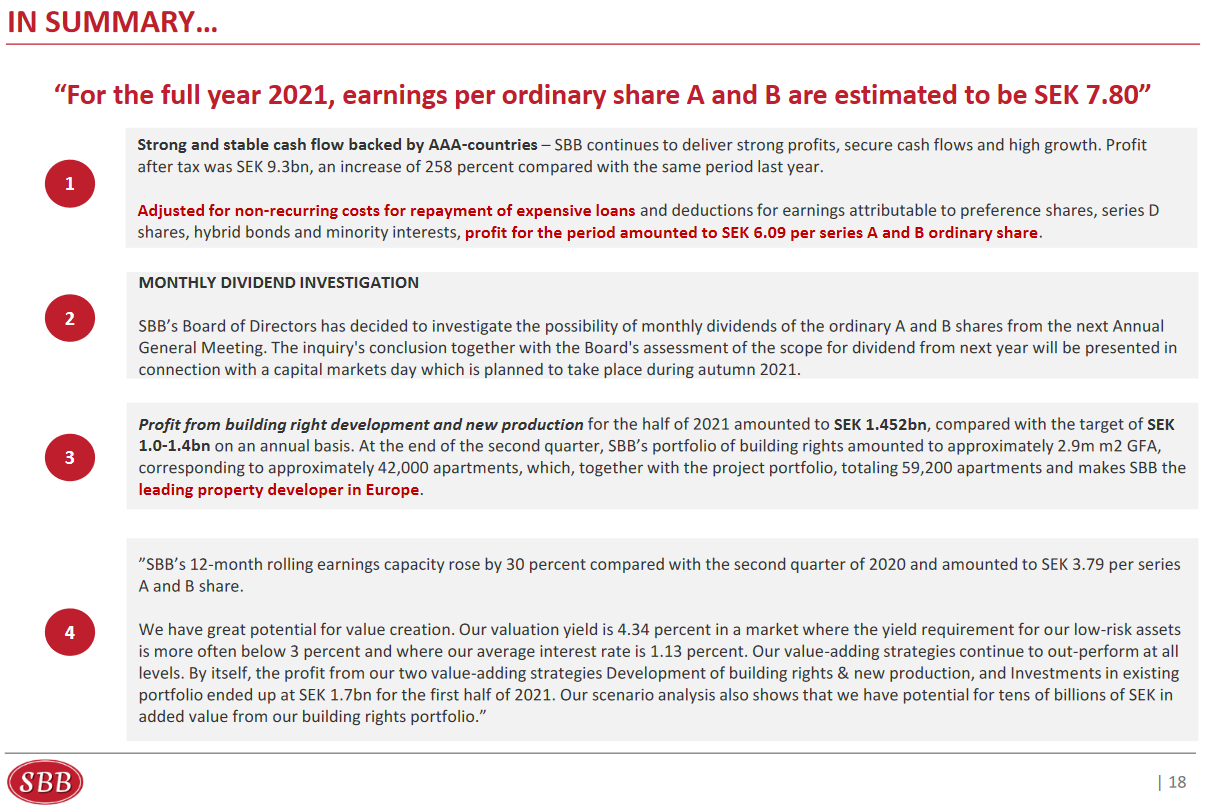
The company significantly raised its guidance again; For the full year 2021, earnings per ordinary share A and B are estimated to amount to SEK 9.80 which is an increase from the forecast of SEK 7.80 that was provided in the second quarter.
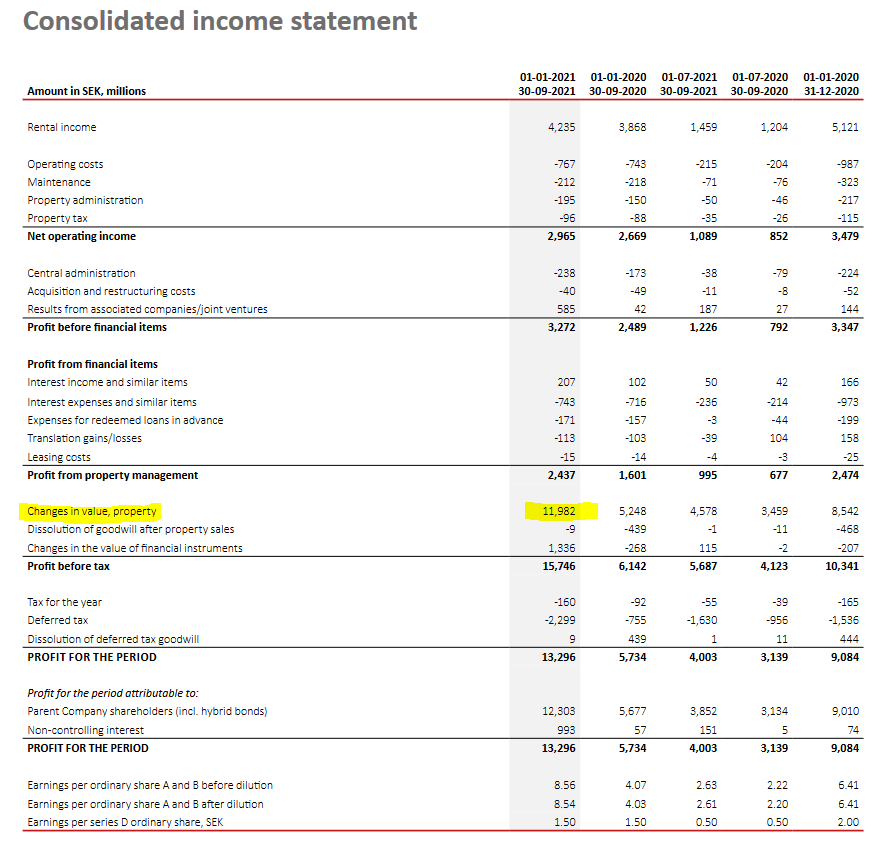
Most of the profit, however, comes from the appreciation of real estate:
SBB apparently gets loans with negative interest (if I read the press release correctly). It’s not the worst business to own public administration properties and finance their construction with negative interest.
I’m looking into Swedish stocks and noticed that SBB also has D-class shares. With Cibus, these seem to be primarily dividend stocks whose value is unlikely to increase much. Is the same true for SBB?
If so, is it perhaps a common practice for D-class shares to always represent this model?
In Sweden, there are also some preference shares (Pref) that offer a certain redemption price, around which the share price tends to hover. When evaluating a company, only 50% of preference shares are counted towards equity.
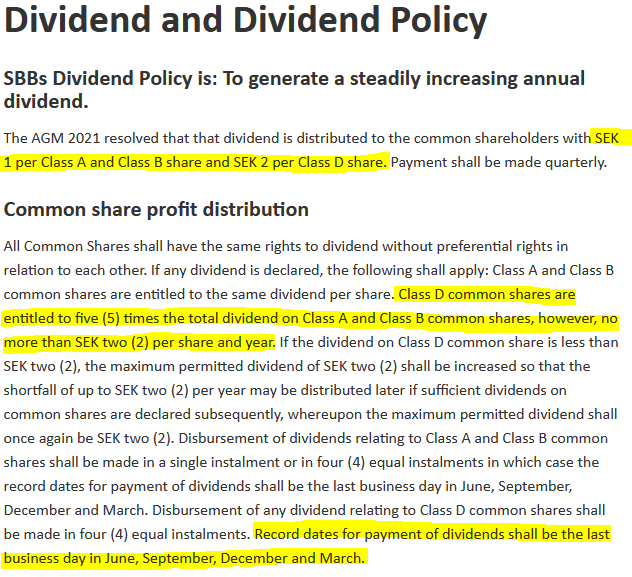
A D-share, on the other hand, is 100% equity for the company, which allows the company to obtain cheaper financing, but it carries more risk for the investor than a preference share because it is still a common share. The nominal dividend yield is enhanced by a limited dividend growth potential (for SBB, the D-share pays 5x the annual dividend of A/B shares, but a maximum of 2 SEK/year), meaning it naturally trades with a higher current dividend yield when the upside is limited.
On 27.4. there will be an annual general meeting where the dividend will be decided.
The Board of Directors proposes that dividend is distributed to the common shareholders with SEK 1.32 per Class A and Class B share to be distributed monthly and SEK 2 per Class D share distributed quarterly.
Record dates for dividend distribution to Class A shares and Class B shares shall be the last weekday for each calendar month with one twelfth (SEK 0.11) per disbursement date and beginning 29 April 2022. Record dates for dividend distribution to Class D shares shall be 30 June 2022, 30 September 2022, 30 December 2022 and 31 March 2023 with an amount of SEK 0.50 per disbursement date. Distribution of dividends is expected to be made by Euroclear Sweden AB three banking days after each record date.
So, the ex-dividend date is the day before the last weekday of each month, starting on 28.4. (0.11 SEK).
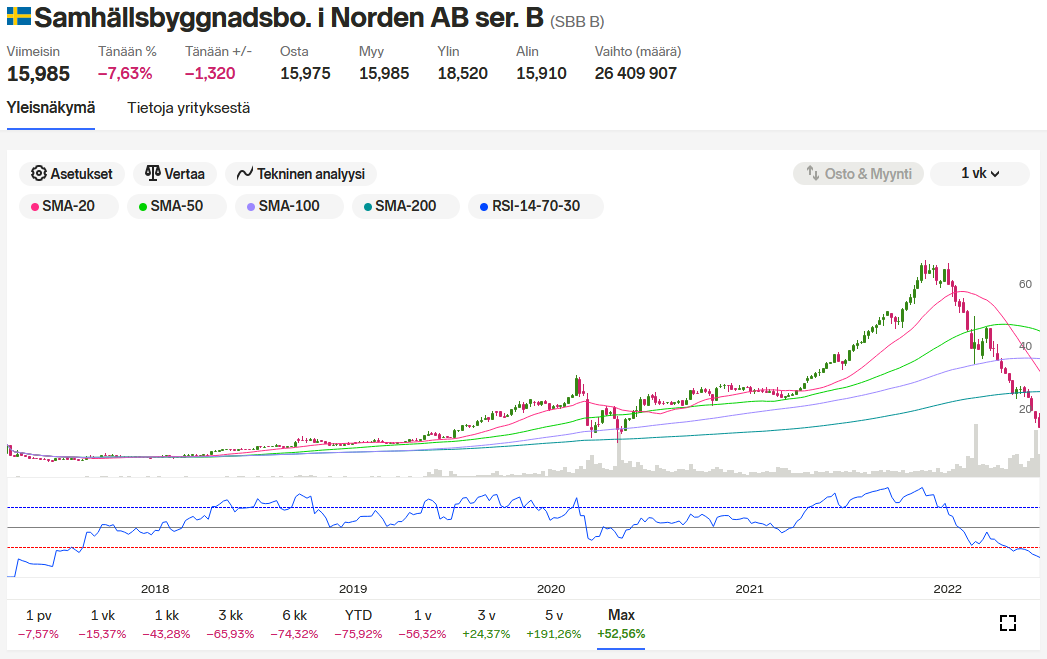
This has come down quite a bit, it’s now hovering below 20 kronor. Of course, the real estate sector is facing tough times as accounting profits cannot be made and interest rates start to rise, but could this have a chance to generate reasonable results in the future?
The drop in the share price is, as I understand it, related to Viceroy Research’s short selling and its published report on SBB’s shenanigans. I haven’t looked into it in detail, but the previous valuation might not have been entirely accurate. Samhallsbyggnadsbolaget – Hard to pronounce, harder to justify value
As a side note, there has been a significant amount of discussion about this company on the Börsnack forum for some time. I need to investigate this case more closely to see if it’s some kind of pump and dump attempt (not the company itself) or what’s causing the discussion.
Börssnack (there was a typo above, with two s’s) is Dagens Industri’s stock discussion forum. borssnack.di.se. The format is a bit cumbersome and the discussions are general, but sometimes interesting points can be found and one gets an idea of which companies generate the most discussion.
Viceroy’s business is to find dirt on companies, open a short position, and then publish their findings. So yes, their activities are intentionally disparaging. On the other hand, they have their own money at stake, so they probably at least believe in their own case.
There are other similar firms, such as Spruce Point Capital, which similarly shorted Oatly last summer.
This has been an absolutely insane downhill ride, and now the weekly RSI has dropped below 20. It won’t take many more days like this until it’s oversold on a monthly level as well
There’s still about a -50% drop from this price to reach the worst of the corona dip, but I must admit, it’s starting to pique my interest a bit. Soon we’d be looking at a 10% monthly dividend if the dividend holds, which seems a bit unlikely at least within the next couple of years, even though the company has stated the dividend will remain as long as interest rates don’t really take off.
Edit: Viceroy seems to have released a new report yesterday:
Aktiespararna’s website offers an analysis. The target price is lowered to SEK 38 to reflect the current situation. Property values have decreased in Sweden, which dragged the reported profit into the red.
According to the summary, the debt burden should be reduced by SEK 10 billion to strengthen the balance sheet. Some sales have already taken place. “SBB genomföra försäljningar om minst SEK 10 miljarder under april-december 2022.” (SBB carried out sales of at least SEK 10 billion during April-December 2022.)
Interest rate exposure has also been shifted towards fixed interest rates. 8.8.2022 14.00 • Cision •
“Samhällsbyggnadsbolaget i Norden AB (publ) (“SBB”) har minskat sin exponering mot rörliga räntor från 35 procent i slutet av andra kvartalet 2022 till 25 procent per dagens datum. Detta har gjorts genom att bolaget räntesäkrat motsvarande 10 mdkr till fast ränta. Räntesäkringar har gjorts på löptider mellan 1,5 år och 10 år. SBB kommer att fortsätta minska sin exponering mot rörlig ränta.” (Samhällsbyggnadsbolaget i Norden AB (publ) (“SBB”) has reduced its exposure to variable interest rates from 35 percent at the end of the second quarter of 2022 to 25 percent as of today. This has been done by the company hedging the equivalent of SEK 10 billion at a fixed interest rate. Interest rate hedges have been made for maturities between 1.5 years and 10 years. SBB will continue to reduce its exposure to variable interest rates.)
In my opinion, the share price is currently attractive, and the dividend yield is strong. I recently became a shareholder with a small sum for myself and am now following the company and the Swedish market more closely.
I’ve been trying to familiarize myself with the company and have now bought a motivational position at prices between 15-17 SEK. I find today’s news reassuring, as it seems there is demand for properties close to their book value. The divestment size was also significant: 9 B SEK compared to Q2 debt of 95 B SEK and a portfolio value of 157 B SEK. Of course, I can’t say whether the sold properties were the best in the portfolio or just average. However, given that the EPRA NRV was 42.72 SEK at the end of Q2, I see a reasonable margin of safety there.


 , where tenants are government-funded or highly regulated in Sweden, such as schools, police stations, and health centers. The company’s weighted average unexpired lease term (WAULT) is currently 9 years.