Investment Companies as the Core of the Portfolio

I’m opening a new thread that deals with investing in investment companies. :slight_smile:

It is possible to build the core of a stock portfolio from one or more investment companies, which we can discuss in this thread.

Possible discussion topics include:

  • Why do you invest in an investment company?
  • Which investment companies have you chosen for your portfolio and which companies do you consider to be the highest quality?
  • Do you have an investment company in mind that you feel hasn’t received the visibility it deserves on the forum yet and that you’d like to introduce to others?
  • Do you have a buying and selling strategy you’d like to share?
  • What are the advantages or disadvantages of investing in holding companies? What should be considered when investing in them?
  • Thoughts on diversification?
  • Just share any thoughts related to the topic

I currently own some Investor, Sievä and Sampo. Berkshire is of course also familiar, even though I don’t own it yet. I like investment companies because they generally require significantly less monitoring and oversight than “direct stocks”. A certain carefree nature, simplicity, and a diversified portfolio managed by professionals. Additionally, it’s nice to buy if you can get it below book value - a free lunch always tastes good. :slight_smile:

It would be interesting to find new potential investment targets in this area and discuss this niche of stock investing.

For your information, a handy link to the ibindex.se website, where it’s easy to check the nearly real-time book valuations of investment companies on the Stockholm Stock Exchange.

41 Likes

Alright, now we’re getting to it. :grin: Investment companies are strongly present in my portfolio, and I really like them as a company type. When you think about them a bit more, there are many benefits:
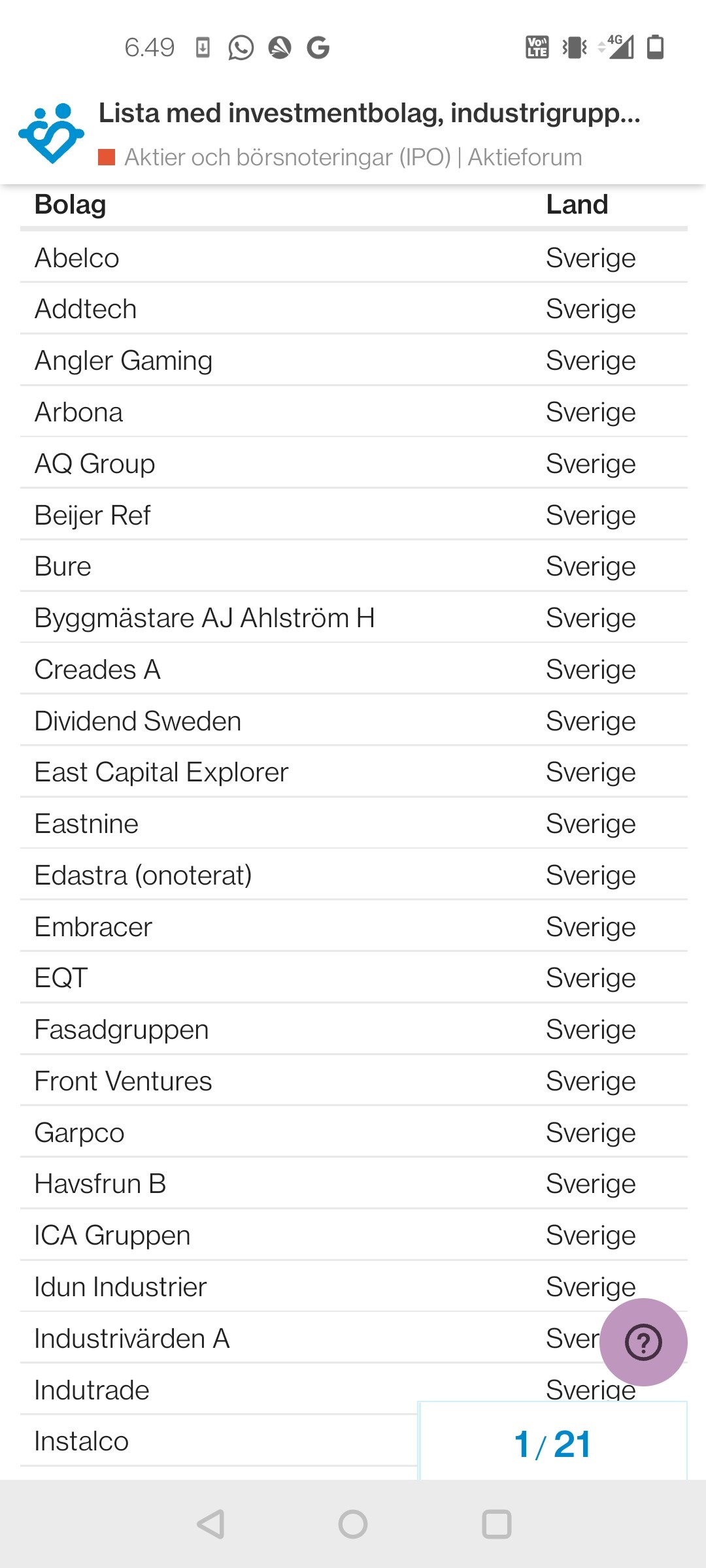
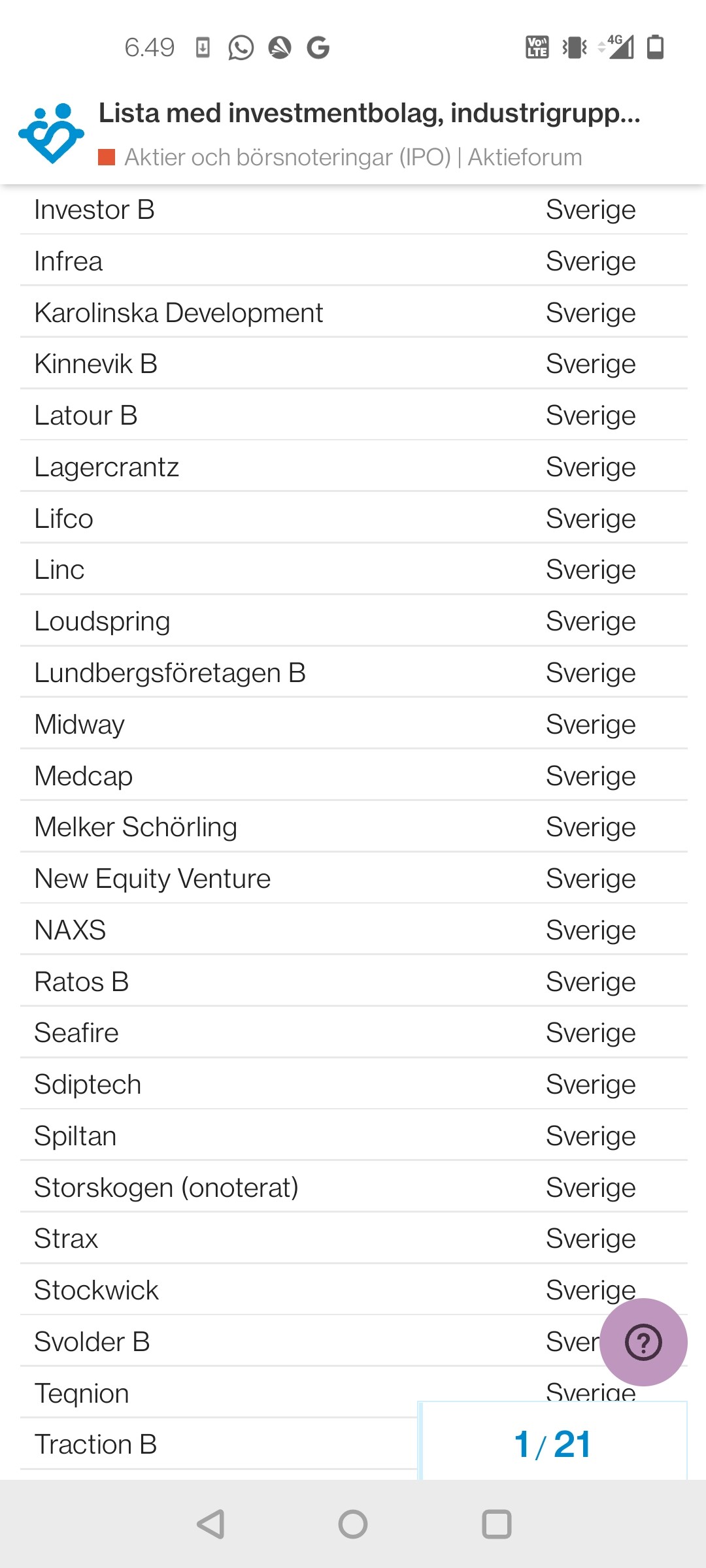
  • Often a good option for investors who want to invest in stocks but don’t trust their own abilities to pick companies. Many investment companies somewhat resemble an active fund. Furthermore, the management of an investment company consists of better investors than you and me, whose expertise can be utilized by buying shares.
  • Strong diversification is almost always guaranteed, which is a welcome feature for risk-averse investors. Some are more concentrated than others, but fortunately, there is choice here too.
  • Perhaps the best part: investment companies practically always require a very long-term perspective, and the short term has little to no significance. In many cases, an investment company is either a) long-term itself, perhaps a family company whose priority is to maintain family wealth across generations, and/or b) a strong owner in its portfolio companies, meaning that small noise and volatility mean nothing to the company (this can also be a disadvantage if the management is wrong!). As a result, the interests of shareholders and management are very aligned if the shareholder is interested in the long-term appreciation of asset values.
  • Often, investment companies are valued in the stock market below the value of their assets, meaning that you can get access to their holdings at a discount. This discount, however, rarely disappears completely – so it’s not often sensible to buy an investment company with the idea of selling once the discount is gone.

A few clear drawbacks of investment companies that come to mind quickly:

  • Never can you rely on traditional valuation ratios. Accounting rules ensure that companies owning especially publicly listed companies can make fabulous profits one year and look bankrupt the next – an example of this is Berkshire’s Q2/2022, from which the company reported over 50 billion in losses due to changes in asset values. So, for investment companies, P/E ratios go straight into the trash.
  • Investment companies are not cost-free funds. It’s good to keep an eye on how much personnel costs eat into the owners’ returns.

Currently, my portfolio includes the investment companies Investor AB, Fairfax Financial Holdings, and Nelnet with roughly equal weightings. Investor has its own thread on the forum and several good commentators to introduce the business (ping @Warren_Fyffet), but Fairfax and Nelnet are probably less familiar. Both amusingly share similar traits with the king of investment companies, Berkshire: there is a stable, cash-flow-generating core business (insurance/student loans) that funds investments in other sectors (FFH: a massive list of value investments, Nelnet: solar energy, fintech/banking, VC investments, etc.). The management teams’ track records in value creation are exemplary, and insider ownership is high – this is very important, by the way, when investing in an investment company, you must be able to trust those who manage your funds.

A fourth investment company that will eventually find its way into the portfolio is one that flies completely under the radar, at least for this forum. This is the Italian Agnelli family’s investment company, Exor, where the family’s holdings are managed, as I understand it, in the fourth generation. The company’s holdings are, in my opinion, quite two-sided – there are capital-intensive industrial kiosks like Stellantis, CNH Industrial, and Iveco, but then, by contrast, there are companies in very interesting and profitable sectors such as Ferrari, Institut Mérieux, Christian Louboutin, and The Economist. Currently, the discount to the value of Exor’s holdings is, according to my calculations, somewhere in the range of 40-50 percent, which is quite a significant figure. We’ll see when I decide to jump on board.

31 Likes

Double posting just in case: would it be an idea to create some kind of master list at the beginning of this thread, where the “characteristics” of the companies discussed in the thread could be collectively listed? It could also help in comparing the companies with each other. :thinking:

21 Likes

I currently don’t have any investment companies in my portfolio due to the market situation. However, I do have investment companies on my watchlist, and I’ve spent time researching them by reading books, listening to videos from Rika Tillsammans and Nordnet’s Alexander Gustafsson on YouTube, and reading many different articles online. There are 7 Swedish investment companies on my watchlist, and investing in global investment companies is handled through Spiltan Globalfond Investmentbolag. The downside of this fund is the 0.5% annual management fees, although these are small compared to the brokerage fees I would have to pay if I bought them individually. I invest in these through the fund because I don’t have the skill to analyze these companies as thoroughly as the Swedish ones, nor can I pick the best ones from a large group. From the Swedish investment companies, I have chosen stable ones with an excellent track record and history for my list. I might also speculate with smaller Swedish investment companies like Abelco, MedCap, VEF, VNV, First Venture, Front Ventures, and Tectona.

The stable investment companies with a track record and history that I mentioned on my list include Investment AB Spiltan (not a fund, but a company that owns, among others, Spiltan Fonder, i.e., the fund management company that has Spiltan Aktiefond Investmentbolag, etc.), Latour, Svolder, Investor, Creades, Bure, and Lundbergföretagen.

Investor’s historical discount to NAV has indeed been in the range of 15-25%, but during crises, it has even reached levels of 35-40%. I don’t see the current moment as a better buying opportunity than the average, which is why I’m still waiting for a better buying moment for investment companies. Such a moment might be seen if uncertainty continues to increase and the discount to NAV approaches the 30% level, and interest in investment companies decreases; then I will start accumulating. I also recognize that there is a probability that this will not happen, in which case I will buy in gradually over time.

The Swedish investment companies I have chosen, which have a history and a long-term track record, have demonstrated value creation over decades, and their annual returns are typically a couple of percentage points ahead of the index, meaning returns with dividends of 12-14% p.a., and for Latour and Investment AB Spiltan, even over 20%.

10 Likes

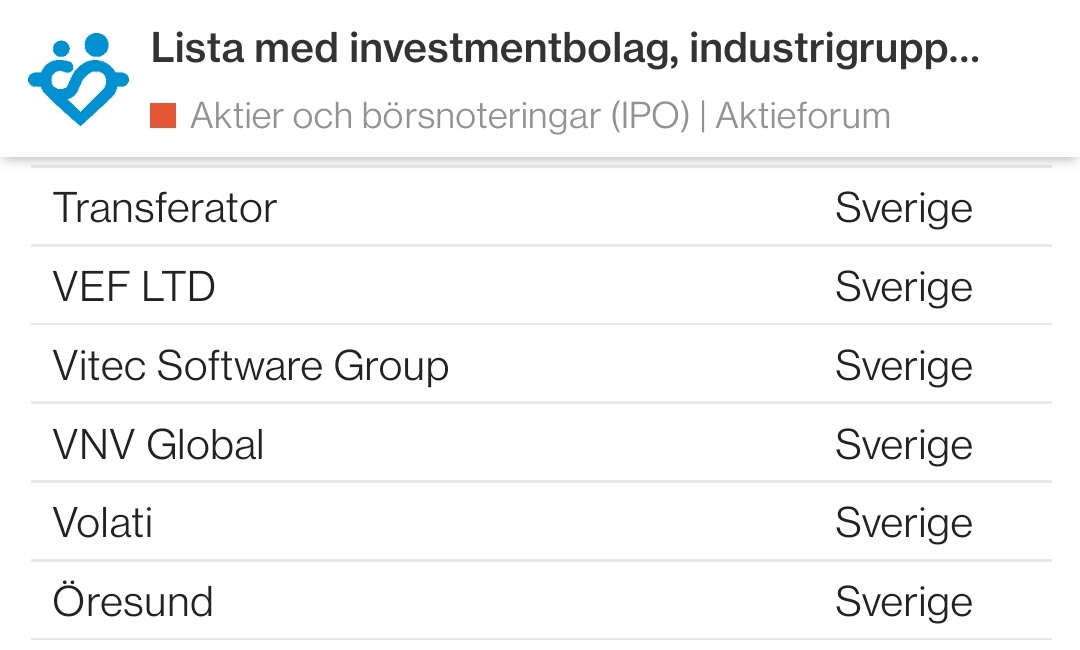
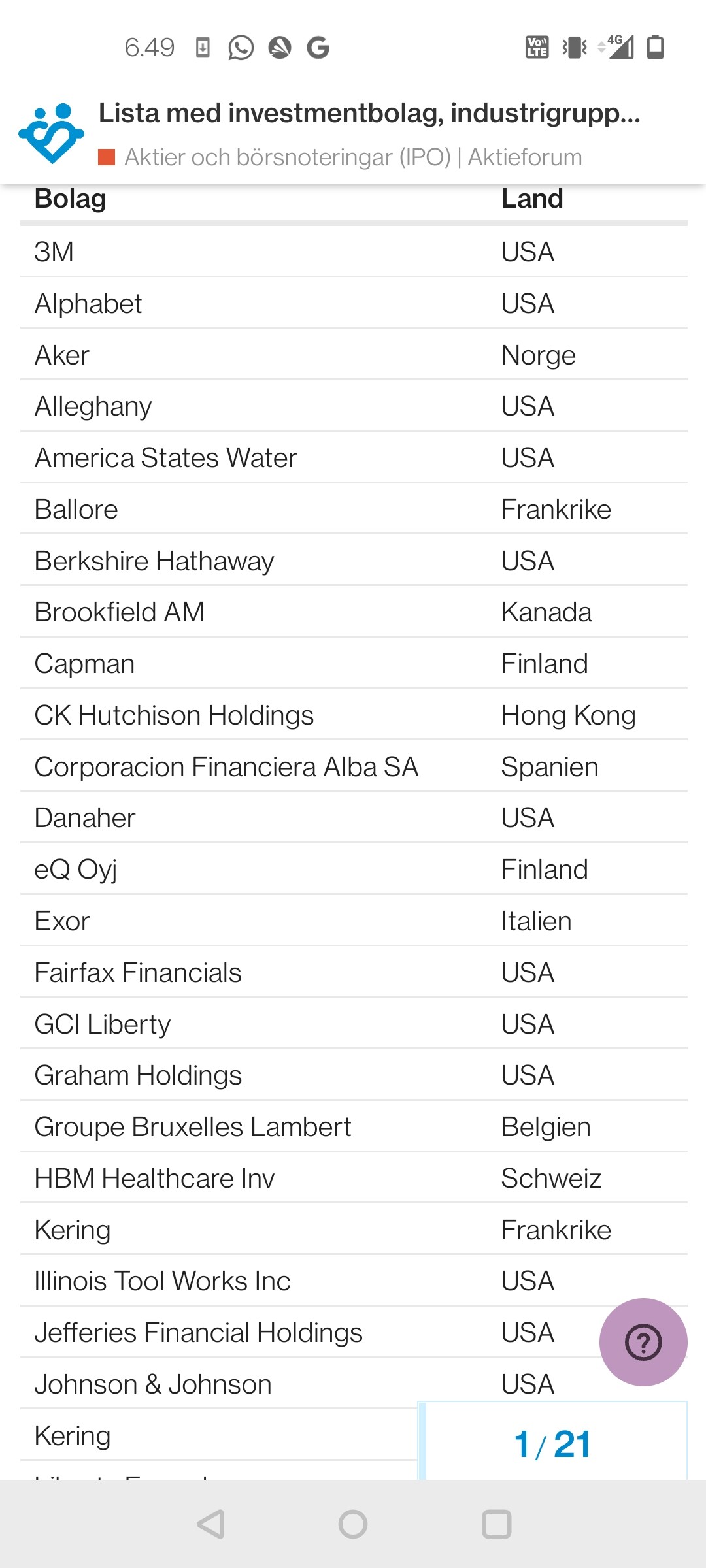
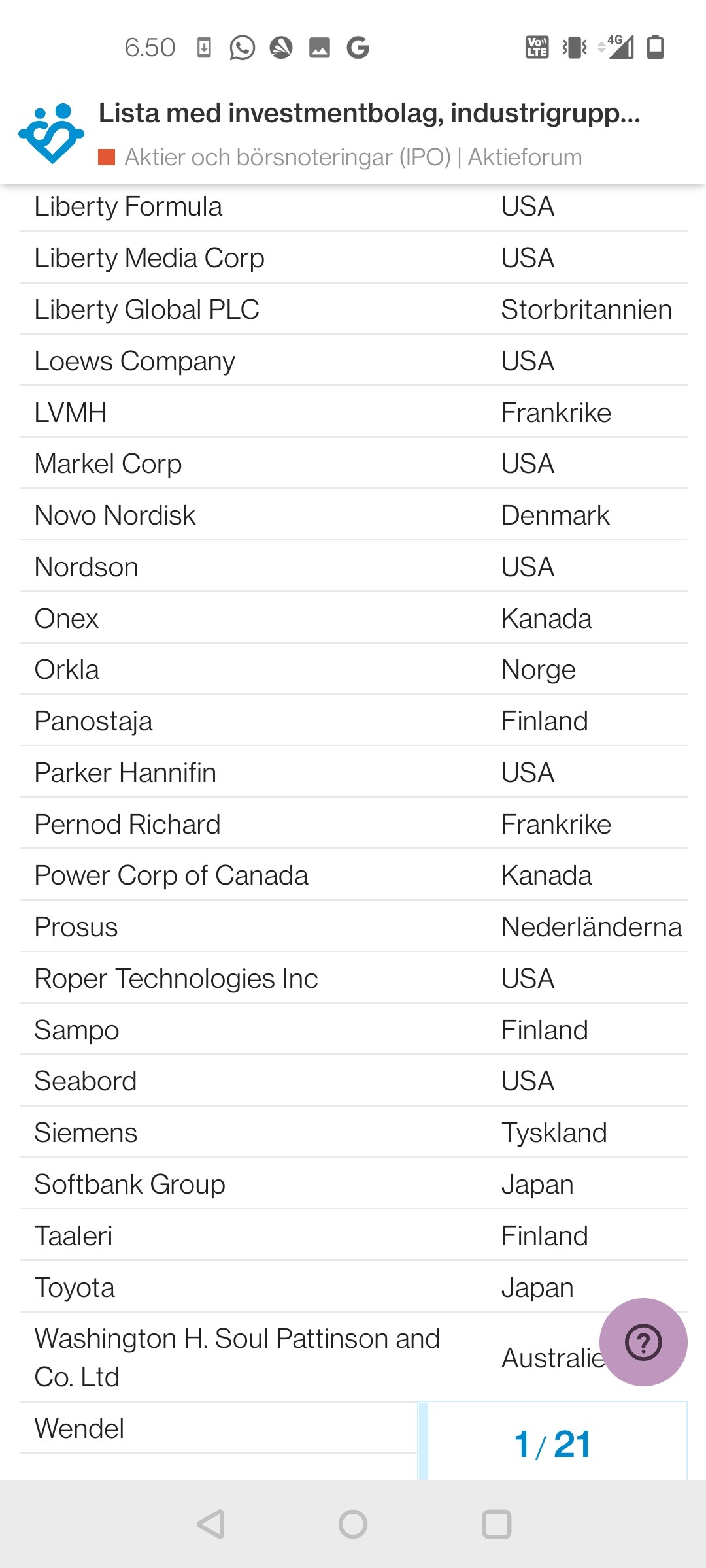
@Hades A kind of (slightly incomplete) “masterlist” from Rika Tillsammans’ thread called List of investment companies, industrial groups, conglomerates and holding companies. Also includes conglomerates, holding companies, and these Swedish “serieförvärvare” (serial acquirers), such as Boreo, for example, and from America and around the world too.


7 Likes

Thanks @lazyway for starting the thread.

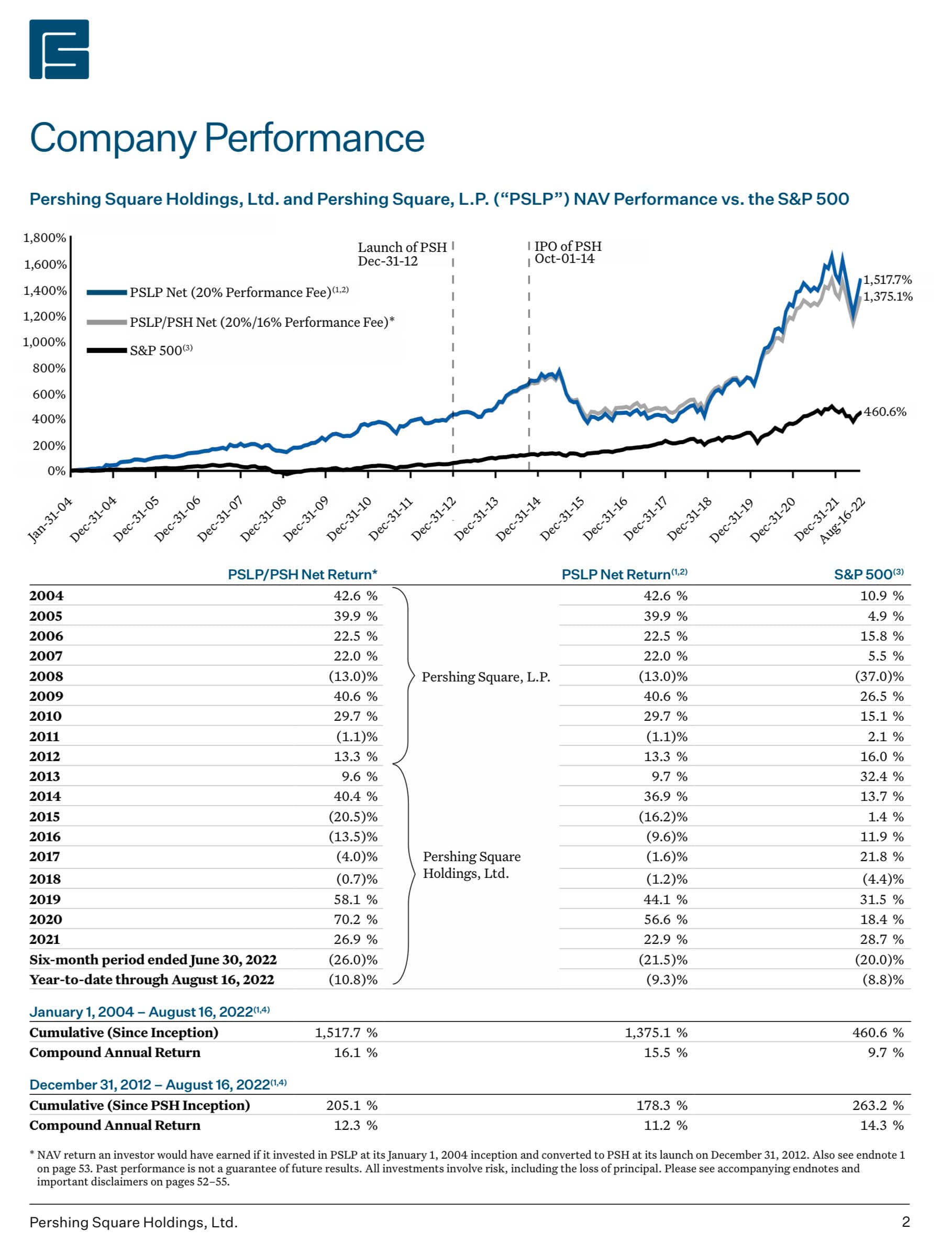
I’ll add one more company here - Pershing Square Holdings (PSH). This investment company is led by the well-known Bill Ackman.

PSH’s investment strategy: Our approach to investing capital is to find extremely durable, well-capitalized, high-quality growth companies that can survive any storm. If we are successful in our investment selection, we can largely ignore shorter-term factors that drive stock market movements and remain focused on our portfolio companies’ underlying business performance. As long as our companies continue to deliver the results we expect, we do not need to make any material adjustments to our portfolio’s composition. In other words, we can sail through the stormy seas with a focus on the long-term horizon.

PSH’s portfolio includes Hilton Hotels, Chipotle, Universal Music, and Canadian Pacific Railways, among others. In addition, PSH occasionally uses derivatives; currently, an inflation derivative is included.

PSH is listed in Europe - in London and Amsterdam. Below is a picture of the track record and a link to the latest review.

10 Likes

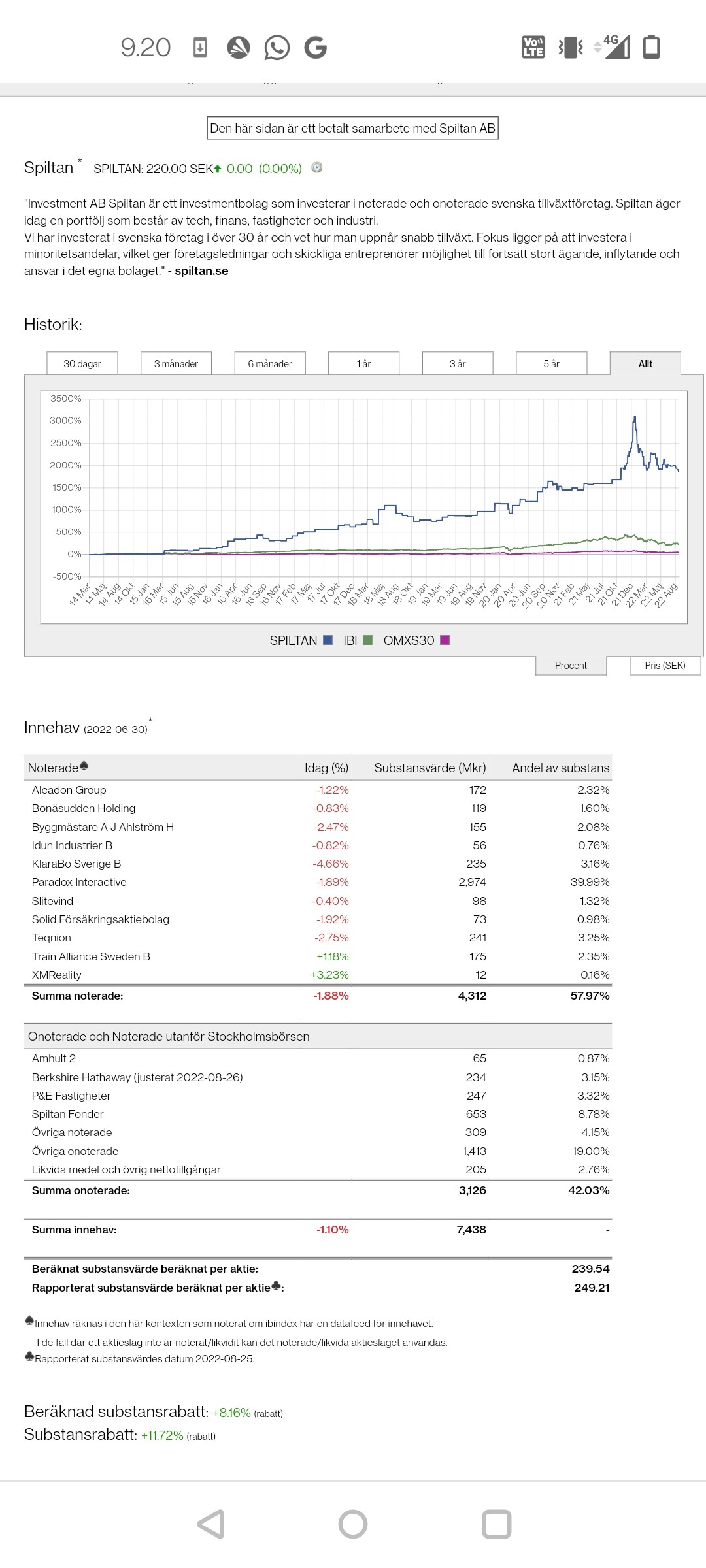
Here, in my opinion, is the track record of the best Swedish investment company, Per H Börjesson’s Investment AB Spiltan. A book has been written about the company, and Börjesson has 3 other books.
Most of the return is explained by Paradox Interactive, which, if I remember correctly, has generated 100% p.a. during Spiltan’s ownership.

https://capitalisti.se/investment-ab-spiltan-paradox-har-varit-en-succe/

2 Likes

That is indeed a very comprehensive list. It does, in a way, mix different types of investment companies, as the list’s name also suggests: I, for one, would not directly consider serial acquirers or other consolidators as investment companies, although one could easily make such an argument. Perhaps an Inderes better master list could be created in this thread, where different types of “investment companies” would be separated…

6 Likes

Great that we got a thread like this going! My own portfolio includes several investment companies, and also quite large positions. In order of size:

  • Investor :sweden:
  • Sampo :finland:
  • Svolder :sweden:
  • Latour :sweden:
  • Aspo :finland:
  • Lundbergföretagen :sweden:
  • VNV Global :sweden:

The first four Swedish investment companies have (rightly) beaten the index in the long term. The last one, on the other hand, invests in small unlisted companies and seemed very promising until the macro turmoil began at the beginning of the year. Since then, a truly ugly track record. Well, the world won’t end this time either.

I personally like their excellent track record, diversification, affordable portfolio management, the “skin in the game” fact (often a wealthy family is the largest owner), and the substance discount. :ok_hand:t3:

10 Likes

Ruonis and Warren Fyffett wrote about their interesting trading strategy in Investor’s thread. I’m sharing it here too :slightly_smiling_face:

1 Like

Perhaps a shared Google Sheets would work best? Though I’m not entirely sure what the smartest structure for it would be.

1 Like

I started working on a Google Sheet, but I’m still figuring out which companies to list there. I separated clear holding companies into their own group, as that seemed like a natural solution.

16 Likes

Why do you consider Spiltan the best Swedish investment company? I looked into the company a few years ago. At that time, a couple of things came up that made me hesitate to buy: the company couldn’t be bought directly from the stock exchange yet, and Paradox’s weighting, if I recall correctly, was something like two-thirds of the company’s value, if not more. (I might be wrong, please correct me if so :slight_smile: )

Don’t you see it as a risk if the impressive return is mainly based on just one large, excellent investment and diversification remains low? The main investment needs to perform continuously well for good returns to continue. Now Paradox’s weighting seems to be only about 40%, so its weight is fortunately decreasing, at least in terms of diversification. The company now looks more attractive to me, even though the discount is only 8%. I remember it being much higher a few years ago.

The volatility here has been quite high: in January, the share price peak was 360 SEK, and now it’s at 220 SEK. It has come down almost 40%. Is there any information on whether this is just the stock market euphoria dissipating or some real fundamental reason related to the company that it has fallen so much?

Paradox Interactive seems to have fallen about 50% from its share price peaks. That’s likely a major contributing factor.

@Valkeus, thank you for the good additional information. It increased my interest in Spiltan. :slight_smile:

1 Like

Does anyone know Fastator better? Is it a stable and high-quality company?
The return over five years looks excellent (~+200%), and the discount is now 45%. It seems to operate in the real estate sector.

The volatility also looks quite wild here. The year’s highs are SEK 23.7 and lows are SEK 12.6.

@lazyway Paradox correction: Investment AB Spiltan’s historical annual return is also over 20% p.a., and Spiltan’s skill has been to hold on to successful companies like Paradox despite huge gains. The company has also occasionally lightened its Paradox holdings and allocated capital to new investments. Börjesson admires Warren Buffett and has attended Berkshire Hathaway’s annual meeting several times, aiming to follow Buffett’s investment philosophy. Investment AB Spiltan invests in stable, “boring” companies with a good position in their industry, in addition to small stakes in promising future companies.

Paradox’s weight was over 80% of Spiltan’s net asset value at one point and is now around 40%.
Investment AB Spiltan’s share liquidity was very poor at the beginning of trading, and additionally, the share is only traded once a week on Tuesdays, which also caused an overreaction in the beginning and the price soared.
Investment AB Spiltan’s share price has 100-bagged in 35 years, i.e., since 1986, which is a very respectable achievement.

From 12:25
Risen from 2.50 kronor to 260 kronor, Peter Lynch would call it a 100-bagger

5 Likes

@lazyway The company has a significant amount of debt, and an additional reason for the large discount to NAV might be that the market doubts whether the fair value of the properties is truly as high as it has been valued on the balance sheet.

2 Likes

Let’s try to keep this thread alive :slight_smile:

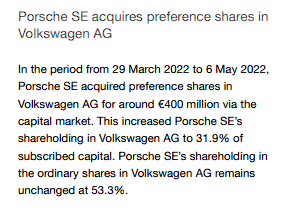
Porsche Automobil Holding SE

A holding company that is the main owner of Volkswagen.

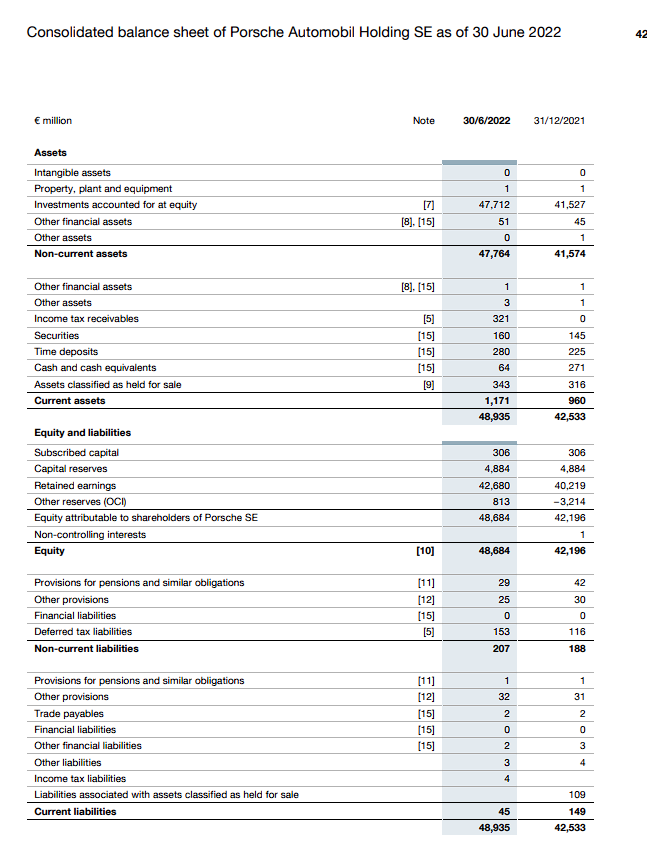
The company’s holdings on June 30, 2022, figures from the Q2 2022 earnings report:

Volkswagen €47.6 billion
Other long-term investments (small automotive companies, start-ups, etc.) €200 million
NET current assets €964 million

The company’s NAV (net asset value) on June 30, 2022, was approximately €48.8 billion. Since then, VW’s share price has risen by about 15%, meaning today’s NAV is approximately €56-57 billion.

Porsche SE has 306,250,000 shares outstanding. At today’s price of approximately €74, the company’s market capitalization is €22.7 billion.

If these figures are correct, a pretty significant discount would be available. One thing to remember, however: the shares of Porsche SE traded on the stock exchange are preferred shares without voting rights; all voting shares are controlled by the Porsche and Piëch families.

Q2 report: https://www.porsche-se.com/fileadmin/downloads/investorrelations/mandatorypublications/report-1-2009/PSE2022_HJFB_en.pdf

Number of shares: Porsche SE: Share

13 Likes

CablevisiĂłn Holding S.A.

Cablevision Holding owns 39.08% of Telecom Argentina. There are no other holdings. All dividends paid by Telecom Argentina are passed on to Cablevision Holding’s owners.

Cablevision Holding mcap $487m USD
Telecom Argentina mcap $2098m USD
Cablevision’s ownership = 2098*0.3908 = $820m USD.

So, about a 40% discount is available.

Seeking Alpha has a quite comprehensive (though certainly a bit bullish) article from a year ago about Cablevision Holding: https://seekingalpha.com/article/4461131-buying-telecom-argentina-teo-steep-discount-significant-dividends

It should be noted that the lawsuit mentioned in the article was concluded in CableVision’s favor.

Risks:

  • The stock is illiquid. Daily trading volume is around a couple of thousand shares.
  • Argentina. Inflation and uncertainty.
  • Dividends are paid through a workaround. TEO pays dividends in pesos, with which Cablevision buys bonds, which it then gives as dividends to JP Morgan, who then sells the bonds and distributes the proceeds as dividends to shareholders. The value of the bonds can fluctuate during the process, as happened with the previous dividend.
5 Likes

Last week, I made a small reinvestment of dividends into Latour, so I’d like to say a few words about this investment company in this excellent thread.

Latour AB was listed on the stock exchange in 1985 (and apparently founded around that time), with approximately 80% of the voting power held by the Douglas family.

Latour’s portfolio primarily consists of companies in the “industrial products and services” category. Roughly two-thirds of its investments are holdings in ten publicly listed companies (the largest being Assa Abloy, Tomra, Sweco), and the remainder are in six wholly-owned companies (the largest being Hultafors Group, Swegon, Caljan). Assa Abloy accounts for about one-fifth of the total portfolio, and the five to six largest holdings together constitute approximately two-thirds of the portfolio (I haven’t calculated this with today’s prices, but the order of magnitude should be sufficiently close). Revenue streams mainly come from Europe (approx. 80%).

Although the company’s portfolio practically only consists of “industrials” (meaning, from a category perspective, the content is very narrowly focused on a single sector), I believe the emphasis is largely on companies that, in one way or another, are fundamental building blocks of a functional and modern societal structure. Furthermore, industrials generally have the advantage that they encompass a wide variety of businesses, meaning practical diversification is often much better than one might conclude by blindly staring at sector allocation (cf. Securitas and Tomra).

As an investment company, Latour has for a good while been among the few of its peer group where one pays a premium for the benefit of owning an investment company, rather than directly owning the investment company’s holdings. The premium is currently 27%, and this has naturally, at least for me, reduced interest in making additional purchases of Latour shares. At today’s price, the dividend yield remains slightly above 1.5%, so Latour might not be at its best as a dividend machine (despite a reasonably good history of increases). Returns have therefore mostly come from capital appreciation, and those who have been in the game longer have enjoyed good total returns (the 10-year annualized return was clearly over 20%).

This year, over 40% has been blown off the share price, though I believe this is mostly a return to more reasonable valuations, and for a long-term investor, it could well offer a reasonable buying opportunity. The stars seemed to align, and with crowns accumulated in my account, I decided to make a small addition myself. Latour has been one of the core investment companies in my portfolio and will continue in the same role going forward.

14 Likes

Continuing from the previous message

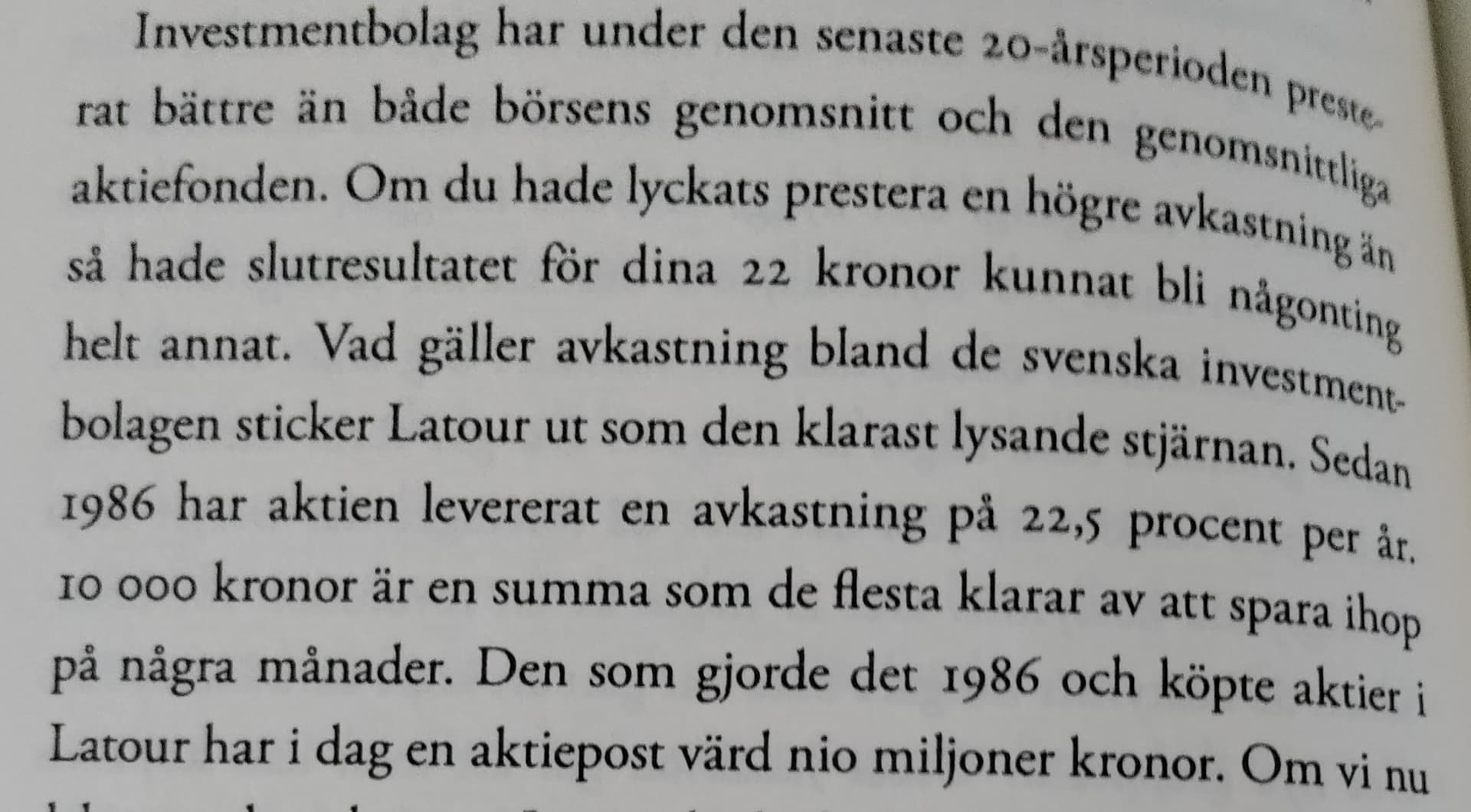
From Marcus Fridell’s book Bygg en förmögenhet - investera i investmentbolag (Build a fortune - invest in investment companies). Latour has generated a return of 22.5% p.a. from 1986 to the present day, and its share price has thus increased 900-fold since 1986.

Absolutely incredible performance.

6 Likes