Let’s open a thread for our western neighbor’s steel giant. What thoughts does this representative of an industry plagued by overcapacity evoke? Does anyone own shares? I myself have been following it for some time, and compared to our domestic Outokumpu, this seems good.
5 Likes
Welcome to this wretched company, if you decide to buy this. The stock was indeed beaten down a while ago, as if the market had forgotten that SSAB is not in the same situation as in 2015. It’s a shame I was so impatient in the spring and early summer that my position started to grow so much that I no longer bothered to buy more from around 2e.
1 Like
In the good old days, Rautaruukki was priced at its best around p/b 2 (if I remember correctly).
2 Likes
In the long run, that emission-free project is a big deal. If it succeeds well and can be implemented cost-effectively, the company will have an emission-free product on its hands (cf. e.g. biofuels vs. fossil fuels). That would be a huge competitive advantage in an increasingly environmentally conscious world. In addition, that technology can simultaneously solve part of the regulation problem associated with renewables. This is a much bigger issue than one would initially guess.
Now, one should be able to assess which steel companies are capable of producing emission-free steel cost-effectively. And what kind of schedule these will be pushed forward on. The availability of renewables (mainly wind power) at a reasonable distance from the factories is one of the most essential things here. SSAB might be strong in this, but it would be nice to hear if someone knows the field better!
3 Likes
Good thing you opened a thread for SSAB!
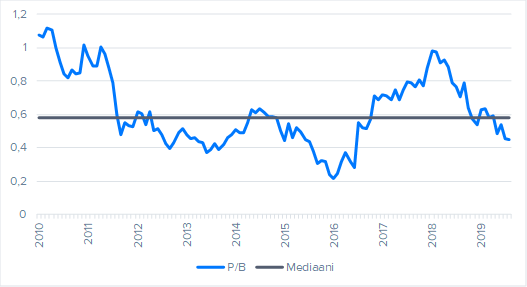
Here’s the historical balance sheet-based valuation and median for the 2010s. As you can see, it’s been a roller coaster 
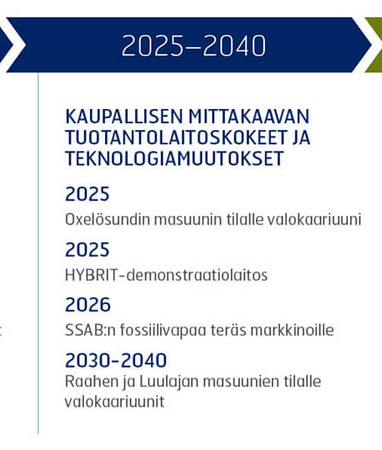
Here’s an excerpt from a comprehensive report and SSAB’s project timeline:
The HYBRIT project is still in an early stage, but the company started construction of a pilot plant in Luleå in 2018. After piloting in 2021-2024, the plan is to start plant trials in 2025-2035, and if successful, the company would be able to start production with a new production method. The company also intends to convert its existing higher-emission blast furnaces into electric arc furnaces, which will reduce emissions.
3 Likes
A story about SSAB. Now would be a good time to lighten the electricity tax for companies, since at the same time a nuclear power plant is coming to Hanhikivi → It will be cheap to run power lines from there to the Raahe factory. (When their blast furnaces are eventually replaced by electricity-demanding arc furnaces)
Nordealta. Jenkkimarkkinan virkoaminen odotuttaa itseään.
Giving up on US recovery case – 2020-21 estimates hold up though previously we thought there was a good chance that US plat margins would trade higher than historically owing to the extreme import barriers. However, primarily due to weak end-market demand, we slash our earnings estimates for Americas. We also take an even more cautious approach to both European standard and special grade prices, which will hurt 2019E earnings. However, due to lower pellet price estimates, our 2020-21 earnings forecasts hold up well.
1 Like
Yeah, it’s making us wait, and I doubt the budding trade agreement will improve things… Outokumpu’s Calvert plant will probably continue its losing streak… Making steel and stainless steel is a difficult business if you need to respect the environment at all. Is the world better in Asia?? Buyers don’t acknowledge SSAB’s or Outokumpu’s responsibility; when the price per ton is even slightly less, everything else is forgotten.
Well, that’s certainly still largely the case “at this stage.” When it comes to finished products, manufacturers aren’t keen on telling consumers about polluted steel in product descriptions. That will also change over time, out of necessity, as consumers finally want to know the origin of raw materials (and their pollution factor) before making a purchase decision…
By the way, steel prices in the US are rising once again:
-
Nucor announced yesterday that it is raising prices for steel coils (HRC and CRC) by $40 per ton.
ArcelorMittal USA and NLMK USA followed suit with their own announcements of a $40 increase. -
ArcelorMittal USA announced that it will no longer accept orders for February.
-
SSAB’s main product in America is steel plates, whose prices producers have also raised. However, coil prices have risen the most.
-
The rising prices and longer delivery times seen in the United States are positive for the steel sector, which is recovering from a bleak turn of the year. This development supports a cautiously optimistic view of steel companies.
-
Prices have already risen by 25% from their lows in the United States.
3 Likes
“We do not provide a target price (previously SEK 27.0) or recommendation (previously reduce) for the share, as we are discontinuing our coverage of the share due to the termination of the company monitoring agreement.”
Now we are dependent on other independent analyses. OP gave a BUY recommendation today with a target price of SEK 36. I’m not buying yet.
1 Like
Nordea updated its forecasts slightly downwards today but still confirmed its buy recommendation with a target price of SEK 50. (Nordea has maintained this target price at least since November.) Nordea expects the Q1/20 result to be better than consensus and the full-year margin to be significantly better than consensus (EBIT 6.7%).
Regardless of the reasonableness of the target price, how often should it really be changed?
Rumors in Sweden suggest that SSAB is interested in acquiring ThyssenKrupp’s steel business. Reportedly, ThyssenKrupp is also holding discussions with other potential buyers regarding the matter.
https://twitter.com/zijoittaja/status/1262258784598138880?s=20
I don’t know how good an idea it is to go and buy Thyssen’s blast furnaces Of course, investing there can increase the demand for special steel and spread it. It works as long as the Chinese don’t learn the same.
In Germany, you just don’t start co-operation negotiations like they did with Rautaruukki.
2 Likes
Could the reason for this be that Thyssen is in a deep crisis and needs to find something to sell? SSAB might be looking for an investment if/when the price hits rock bottom. Perhaps they plan to utilize hydrogen technology here as well; @Nyyb knows more about this.
Converting blast furnaces to electric arc furnaces is no minor “renovation.” It requires significant investments, and not all blast furnaces can be converted at once. Additionally, each plant seems to be slightly different, even if the operating principles are the same (a real pipe hell).
What is the capacity of Thyssen’s plate/strip rolling mills? What kind of steel do they produce (are there experiences with high-strength steels)? At the melt shop, all raw materials are mixed (pig iron from the blast furnace + nickel, chromium, etc.) to create the steel’s properties (355, 420, 460, 520, 700 hardness grades + suffixes like K2+N, ML, etc.).
Do they have direct cooling technology? Or is only a blank produced at the melt shop, which is later heated and sent to a different line for processing + hardening?
Electricity supply must also be in order - this seems to be a big question mark in Germany? They want to move away from coal and nuclear power at the same time. It should also be remembered that when coke use ends, coking plants will no longer be needed? (write-downs to the balance sheet?) Many jobs will also be lost there, just as they were from sintering plants in their time. (Coking plant jobs will probably largely move to the hydrogen sector).
What about the location of the plants? If they are in the middle of Germany, it might not be very easy to reach by ship. For example, between Raahe and Luleå, blanks are moved as needed, for example, if a blast furnace is broken.
During the corona period, however, blast furnaces are also being refurbished ahead of schedule.
Could SSAB’s balance sheet withstand Thyssen’s loss-making blast furnaces + its own investments?
4 Likes
Somehow I have a feeling that SSAB shouldn’t get into that mess; they have their hands full as it is.
Maybe if they could get it for dirt cheap, then yes, but even in that case, it would really stretch their balance sheet.
I see the positive side here that for political reasons, they probably don’t want to sell to the Chinese, which removes one bidder from the tender.
True, the only wrench in the works is that it’s now cheaper to buy, for example, “just air” from Germany than extremely large pension liabilities (which are greater than the value of the entire business)…
Chinese companies (= Chinese Communist Party) with their “bottomless coffers” do have the means for that, and even the ayatollahs of the EU Commission’s competition department won’t interfere with their purchases, as these “own dogs” don’t bite strangers, especially not Chinese ones…
Well, I guess SSab is just “gentlemanly obligated” to be part of these trade negotiations…

DNB maintains SSAB’s target price at SEK 35 (Buy).
https://www.dnb.no/seg-fundamental/fundamentalweb/inst/GetReport.aspx?file=CMP4_158140.pdf&uid=1154&auth=2jMoUXPS1%2FJy8ZNikSg5XXKm0kY%3D&pwd=&popup=n
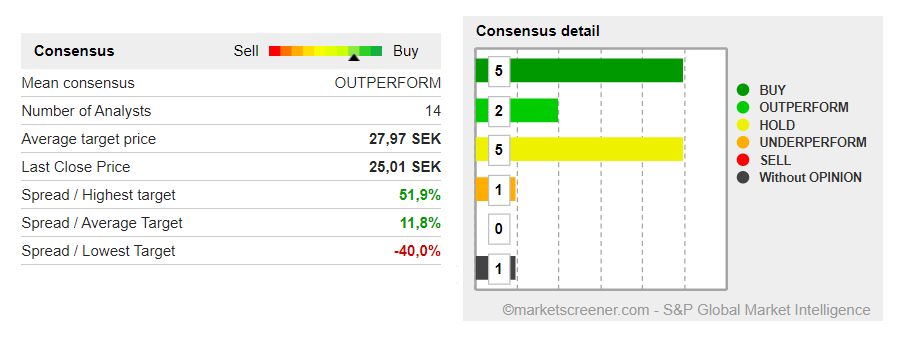
DNB’s analysis differs from the consensus, for example, in:
- expecting volumes in the Special Steels division to grow (e.g., Hardox, Strenx)
- DNB dividend forecast 4%, consensus 2%
- SSAB’s 2020 and 2021e EV/EBITDA multiples are 9.7x and 3.9x
=> The consensus forecast (Marketscreener) already seems to be pricing in an earnings improvement, even though Q2/20 could be really weak. In practice, the earnings improvement potential might only materialize in 2021.
1 Like
According to a German source (WAZ), ThyssenKrupp is exploring a merger with SSAB. Various reports about some kind of corporate arrangement between these two companies have been circulating for a few months now.
5 Likes