Sanoma - undervalued dividend machine?

Onks tää nyt se hetki kun maallikon pitää keskeyttää opetusalan asiantuntijoiden aivoriihi ja kerrata omat koulutraumat vuosikymmenien takaa? Saamanne pitää!

Lähestytääs tätä digitalisaatiohaastetta 1800-luvulta, kun nykyinen koulujärjestelmä keksittiin. Kyseessähän oli jo silloin valtava ongelma, että miten koulutat rajallisilla resursseilla ja primitiivisellä teknologialla (kirjat, liitutaulut) hurjan määrän lapsia niin, että parhaat lahjakkuudet pääsevät vaativiin hommiin ja heikompi aines päätyy hanttihommiin. Mallia otettiin sen ajan huippuorganisaatiosta, eli tehtaasta. Kouluun ei mennä taitotason, motivaation tai valmiuksien perusteella, vaan lapset laitetaan liukuhihnalle valmistuspäivämäärän mukaisesti. Koko ikäluokalle tehdään opettajien toimesta samanaikaisesti ennalta tehtaanjohdon tarkkaan määritetyt prosessit ja tuotannon laatua mitataan määräaikaisesti järjestettävillä kokeilla. Heikompi aines seuloutuu amikseen ja lukiossa satsi laitetaan normaalijakaumalle, josta osa jää sille tielle, iso määrä päätyy ammattikorkeakouluun ja parhaiten menestynyt osuus yritetään ohjata yliopistoon.

Näin tämä järjestelmä toimi 1800-luvulla ja näin se toimi myös itse käydessäni koulut 1900-luvun loppupuolella. ATK-laitteet oli toki keksitty ja niille sai oikein suorittaa ajokortin ja kymmensormijärjestelmän osaamistestin, mutta käytännössä opetuksen kovin innovaatio siihen mennessä olivat tuliterät piirtoheittimet, joilla oli mahdollista saada graafista aspektia mukaan opetukseen. Rakastin oppimista ja lukemista, mutta vihasin koulua ja olin siinä helvetin huono, enkä varmaan olisi ikinä valmistunut edes lukiosta, yliopistosta nyt puhumattakaan, mikäli älypuhelimet olisivat tuolloin olleet keksittyjä ja laajalle levinneitä. Se jatkuva mieltä puuduttava tylsyys oli vain pakko kestää päivästä toiseen, vuodesta toiseen, kun ei ollut muutakaan vaihtoehtoa tai paikkaa missä oleskella päivät.

Ironisinta oli, että kaikki tekniikka oli jo silloin olemassa rakentaa huippuluokan digitaaliset oppimisvälineet, mutta niin ei vain koskaan tapahtunut. Softassa on se hieno puoli, että se skaalaa rajattomasti, joten kun olet kerran rakentanut parhaan mahdollisen kuviteltavissa olevan multimediapläjäyksen jolla opettaa vaikkapa Pythagoraan lause, niin sitä ei enää tarvitse luoda uudestaan, vaan voit skaalata sitä loputtomiin yhä uusiin vuosiluokkiin. Ja mikä parasta, parilla äkkiä kirjoitetulla funktiolla saat ohjelmasta ulos opettajalle kaikki hänen haluamansa yksilölliset tilastot oppilaasta. Kauanko mitäkin aihekokonaisuutta on tuijotettu. Kuinka pitkään missäkin on mennyt aikaa? Mikä vaihe on ollut oppilaalle vaikein? Paljonko on arvioitu osaamisen taso? Aivan triviaalia puuhaa softakehittäjän näkökulmasta ja mitään säännöllisesti järjestettyjä kokeita ei digimateriaalien ansiosta edes tarvita, kun opettajilla on aina saatavilla reaaliaikainen tieto jokaisen oppilaan osaamisen tasosta.

Noh, olen päässyt seuraamaan akateemisesti koulutettujen työttömien ystävieni keikkatöitä koulujen sijaisena ja sitä kautta nähnyt, että miten se kuuluisa digitalisaatio on kouluissa edennyt. Suoraan sanottuna käyttöliittymät ja materiaalit näyttävät siltä, kuin ne olisi rakentanut joku sadistinen 00-luvun alkupuolella TietoEnatorilla työskennellyt järjestelmäsuunnittelija. Sehän on sitä samaa paskaa, mitä itsekin jouduin koulussa sietämään, mutta se paska on vain siirretty digitaaliseen muotoon. Ja mikä pahinta, lapsilla on nykyään älylaitteita, joilla pääsee näkemään aidosti hyvää opetusmatskua esimerkiksi Youtubessa, ellei sitten joku myrkyllinen algoritmi tai some ehdi kaapata huomiota kokonaan pois oppimisesta. Noita digimateriaaleja rakentavat tahot eivät näillä näytöillä pääsisi Applelle edes kesäharjoittelijaksi kahvia keittämään, kun ei ole mitään luottoa, että Moccamasterissa osattaisiin painaa sitä keinukytkiminen oikeaa puolta.

Pahintahan tässä on, että kyseessä ei kuitenkaan pohjimmiltaan ole Sanoman tai muiden digitaalisten opetusmateriaalien valmistajien syy. Järjestelmä ei tarjoa markkinamekanismia, jonka perusteella yrityksillä olisi minkäänlaista insentiiviä rakentaa opetusmateriaalia, mikä maksimoisi lasten oppimisen. Keskusjohtoisessa järjestelmässä uudistukset ja kehityksen virrat etenevät Opetushallituksen politbyroon eläköitymisten kautta.

Tämähän olisi tietysti paperilla helppo korjata. Lanseerataan koko Suomeen Koulu+ -oppimispalvelu, jossa vanhemmat voivat maksaa siitä, että heidän lapsensa saa koulussa parempaa digitaalista opetusta. Ensimmäinen taso voisi olla mainosrahoitteinen ilmainen koulu. Tämä ei edes ole mitenkään radikaali ajatus, vaan reaktionäärinen, koska omassa lapsuudessani kouluissa mainostettiin aktiivisesti sekä Valion maitoa, että Jeesuksen pelastusta, eikä meidän silti tarvinnut hävetä tuloksia sen enempää PISAssa kuin Cooperissakaan. Toinen taso voisi olla esimerkiksi 500 €/kk premium-koulu, missä koulu ostaa kumppanilta paremmat opetusmateriaalit ja kolmas taso kunnon 1000 €/kk maksava eliitti-koulu, jossa jokaiseen oppilaaseen panostetaan mielettömän paljon. Näin saadaan rahalla kannustettua yritykset kilpailemaan keskenään ja panostamaan koulukokemuksen kehittämiseen ja kehitetyt oppimisinnovaatiot saadaan ennen pitkää käyttöön myös maksuttomaan koululaitokseen.

Paljon vaikeampi nakki on päästä eroon tästä tehdasajattelusta ja lakkauttaa ylioppilaskokeet, ammattikoulut ja muut vastaavanlaiset täysin hyödyttömät traditiot ja turhakkeet. Meillä on viimeisen muutaman vuoden aikana vihdoinkin tullut käyttöön mullistava tekoälyteknologia, joka mahdollistaa luokkaopetuksen sijaan jokaisen oppilaan täysin yksilöllisen opettamisen ilman opettajan jatkuvaa mikromanageerausta. Sen sijaan, että opettaja jakaa huomionsa 30 oppilaan kesken voisi jokaisella oppilaalla lähitulevaisuudessa olla oma tekoälyopettajansa tarjoamassa täysin jakamatonta huomiota ja laatimassa tarvittavat opetusmateriaalit lennosta, kun taas pedagogiikan ammattilaisen harteille jää toimiminen korkeamman tason hallinnoijana ja oppimisongelmien ratkaisijana. Ja mikä parasta, jokainen oppilas voi valita itselleen sopivimman oppimistavan ja lähestymiskulman aiheisiin ja mahdollisesti myös opiskella sellaisia asioita, mitä opettajakaan ei osaa.

Dippainssin näkökulmasta teknistä estettä tällaiselle tulevaisuudelle ei enää ole, koska tarvittaviin tekoälyratkaisuihin liittyvät haasteet ovat jo enimmäkseen ratkottu tai tulevat ratkaistuksi muutamien vuosien sisällä. Käytännössä muutos koulujärjestelmässä on ilmeisesti kuitenkin mahdotonta. Julkinen ei ole valmis maksamaan riittävästi rahaa uuden sukupolven oppimisjärjestelmän rakentamisesta, eikä toisaalta kykene kehittämään sitä omatoimisesti. Konservatiiviset voimat yhteiskunnassamme vastustavat isoja järjestelmätason muutoksia, joten innovaattorien yritykset kääntää mammuttitankkerin kurssia taantuvat yksittäiseksi hankehumpaksi ja tutkimusten tehtailuksi, ilman todellista pitkäkestoista vaikutusta kokonaisuuteen.

Valtavasti teknologisesta kehityksestä huolimatta en oikeastaan usko, että mikään lähivuosina tulee kouluissa muuttumaan, paitsi että nuorten pahoinvointi kasvaa kun ero koulumateriaalin ja yhä tehokkaammin laaditun viihteen ja viihteellisen opetusmateriaalin välillä kasvaa entisestään. 20 vuoden päästä tulee sitten joku jenkkimegatekno, mikä käyttää satoja miljoonia tekoälyn kehitystyöhön ja lanseeraa sitten täyden peruskoulun tekoälyopettajan, joka pyyhkii nykyiset toimijat kentältä ja pakottaa koulujärjestelmän muuttumaan, kun vanhemmat alkavat vetämään lapsiaan pois koulusta kotiopetukseen.

Nyt kun tuli haukuttua koko koulutusjärjestelmä ja opetussektori, niin asiantuntijat voisivat sitten toivottavasti kertoa, että mikä on asioiden todellinen laita :smiley:

11 Likes

As a teacher (math, physics, chemistry), I can say that Sanoma has excellent digital materials and truly fast and good customer service for schools. Their book series for schools are also generally superior. I wouldn’t even consider switching to another publisher.

4 Likes

Could you, @Verneri_Pulkkinen, read this text by Eka aloud right at the beginning of the Roast, steadily increasing your volume and reading speed?

This is probably the core of the matter. It probably comes as no surprise to anyone that the public sector is always at least 5 years behind all development. Even at the idea level, and from there it’s still a long way to implementation.

Individual young teachers do always develop something great, but those innovations usually only concern a specific niche area of teaching, and after five years of trying, they realize that all the wasted time was in vain and return to basic methods.

Because the public sector is so inefficient, I believe it’s futile to rely on it for learning innovations. The most advanced solutions come from the B2C market, which Eka touched upon in his writing. Of course, skilled and diligent teachers can harness them for school education, but even then, various copyright issues often arise, which are then violated according to one’s own courage. For this reason, most people settle for publishers’ materials, because it’s easier that way.

The B2C market hasn’t yet managed to monetize this properly, which is why I have suggested that weekly allowance application for monetization, from which the service provider could take a commission. In this way, it would not be too large an additional cost for the user.

7 Likes

Here are a couple of questions:

The share of digital products in Learning continues to grow. What concrete actions does Sanoma intend to take to improve margins, especially as the scalability of new, diverse digital platforms increases?

AI must be pushed everywhere, so let’s try; how does Sanoma intend to utilize AI in the development of learning materials and these other services, considering its effects on potential cost-effectiveness, scalability, and even improving learning outcomes? Or has the company fallen off the AI bandwagon…? :slight_smile:

3 Likes

When the kids were small around the turn of the 90s/00s, we had the game “Mahtava Matikkaraketti” (Awesome Math Rocket). It was certainly strange when we had to order the children to stop calculating.

4 Likes

Vielä muistutuksena että kohta lähtee! :fire:

Lisäys. Tässä vielä ROASTin kysymyslista.

Sanoma ROAST – CEO Rob Kolkman
-Could you share a few interesting facts about yourself to start with?
-What does Sanoma do, in a nutshell?
-Why do you think Sanoma is a good investment?
*If so, why haven’t you bought more shares with your own money? Most of your shares have come from incentive programs.
-In the last five years (2019–2024), Sanoma has increased its revenues by many acquisitions—from €900 million to €1.4 billion (+50%) using pro forma numbers—but the dividend has decreased, EBIT has increased less than revenue (+30%), and operating EPS (continuing operations) is at the same level as in 2019 (0.49 vs. 0.46). ROCE has been just over 10%. Are you happy with Sanoma’s value creation?
-Sanoma bought Santillana Spain for €465 million at an EV/EBITDA multiple of 9.3x. It seems Santillana has not grown materially since then (net sales: €122 million in 2019, €135 million in 2024). Do you view this acquisition as a success from the shareholders’ perspective?
*Did you pay too high a multiple for such a slow-growing business? Note the cyclicality of the learning business.
-You haven’t experienced meaningful growth in Italy either. What is the logic here? (>€100 million in revenue.) You also divested parts of the German business later on.
-Are southern European markets attractive considering the lower level of digitalization?
-And… based on population growth, the number of students is not growing fast—maybe even declining in markets like Finland. Does it stop the growth in Learning segment in the long term?
-You are targeting €2 billion in sales by 2030, of which 75% is from Learning. Considering rather high acquisition multiples and sluggish growth outlook, is this growth target sensible from a value-creation perspective?
-Back in 2023, Sanoma issued a hybrid bond with an 8% coupon interest to help finance the aggressive inorganic growth in Learning. At the same time, you continued to pay dividends. Why?
*Why not cut the dividend?
-Are share buybacks on the table as a capital distribution tool? I know Sanoma buys shares for incentive programs, but as I understand it, Sanoma doesn’t cancel those shares.
-Learning aims for a 23% profit margin by next year. How?
*Are there real synergies between different markets?
-How do you view gamification in learning content?
-Are Duolingo and similar apps a threat or an opportunity for Sanoma?
-What about the digital material provider Studeo? Some teachers in our forum discussing roast questions said they try to move away from Sanoma and Otava and prefer Studeo instead.
-Have you considered the B2C market in the Learning business? (How could Sanoma compete against agile digital providers, AI, and YouTube?)
-In many of Learning’s core markets, the number of students is actually decreasing. Does this affect Learning’s long-term growth potential if there are fewer students to provide materials for?
-PISA results are decreasing in many countries like Finland, and some people criticize digital learning materials. Could the trend toward more digital materials reverse back to favor physical books?
-In general, do you view generative AI as a threat or an opportunity for Sanoma?
AI as a tool: everyone can use it. Does it give any one company an advantage? For example, Alma Media’s CEO Kai Telanne said they are either going to produce double the news with AI or the same amount with half the resources they use today.
-How do you apply AI in the Learning segment—in learning materials, etc.?
-How do you feel about investing in content (for Ruutu, etc.) in this competitive environment?
-Don’t you think generative AI will create a flood of content and make competition for attention even harder in the future?
-Media Finland targets a 12–14% EBITA margin. We haven’t seen that for years, so how are you going to get there?
Alma Media is already there—perhaps because they have less print?
-Learning and Media Finland are totally different businesses. Should Sanoma split into two standalone companies?
(There is less debt nowadays, and both are large businesses on their own, etc.)
-How do you view the future media landscape in Finland? There are Alma, Sanoma, Otava, regional media, and YLE. Over the next 10 years, how much consolidation do you expect?
-Where do you see Sanoma 10 years from now?

9 Likes

Petri has written preliminary comments as Sanoma will publish its Q2 report on Wednesday. :slight_smile:

Sanoma will publish its Q2 report on Thursday around 8:30 AM. We forecast the company’s revenue to have decreased in both segments, but thanks to slightly higher profitability, our operating profit forecasts are, like the consensus, practically at the comparison period’s level. Consensus estimates for the current year are above the midpoint of the given earnings guidance range, but Sanoma, which typically provides conservative guidance, is expected to reiterate its current year guidance range at this point in the year.

EDIT: @Petri_Gostowski, corrected :slight_smile:

2 Likes

Just a clarification, that Thursday had accidentally been mentioned earlier when the correct day is Wednesday. It has now been corrected, but the wrong day still appears in @Sijoittaja-alokas’s message, as it was copied from a draft that I hadn’t had time to edit yet :slight_smile:

1 Like

Here are the initial comments on Sanoma’s results, which were slightly better than we expected, line by line. Sanoma’s webcast starting at 11 AM can be watched here Sanoma Oyj, Webcast, Q2'25 - Inderes

3 Likes

Evening Worker and Chief Analyst Petri has prepared a new company report on Sanoma. :slight_smile:

Sanoma’s Q2 result was slightly better than our expectations across the board. Despite the profitability improvement progressing slightly better than expected, we have not made significant forecast changes, but the Q2 report further strengthens confidence in next year’s forecasts. We also recognize the possibility of raising guidance during the rest of the year, provided the domestic advertising market develops tolerably. We raise Sanoma’s target price to 10.9 euros (previously 10.5 euros) and reiterate our ‘add’ recommendation, reflecting a moderate valuation.

Quoted from the report:

Cash flow typically improves in H2

In H1, Sanoma’s operating cash flow settled at -33 MEUR, while after ordinary organic investments, hybrid loan interest expenses, and lease liability payments, free cash flow was -80 MEUR (previous 12 months 101 MEUR). Free cash flow continued to improve from a year ago, and thus Sanoma is well on track with its guided free cash flow improvement for the full year. The company’s financial position has also strengthened, although seasonally, indebtedness is at its highest at the end of Q2 (Q2’25 end net debt/EBITDA 2.5x).

3 Likes

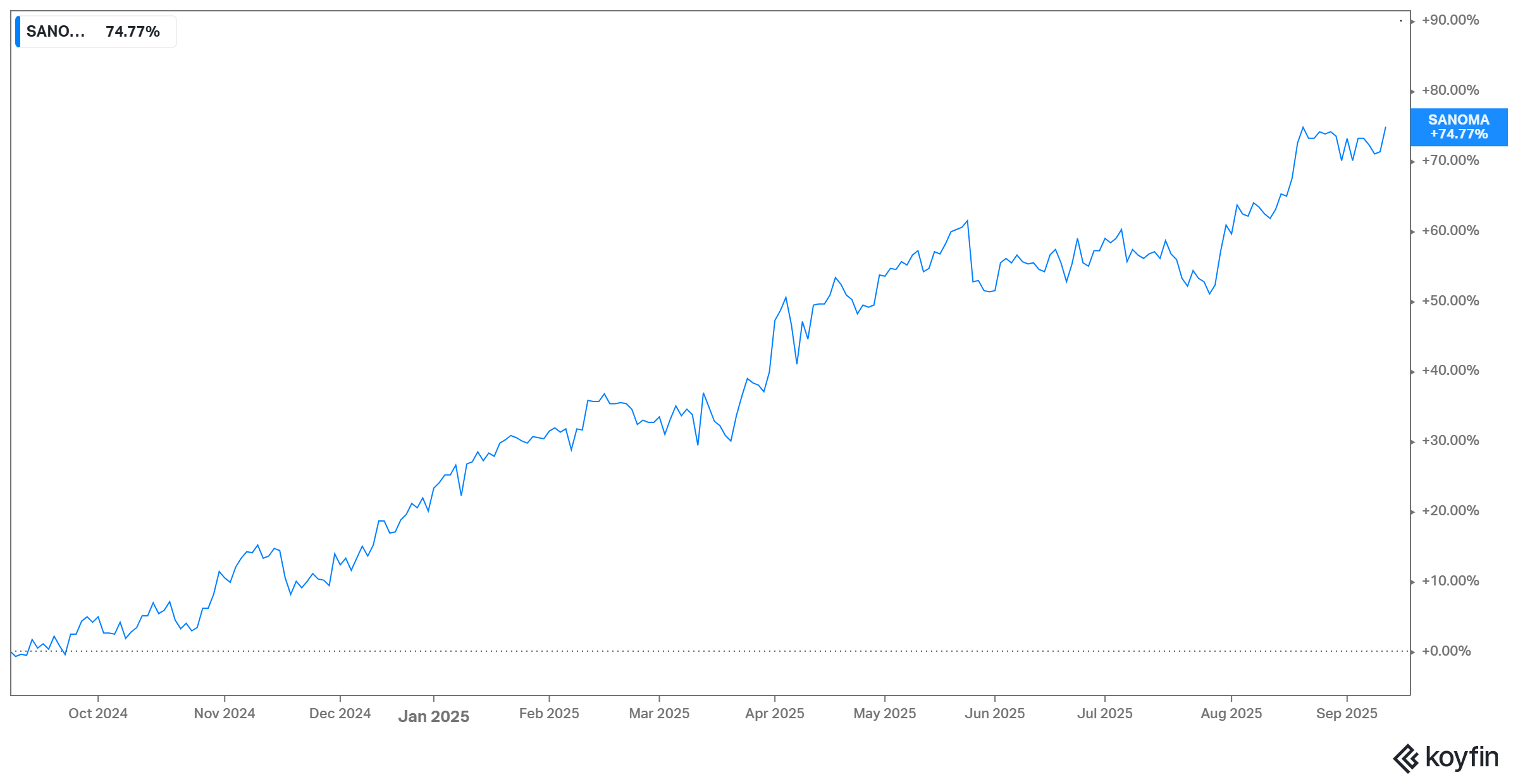
#Sanoma’s stock has quietly crept up almost 75 percent in the last 12 months. CEO Rob Kolkman presented #Sanoma as an investment target at the #PörssiSijoittajanViikko event.
Here are a few observations:

  1. Which markets does the company focus on in Learning?
  • The company focuses only on K12 markets
  • Sanoma is not longing for other markets, as there is still room for growth in K12
  • The company has clear competitive advantages in K12
  1. Where does the company’s profit come from?
  • Learning now brings 76 percent of the company’s profit
  • Learning has doubled in size over the last five years through organic and acquisition-driven growth
  • The goal is to double revenue by 2030
  1. Where will acquisitions be made?
  • Expansion in current operating countries
  • Can also expand to new countries, although it was not mentioned what they might be
  • If acquisitions are made, the aim is to achieve a leading market position in K12
  1. Where is organic growth sought?
  • Spain and Italy are fragmented markets
  • Growth expected in the European learning materials market in 2026-2028
  1. When will Media Finland be separated into its own company?
  • No plans at the moment
  • Development will continue separately
  1. Is Solar on schedule?

  • Yes
4 Likes

Sanoma Media Finland plans to centralize its news media printing operations in the Helsinki metropolitan area to Sanomala, Finland’s largest newspaper printing house, and to close the Sanoma Manu printing facility located in Tampere. The plan is driven by the accelerating shift in media consumption towards digital channels. As a result of declining newspaper print volumes, unit costs for printing have increased. The newspapers produced by Sanoma could in the future be printed more cost-effectively in one printing facility without significant impact on customers.

Final decisions will be made after the conclusion of change negotiations in accordance with Finnish legislation. If implemented, the plans would affect an estimated 65 employees.

If the closure of Sanoma Manu were to materialize, Sanoma would record approximately EUR 30 million in restructuring costs as items affecting comparability in Media Finland’s result. Of these costs, approximately EUR 27 million would primarily be write-downs related to right-of-use assets, which have no cash impact. In the coming years, the annual cost benefits brought by a potential closure will support Media Finland’s established continuous efficiency improvement approach, which helps manage the effects of declining revenue in the printed business and cost inflation.

The planned closure has no impact on Sanoma’s outlook for 2025 or its long-term financial targets.

EDIT: Let’s add this here too

OP’s Chief Analyst Antti Saari believes Sanoma is steadily progressing towards the peak cycle of the European learning material market, expected in 2026–2027.

– The learning business is extremely stable by nature, and in the short term, uncertainty is mainly caused by the development of the advertising market. However, its significance for the share price is limited. Sanoma offers investors a combination of defensiveness and earnings growth, which we believe is not fully priced into the share price, Saari states.

4 Likes

Here are Petri’s preliminary comments as Sanoma publishes its Q3 report on Thursday. :slight_smile:

We forecast the company’s revenue to have decreased in both segments, but thanks to slightly higher profitability, our operating profit forecast is only marginally below the comparison period. The consensus forecast for the current year is above the midpoint of the given earnings guidance range, and we expect Sanoma to refine the earnings guidance range upwards with the Q3 report, similar to last year.

And here are the comments on the result. :slight_smile:

Sanoma published its Q3 results this morning, which were operationally slightly better than expected thanks to the very good profitability development of Media Finland. Sanoma also, quite as expected, specified its current year guidance ranges and raised the lower end exactly in line with our expectations. Overall, the initial impression of the report is quite positive, so we expect the stock to perform more positively than the general market today. The company’s earnings call, starting at 12:00, can be followed from this link.

1 Like

Petri, guided by the Lutheran work ethic as a night worker, has completed the post-Q3 company report. :slight_smile:

Sanoma’s Q3 performance was operationally slightly better than we anticipated, and the upward revision of the current year’s earnings guidance range met our expectations. We expect the company’s earnings growth to accelerate next year as demand for Learning’s educational materials increases and the benefits of its efficiency program emerge. We estimate that the company will also accelerate growth through acquisitions, and further details on these plans are likely to be provided at the Capital Markets Day on November 25. We revise our target price to 11.2 euros (previously 10.9 euros) and reiterate our ‘add’ recommendation for the stock, which offers a good return expectation with earnings growth.

Quoted from the report:

Free cash flow rolls upwards as expected. In Q1-Q3’25, Sanoma generated 114 MEUR in operating cash flow, while after ordinary organic investments, hybrid loan interest expenses, and lease liability payments, free cash flow was 51 MEUR (previous 12 months 112 MEUR). Thus, Sanoma is well on track with its guided improvement in free cash flow for the full year. Accordingly, the company’s financial position has strengthened (net debt/adjusted EBITDA at the end of Q3’25 was 2.0x) and well enables a more active approach to corporate arrangements in the future.

This topic has probably been discussed somewhere already, but I haven’t seen it myself. So, feel free to refer to a previous answer on the same topic, if one exists.

Now that these American ad giants are banning political advertising, which apparently also excludes some indirect political actors who are nevertheless societal.

Does this have a positive impact on domestic media conglomerates? Finland is a nation of elections. We have municipal, parliamentary, SOTE (social and health care) area, SOK elections, and then some smaller elections, such as OP and Tradeka elections, etc., mainly traditional cooperatives.

Individual candidates can presumably still advertise themselves, but organizations, such as parties, cannot advertise. So, is there going to be a rush of audience to Sanoma, Alma, Ilkka (or nowadays their joint venture with Kaleva), Keskisuomalainen, perhaps Panostaja Grano?

If so, how significant an additional income is this for domestic companies? Of course, the strictness of the interpretation also matters. Is societal advertising, for example, by human rights or environmental organizations, considered political advertising? That wouldn’t make sense, but from the perspective of American social media companies’ investors, the entire ban probably doesn’t make sense anyway. Or perhaps the potential benefit has just passed me by.

So, is more money coming to domestic media companies?

2 Likes

Juho Toratti has written an analysis of Sanoma. :slight_smile:

Based on strategic moves, Sanoma appears to be loading its stakes already for next year, when the market is expected to accelerate, especially in the learning business.

Positions for 2026 indeed seem very stable.

In the past quarter, the effects of the Solar efficiency program were again reported to be significantly visible in profitability development, and the effects are expected to be emphasized next year. The company’s management is confident that the targeted 23 percent operating margin will be achieved and even exceeded.


Note.

IR-ikkuna is a channel for SalkunRakentaja’s and Sijoittaja.fi’s corporate partners for background and analytical articles, as well as other interesting investor information. The article is part of a commercial collaboration with the company. The article does not contain investment recommendations.

1 Like

Petri is in an excited mood ahead of the event, as Sanoma has its Capital Markets Day next Tuesday, and here are his comments on it. :slight_smile:

At the Capital Markets Day (CMD), our focus will be on the company’s growth outlook and targets for 2026–2030, as well as potential comments on capital allocation plans. We do not fundamentally expect changes to segment-specific financial targets, although clarifying the profitability target for Learning may be timely.

Here are Pauli’s and Kaisa’s comments on Sanoma’s updated financial targets. :slight_smile:

Sanoma published its updated financial targets for 2026–2030 in connection with its Capital Markets Day. Growth expectations for the Learning segment increased, and the drivers for Media Finland’s earnings growth became clearer. The company also tightened its leverage target. We will comment on the new strategy in more detail after the Capital Markets Day.

Sanoma’s CEO Rob Kolkman was interviewed by Pia at the company’s Capital Markets Day. :slight_smile:

Topics:

00:00 Start 00:08 Growth 00:23 Impact of AI 01:21 Learning 02:07 New countries 03:13 Teacher shortage 04:04 Media 04:32 Opening of the gambling market 05:34 Finnish-language media 06:57 Possible demerger 07:48 Factors affecting Sanoma’s growth

1 Like