News came this morning that the arrangements in the Finnish media landscape continue. Ilkka sells part of its ownership in Alma Media (16%) at a price of €7.44 per share. A total transaction of approx. €100M, from which Ilkka records a profit of approx. €44M. So, Ilkka’s owners will receive almost €4 per share, and Ilkka’s earnings will be over €2 per share for this year. I still see significant upside potential in the stock, or should I go to the general meeting to propose ceasing the company’s operations and distributing
5 Likes
Ilkka still receives Alma dividends tax-free, so for example, with Inderes’ forecast of Alma’s dividend being €0.3, Ilkka pockets approximately €2.7 million (over €0.10/share). Additionally, its own business is profitable, and it now has a net cash position of well over €2/share. It can certainly afford to pay dividends for a long time/a lot. It’s rare to get a profitable company from the stock market at 1.5x net cash.
The only fear is that the money will be used for something stupid.
1 Like
Ilkka’s market capitalization is €96.5M, net cash is €60M, and the remaining 10.9% Alma ownership market value is €61M. → The market capitalization of its own business is -€24M. However, its own business generated a profit of €0.5M in Q3 alone, and the current restructuring program will be fully implemented by the end of the year. The biggest question mark is likely how the current overcapitalized balance sheet will be reallocated.
1 Like
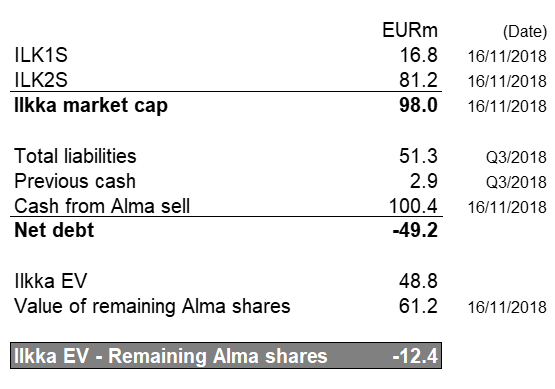
The valuation of Ilkka has been completely off since early 2017. Yesterday, the mispricing decreased somewhat, but it still hasn’t been eliminated… The market still values the business at EUR -12.4m, and this figure only considers cash and Alma’s shares (at market value) from the balance sheet assets. For example, “Tangible assets” EUR 7.8m, “Accounts receivable” EUR 3.2m. When these are included at their balance sheet value, the business value starts to be EUR -23m. The image shows a quick calculation.
1 Like
Again, solid text from Akilta.
2 Likes
Ilkka generates even less passion on the discussion forum than on the stock exchange…
A moderate share in my own portfolio
Ilkka has a reputation for being a bit of a newspaper publisher, even though it seems to be a bit of this and that, and above all, something completely different.
Shares 25.45 million pcs,
-Voting series I shares 16% and 84% series II shares
-However, 80% of the votes are held by the series I shares
Share price 3.07 EUR (series II) (series I today 3.56 EUR))
Valuation 1H2020:
-liquid assets 43.73 MEUR, i.e., 1.72 EUR/share
-interest-bearing liabilities (2.69) EUR, i.e., (0.11) EUR/share
-Alma ownership @7.82EUR 2.76 EUR/share (10.9% of Alma, i.e., approx. 8.97 million pcs)
= 4.37 EUR/share
In addition, the actual businesses
-a bit confusing due to acquisitions and all sorts of adjustments, but all in all, the revenue level has come down from the pro forma run rate of 50 MEUR to about 47 MEUR (2x1H2020), i.e., -7%
-adjusted operating profit of own operations slightly in plus even during the corona period
-newspaper and printing house business; Revenue 36.4 MEUR (2019)
-Liana Technologies (acquisition 8.1.2020 67%, digital marketing, etc.); Revenue 14.2 MEUR (2018)
=50.6 MEUR
-adjusted operating profit of own operations 2019 approx. 1.25 MEUR, i.e., 0.04 EUR/share
(2019 Ilkka’s share 1.25 MEUR and Liana -0.3 MEUR)
-Liana 2019 figures are reportedly similar to 2018
-1H2020 revenue 21.5 MEUR, of which 2Q2020 share 11.35 MEUR. Without the 1.9 MEUR downward adjustment of acquisition revenue, it would probably have been approx. 23.4 MEUR
-1H2020 adjusted operating profit of own operations 0.02 MEUR, of which 2Q2020 share 0.25 MEUR
-outside of adjusted operating profit: 2.667 MEUR acquisition-related expenses and items related to acquisition cost adjustments, as well as Alma dividends approx. 3.6 MEUR
The question still is that if cash is cash and Alma is a correctly priced stock, why is it not even 4.37 EUR/share?
Gap (4.37-3.07)x25.45 = 33.1 MEUR and a couple of MEUR less when considering that series I shares are 0.5 EUR more expensive. So approx. 31 MEUR
Even businesses with 50 MEUR in revenue have value; Ilkka paid 15 MEUR for only 67% of Liana, from which an immediate write-down was made. According to the 2019 level, a 0.04 EUR/share result easily gives a value of 0.4 EUR/share, or 10 MEUR, which would not even be the acquisition price of Liana. Or let’s say 20 MEUR.
→ gap 31+10=41 MEUR or 31+20=51 MEUR, 1.6 EUR…2.0 EUR/share
Ilkka’s >10% ownership is crucial, e.g., if an acquisition comes along
What should Ilkka do to close the valuation gap and rise to the 4.7…5.1 EUR level?
Distribute the overflowing cash as dividends?
Distribute Alma shares to Ilkka’s owners?
Sell Alma shares with a premium to corner investors?
Sell the newspaper and printing business?
Merge the digital side with a new digital Alma?
Any ideas?
Ilkka does not really try, in my opinion, to keep its own flag high and increase shareholder value:
- The 2020 dividend level of 0.2 EUR is about 75% of the Alma dividend redistributed and only 6 cents = 1.5 MEUR from that overflowing cash
- The 10% operating profit target for own business is conspicuously absent already before corona
- Immediate write-downs from acquisitions
- The share price is stuck at corona lows even though the sum of the parts is 40-50 MEUR higher than the share price
Ilkka-yhtymä (Ilkka Group) Mission (according to the group summary page): Information unites
According to the investor section, Mission: We strengthen Ostrobothnian success and create new content for life
However, the revenue growth target and the 10% operating profit target for own business are consistent
3 Likes
Inderes initiated coverage, target price EUR 3.75 and “buy”
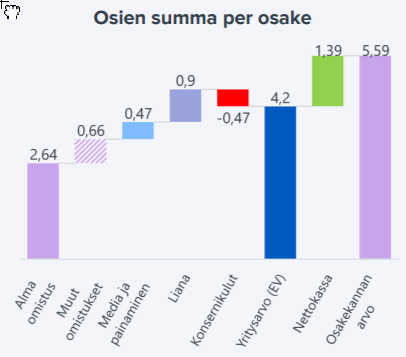
“We assess the valuation of the share especially through our sum-of-the-parts calculation, where a significant portion of the company’s value consists of relatively liquid assets. This value is buried under the development of operational results burdened by the structural transformation of print media, and the greatest uncertainty relates to the realization of the hidden value in the parts. With a conservative estimate of the duration of value realization, the investor’s medium-term annual return expectation rises to an attractive +20% level according to our estimate. While waiting for the realization of the sum-of-the-parts value, we predict the share will offer a high dividend yield of 6.5-7% in the coming years. Overall, we believe the share’s return/risk ratio is very attractive, considering the current valuation and the potential included in the sum of the parts.”
Sum of the parts: EUR 5.59
1 Like
Hey @Petri_Gostowski,
After reading that comprehensive report on Ilkka-Yhtymä’s business, a few clarifying questions still arose.
The acquisition of SaaS company Liana Technologies in early this year serves as the first indication to investors of the future direction and creates a platform for the growth of digital services.
Could you elaborate on what Liana does, who its competitors are, and what its potential competitive advantages are?
Also, does the comment mean that Liana’s operations will be expanded further, or that in addition to Liana, Ilkka will invest in other companies offering digital marketing and communication solutions?
In our view, Liana serves as a platform for developing the M&A process and for new acquisitions. We expect Liana to make growth-supporting acquisitions in the coming years, especially in international businesses, where the company already has a good foothold in several markets but lacks sufficient scale.
Does this refer to the acquisition of technology or the acquisition of individual players (advertising agencies?) that have local sales power?
My understanding based on the report is that Ilkka’s growth opportunities will hereafter rely on Liana and other acquisitions. Without speculating on future investors, one must currently lean on Liana’s story, which has not shown significant growth in recent years.
Hi @Konkakkelzr, great questions!
Liana is broadly defined as a partner in customer marketing and communications. It can offer, for example, marketing automation services, direct marketing services, and/or online visibility. The competitive landscape varies slightly across different service areas, as competitors in marketing automation services, for example, may not necessarily offer online visibility services. This broad service offering can be seen to some extent as a competitive advantage, but not necessarily sustainable over time, as competitors can also expand their service offerings. For example, Apsis and Hubspot also have, to my understanding, a fairly broad service offering.
As I understand it, Liana is relatively satisfied with its service offering and technology (although good services are, of course, always developed), so growth is more likely to be sought by acquiring customers. That is, in acquiring a competitor, the focus is not so much on technology/service but on the customer portfolio. This is my assessment, and we will be wiser about this when/if acquisitions occur.
“My understanding based on the report is that Ilkka’s growth potential will be dependent on Liana and other acquisitions in the future.”
This summarizes the whole big picture. Regarding growth in recent years, I would say that the funds to grow digital businesses have mainly been obtained only in 2018 by selling Alma shares. After that, the first small acquisitions were made in 2019 and now early 2020 with Liana. For this reason, there haven’t really been the means for significant growth before.
Hope this clarified things 
Hey,
Thanks for the reply, it clarified things well.
I spotted a good point about this topic on the Kauppalehti forum:
Those potentially interested in Avidly should consider Liana Technologies Oy. This marketing automation SaaS company does the same as Avidly, but instead of Hubspot, it has its own software. The company is in good hands and has already reached a sufficient size so that losses won’t sink the company. No need to fear new share issues in the future.
This brings nice competition within the stock market for the same industry. There aren’t too many such competitors in the Helsinki Stock Exchange. In Ilkka’s case, shareholders really don’t have to worry about share issues.
I’m certainly interested to follow what kind of profitability and growth Liana itself achieves. One could at least imagine that the company’s products have reached a reasonably mature stage based on references. Thus, one could assume that SaaS would, in the best-case scenario, start generating profit, which would draw more interest to the Ilkka case.
3 Likes
The valuation of Ilkka Yhtymä is in a strange limbo. The company is not even valued at the sum of its cash and the value of its Alma ownership.
Alma shares 8,993,473 * share price 7.46e = 67,091,308
Total number of Ilkka’s Series I and II shares is 25,450,411. Alma’s ownership per share today is 67,091,308 / 25,450,111 = 2.64e.
Cash - interest-bearing debt as of 30.6.2020 (from Inderes report) = 1.39e/share.
In what other listed company is the distrust towards a strong-cash company so blatant that the share price (now 3.39e) does not even correspond to the sum of Alma’s ownership and net cash of 4.03 euros?
In other words, all other ownership, i.e., Arena Partners, newspapers, printing services, and Liana, has a negative value.
2 Likes
Yep, these are precisely the factors that make this a very interesting case for creating owner value.
Very often, however, companies are valued at less than the sum of their parts, though not as glaringly. There’s clear skepticism here about whether Ilkka can continue to make profitable acquisitions in the future to compensate for the shrinking media division.
> In other words, all other ownership, i.e., Arena Partners, newspapers, printing services, and Liana, get a negative value.
Now, the company itself also has a good opportunity to open up these business areas more openly and understandably. So that, for example, Liana’s services would be easily understandable and their potential market. In the case of Liana, the term SaaS appears, which in the current market should be actively marketed to investors as well.
1 Like
Let’s put on our tinfoil hats for a moment. Background: After Sanoma bought regional newspapers, including Aamulehti, from Alma, a competitive situation has arisen in the printed media: Sanoma versus others (Ilkka-Yhtymä, PunaMusta Media, Keskisuomalainen). Sanoma made a strategic move in the spring and decided to withdraw from the Lännen Media cooperation. As a result, the Lännen Media community will lose one-third of its journalists (the share of Satakunnan Kansa and Aamulehti). Either the remaining companies increase their investment or narrow the range of stories they receive from Lännen Media.
Or, perhaps the cross-ownership of the regions would finally find its ultimate solution: Keskisuomalainen and/or PunamustaMedia buy Ilkka-Yhtymä’s newspapers. Synergies would then close the financial challenge brought by Lännen Media’s new situation. I know the quality of the South Ostrobothnian character. In the plains, they might not want to give up the last print fortress. On the other hand, Ilkka already showed its ability to make tough decisions by merging Ilkka magazine and Pohjalainen. Why not go a step further? I believe that this measure would alleviate the undervaluation. What do you think, @Petri_Gostowski?
I give my B-series vote to the proposal 
Unfortunately, the A-series shareholders control the company’s decisions, as they hold almost 85% of the votes.
I don’t understand why the company’s main owners and the board don’t really try to get the company value or, more specifically, the stock price going in the right direction. Clearly, it’s not a priority, and in this case, not necessarily even for the majority of owners, but for the majority with voting power.
It’s an interesting setup; the general meeting elects the Supervisory Board. The Supervisory Board elects the Board of Directors. The Supervisory Board appears to be quite Ostrobothnian, except for a few individuals.
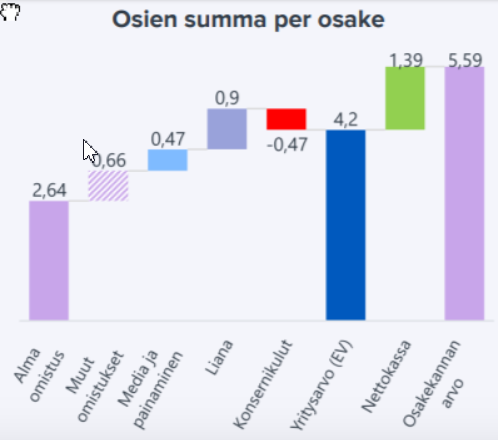
Here’s the sum of parts, à la Inderes, Alma’s ownership >10% - a very strategic piece if an Alma redemption were to happen…
@raha-aasi, that’s a pretty good speculation  However, I believe that due to local roots, the threshold for selling is quite high..
As for value realization, I believe the most significant driver for it would be the acceleration of Liana’s revenue and profit growth. When we look at the sum of these parts, a considerable portion consists of liquid assets. Since the stock is priced significantly below this, it means that the market wants to say that the company cannot successfully invest these funds. Simplified, the return on investments falls below the required rate of return → a significant discount. This is certainly true for the hefty cash reserve at the moment.
For this reason, I would not count on the sale of the newspapers and the resulting increase in cash reserves as the path to value realization. Of course, it could accelerate if the newspapers were sold and the funds received, along with the already existing cash, were used to boost Liana’s growth through successful acquisitions. Even in this case, however, I believe the key is Liana’s growth once again.
1 Like
Hi,
That’s right. At least Avidly’s Inbound grew well in Q2, which also creates the impression that Liana has probably also increased its service sales. The automation market is growing rapidly, as Valor-partners highlighted in Liana’s presentation.
An interesting question is whether Liana can expand its good local market coverage to an international level; that’s where the potential lies. As is often the case with many other Finnish companies expanding internationally. At least the references and the relatively long history in different countries would suggest that there is demand for the service.
1 Like
I was listening to Petri (Gostowski), Alma Media’s CEO, being interviewed earlier today, and I got a good feeling from it. That reminded me of this case and how much it’s trading below the sum of its parts. I mean, just the net cash and Alma’s ownership are easily more than the market value.
As we’ve discussed above, the value probably won’t be able to break free until we get more evidence of the new businesses performing well. So, I’d like to ask if anyone here has experience with Liana’s products and services? What kind of potential do you see in them? Would accelerating international growth be possible with Ilkka’s muscles?
Let’s at least gently tap @Timo_Huhtamaki on the shoulder, do you have any insights into Liana? I just spotted your post on Avidly’s thread
5 Likes
Yes, Liana’s name does pop up in marketing automation discussions and system vendor surveys. My interpretation is that the phenomenon behind the demand is the same for Liana and HubSpot, represented by Avidly, namely the need for marketing automation. Both are, to my understanding, functional technologies; I personally don’t have experience with Liana. The key difference, I believe, lies in who each of these is suitable for.
I’ve understood that Liana is good for SMEs and HubSpot is better for large and highly digitalized companies. The reason being that large international companies piece together websites, marketing automation, content production systems, linked customer services, and integrations for contacting warm leads with sales service companies or their own sales organization systems (some even with separate systems to track marketing effectiveness). In such cases, it’s always quite a project hell, requiring the system vendor/consultants to have C-level discussion skills and an understanding of how systems communicate. This is emphasized the more digital the client’s business is. In this regard, HubSpot, in my opinion, has a clear competitive advantage, and they also direct clients to these Elite partners, who have the highest level of project management expertise and understanding of integrations (Avidly, by the way, is one of these six highest-level Elite partners globally).
I wouldn’t be surprised if in a few years, market positions looked like Liana has successfully captured SMEs in Finland, and HubSpot has mined large, international companies and e-commerce players.
1 Like
Yes, thank you for your insight 
That market positioning also reflects what Liana itself stated:

There is also more cash for acquisitions, and Alma’s dividends will continue to flow into the cash register. Would it be possible to find a suitable Hubspot expert at a reasonable price in the market 
Ilkka’s valuation is so low that Liana’s growth could essentially be an option at the current share price. I don’t think there should be much downside for a while, as the dividend alone should provide some support for at least some time. Of course, that’s if Liana and others have to be flooded with an enormous amount of money.
1 Like
They probably aren’t looking for Hubspot companies on the market, as Liana has its own competing software. Liana’s growth should come from 1) cross-selling to Ilkka’s current customers, 2) further developing its own software, and 3) acquisitions, the main motive of which is new customers.
Liana was very well explained in the presentation of the press conference on 14.1.2020. The potential is huge!
1 Like