Keskisuomalainen didn’t seem to have its own thread, so let’s start one in honor of a decent financial statement. I haven’t had a chance to look into it more closely myself. The numbers look pretty good at a quick glance, at least. With the number of dividend-entitled shares, P/E 10, P/B 1.7, ROE 16.9%, EV/EBIT 12.5. Apparently, there’s no analyst coverage at all.
1 Like
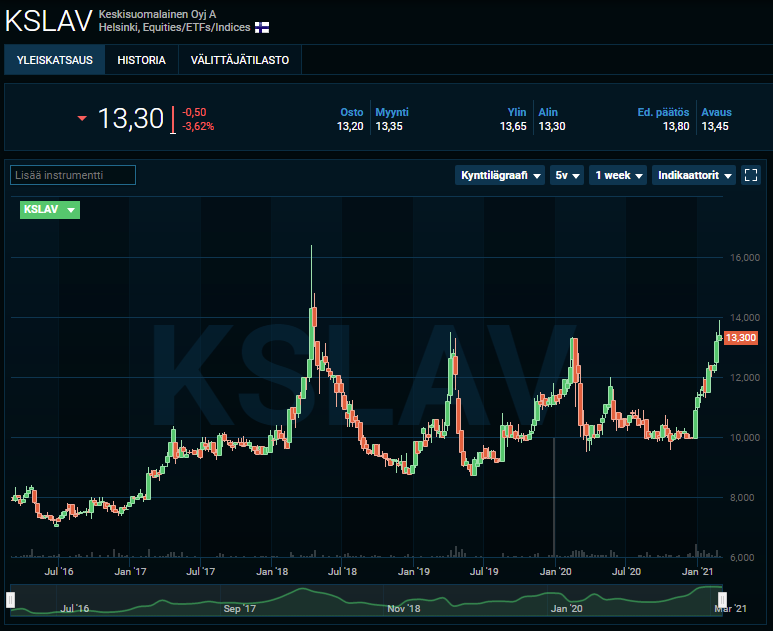
Keskisuomalainen’s news improves, and the stock price rises again in cycles, from the previous summer’s low towards the next spring’s annual general meeting. For those who attended the AGM and listened to the CEO’s stories, the success of local newspaper acquisitions has been obvious. The digital side has finally been revived. On top of a dividend exceeding 5%, a delicious lunch with layer cake is offered at the AGM, in valuable senior company. Let’s enjoy it.
3 Likes
I tried to extract the essential points from the financial statements:
-
The 2019 result, adjusted primarily for non-recurring items related to acquisitions, would have been approximately EUR 1.6 million better.
-
Kaakon Viestintä, in particular, had a significant positive impact on the company’s operating profit in 2019. The impact of Kaakon Viestintä is reflected in the company’s profit and revenue for nine months.
-
Keskisuomalainen acquired 100% of the shares of Kaakon Viestintä Oy, ESV-Paikallismediat Oy, and Kiinteistö Oy Lehtikaari 1 on April 5, 2019. The acquisition price of the shares is EUR 14.2 million and will be paid in cash. The profit for the financial year includes revenue of EUR 36.5 million and a profit of EUR 4.4 million from the acquired companies.
-
Keskisuomalainen Oyj has decided to close the Hämeenlinna newspaper printing plant, and printing operations in Hämeenlinna ended on December 31, 2019 (I guess this will also result in some savings).
-
A possible future step regarding treasury shares is their cancellation, which would strengthen per-share key figures in the long term.
-
The company’s revenue and operating profit are estimated to be at the previous year’s level in 2020, provided that no significant changes occur in the operating environment.
-
Keskisuomalainen is reducing the number of group companies in spring 2020, and related plans were registered with the Finnish Patent and Registration Office (PRH) on December 12, 2019.
-
The concentration of population in growth centers may lead to us restructuring our regional product portfolio.
-
Yle continues its investments in written online news operations. This may reduce newspaper readership and make it more difficult to monetize digital content from newspapers.
-
Shares entitling to dividends: 10.05 million @ €13.15.
-
Strong cash flow: Cash flow from operations EUR 23.9 million, Profit EUR 13.3 million.
-
Cash balance: EUR 24.6 million (some of which probably went to the acquisition of Mikkelin kaupunkilehti in 2020, but some also came from the sale of Moottori Media).
4 Likes
This is one of the forgotten companies on the stock exchange; I was amazed when I researched its background over the weekend.
My interest was piqued when I was recently digging into Ilkka as an investment. At that time, among the undervalued items on its balance sheet, I came across Ilkka’s ownership in Arena Partners (a little over 40% ownership), which is similar in size to Keskisuomalainen’s stake. This company, unknown to many, owns 35% of Alma Mediapartners, so the value of that slice for Ilkka and Keskisuomalainen is between 15-20 million per head, if that slice were to be liquidated now. In addition, Keskisuomalainen currently owns a roughly 9 million euro slice of Ilkka at current prices, the actual value of which is at least 15, even 20 million, if Ilkka’s parts were to be broken down. So, on top of its operational business, Keskisuomalainen conservatively estimates assets of 25-30 million in Ilkka and Arena Partners, and otherwise, the share price is under ten euros.
I would say that this is a case worth delving into for anyone interested. And I’m not even referring to the option of industry arrangements, which is obvious.
Happy holidays everyone! 
P.S. I own a small slice of the company in my long-term portfolio.
3 Likes
Isn’t it also an excellent stable dividend payer?
But aren’t the economy tanking, and through that, advertising revenue decreasing, and on the other hand, the population in the provinces declining, bad things for the company?
Yes, the trend in advertising revenue is indeed downwards, according to studies. I myself believe that there will continue to be demand for local media, and the consolidation trend in local media will continue. There are many cross-ownerships in the media industry, the most interesting of which I see as the Ilkka-Keskisuomalainen media portfolios and their possible bundling. The reduction in staff and concentration in growth centers you mentioned accelerates this development, but I believe that together with digitalization, it creates a basis for improved profitability. And the dividend has indeed been at a very high level.
4 Likes
Knoppina, Keskisuomalainen is probably the only (?) Finnish listed company that owns an esports company. The Kova team is a small piece of the puzzle, but it shows how they’re trying to find new growth areas around the core business. Keskisuomalainen also operates ad displays… are they expanding too much when they find uses for cash flow outside of their core business?
The company will continue to be active in consolidating the media landscape. As the coronavirus severely impacts media advertising revenue, the position of a solvent buyer will only improve. Is the atmosphere ripe for a merger of a couple of larger regional newspapers?
2 Likes
15 million in hidden balance sheet value dropped into the cash register. Keskisuomalainen Oyj:n osakkuusyhtiö Arena Partners Oy myy
4 Likes
Hey,
What could be the reason why Keskisuomalainen’s share often drops 25-40% from the beginning of the year?
“When the dividend is detached, the stock cools down and is low-volatility and stable, not a growth rocket that has attracted the interest of the masses in recent years. There has certainly been a clear swing opportunity in recent years if one buys at the end of the year and sells in early spring (or holds and takes dividends). But the low volatility makes it a bit difficult, as there may not necessarily be suitable buyers available every day (liquidity).”
The results are out:
https://www.inderes.fi/fi/tiedotteet/keskisuomalainen-oyj-tilinpaatostiedote-2122023-klo-1710
I’m estimating the enterprise value as follows:
- Ilkka ownership €12M
- Alma ownership €8M
- Cash and cash equivalents at the end of 2022 €25M
- Debt €60M
- Market cap €135M
The enterprise value would thus be €150M.
The company’s comparable EBITDA was €17M, and it decreased significantly. The EV/EBIT is therefore 9. On the other hand, the company generated €24M in free cash flow. The company provided very positive guidance.
My own view is that the company is cheap if the earnings guidance holds. Cash flow is damn strong, ROE is moderate. This suits people who collect cigar butts. In addition to dividends, they could even buy back their own shares, perhaps even with debt.
E. Look below and judge for yourself.
4 Likes
I really had to double-check if we were reading the same interim report. The result was absolute garbage 
H2/2022
- Operating profit -5.7 Me (4.0 Me), -241.9 % year-on-year
- Operating profit -5.3 % (3.8 %) of revenue
- Operational comparable operating profit 1.4 Me (7.6 Me), -81.6 % year-on-year
- Operational comparable operating profit 1.3 % of revenue (7.0 %)
- EBITDA 7.3 Me (13.9 Me), -47.2 % year-on-year
- Operational comparable EBITDA 7.2 Me (14.5 Me), -50.6 % year-on-year
- Result -5.0 Me (3.2 Me)
- Earnings per share -0.49 euros (0.32 euros)
This is for the operational activities. The whole year was only saved by the capital gain from the sale of early-morning delivery, which made the result look normal.
p.s. You have EV/EBIT and FCF calculated incorrectly…
3 Likes
:DDD This is what happens when you do it yourself.
I was only looking at the full-year results, of course.
For EBITDA, I used the full-year operationally comparable EBITDA. I showed the EV calculation above. FCF consisted of operating cash flow €11.6M and investing cash flow €12.8M.
I really should have noticed that €16.6M item from the sale of business operations. Substandard performance.
2 Likes
Here is an article from Salkunrakentaja about Keskisuomalainen and its results.
The company’s strong balance sheet, cash flow, and good equity ratio enable a dividend payment for 2023. The company’s board proposes a dividend of 0.55 euros per share, which at the current share price represents a high dividend yield of 5.5 percent.
3 Likes
It would be great if this stock gets Inderes coverage as early as August. The share price has drifted to historic lows; hopefully, the coverage will at least boost the trading volume.
6 Likes
Sharing this here so no one misses it: Inderes initiates coverage of Keskisuomalainen with a Reduce recommendation and a EUR 8.40 target price: Keskisuomalainen seurannan aloitus: Valtakunnallista mediakonsernia käypään hintaan - Inderes
5 Likes
A better title for the report would have been Dying business in declining regions.
Inderes’ forecasts for 2025–27 seem really over-optimistic regarding operating profit. It is as if the good old days would return after a couple of difficult years. In my opinion, Keskisuomalainen has made major strategic mistakes over the last 15 years by investing in print media in regions where paying customers are dying of old age. Understanding of the changes in the media and advertising industry has been weak, and now mistakes are being corrected with a decade’s delay.
The market considers similar media business in Ilkka to be worthless.
I can comment on this. Generally, I can say that we expect news media revenue to decline, even though we expect digital media to grow at a strong pace. This is because higher-priced print media is declining by 5-10% annually.
Distribution business growth and price increases: Posti is exiting the unaddressed direct mail distribution business at the end of 2024. According to our estimate, this will bring Keskisuomalainen nearly 15 MEUR in new revenue in 2025-26. In this case, Keskisuomalainen is the only nationwide distributor of unaddressed direct mail, which we believe will allow it to raise its prices significantly. Previously, Posti has pushed the pricing of direct mail distribution to unsustainably low levels with the help of volume benefits from other distribution activities. As a result, the business has been heavily loss-making. We forecast this to flow to the bottom line with fairly good margins, which will turn the entire segment (Production and Logistics Services) positive in terms of operating profit. In the longer term, we believe the segment’s revenue will decline, driven by the recession of print media.
News media elections (municipal and regional elections) are estimated to bring an addition of several million euros to news media revenue. This likewise flows to the bottom line with very good margins, as advertising can be added to newspapers that are being distributed anyway. In 2026, our profitability expectations then decline and remain at levels of around 7-8%, which reflects the profitability levels of traditional news media.
Digital out-of-home advertising is growing by 20-40% annually, as a result of which its profitability will improve substantially. Keskisuomalainen has just finalized the City of Helsinki’s tender and is, among others, involved in HSL’s (Helsinki Regional Transport Authority) tender offer. The market is also growing by ~10% annually, so the growth drivers for this are very strong. However, the profitability of unallocated items will remain negative, as it is weighed down by group costs and large depreciations.
The most essential thing in Keskari’s case is to convert print media customer relationships to more profitable digital ones and to scale down the printing business in a managed way and eventually shut it down OR sell it, as it will shrink along with print media consumption. Currently, printing is profitable for the group, but in the longer term, its operating profit will decline.
5 Likes
That too. But having moved from Jyväskylä to Vantaa in 2020, I have been positively surprised by how strongly the media giant of my former province is visible here as well. Länsiväylä, Vantaan Uutiset, and Helsingin Uutiset complement Helsingin Sanomat well and are thus not really its competitors. Their brand recognition seems to be strong, and at least for now, they are highly visible thanks to the advertisement screens on buses. It would be interesting to know how the Länsiväylä digital subscription trial has performed (I am a subscriber myself, but I haven’t had time to dig into the data).
I am considering returning as a shareholder of Keskisuomalainen, but I still need to investigate and reflect further.
5 Likes
Keskisuomalainen’s strategy for the media industry transformation has differed from other traditional regional media houses. This choice has been deliberate and has taken advantage of the low valuations of traditional media. Geographically speaking, Keskisuomalainen has grown from a regional newspaper into a national media house.
If we look at, say, the last ten years, if you bought Keskisuomalainen back then (€8.66), you have received €7.05 in dividends (gross) so far. Granted, the share price would currently be below the purchase price, but it did reach €18 at one point. So, if desired, a return from a 100% share price increase would also have been available in the meantime.
It is therefore hard for me to say that the strategy was wrong. It has leveraged market consolidation at a low price, which has allowed for the steady growth of multi-channel operations. There have been some foolish experiments along the way; in my opinion, those could have been skipped. Overall, however, I think the return/potential return in this “sunset industry” has been quite commendable.
If you want to compare this to Ilkka, Ilkka hasn’t actually made any operational profit in the meantime. Ilkka’s entire profit has been based on its ownership of Alma Media, and even that return hasn’t been fully distributed to its owners.
The truth is that the traditional print media/newspaper business is brutal, and quite a few competitors have already thrown in the towel—PunaMusta being the latest, which sold Karjalainen… to Keskisuomalainen, of course. Once again, there is more opportunity to streamline operations, gain more regional coverage, and gain time to build a multi-channel media business.
5 Likes