S&P500 for ETF Investors

I am opening this thread with a relatively specific title with the aim of generating discussion and commentary from that perspective, though I don’t intend to limit it strictly to that.

I mainly thought that an overly general thread name like “S&P 500” would either overlap with “Market Direction” or fail to attract “index investors.”

I noticed that there isn’t a dedicated thread for any single index as an investment target.

This is a timely matter for me, and I don’t want to spam my beginner questions in threads like “Market Direction,” for example.

The motivation is to gather and share information and views on developments over the coming months. I started my own purchase program for a long-term investment yesterday and want to optimize my results.

On Nordnet, there seem to be nearly 30,000 owners of SXR8 (iShares Core S&P 500 UCITS ETF USD) investing in the index, and the accumulating version of the ETF is the third most popular. Perhaps some of them are on this forum as well, and there are others interested in exchanging thoughts.

10 Likes

I’m starting a monthly savings plan for “Sepee” with Nordnet’s monthly savings agreement on April 5, 2022 :slight_smile: I’ll buy 1-2 units per month.

-Bosaboi

3 Likes

My own guess is that the index will go significantly lower than its current level between now and, say, about a year from now. However, I started buying as a precaution.

So, the classic investor questions: How deep will it go and when will it happen?

My buying program aims for long-term holding. A steady investment program with equal stakes according to the calendar, say monthly, regardless of the price, does not appeal to me.

One of my justifications for this:

The rise from the corona dip is so fresh in memory that I believe there will be quite a bit of up-and-down sawing before the bottom is found. It’s worth looking at a certain month’s stake over a week-long period, and if a bigger down day hits, buy it, and if not, then the deadline is according to the calendar. And then continue the next month.

2 Likes

Very interesting thread idea! This can be used for shorter-term views rather than long-term speculation on the S&P’s direction. Technical analysis can certainly offer insights here. I still have some leverage available, and I’ve tentatively planned to use full leverage once the S&P breaks the 3900pts mark.

7 Likes

Exactly! My added value is probably that I ask the dumbest questions and maybe some “outsider” out-of-the-box perspectives :smiley:

2 Likes

Market timing is difficult, but I understand if, at this very moment and valuation, one doesn’t want to go all-in on the S&P 500. Dollar-cost averaging would probably work well for ETF/index investing.
However, if you’re looking for a long-term entry into the index, here are a few things to consider.
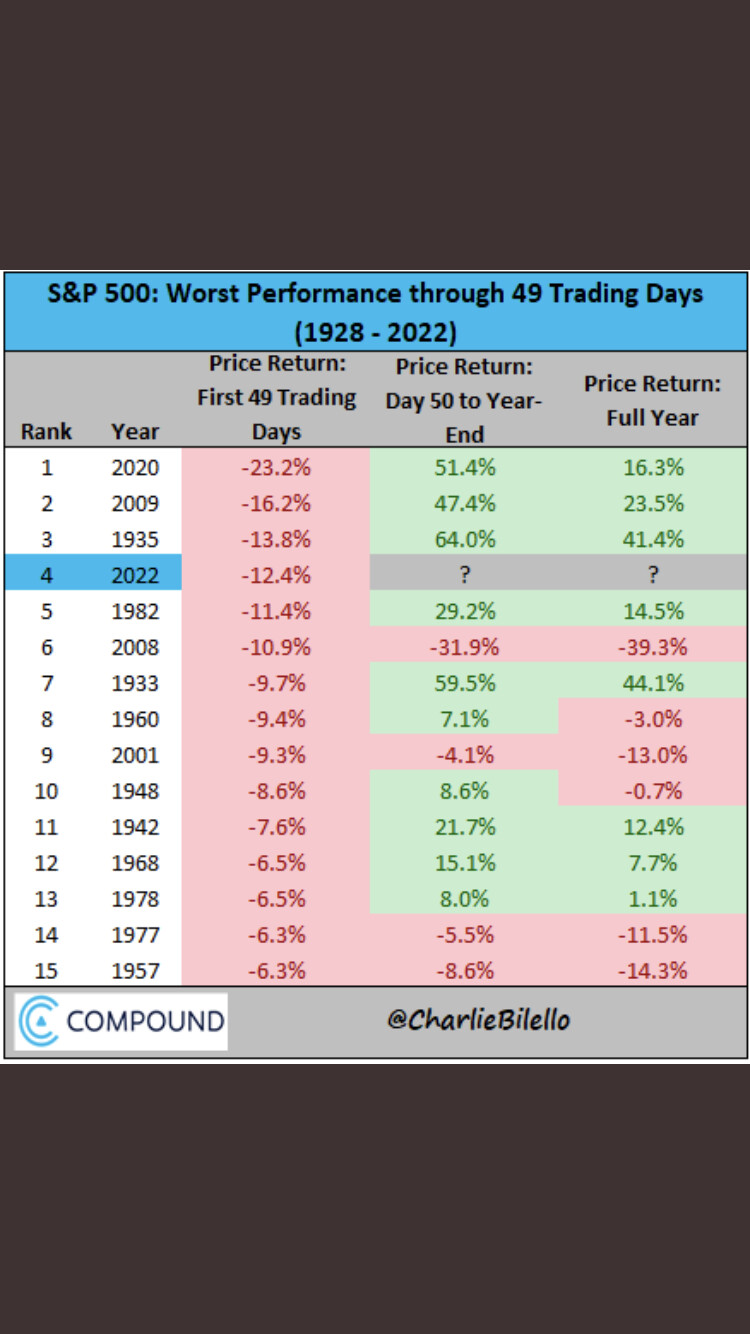
First, an interesting graph showing how the S&P 500 has historically performed at the beginning of the year and what the returns have been thereafter.


So, GENERALLY, when the beginning of the year has seen a sharp decline, the rest of the year has been good. It’s worth noting, however, that in many rebounds, the decline started earlier than the beginning of the year. Additionally, even though the S&P 500 has already fallen over 10% from its peaks, by many metrics, it is still among the most expensive in history. The CAPE ratio is still over 30. This means valuations are still high, and earnings growth expectations are high, reflecting a zero-interest-rate environment (which, however, has wobbled a bit this year). If earnings growth doesn’t materialize as expected, and accepted valuation multiples decrease due to this and rising interest rates, there’s a potential double leverage downwards. Furthermore, the S&P 500’s “Goliaths,” i.e., megatech companies, have already fallen more, and if these start to be repriced, downward pressure could increase, given their large weighting in the index.
Nevertheless, major US banks still predict the S&P 500 to be at a higher level at the end of the year than it is now. The USA is also becoming an increasingly strong safe haven as the rest of the world falters. One could also argue that the CAPE ratio is less relevant in the current interest rate and profitability environment than it was, say, 30 years ago.
Go figure. Here are just a few thoughts, both for and against.

6 Likes

One thing to note is exchange rates. Without speculating on the future, it might be useful from a risk management perspective to practice calculations for, say, 10 percent exchange rate changes.

2 Likes

I watched that Verner’s video a quarter of an hour before opening this thread. The S&P500 forward P/E ratio has decreased roughly as much as the index, so the drop is from the numerator, i.e., the price, and the earnings expectation for the next 12 months has remained without a drop even in the beginning of the year, if I understood correctly.

As a layman, that sounds somewhat optimistic from the earnings expectation estimators. So I’m trying to rationally figure out what would be an all-in level for me in the index.

When a fund is euro-denominated and the trading venue is in the Eurozone, that variable is not present, but yes, I encountered it when I bought a Swedish fund.

This probably meant that since the target stocks are denominated in dollars, the euro-denominated ETF’s value can fluctuate with the currency, even if the S&P 500 stocks remain “flat” in dollars.

2 Likes

Good points and new things to learn. I’ve been thinking a lot about the P/E level. In my opinion, there are several factors that challenge the view that the level should be at the historical approx. 15-16 level (CAPE). In the 2000s, it has only briefly touched that level after the financial crisis.
CAPE is high, but current (“momentary”?) P/E is approx. 24, which, looking at the chart visually, is at the level of this millennium.

I have been examining the biggest declines of the 2000s, i.e., those exceeding 10%, and one thing that is “this time different” is probably the fact that the sharp COVID-19 dip and the speed of recovery from it are very recent and still fresh in our minds.

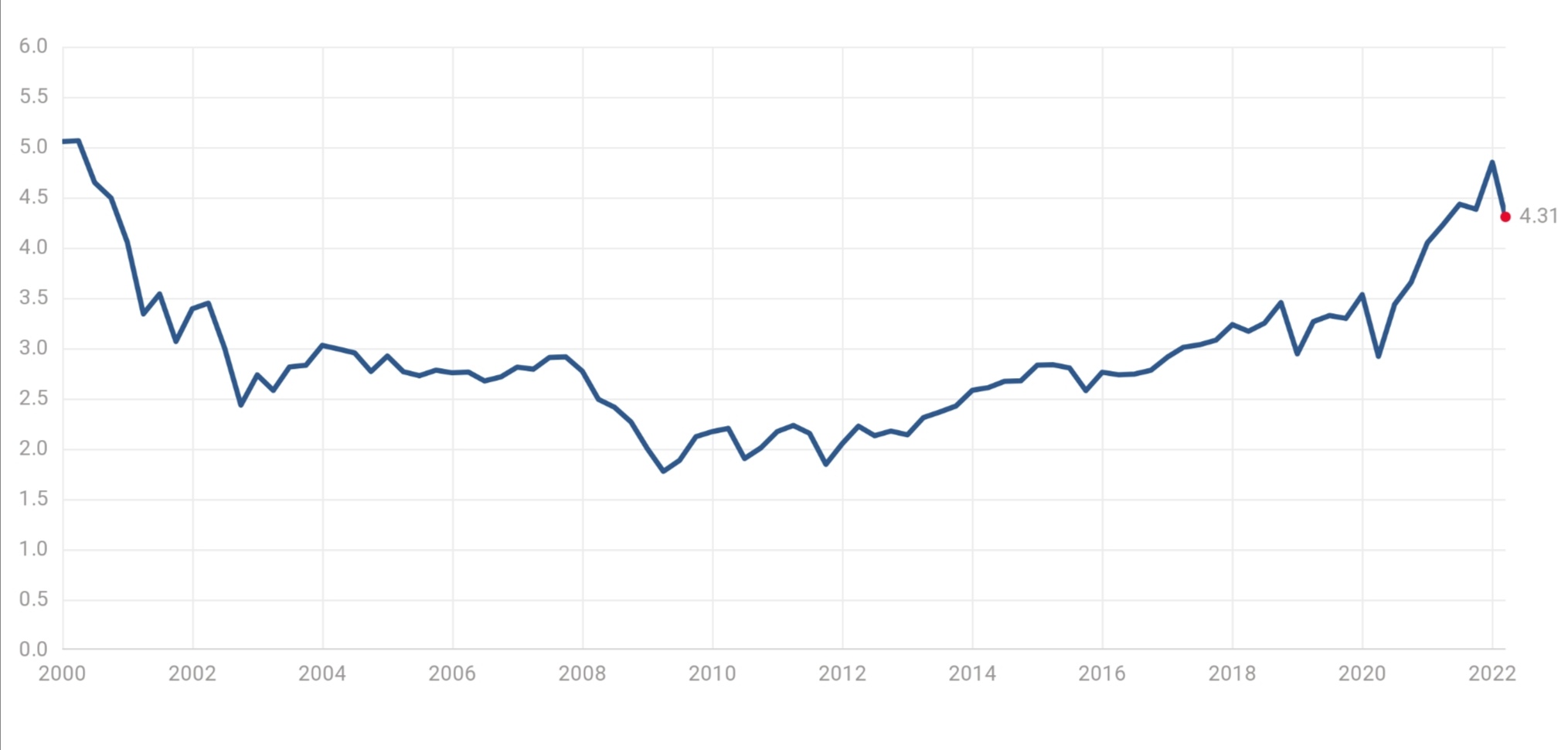
In the picture: S&P 500 P/B (Price-to-Book) at different times.
This, alongside CAPE (Cyclically Adjusted Price-to-Earnings), also supports the idea that the current earnings component may not be at a sustainable level. I’ve taken this into account by currently allocating most of my monthly savings to the Eurostoxx600.

2 Likes

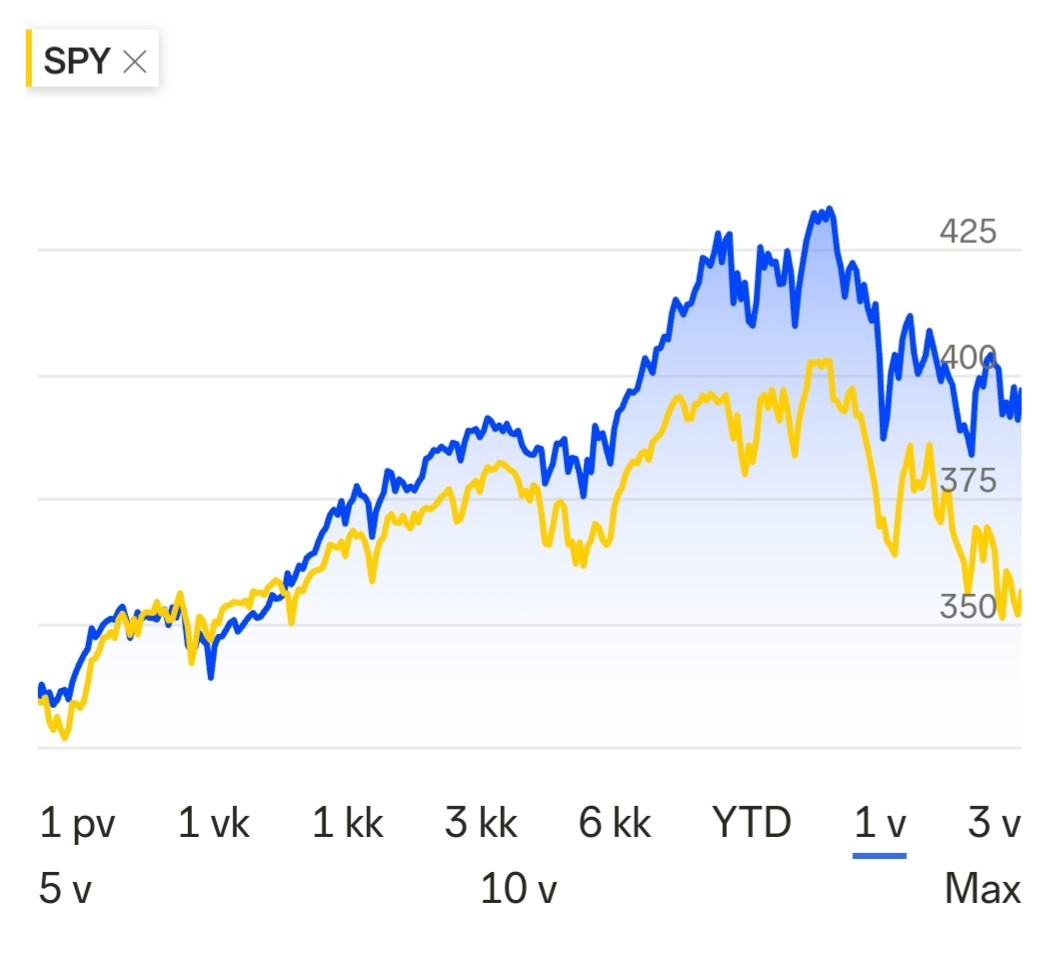
Exactly. Here’s a somewhat biased look at the period, which shows an example of the impact of the exchange rate on the development of the ETF mentioned in the introduction compared to the target index.

1 Like

Indeed, historical P/E levels may never be reached again, at least not for an extended period. Systemic shocks are, of course, a separate matter. Stock market valuations have been on an upward trend over the decades. There are several reasons for this, such as interest rates having been on a downward trend over decades/centuries, and perhaps digitalization and automation are seen as leading to sustained, faster earnings growth, etc. Many signs, however, indicate that the S&P 500 is currently expensive. There are indeed justifications for this, but their sustainability even in the shorter term (interest rate level, earnings level) is questionable.

ETFs that track indices are excellent long-term investment vehicles because stock markets tend to rise in the long run. The S&P 500 has been among the best, at least among major stock indices. This is, of course, no guarantee of the future, but as Warren Buffett said, “never bet against America.” It’s probably not worth spending too much time looking for the “perfect” buying opportunity. My suggestion is that if you have a certain sum you’ve intended to invest now, you could, for example, invest X amount of it monthly, spread over a year. If the intention is to save more long-term from salary income, then it’s especially unwise to wait on the sidelines.

2 Likes

Yes, that’s my basic plan. But partly it’s a character flaw to try to do it optimally.

And I’m fully aware that I’m seeking answers to questions for which unlimited resources have hired the world’s sharpest minds.

1 Like

I jumped between those quite a bit and eventually decided to stick with Nordea’s selection at this stage, because sometimes the curves cross.

1 Like

Which platform do you use to follow the S&P500 index? I’m looking for Lepikko’s (Lepikön) candlestick chart with averages and other curves.

Jukka probably uses Tradingview.

Another good one is investing.com.

More on the currency issue. It’s not that simple after all. Simplified, the quoting currency or the quoting currency of an ETF’s investments is irrelevant. An ETF is always worth the same regardless of the quoting currency. Currency exchange rate changes affect companies’ earnings performance and thus their valuation, unless the company operates entirely in the domestic market (in dollars).

Let’s consider an extreme example of an S&P 500 ETF, of which there are similar versions in euros and dollars (nowadays you can no longer buy ETFs from the US) and the dollar collapses by half, and unrealistically, stock prices are expected to remain unchanged.

Before the currency exchange rate change (for simplicity, 1 EUR = 1 USD), the price of both ETFs was, say, 100, but after the currency collapse, the quote would still be 100 USD. One euro would then buy 2 USD, so in euros the quote would only be 50.

How does that affect you? If you live in the Eurozone, it’s bad. If you live and spend money in dollars, it has no effect.

This is just a theoretical example, and certainly, the prices would not remain unchanged if the dollar were to collapse by half overnight.

Reading:

Well, this might be a bit off-topic, but I still think it’s important to understand the currency issue.

2 Likes

Thanks for your comment. When the explanation is simple enough… This is actually a very significant point for me.

As I understand it, Europe has decided that defeating Putin, breaking away from Russian dependence, and implementing the green transition will be carried out no matter the cost, and money printing will be the tool.

In the US, as soon as the Russia crisis subsides, and even alongside it, money will start to be drawn in, or at least interest rates will be raised, right?

Doesn’t this inevitably mean a weakening of the euro against the dollar? A weak direction for a euro-zone buyer, but a good one for a seller. These “sister funds” with the same ISIN number in different currencies do follow that exchange rate fluctuation.

This actually adds an extra perspective to timing. However, even within a year, the maximum and minimum difference in exchange rates is over 10%.

“The ease of trading passive exchange-traded funds is one reason for their great popularity. However, ease also brings danger. Easy trading creates the temptation for active trading and attempts to time the markets. Actively using passive products has been shown to lead to underperformance for investors.”

There is wisdom in this, but everyone has their own style, goals, and methods. One person trades and another holds, but the S&P 500 is still a basic diversification tool.

3 Likes