This topic seems to divide opinions among experts quite a bit. I watched Viggo Löfgren’s interview on the Inderes podcast, and then Nordnet’s Titans’ Battle discussion on whether index investing creates a bubble. What are your thoughts on the topic?
Investment blogs talk about little else but that stock investing is compound interest and that an index fund removes risk from stock investing. Stock investing is really easy when it doesn’t matter which stock you buy, because they all double one after another anyway.
Regarding compound interest: what happens when this compound interest is +10%, +5%, -30%, and +15% in consecutive years? Mostly positive? In reality, this investment is about 7% in the red, and knowing human psychology, many would pull out during that decline. Bear markets are poison in these calculations. Has Martin Paasi considered that when an investor has those 935,000 euros saved in the stock market in their 59th year, what if there’s a recession that year and they don’t become a millionaire?
Index funds offer no protection. KONE’s stock is expensive. It yields about 2.9% before fees and taxes. The stock doesn’t become cheaper even if the investor owns it through their index fund. An index fund works if the investor doesn’t bother to delve into companies but mainly wants to bet on the growth of stock demand, which can be a justified plan when bond markets are in a bubble. I’ve been baffled by how this zero interest rate is used when calculating the risk premium for a long-term plan. Governments and households can’t indebt themselves forever; there has to be some stop—let’s call it “interest”—that sets a requirement for the productivity of borrowed money and thus curbs borrowing.
What happens then when borrowing tightens? Demand in the stock market quiets down. Funders need to be presented with something other than a vision of unprofitable growth. Debts can no longer be rolled over by just taking new tens of thousands of “arrangement loans” advertised on TV. Then the party’s over.
6 Likes
If the bogeyman still brings in more minus, we will practically see how index funds affect stock prices. My assumption is that when the market trend turns (even temporarily), the funds have to sell to pay redemptions. It may be that investors keep their cool and trust their investment strategy and long-term investing, but I wouldn’t put big money on that bet. A human is a human.
Michael Burry’s theses on the index bubble gained attention at the end of the year, but the consensus seemed to be that a bubble could not form. Let’s see if Burry gets the last laugh on this matter as well.
2 Likes
Yesterday, in Tuesday’s Kauppalehti, there was a short article related to the topic, from which this excerpt is taken:
The movements of massive ETF (Exchange Traded Fund) capital have still not been tested in a proper stock market crash.
4 Likes
Of course, large index funds will aggressively sell if there’s a downturn, but how is this different from people owning stocks directly and selling them versus owning them through ETFs and selling those, where the same stocks still go up for sale, but more evenly?
The situation now is that, for example, Blackrock’s funds are among the biggest owners of many large American companies. Index fund capital is larger than active funds for the first time in history, to my knowledge. If ETFs and index funds start selling heavily, then the decline will indeed be larger across a broader front.
Let me start by saying that I’m neither for nor against Burry in this. But I’m curious to hear his reasoning, because what you’re saying is how it’s been explained to me as well.
If I understood Burry’s criticism correctly, at its core is the blurring of stock price formation. Large indexes like the S&P 500, which numerous equity funds follow, end up buying the same set of stocks from the market. Otherwise, they would break the idea of an index fund.
Companies in popular indexes form a “golden pig club,” where passive money easily flows and raises the valuation level of companies belonging to that index. Those outside the popular indexes receive relatively less attention from passive funds.
For Burry’s logic to hold true, the volume of passive funds would have to overwhelm the volume of active investors. That is, even if company X were “mispriced” (on a theoretical level, reality is not this binary simple), the pressure from passive funds would be able to maintain the wrong price. Markets would no longer be efficient. Okay, but would that really lead to a big mess comparable to a CDO bomb?
At this point, I raise my hands and wave a white flag. I don’t have the understanding or means to show whether this can happen or if such a moment has already been experienced in the markets. I leave that demonstration to quants smarter than me. And if I misunderstood Burry’s thoughts and line of reasoning, please correct me.
2 Likes
That’s exactly how I see it too. It’s a very understandable argument that price discovery weakens, but this should benefit active funds. If price discovery isn’t as precise, one would think that active funds would generate alpha. In that case, money would shift from passive funds to active funds until equilibrium is reached.
2 Likes
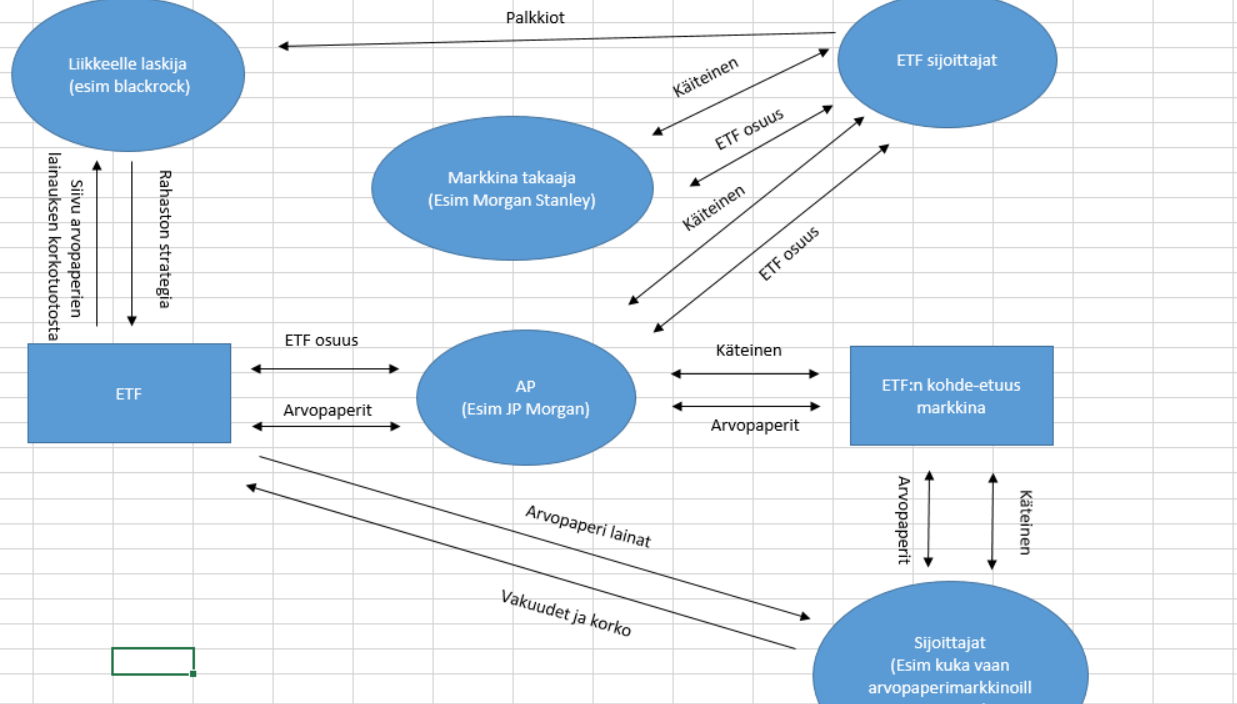
One of Burry’s theses was the efficiency of price formation. Another is liquidity risk. I don’t have enough ammunition to say for or against. The third point, which perhaps also relates to the comparison to financial crisis CDOs, is the fact that ETFs are in reality more complex entities than they let on. Just as an example of how they work.
Here’s a normal ETF:
Synthetic ETF:
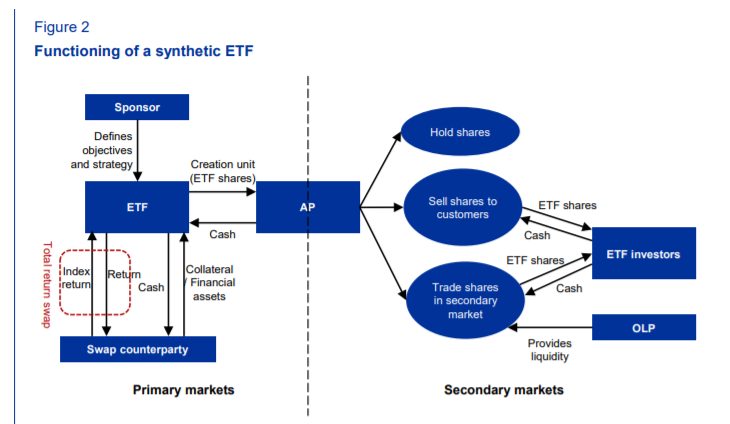
Burry’s point seemed to be that similarly complex CDOs gained massive popularity before the financial crisis, and when the bubble burst, risks emerged that no one could properly assess. In the same way, ETFs are now incredibly popular even though they are not entirely straightforward instruments in their operation.
6 Likes
So far, ETFs have withstood high volatility in the secondary market beautifully:

The video itself is quite a circle jerk (excuse the vulgar phrasing), which is understandable given the backgrounds of the debaters, but at the same time a bit concerning. But really, all in all, it’s very good that there haven’t been any problems with ETFs so far.
3 Likes
This might be a good thread to address.
Current IPOs and Tesla’s insane rally can’t help but affect indices. The same applies to gaming companies etc.
Many portfolio managers wouldn’t invest their own money at those prices, let alone sell dividend companies.
1 Like
{“content”:"Good bump on this thread! It brings back memories from when I created this thread last December, almost exactly a year ago, when I was on vacation in the Canary Islands and there was no sign of corona.
Things have only gotten crazier since then…",“target_locale”:“en”}