Video title:
“Bitcoin Should Be Worth $400,000, Guggenheim’s Minerd Says”

Umm… Does anyone have anything to add? To me, it seems like nonsense and institutional bubble-blowing.
Video title:
“Bitcoin Should Be Worth $400,000, Guggenheim’s Minerd Says”
Umm… Does anyone have anything to add? To me, it seems like nonsense and institutional bubble-blowing.
Head over there. You’ll find some pretty solid analysis related to those Bitcoin price predictions.
This article also speculates about inflation. Although it focuses on gold, it can also be considered in a general market context. https://www.investing.com/analysis/will-biden-trigger-inflation-for-gold-200548404
This is already old news and new, higher “analysis” is available 
https://finance.yahoo.com/news/are-bitcoin--to-500000-191349207.html
Everyone happens to be higher than the last, and surprisingly from institutions that have now become 100% Bitcoin believers and are trying to make money on this general upward trend. It’s interesting that only Bitcoin is the one and only and the new gold, etc., but other cryptos that would be more potential fiat replacements are not mentioned. It’s starting to be a repeat of 2017, but now with real “circle foxes” (experienced players) involved, so the bubble can be inflated for a very long time, like Tesla’s.
Edit: the link doesn’t seem to work for me, so just Google “bitcoin 500000” and you’ll find it 
Small investors account for less than 1% of stock trading, so the answer is no.
If institutional investors are buying rather than selling, they absorb small investors’ sales in seconds, and the share prices don’t even budge, except for very illiquid stocks.
A small rally towards the end of the year might come with the approval of the US stimulus package!
Congress Reaches Final Agreement on Pandemic Relief
Package will contain $600 checks for many Americans, $300-a-week in extra jobless aid and help for schools, vaccine distribution and small businesses
Updated December 20, 2020 07:38 p.m. EST
By Kristina Peterson…, Andrew Duehren… and Nick Timiraos…
Updated December 20, 2020 12:58 a.m. EST
WASHINGTON—Senators reached an agreement on the Federal Reserve’s emergency lending pow-ers late Saturday, clearing the last major hurdle on a $900 billion coronavirus-relief package, according to aides from both parties.
The US Senate has reached an agreement on a $900 billion stimulus package, according to sources from both parties.
“If inflation remains subdued for a long time below the target levels, in line with the ECB’s forecast, it will also keep short-term interest rates in the euro area low for the next few years,” estimate Handelsbanken economists Timo Hirvonen and Janne Ronkainen.
The news about the new virus variant in Britain indeed seems a bit concerning. Although there’s light at the end of the tunnel, we’ll have to take on even more debt, if this spreads wider in Europe and we’re forced into strict lockdowns for the entire early part of the year/spring before enough people can be vaccinated:
To date, no variant of the virus has been resistant to the vaccine, meaning the vaccine has also worked against variants.
The new strain was first detected in England in September and was identified last week. The European Centers for Disease Control said Sunday that a few cases of the new strain had been reported in Denmark, the Netherlands and possibly in Belgium. A similar mutation has appeared in South Africa, scientists said.
Moncef Slaoui, the chief science adviser for Operation Warp Speed, the U.S. government’s coronavirus response program, said on CNN’s “State of the Union” that health officials don’t know whether the new strain is already in the U.S., but they are closely watching it.
“Up to now, there hasn’t been a single variant that would be resistant to the vaccine,” Dr. Slaoui said. He noted that viruses mutate frequently and RNA viruses such as the coronavirus are particularly susceptible to changes. However, the protein cannot mutate very much, so the mutations are unlikely to affect the efficacy of vaccines.
To date, no variant of the virus has been resistant to the vaccine, meaning the vaccine has also worked against variants, says Dr. Moncef Slaoui, the chief science adviser for Operation Warp Speed, the U.S. government’s coronavirus response program.
Pfizer Inc. and BioNTech SE are monitoring coronavirus mutations and working to generate data on how well serum samples from people treated with their vaccine are able to neutralize the new strain, a Pfizer spokeswoman said in an email.
It is possible that investor sentiment in the US, despite the COVID-19 variant observations from Britain, remains calm after the vaccinations have begun and the long-negotiated stimulus package has finally materialized.
This week, the federal government planned for deliveries of 5.9 million doses of Moderna’s vaccine and two million doses of Pfizer’s.
The U.S.-made doses are sent to a plant in Bloomington, Ind., operated by contract manufacturer Catalent Inc. It fills vials with the vaccine and packs them for shipment.
Catalent Inc. said its employees are working around the clock to supply 20 million doses of Moderna’s vaccine by the end of the month, and hundreds of millions of doses next year.
20 million doses of Moderna’s vaccine will be delivered for distribution in the US during December, and hundreds of millions of doses next year.
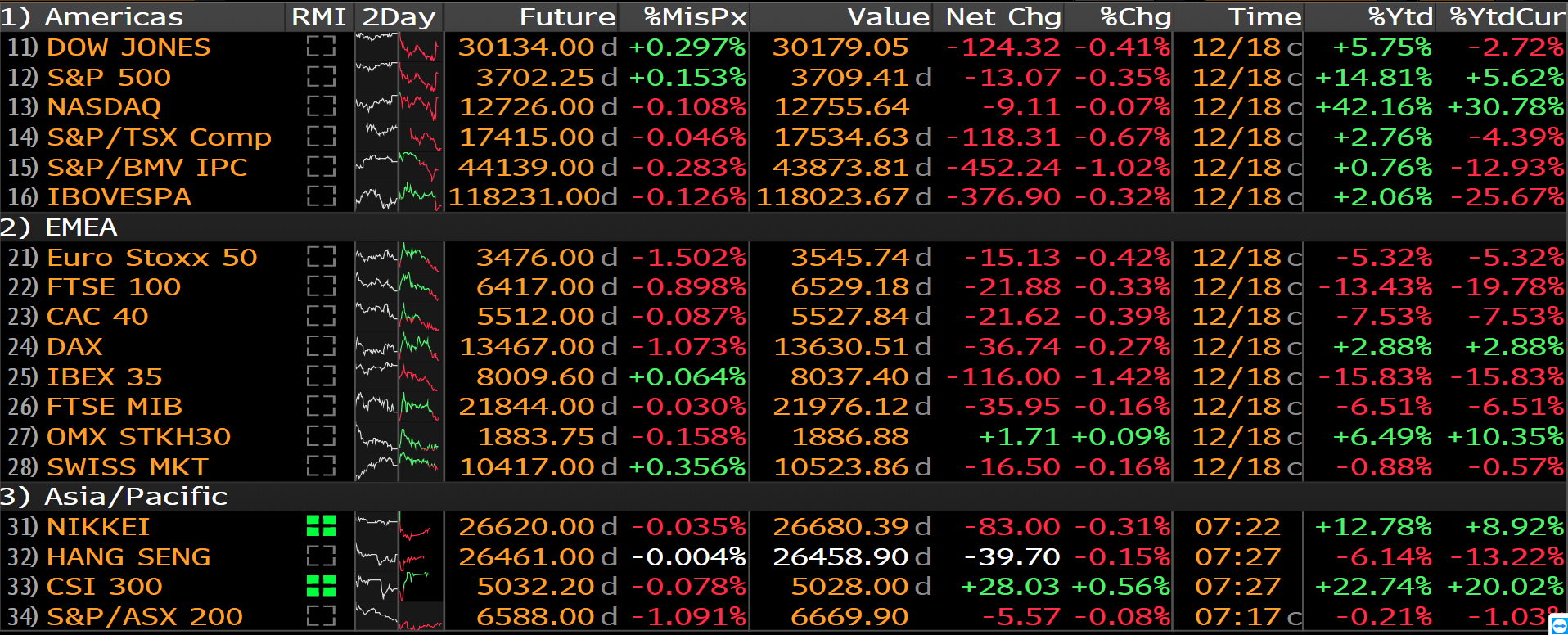
For the moment at least, the new Covid-19 variant seems to be pushing indices down in Europe, and Britain’s isolation is making investors ponder. This afternoon, when US stock markets open, we will see the actual direction for the week.
It will certainly lower oil prices and the value of travel-related stocks, but whether Moderna’s commencing vaccinations will overcome these concerns remains to be seen.
When even freight transport from France to Britain is cut off because of that virus variant, the Brits will get a little practice for a hard Brexit.
The situation in Britain even has elements of panic. It seems to be gripping futures quite tightly as well.
Another new surprise for this year. The start of vaccinations and the US stimulus package, at least from a European perspective, is going to waste.
On the other hand, the timing is perfect for a lockdown or the isolation of Britain. But if the situation continues or deteriorates rapidly, there might be buying opportunities on the stock markets again. 
A few picks from the last Almost in a Minute episode of the year.
As a general observation, many of the world’s key indices are ending 2020 on a high note. Nasdaq has offered tasty returns (even in euros +30%) as well as various Chinese stock indices. The Helsinki Stock Exchange has yielded +10% and including dividends, about +15%.
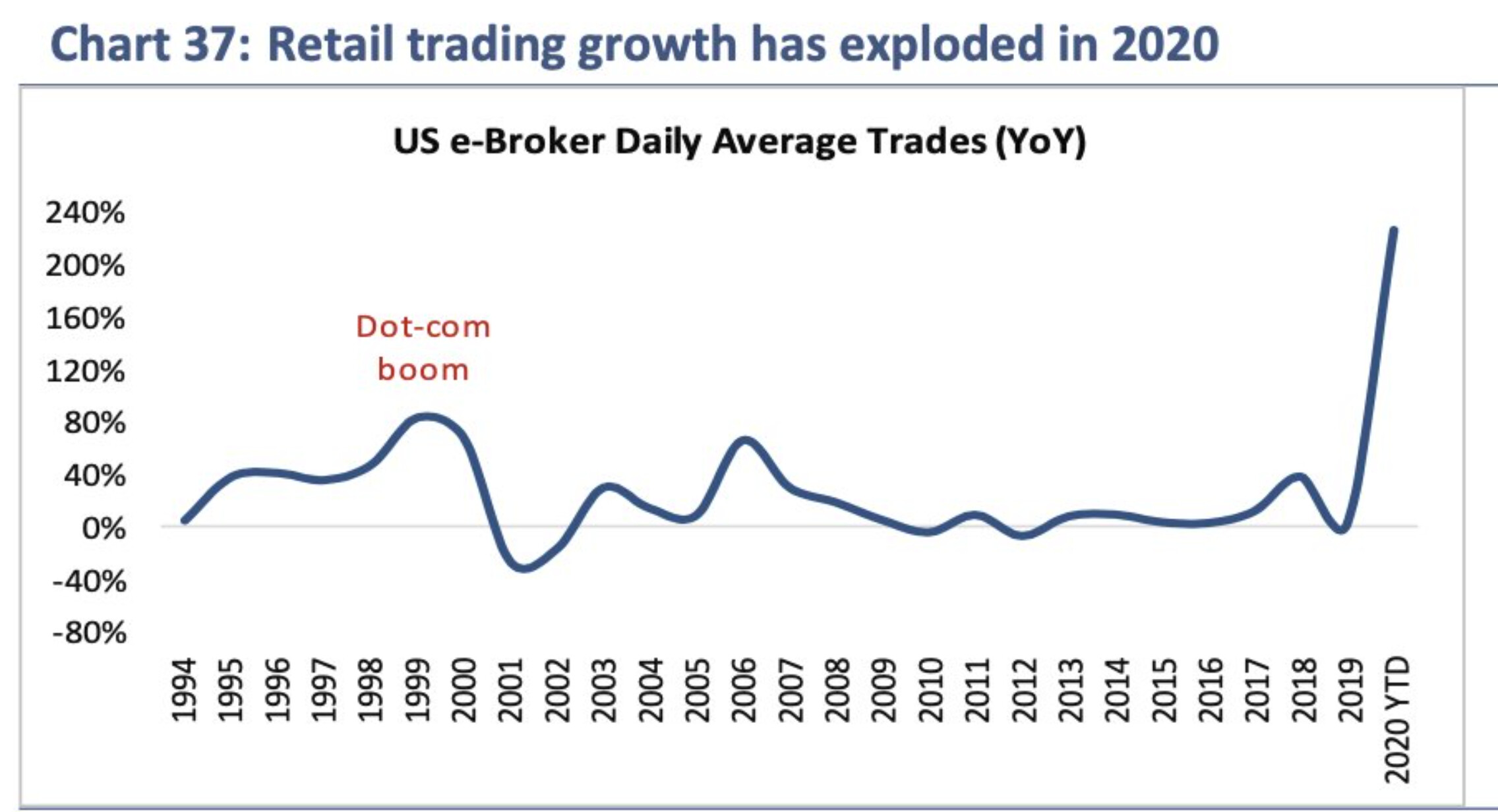
The number of traders exploded in 2020 with “everyone” trading. That data is from the US, but for example, in Finland, Nordnet’s business has gone through the roof this year. It will be interesting to see if the phenomenon is permanent or if it reflects an easier market.
Nordea’s macro colleagues kindly listed consensus expectations for the market. Practically everyone is super bullish, and investors expect an almost perfect state of affairs to prevail with stimulus, liquidity, and TINA in 2021–22.

Generally, when the market tightens into a single position, the risks of surprises greatly increase. For example, in January 2020, most investors were prepared for a rise, but the coronavirus caught them off guard.
On the other hand, if those expectations materialize, they are already largely priced into stocks.
I couldn’t get the sentiment on video due to Monday morning’s production pressure, but here it is in all its bullishness.
We are in an interesting situation, in that I believe the direction of the stock market is currently genuinely linked to one understandable factor: the success of vaccination. At best, the crisis will be over after spring and “back-to-normal” stocks will skyrocket even further, leading to significant reflation as all the money begins to circulate. On the other hand, if vaccination for one reason or another doesn’t provide a solution to the epidemic and the market loses faith in the future, a crash similar to March’s is possible.
And the market doesn’t see these things in black and white, but in terms of probabilities. Now, after the UK and South African variants, faith in the vaccine probably dropped by a few percent, which is reflected in the decline of “back-to-normal” stocks. FAANGs, on the other hand, might even rise today?
I personally see the downside currently as greater than the upside, but the upside option as more probable (i.e., that the vaccine succeeds). In other words, if vaccination succeeds, the markets will rise less from current levels than they would fall if vaccination failed.
I need to carefully consider how to build a portfolio that benefits from the most probable scenario while also acquiring insurance against the failure of vaccination.
Another good reminder from Pettis that China’s recovery doesn’t necessarily speak to the resilience of its economy, but rather to the imbalance of the global economy. In practice, Western countries have supported consumption more than production. In China, it’s the other way around, with the result that China’s exports have gone through the roof this year, boosting its GDP at the expense of others, such as the US and the EU.
https://twitter.com/michaelxpettis/status/1340938922743001088
This is unlikely to facilitate trade negotiations and generally gives the wrong lesson on teamwork in the global economy.
{“content”:“I built things like this: The portfolio is full of good companies, but I shorted the index last week, and I thought I’d hold onto the short for now. So the insurance payments started running :)”,“target_locale”:“en”}
Well, we got a pretty decent correction here, DAX just dropped -4% and US futures are already almost -2.5%.
Some market commentator (maybe more than one) mentioned that it would be quite ironic if the short-term peaks of the S&P500 were precisely when Tesla is added to the index. Well, let’s not get ahead of ourselves with a small correction, but it does look strong enough that we probably won’t bounce back tomorrow.
I had already planned to spend peaceful holiday days away from the stock market during Christmas, but I’ll have to keep an eye out to see if I need to put the cash position, which has swollen considerably (almost 50%) during December, to work.