The Future of Comprehensive School and Education

From time to time, discussions arise about the state of our comprehensive school system in Finland, so I thought I’d kick off a thread related to the topic. :slight_smile:

This thread is mainly for comprehensive school + upper secondary education. The hope is for discussion about the situation in Finland: what works, what doesn’t? What can we do differently? Will private schools take over the sector in a few years because parents are fed up with insecurity and declining learning levels?


PISA

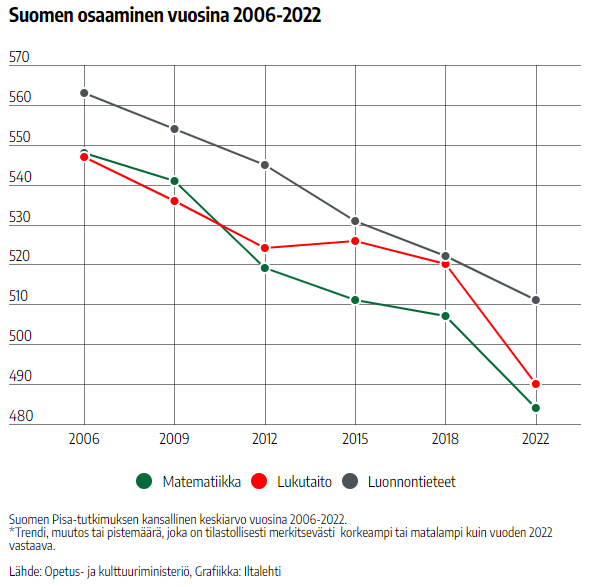
The discussion will become even more frequent in December 2023, when the results of the PISA study are made public. The focus area for PISA 2022 (which will be published) was mathematics. In previous years, Finland has performed excellently in PISA studies in all areas! The reason why this topic causes discussion is the direction in which Finland is undeniably heading in the studies. As someone working in the field, I am somewhat concerned about the upcoming results, and I believe the trend has remained steadily poor.

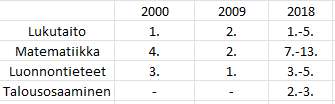
To provide some comparison, let’s list a few years of PISA results [1].

Below are the ranks Finland achieved among OECD countries. In the scale reported in 2018, the scores did not differ statistically significantly from each other.

Compared to the 2015 PISA assessment, Finland’s average reading literacy score decreased by 6 points. Reading literacy skills have declined in Finland over the long term, as they have on average in OECD countries. Finland’s average score decreased by 16 points compared to 2009 and 26 points compared to 2000.

The results are therefore by no means absolutely alarming, but rather the direction in which the level is heading.

I’ll end this opening post here so I can clearly separate PISA from my actual opinions/observations. I will return later today with a message more about everyday life. :slight_smile:

If the topic sparks discussion, let’s try to keep party politics out of the thread as much as possible.

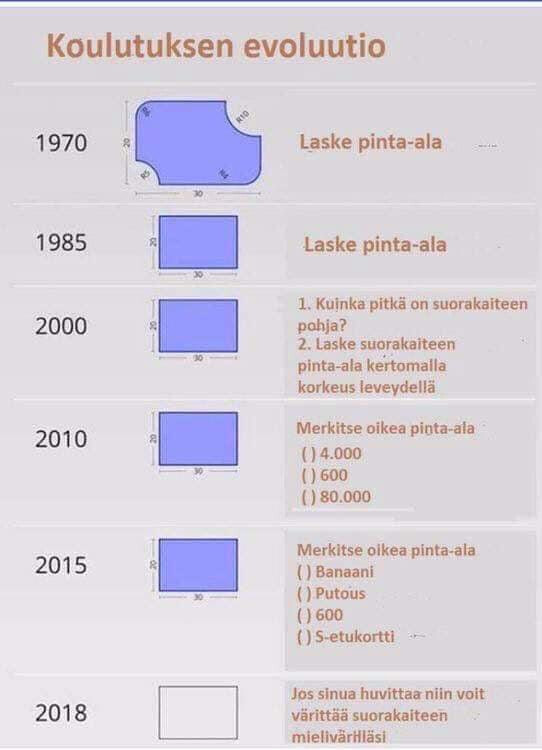
Finally, something to think about, which is meant as a joke, but everyone can still consider if there is that famous grain of truth in it.

44 Likes

You can’t demand a ladleful if you were only given a spoonful.

2 Likes

I first wondered if such a thread and these kinds of posts could be made on an investment forum. But then again, this is what our children encounter at school, so perhaps it is good for us parents to endure this in text form? After all, we aren’t “skin in the game” in the position of a young person.

Linking the topic to investing shouldn’t be a challenge for anyone, so I won’t necessarily write about that, at least not right away.

I aim to use my own experiences to describe the state of the Finnish comprehensive school system (my understanding is mainly from Southern Finland, but from a school in a “good” area), plus, of course, what I hear from colleagues around the country. The intention is not to underestimate anyone, sweep problems under the rug, or to fearmonger. These are, however, certain realities that we are struggling with now, and most certainly will in the future as well. Interventions should be made now, not later.

I will try to write about each topic area almost as its own post, so the thoughts stay clear and the texts don’t become too long.

In these overviews, I aim to take the reader back to the school bench and have them imagine the situation for themselves. This doesn’t apply to all young people, of course, but I contend that during their school journey, everyone is exposed to these side effects in one way or another.


Safety in comprehensive school

Generally, comprehensive schools are still safe today. The biggest change in the sense of security is that young people are very afraid of being “lynched” on social media. We adults don’t even understand the mental pressure this causes. Whether it’s sharing an “ugly photo” with others or making a mocking video. You practically cannot be yourself (if you feel you are different), because at any moment you might end up online, and as we know, you never really get off there.

Physical violence is increasingly moving in a direction where “gentleman’s rules” can be forgotten. Out in the yard, it’s not about two people testing their mettle; when someone gets hit, they get a proper beating from a group. Many have surely come across these videos on Twitter (X), among other places. In these situations, violence is directed with enough numbers and force that the victim has very little chance. This is also often combined with various forms of humiliation.

Part of the safety aspect is that carrying knives and blades is quite common. You would be surprised if you knew how many are found in backpacks. I encourage every parent to “raid” their own Markku-Mirjam’s school bag from time to time, simply because of substances and now these blades (this applies to all socioeconomic classes). Of course, they aren’t flashed daily at school; they are “carried for one’s own safety,” or if someone knows that some degree of “face-swelling festivities” have been arranged for the walk home in the afternoon, they can defend themselves a bit.

At first, what seemed like pathetic “gang signs”—hand gestures associated with gang-LARPing (role-playing)—have become drastically more common. These are harmless in themselves, but clearly already part of this larger whole where 10–15-year-old rascals imagine they are the mafia. Some young people find this frightening—and I don’t wonder why. I emphasize that both those with immigrant backgrounds and native Finnish students are guilty of this.

Fortunately, dealing weed, let alone pills, hasn’t arrived at our school in a major way yet. Sales are mainly focused on vapes and their liquids. The activity is already organized enough that they know how to place lookouts near the exchange points so that these newest “gang” recruits can howl a signal when the “camel” (teacher) comes on their rounds.

These “sweethearts” also know perfectly well that, ah, there are no consequences for getting caught. Criminal liability begins at age 15, and this is unfortunately being exploited. This relates to everything I wrote above, as well as many other side effects, such as robbery and theft. One of the latest cases was when a student took products from a well-known electronics brand from others’ pockets and sold them on, making quite a profit for an 11-year-old in just a few days.

31 Likes

The primary reason for the dumbing down of children and humanity is the smartphone. And things are getting even worse as more and more services and other aspects of life are being moved onto such a device.

The most depressing sight I have ever witnessed in my life was when five 10–12-year-old boys were walking along the streets of Kuhmo in a so-called group. There was none of the normal pushing, jumping, and rowdiness in the boys’ behavior that children of that age used to have. Every single boy was staring at his phone while shuffling along. All five of them. That was when I realized, if ever, that humanity’s best days are behind us. If that devilish contraption isn’t removed at least from the hands of schoolchildren, it is useless to expect that learning results would be anything remarkable.

32 Likes

I couldn’t agree with you more. I would also add incompetent and immature parents to the mix, and the recipe for disaster is complete. I have a couple of friends who are teachers, and one of them has been a special education teacher in primary school for decades. They say that every year when the new first-graders arrive, the adults that come with them are increasingly challenging in various ways. Schools can’t do everything; the home must ensure that children are well-nourished and have stimulating activities in their lives. I remember visiting a friend in the early 90s as a child; his parents were always sitting in their armchairs reading books. Looking back, it’s no surprise that my friend and his brother have been successful in their professional lives.

Let’s also add the importance of the amount and quality of sleep for a growing child. This is in a sorry state for many, thanks to those smartphones.

21 Likes

This has been an extremely harmful belief. In an episode of the investigative program MOT regarding school bullying, a lawyer stated that being under the age of 15 is not some magical “get out of jail free” card. The tools are simply different for those under 15. Granted, they haven’t really been used until now because almost everyone—including adults, teachers, and authorities (!)—thinks that nothing can be done about the delinquency of those under 15. It’s no wonder children commit offenses when it’s implicitly trumpeted everywhere that it’s okay.

It’s good that this issue is finally coming to the surface; there is a lot to fix across society. Especially in attitudes! If this discussion doesn’t get buried under whining about immigrants, then progress might actually be made.

8 Likes

Thank you for your good point!
I agree that there are indeed measures on paper. Can you tell me what these practical tools would be? In addition to a child welfare notification :slight_smile: .

2 Likes

I’ve been observing this on my commute and noticed that at least 90 percent of elementary school-aged kids shuffle home from school with a phone in hand. The situation wasn’t nearly this bad just a few years ago. They don’t even bother to look up when crossing the street. As a driver, you have to be really careful not to accidentally run over those walking zombies, as you can’t really tell where they’re headed based on their movements.

Smartphones should be banned by law for comprehensive school students, or at least their functionality should be restricted.

11 Likes

In much-maligned China, the same has apparently been noticed…

7 Likes

A great and fascinating start @Ituhippinen!

I have also been thinking about this topic, even though I don’t have children of my own yet. As such, my own experiences with comprehensive school are from about 15 years ago. I would like to hear your thoughts on how you and your fellow teachers would solve the problem if we exclude the left’s favorite solution—increasing resources? To me at least, one major problem in basic education seems to be the lack of respect for authority, which then spills over as problems into the rest of the school system and society.

Why is OAJ (The Trade Union of Education) so toothless when it comes to occupational safety? Except for nurses and teachers, workplace violence is not accepted in any other field. Or why is a student who gets beaten up at school forced into mediation, while a similar situation between adults is considered assault and resolved in court?

In my opinion, it feels perverse that those terrorizing the whole class cannot be kicked the hell out of there because of appeals to the criminal’s human rights. Are the human rights of the other students in the class worth nothing? For example, this recent case in Turku that was in the headlines (there is probably a similar example in every city). Why doesn’t OAJ mobilize strikes to support its members? In my opinion, that would be a more sensible reason for a strike than political or sympathy strikes.

The left encourages inclusion, but even the police have emphasized that while youth are doing better on average, a small group has severe, multifaceted problems. Should Finland consider violating the human rights of those few if the benefits outweigh the fines?

Returning to the topic of the heading (from an economic perspective), I am more than worried about Finland’s future and competitiveness. Why would anyone buy Finnish products and services anymore if their quality is crap (and the price is high due to taxes and tax-like levies) compared to foreign ones? Russia, and before that the Soviet Union, had a large enough domestic market for that equation to work, but Finland is—at least for now—small, and Finland’s wealth largely depends on exports.

11 Likes

The left would increase resources, the right would cut them, and I don’t believe either is the solution to this question :slight_smile: . This requires everyone’s contribution, regardless of party affiliation.

In this message, I will only respond to the safety aspect; I’ll address other topics later!

My own view is that there are too few tools available. The best thing a school can do on its own for the problem is fixed-term suspension. In my opinion, this is used too little. As I understand it, the reason is a fear of repercussions. This also causes societal problems if all the worst troublemakers are simply excluded from their age group. They don’t stay at home; they socialize somewhere else where there aren’t even those few adults (teachers) around to restrain them.

If resources should be increased anywhere, it would be for family counseling centers (perheneuvola) and child welfare services, as well as family work. Parents who are completely helpless with their children need more help. Sometimes help isn’t requested, but I’m enough of a mean person to think that society should provide it by force, even if the parents don’t want it. Of course, stuffing 20 problem cases into an institution might not be the best long-term solution either…

OAJ is toothless in everything. I’m not a member for this very reason. Had teachers last gone on strike sometime in the '90s, and now this card and victim points are being used—why? To get a pathetic pay raise that loses to inflation, rather than a change in working conditions.

One mindset that has taken deep root among teachers is how even those who terrorize others are victims. They are rarely from good nuclear families; instead, there’s a background of parental alcoholism/drugs/domestic violence. “Understanding” these cases is certainly one reason why things aren’t handled firmly enough, even if someone were to come up with solutions. Even empathy that goes to extremes is an occupational hazard for us. Additionally, everyone truly thinks, “maybe I can change this child.”

Otherwise @DarkRoast, I completely agree with your message. I want all the troublemakers out of schools and away from teachers’ responsibility.

I personally blame the current situation entirely on homes and parenting. Too much screen time and being “friends” with the kids. Too little love and boundaries.

Apologies for the very tired post, I’ll probably write more tomorrow once my brain gets some rest :slight_smile: .

15 Likes

I’ll write a bit more while sleep isn’t catching on. In the morning, I’ll have to wonder if this made any sense. :slight_smile: Typed on a phone, apologies for any typos!

The tree-hugger’s “peace of work for all” intervention

Let’s change the legislation so that the following actions are possible (partially they already are). This scale would be uniformly implemented across Finland.

  1. For the first offense, parents to the school for a discussion (minor offenses, such as vaping indoors, or inappropriate behavior [verbal]). Let’s introduce this scale and make the ground rules clear. Both the student and parents sign.

  2. All offenses result in detention. Nowadays, you don’t actually have to serve them and can still receive a graduation certificate. The reform would ensure the school year does not end for a student until all obligations are met, including detentions. If obligations haven’t been met by spring, the grade must be repeated.

  3. Continuous offenses lead to a written warning. This includes smaller, recurring offenses. A written warning directly for “mid-level” acting out (perseily), which includes breaking communal property or blades/knives being found in belongings. After a written warning, there would be a specific period during which a single offense leads to a fixed-term suspension.

  4. For major offenses, such as physical violence, an immediate fixed-term suspension. The home is held responsible such that for every day of suspension, the guardians pay daily fines. If the family receives social benefits, these are cut first. When the return to school happens, a probationary period for the rest of the school year begins, during which even minor offenses result in a longer fixed-term suspension and daily fines for the guardians.

  5. Bring back “behavioral units” (tarkkikset). The problem has been the inability to get qualified teachers, with someone instead being pulled from the unemployment queue to just sit out their term. Let’s raise the salary for these “shit jobs” to market rates, as it would benefit everyone. If someone wants to lead a youth gang of 10 for €3000/month, let them! In my opinion, the pay should be high enough that a group can be formed, and these students don’t have to be placed where they bother others.

  6. Parents who cannot get their own youth to attend school (excl. mental health reasons for the youth) are made to take responsibility by making the guardian a home-school teacher for their youth. For this, they would only receive a small daily allowance, and employers would not be obligated to compensate for anything.

I NOTE. The above are quite radical solutions, but in my opinion, not any tougher than what the situation requires. Kind and nice has already been tried; perhaps it’s now time for the stick?

27 Likes

A utopian thought, but if better ways were found to support good parenting, the work in schools would be significantly easier. That wouldn’t be free either, but at least it would be more cost-effective.

Nowadays, schools are left with the responsibility of putting out fires that should be prevented at home. We are talking about young people who cannot handle disappointment, cannot concentrate on anything demanding for longer periods, and do not understand their responsibilities even at a basic level (e.g., respecting others, being on time, taking care of belongings) - if the home handles its upbringing duties, such problems should not arise. More experienced colleagues always say that home upbringing doesn’t need to be special in any way: sufficient caring and setting boundaries is already an excellent starting point for a good upbringing and youth.

One could always hope, of course, that the worst problem cases could be removed from school to stop them from terrorizing others’ right to education (and we do hope so; I don’t think any teacher could claim otherwise), but it is by no means a simple process. From the link below, anyone interested can check the protocol for fixed-term suspension - a noteworthy point is that the school must hear the student, the family, and if necessary, the authorities before it can carry out its duty. Absurd, isn’t it?

https://www.oph.fi/fi/koulutus-ja-tutkinnot/kurinpitokeinot-ja-turvaamisoimenpiteet-perusopetuksessa

Whether the child’s “rights” should be infringed upon in this context is, quite justifiably, a divisive issue. Removal from school can be a well-deserved and necessary wake-up call for one, and for another, the severing of a young person’s very last sane adult contact. But as @Ituhippinen suggests above, the focus should instead be on the rights and duties of parents, and with firm measures if necessary. The home is the only entity that can bear the responsibility for upbringing with proper resources and strengths - there is no room for compromise on this in a society whose future success always depends on the next younger generation.

9 Likes

I watched that MOT segment again; apparently, there are no other means besides child protection.

https://areena.yle.fi/1-63858260?seek=854

1 Like

This might have already been mentioned above, but the problem seems to lie primarily with the parents. Children acting out is then a result of parents not being interested or lacking the necessary skills. In other words, upbringing is outsourced to institutions like schools, and electronic devices are shoved into their hands to keep them quiet. It’s unfortunate to say, but it’s difficult for schools to fix this, and one could argue it’s not even their responsibility.

In my view, Ituhippinen’s list of suggestions follows the logic: “Push the problem away from the school and back to the parents, where it belongs,” and it’s hard to argue with that in a way. I think there are two problems, or rather consequences: the disruptive children themselves, and the fact that the education of well-behaved children is ruined by those disruptors. Schools can indeed react to the latter, and in doing so, the first issue is pushed back to the home, which of course leads to the problem Ituhippi mentioned earlier: these kids will then drop out of the system even more certainly and end up in gangs or similar in large numbers. But in my opinion, schools shouldn’t, nor can they, take responsibility for this. I think it’s wrong to demand that schools take responsibility for something they don’t have the tools to handle.

5 Likes

This is the situation in the U.S. When life lacks purpose and is dominated by a lack of prospects, the motivation to study can suffer a bit.

6 Likes

This is exactly it. But someone like me, approaching middle age, can’t understand just how important that phone is to today’s youth. After all, they have all the Instagrams, Snaps, and whatever else there is.
I still remember the first phone I ever had, sometime in the late 90s during my final years of comprehensive school, an Ericsson 337.
You could use it to make calls and send text messages. In a way, I’m really grateful that these damn smartphones didn’t exist back when I was young.

2 Likes

Since people tend to grumble about financial education in schools and shout on social media for more of it, I’m going to push back a bit.

I just wrote a book for children about financial skills, and in the process, I looked into what the curricula and textbooks for environmental studies in elementary school, middle school, and high school actually contain. Financial skills are already integrated into the curricula quite extensively. Additionally, they are covered in mathematics (interest calculations, etc.) and home economics (personal finance, budgeting, etc.).

You shouldn’t base your views on your own school days. Nor should all the responsibility be pushed onto schools and already overburdened teachers. I’m thinking here, as the conversation revolves around “the future of comprehensive school and education,” what exactly the role of the school is and what the responsibility of the home is. More and more responsibility has been dumped on schools, and teachers are forced to spend part of their time acting as social workers and psychologists. At the same time, there’s phenomenon-based learning, and we’re expected to talk about investing too…
As a parent interested in financial literacy, I would definitely take the ball into our own hands at home a bit more. Schools can level the playing field regarding differences arising from families’ socioeconomic backgrounds to some extent and provide information. But the daily education of values and attitudes, as well as observational learning from our example, happens at home.

In the 2018 PISA study, Finnish students’ skills were rated](https://okm.fi/-/pisa-2018-talousosaaminen-suomalaisoppilailla-vahvaa-osaamista-ja-vastuullista-rahankayttoa) as the second best in the study. However, the differences between students were very large. The socioeconomic background of students influenced financial literacy in Finland the second most among the comparison countries.

I wrote a bit more about this on my blog:

14 Likes

Personal experiences from my journey as a vocational teacher.

  1. Everything has changed in recent years—absolutely everything. Before, we taught; now, we guide. We guide them to show up to school on time, to come to the workshop in work clothes, to eat properly and at the right time. We guide the shy ones into social relationships and the hyperactive ones to calm down. We guide them so that the young person can survive in life at all. We start by learning how to tell time and tie shoelaces. The reason is partly found in many homes, a large portion of which are now broken. Consequently, no one guides or tells them how to act, let alone that there are rules that should be followed. Modern working life is demanding; if you don’t have the readiness, you fall behind. If some parent feels a pang of guilt, good. Many young people have their circadian rhythms upside down. They play games at night, for example, and are expected to learn new skills during the day. How do you absorb anything when you’re dead tired with an energy drink can in your hand? Many young people have zero physical fitness. In logistics tasks, strength is needed, for example, in matters related to load securing.

  2. Groups are large. Occupational safety is difficult to monitor. Add to that multiculturalism and the aforementioned challenges, and there you have it. Special education teachers are exhausted because the other party doesn’t understand the language even passably. There are dangerous situations almost every day due to lack of understanding. Try teaching truck driving in traffic when your message isn’t understood or is understood incorrectly…

  3. A surprisingly large part of the work is on the computer and it’s increasing all the time. Monitoring student progress, matters related to driving licenses, etc. All of these take away from the actual teaching work. They just have to be done. Often they take up a large part of the workday. Additionally, the teacher sits in semi-useless meetings nearly every week, which the employer mandates attending. He who pays the piper calls the tune…

  4. Everyone should be pleased. Negative feedback is forbidden so that no one gets offended. Parents are very quick to teach you how their particular child should be guided. We have been told, among other things, that “my child has never been disappointed. Please ensure that doesn’t happen in vocational school either.”

  5. Nowadays, students have a huge threshold for contacting internship placements. They are afraid of it, and so the contacts aren’t made. The social limitations of meeting a stranger can be quite incredible. Thanks to smart devices and social media. Committing to long-term training is challenging for many. For example, in logistics, you have to wake up early and work is done even in the rain.

  6. All this causes an increasing number of teachers who only do what the employer requires. Developing one’s own professional skills is no longer interesting; they just wait for the summer vacation or holidays in general. Nothing gets accomplished in team meetings when everyone is bickering and no decisions to improve operations are made.

  7. The best reward for myself as a teacher is not that a young person completes their degree. The best reward is when a former student comes across me, for example, at a gas station and offers to buy a coffee while dressed in the work clothes of some transport company.

  8. Despite all the negativity, I have worked as a vocational teacher for 12 years. I get my strength from the latter sentence of point 7…

Don’t take this quite literally. I tried to include some dark humor as well…
I feel it’s good to open up about these things too.

45 Likes

General

Alright. The results are out, and here is a super-quick summary of them.
image

The plug is still out, then, and the trend has remained downward. Note from the field: no turnaround is in sight.

  • The collapse in reading literacy, in particular, is alarming. After all, it has a quite significant impact on the level of general education and schooling. We are still on the better side of the OECD average (Finland 490, OECD 476).

  • Compared to our southern neighbor, Finland has also plummeted like a stone in mathematics. We are now in 20th place, while Estonia is in seventh. The teaching style in Estonian schools today is what we had in the '90s (source: concrete visits and discussions with colleagues there). Everything isn’t digital, ICT, or phenomenon-based learning. Pen, paper, and oral instruction are more familiar.

  • Performance in science is better, and we remain in the TOP 10 among OECD countries. Perhaps we still have some primitive relationship with the forest…

Gender

  • We stand out as the only OECD country where daughters perform better in mathematics than boys. As a trend, boys’ results have also declined slightly faster than girls’, though there is no revolutionary difference here.

  • In reading literacy, girls’ results have fallen more than boys’, but the gap between genders is still quite significant in favor of the ladies.

  • Boys also perform worse in science. We have the largest gender gap among OECD countries.

Backgrounds

  • Unsurprisingly, parents’ backgrounds (education, occupation, wealth) were linked to the students’ proficiency levels.

  • For example, in mathematics, those in the top socioeconomic quartile performed significantly better than those in the bottom quartile (a difference of 83 points, 529 vs. 446). This gap has grown significantly since the 2012 PISA (the last time mathematics was the main focus of the study).

  • Differences in socioeconomic background were also visible in reading literacy and science. The differences were not as brutal as in mathematics.

  • The performance of immigrants in mathematics compared to native students was clearly weaker (point differences of 49-78p depending on which generation of immigrant).

  • In reading literacy, the gap between immigrants and native students was truly remarkable. The point differences between native-born (500) vs. immigrants (384-439) are truly radical.

Schools

  • Differences between schools used to be small; now the variation is even greater.

  • Differences between students within schools have increased.

27 Likes