Parliamentary Elections 2023

The parliamentary elections will be held on Sunday, April 2, 2023. Since the 2019 elections, the world has changed in ways we could not have imagined back then. Covid-19 swept across the world and is currently raging everywhere as countries try to return to normal life. Russia attacked Ukraine on February 24, 2022, as a continuation of the 2014 annexation of Crimea and the occupation of eastern parts of Ukraine. Finland is applying for NATO membership.

What are the biggest election themes? Surely the national debt will receive a lot of coverage; more on that below. In addition, questions will certainly arise regarding energy self-sufficiency, the wellbeing services counties (SOTE-alueet), the nursing shortage and healthcare in general, and the perennial topics of employment and unemployment. NATO, defense spending, the European security situation, and support for Ukraine will also surely find their way into the discussions.

In my opinion, the most important question is the growth of the national debt and its impact on the future as the dependency ratio weakens. That’s why I’m highlighting it below.

At the time of the 2019 parliamentary elections, Finland’s national debt was approximately 103.6 billion euros. Since then, about 38 billion euros in debt has been taken on, and it is approximately 50% relative to GDP. The last time the debt-to-GDP ratio exceeded 50% was in 1993, when Finland was in its deepest recession in history.


Source: https://www.valtionvelka.fi/
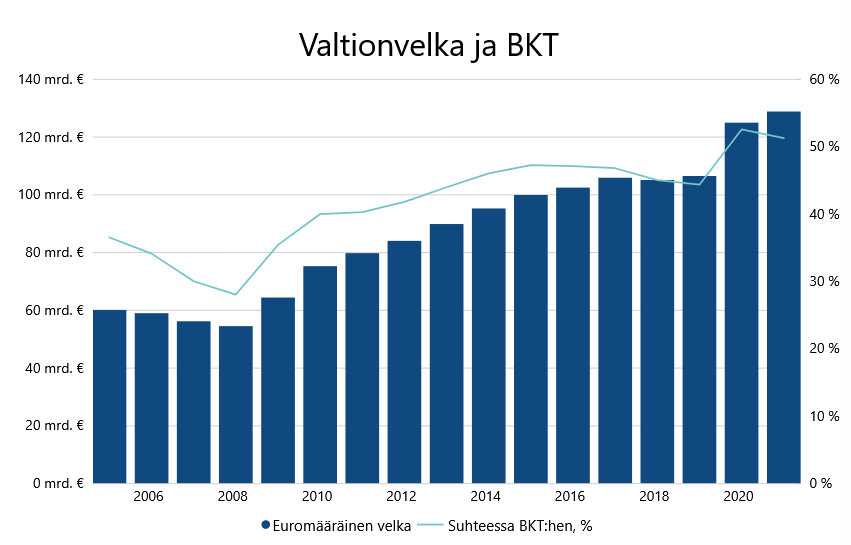

Source: Valtion velanhallinta – Tilastoja valtionvelasta

So, it is likely no surprise that while parties are largely in agreement on other matters (NATO membership, supporting Ukraine), breaking the growth of the national debt is likely the biggest election theme. How it happens and by whom.

The election schedule can be found here.
Election schedule can be found on the vaalit.fi page.

According to the latest YLE poll, below is the support for parties as of January 7, 2023.
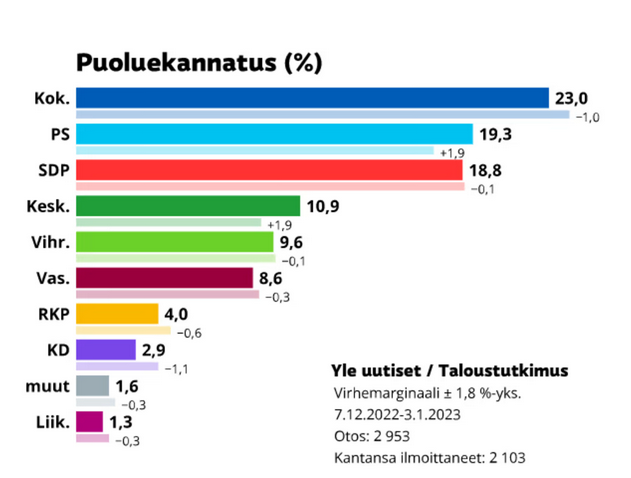

Source: Ylen kannatusmittaus: Perussuomalaiset kiilasi SDP:n ohi kakkoseksi | Yle

Here are the election manifestos
…or at least some party program, if the actual parliamentary election manifesto does not exist yet (most do not have one at the time of writing).

National Coalition Party’s election manifesto, although at the time of writing it only contains the main lines of economic and tax policy, and the link at the bottom of the page leads to the 2019 program.

Centre Party’s election manifesto is still at an early stage and only contains the main goals.

There is no information yet on the Social Democratic Party’s (SDP) election manifesto, so I am linking to the party’s general policy page.

The Finns Party’s election manifesto consists mainly of an alternative budget, and no concrete goals were listed on the party’s website yet.

Movement Now (Liike NYT) has listed its goals, although the actual election manifesto is not yet on the site.

The Greens’ election manifesto is still at the party program level.

The Left Alliance’s election manifesto is still a campaign page for candidate recruitment.

The Swedish People’s Party’s (RKP) election manifesto is organized into different categories.

The Christian Democrats’ election manifesto has not been compiled yet, but the party’s themes can be found.

The Liberal Party’s election manifesto has been published.

I did not include the programs and websites of all small parties, but registered parties can be found here: https://vaalit.fi/rekisteroidyt-puolueet

Finally, I’ll post a small poll that you can answer if you wish.

Which party’s candidate are you most likely to vote for?

  • National Coalition Party (Kokoomus)
  • Social Democrats (SDP)
  • Centre Party (Keskusta)
  • Finns Party (Perussuomalaiset)
  • Left Alliance (Vasemmistoliitto)
  • Green League (Vihreät)
  • Swedish People’s Party (RKP)
  • Christian Democrats (KD)
  • Movement Now (Liike NYT)
  • Liberal Party (Liberaalipuolue)
  • Pirate Party (Piraattipuolue)
  • Animal Justice Party (Eläinoikeuspuolue)
  • Seven Star Movement (Seitsemän tähden liike)
  • Communist Party of Finland (SKP)
  • Other party
  • I do not intend to vote
0 äänestäjää

Let’s start the discussion about Finland’s future and how our country can be saved. Moderators, please update those links as you notice a party has published a new page/manifesto. I will try to check them periodically myself, but you can all always tip me off via private message where a new program can be found, and I will update the link. :slight_smile:

42 Likes

It should be noted separately, in case someone doesn’t want to make their stance public but would still be willing to take part in this poll, that the survey does not show the voters.

8 Likes

I would at least add the Liberal Party’s party program as well. Puolueohjelma – Liberaalipuolue

8 Likes

Ok, only three comments in the thread so far, so let’s heat things up a bit to get a proper discussion going.

In light of this information, I believe the current government base will continue for the next four years after the elections. I base this on the fact that the National Coalition Party (Kokoomus) doesn’t really have the possibility of forming a government with the SDP, because their supporter base has shifted a few notches towards the Finns Party direction, and cooperation with the SDP would jeopardize the party (and the unity of the parliamentary group). If the Centre Party’s (Keskusta) result is even remotely acceptable, it is most sensible for them to continue in the current government, joining it “reluctantly” and thus negotiating ministerial portfolios and terms that are larger than their actual size. Lest we forget, the Centre Party’s actual collapse occurred during Sipilä’s government, when the party (and the entire government) practically became an extension of the Confederation of Finnish Industries (EK). This is surely still in the minds of the party members, so the threshold for entering a government with the National Coalition Party is very high, and thus the National Coalition Party would need to secure an absolute majority with the Finns Party (Persut) and the Christian Democrats. The latter option seems unrealistic.

2 Likes

The last messages in this thread concern the topic:
https://keskustelut.inderes.fi/t/politiikkanurkkaus/

As for the previously mentioned RKP (Swedish People’s Party) and PS (Finns Party), here is an interview regarding the matter:

RKP is no longer at the “Astrid Thors” level, where, for example, direct flight connections to Somalia should be established to move large numbers of people, but there are still plenty of political-ideological sticking points.

The biggest sticking point is language policy; the PS has a huge need to push forward language policy reforms, in which there has been no progress since the Vanhanen government and the removal of mandatory Swedish from the matriculation exam (Yo-ruotsi). RKP cannot give an inch on these, because the whole party is synonymous with language policy; everything else is a smoke screen. The party gets votes from everyone from painters to bank managers and everything in between solely because of language policy.

Another problem is RKP’s left wing, for whom tightening immigration policy, big cuts to Yle’s budget, etc., are poison. RKP doesn’t want to lose them. Even if the government program were written entirely by RKP, the PS would still get to appoint their own officials during the four-year term—this is not wanted either.

If KOK+PS (National Coalition + Finns Party) cannot succeed without RKP, then naturally this card will be played, and the National Coalition will be forced to choose the SDP. A vote for RKP is exceptionally clearly a vote for a blue-red (sinipuna) government.

Which brings us to the SDP; its support is surprisingly good at this stage of the government term. I vaguely recall that 30% of voters primarily vote for the individual, meaning that in addition to the debt-taking, Marin is an important pillar of support.
Back in the day, regarding the support for the Finns Party, it was mocked that Soini could only be voted for in one constituency; should we start asking this about Marin too? What impact will this have, and will Marin’s teflon and nerves hold up until election day?

SDP’s support percentage in parliamentary elections:

2003: 24.47%
2007: 21.44%
2011: 19.10%
2015: 16.51%
2019: 17.73%

17 Likes

I’ve completely lost all motivation to vote. There are only various shades of left-wing parties on offer, none of which have the backbone to make any meaningful change.

Especially with Finland’s most bland man, Orpo, leading the National Coalition, it’s futile to expect a transformation into a real right-wing party. You could already see from the Rydman case how much Orpo fears public pressure; they were ready to fold immediately as soon as the “Helsinki Pravda” wrote something uncomfortable. As long as Orpo doesn’t have trouble wheeling and dealing rewards and jobs for himself and his circle of friends, anything goes when it comes to government negotiations.

Korjausliike is a good attempt, but I fear it will remain completely marginal. As long as Finland’s demographics are heavily tilted toward retirees, the SDP will be able to seize the reins of power with rhetoric that reeks of 1970s Taistoist spirit.

Sanna Marin’s halo effect is still very strong, and I believe—to my own chagrin—that it will still carry these elections.

36 Likes

Good to know, thanks. Hopefully it’s so good that even the bigger parties start copying it.

Someone more skilled could just go ahead and move at least my messages from there to this topic, if they deem it appropriate.

At the moment, it is almost certain that the National Coalition Party (Kokoomus) will be a government party. Whether it or the Finns Party (PS) becomes the largest party remains to be seen. The National Coalition’s greatest merit has been that Orpo has stayed out of scandals and is strictly avoiding making any gaffes (frogs out of the mouth) before the election. In other words, Orpo is now a bit like Biden was two years ago: keeping a low profile and avoiding rocking the boat, which is sailing well.

I am absolutely certain that the Centre Party (Keskusta) will no longer join a government, no matter what is promised. Already in the last elections, the Centre Party should have gone into opposition to improve its support. Power tempted them too much, and in the government, they noticed they had ended up in the position of a foster child, led by the Social Democrats (SDP). It shows. Furthermore, if the National Coalition becomes the Prime Minister’s party, the program for the upcoming government term will be about cuts. The need for them is actually significantly greater than what the National Coalition is currently talking about, but they seem to be the only party even discussing balancing the budget at a deeper level than slogans.

If the Centre Party joins Orpo’s bandwagon, it will be the kiss of death for them, as the cuts will inevitably affect the Centre Party’s core supporter base: rural people. The Centre Party’s biggest competitor is the Finns Party, which has eaten away a lot of their support over the years in the Centre Party’s core areas, and if the Finns Party is in opposition at the same time, the Centre Party’s story is over.

The Social Democrats have, of course, spoken through Marin about the need for cuts, but they haven’t brought forward any concrete measures. They probably won’t, as it would be a total U-turn in the redistribution policy aimed at their supporters. Marin certainly knows what should be done, but it is politically impossible for her.

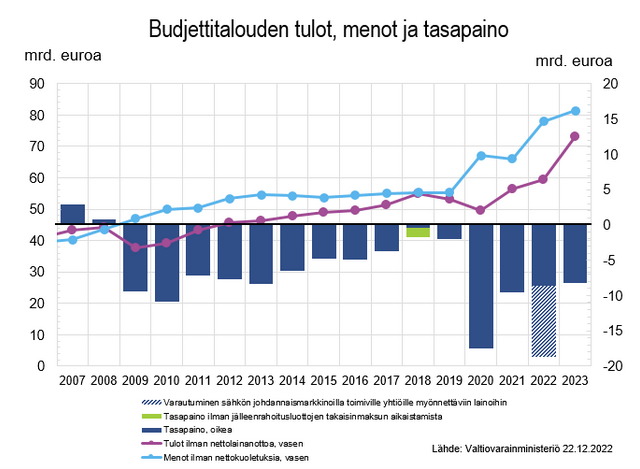
The graph shows that the largest state expenditures are State aid to municipalities (€27.6 billion), social expenditures (€21.4 billion), and Other consumption expenditures (€12.7 billion). If real balancing measures are desired, these must be touched with a heavy hand.


Source: https://vm.fi/valtion-budjetti

In the last 2 years, state revenues have surprisingly been increased, but it hasn’t been enough; instead, net borrowing is growing all the time. The budget was last in balance in 2018, during Sipilä’s government, when, among other things, the active model was in use in 2018 and 2019. Whether the budget balancing was thanks to that, some statistician might be able to say with justification, but I don’t believe it was a coincidence.


Source: https://vm.fi/valtion-budjetti

So this active model caused the Centre Party’s support to tank, and there was certainly a lot to improve in it, but in my opinion, Sipilä did what he saw as being in Finland’s best interest, even though it caused personal unpopularity and his party’s decline. Something similar may be coming if Orpo becomes Prime Minister and gets government partners to join the effort. It won’t be easy, but I see that small cuts and discomfort over the next few years is a better option than the “Greek road,” where the state’s catastrophic finances were hidden until it was no longer possible. And everyone knows what happened after that.

In addition, to become more competitive, Greek wages fell nearly 20% from mid-2010 to 2014,[citation needed] a form of deflation. This significantly reduced income and GDP, resulting in a severe recession, decline in tax receipts and a significant rise in the debt-to-GDP ratio. Unemployment reached nearly 25%, from below 10% in 2003. Significant government spending cuts helped the Greek government return to a primary budget surplus by 2014 (collecting more revenue than it paid out, excluding interest).[34]

Source: Greek government-debt crisis - Wikipedia

Finland is not yet anywhere near the same situation as in the early 90s, but it should be noted that the state economy can no longer withstand similar shocks as well as in 2019 when Corona started. Now is still a good time. Employment has grown, the economy is not yet in recession, the state debt is not yet at an unsustainable level, and we are not yet at war with a large neighbor. Now things can still be set in the right direction with small changes, without creating personal catastrophes, as many who lived through and experienced the 90s depression know what it’s like.

If the government coalition ends up being National Coalition + SDP seasoned with, say, the Swedish People’s Party (RKP), Orpo may have real difficulties achieving any significant cuts. I bet that National Coalition + Finns Party + RKP would likely be easier to achieve a policy shift. For RKP, language policy has always been the most important thing, and that has never been a threshold issue for the National Coalition. I bet that studying Swedish in schools is not a threshold issue for the Finns Party either; it has mainly been a feature related to the party’s identity, but I bet that for most Finns Party voters, it is less important than economic issues and, say, immigration.

22 Likes

The subject matter surrounding this political issue is vast and is not limited to comprehensive school lessons. Everything from civil servant Swedish (virkamiesruotsi) to services and the constitution. The matter could be summarized by when the Swedish Prime Minister visited Finland and a journalist asked why Sweden isn’t officially a bilingual country: “We could never afford such a thing” or something along those lines was the answer.

In this government formation puzzle, the Centre Party (Keskusta) is a “kingmaker” of sorts. It would be quite odd to go into an election and announce at the same time that we will under no circumstances join the government? Of course, after an election defeat in Finland, it has been customary to declare that the people have expressed their will, and that is what’s coming now.

Finland does not have a tradition of minority governments, but in theory, that would also be possible, meaning the Centre Party would keep the government afloat from the opposition; it wouldn’t need to be anything particularly flashy, it’s just a matter of a few missing votes. The Centre Party could announce that it doesn’t officially support the government and that the parliamentary group is allowed to vote “according to their conscience.”

7 Likes

You have (considering the rest of your text) surprisingly high faith in the National Coalition Party. I wish I did, too.

5 Likes

I recall reading that about 70% of Finnish households are net recipients, meaning they receive more in transfer payments than they pay in taxes. On top of that, there are the high-income earners working in the public sector. Thus, the majority of Finns live on tax revenue or pensions.

At this stage of the election campaign, everyone knows that the next government will be forced to cut public spending. But who would saw off the branch they are sitting on? For this reason, left-wing parties likely enjoy consistently strong support.

11 Likes

The National Coalition Party (Kokoomus) must win the election. Everything has been handed to them on a silver platter, so they just need to take what they want. However, they are being fastidious and making things difficult for themselves;
Orpo keeps making gaffes, and the other parties and the media are watching him relentlessly. That’s why Orpo has taken a defensive stance and stayed quiet, much like Sipilä in 2015; “if you don’t say anything, you can’t make any gaffes.”

However, the silence is as damaging as the gaffes, as others seize control of the narrative. The Finns Party (Persut) benefits the most from this, and the final stretch is long. They’ve already passed the Social Democrats (SDP), and historically speaking, it wouldn’t be an extraordinary feat if the Finns Party caught up to the National Coalition. The general situation, interest rates, inflation, etc., serve the Finns Party’s agenda more than well.

The Centre Party (Keskusta) is in decline. Enough said. Their place is in the opposition and with a new chairperson. Saarikko was no miracle worker. More like an irritant.

The Social Democrats (Demarit) are all about Sanna [Marin]. And people regret that they can’t vote for Sanna unless they are in Tampere. She’ll be the “vote queen,” dragging many other Social Democrats into Parliament with her. Third place is becoming a certainty for the Social Democrats. Whether that’s enough for the government or the opposition depends on the percentages.

The Greens (Vihreät) and the Left Alliance (Vasemmistoliitto) are in a state of steady melancholy in terms of support. No rise, and not really a fall either. The core supporters of the Left Alliance are already in their graves, and in this economic climate, the Green Transition isn’t the big thing.

I don’t feel like talking about the rest of the parties, but the Swedish People’s Party (RKP) is okay with anything as usual, and I wouldn’t want to see Ano Turtiainen anywhere except at the Juva ABC. To be honest, I’ve never been there, but VKK (Power Belongs to the People) doesn’t need any airtime.

In conclusion, the upcoming parliamentary term will be Orpo’s last as chairman. If the National Coalition becomes the Prime Minister’s party, the upcoming government program will make the party very unpopular once the cuts begin and Petteri takes the responsibility.

Edit: Orpo will also be replaced if they aren’t the biggest party in the election. That would just happen immediately rather than at the end of the term.

12 Likes

Thank God the Finns Party is at least eating into some of the Social Democrats’ votes.

I have to tip my hat to the Liberal Party for drafting their program well in advance. Good stuff in their program otherwise, but for some reason, they are advocating for the decriminalization of drug use. Including this decriminalization in the party program is a clear red flag for me, at least. Based on what I’ve studied, the difficulties in treatment referrals and accessing care are due to the service providers, not the criminalization of possession. Instead, small-scale drug dealing becomes remarkably easier if there’s no need to fear possessing a few grams for “personal use.”

1 Like

This is an interesting detail, as the National Coalition Party has openly advocated for austerity policies and yet the party’s popularity remains high. From this, one can conclude that the supporters are mainly a group of people who won’t be hit very hard by the potential upcoming cuts. If this is the case and austerity policies are implemented, it is quite possible that the party’s popularity will not drop radically despite the cuts. Of course, cuts always affect the party’s own members to some extent, but likely least of all the working supporters of the National Coalition Party.

If the SDP wins the election, there is hardly any talk of cuts; instead, the focus will likely be on broadening the tax base and increasing taxes for the highest earners, as well as striving to increase employment, but hardly by shortening earnings-related benefits or through other so-called “stick tactics.” In other words, expenses probably won’t be cut except perhaps for appearances—a million here, another there—while at the same time, a lot of money is spent on increasing employment through soft means. I’m not saying these methods are wrong, but a more effective incentive is likely a carrot in one hand and a stick in the other.

I could, of course, be wrong. The SDP did master the stick tactic 30 years ago. I don’t know about today. The world was certainly different back then.

5 Likes

Among current National Coalition Party voters, there are also many swing voters who want to see debt brought under control. However, voter mobility is constant, and upcoming austerity measures will likely hit everyone. Then, they will switch parties again.

”The best tax or tightening is the one that doesn’t affect oneself.”

Seat forecasts vs actual results from the previous parliamentary elections

https://twitter.com/jussisalonranta/status/1612083535174574080?t=ORRBhAJjuAJfOA8v2AA9vA&s=19

1 Like

It would probably help if you didn’t talk about the “handout crowd” or otherwise just paint a picture of immigrants being behind some supposedly inevitable destruction.

P.S. The United States of America is a nation built by immigrants.

14 Likes

The Center Party’s politics is “Finns Party-like”. Meaning nothing is done, but things are allowed to proceed under their own weight. Taking a stand and a “down to business” attitude is seen as populism and too extreme. When matters requiring decisions arise, they first stand around wondering and only then react. Decisions made in advance and on time are populism, etc.

As an example of the “Kepu” spirit, a metaphor: if it is known in advance that a river will flood in the spring and cause all sorts of damage. The situation and the resulting damage are watched from the sidelines, commenting “oh goodness me,” “my thoughts are in river,” “Shokked by news.” Condolences are offered to the victims’ relatives, and those who suffered financial losses are assisted.

So, I’m voting for Kepu because the familiar and safe vibe continues. And at least nothing is being done about anything.

A great start for the whole thread, and it’s good that this is getting its own corner.

This economic issue is important, and one would indeed hope for a realistic approach to the discussion on this topic. One good way to examine the state budget (this is what the Parliament decides on) is Explore the Budget (vm.fi). From there, you can examine expenditures (and revenues) by administrative branch or by expenditure category. The most significant portion in the expenditure classification is Transfer Payments (€57.8 billion), the majority of which (€27.6 billion) goes to the municipal sector (with the largest share, €20.6 billion, going to the wellbeing services counties – i.e., healthcare). By clicking the (i) icon, you can examine the actual budget texts. I don’t mean that this is necessarily where savings should be made; I’m simply stating that by examining it, one can see where the billions go. I expect a significant part of the wellbeing services counties’ expenditures consists of salaries for nurses and others (I haven’t looked into this in more detail, though medicines and equipment also cost a lot).

It should also be noted that the costs of many other items can be found there, and by exploring it, you can find clear information on various types of expenses (such as those related to immigration – of course, small streams make for significant flows, but in my opinion, the actual challenges lie elsewhere).

So, when discussing these economic challenges, take a look at that first.

Municipal taxation is another story and not the subject of this election (at least not directly). However, for most people, municipal tax accounts for a significant portion of the income taxes paid. This means that some of the factors related to the level of taxation can be found right in your own municipality.

2 Likes