Politics Corner (Part 1)

I was just watching A-studio, and all the MPs participating in the discussion were of the opinion that pensions need to be raised—the smallest ones by at least 100 euros. Nobody talks about how it’s going to be funded. Everyone has ideas on how to squander tax money, but no one is worried about the tightening taxation on labor at the same time. Taxation is already at a level where it’s no longer worth doing low-wage work as a side job on top of another job, as half goes to taxes or tax-like contributions. The incentive problems aren’t just limited to those living on benefits, but also to people who could work more than they currently do, but it’s in no way meaningful if, for example, half of a 12€ hourly wage goes to taxes.

Significant reforms to labor taxation certainly aren’t coming if we aren’t ready to cut current society-funded services or benefit levels. No party seems ready for this. Even the National Coalition Party (Kokoomus) advertises itself as a right-wing party, but in reality, it is completely leftist with only small right-wing nuances. A good example is that Juhana Vartiainen can jump from the Social Democrats (SDP) to the National Coalition Party without his political views changing.

Finland is completely under the thumb of pensioners and the older generation. Because they represent the largest voting blocs (with high voter turnout, their weight is significantly greater than their actual share of the population), all politics is made with the needs of the older population in mind. Others are only offered just enough to keep the whole thing from falling apart.

We could very well take life expectancy into account in voting and give more weight to the voices of the young, as they will have to struggle in this society in the future as well. Since the life expectancy coefficient also reduces the future benefits of the young, this would be very logical. Now the situation is becoming such that those on the receiving end of society hold the largest voting masses, so you can directly conclude from that what kind of politics is being practiced.

The entire Finnish political system should be blown up and rebuilt from scratch. This is starting to be such a shack that there are no longer any real possibilities to fix the foundations without it becoming really expensive.

Even Sipilä had all sorts of visions when he entered politics. But it just so happened that the political machinery turned a fairly sensible-looking guy into a power-seeker fishing for the voter masses. Why isn’t there enough desire for reform in Finland to bring about change? I would assume that many people here also vote for those career politicians steeped in the system, and then wonder why change isn’t happening.

Finland really needs a Trump-like politician to shake up the whole system a bit and have someone show the direction. Whether it’s good or bad, change is definitely needed. In Finland, there is practically one “correct” line for every issue, and you’re only allowed to deviate slightly from that line to avoid being labeled a wrong-thinker. Even Jussi Halla-aho is seen as the worst enemy of politics just because he has a dissenting opinion, even though his arguments are much more logical than those of many other politicians.

If some politician came to their senses and demanded sensible cuts, it would practically be political suicide. In Finland, there is this bizarre notion that benefits already achieved and paid for with taxpayer money cannot be touched. They should be able to be cut just as easily as they are raised. Earnings-related pensions already in payment could be ruthlessly cut to the level that matches the amount actually accumulated. Why should those currently retired have the right to enjoy excessive earnings-related pensions compared to what they have contributed?

Now we basically just need a few dictator-like central bankers to crash the economy with excessive rate hikes so that reforms would be forced elsewhere than just in Finland. The global economy could be rebuilt after that.

There was actually just a news story saying that the vitality of forests is only preserved if they burn often enough. The exact same logic applies to the economy, which has now been patched up in so many ways that the whole cannot be healed without a collapse.

It sure is interesting how nothing gets done anywhere in politics. Besides vote-fishing, of course.
14 Likes

Fortunately, Finland has a mixed economy, meaning relatively free markets that also account for some share of the economy, and rigid institutions/ministries that restrict politicians.. ;D

4 Likes

And fortunately, one can leave Finland (free movement of people and goods, and all that) for countries with lower taxation, where one can get rich in other ways than just winning the lottery. Perhaps Finland still has that extreme red-green envy complex going on, which drives the intelligentsia out of Finland.

5 Likes

Well, Finland is by many measures one of the best countries in the world, and perhaps we are overly critical of our home country. I agree with the start of the thread that action is needed in the long run, but Finns have always found a desire and energy for reform when facing a difficult situation. I am an optimist =)


Here is a dry report on the sustainability of the pension system; it seems that there is no deficit in that sector with current specifications. You can read the report here: https://www.taloustieteellinenyhdistys.fi/wp-content/uploads/2017/06/LOW_KAK_2_2017_176x245_nettiin-55-68.pdf

I won’t comment on whether the report’s assumptions are realistic, but it provides good background information and material for discussion.

1 Like

So, voters can also be blamed. In the best-case scenario, the politics they pursue gather support, and support isn’t just gained by flattering voters.

For an ordinary citizen, it’s actually a pretty big hurdle to move out of the country. Into a foreign culture, a foreign language, far from relatives and friends (if you happen to have any). I wouldn’t move from Finland, even if taxation were 10 percentage points higher, because my (no-life) life is here.

Despite that, I can still criticize current politics. Immigration issues largely involve a completely similar problem. Is it therefore reasonable to think that everyone who doesn’t like their country of origin can freely move to countries with good social security in pursuit of a better life? Or would it be better to try to influence the situation in their country of origin so that it would be better to live there? Running away from problems doesn’t lead to good in the long run. The problem is not easy to solve, but one can still try to influence it.

1 Like

Finland is a nice and great country, worth coming to even from far away in the hope of a better life. Finland is a great country, but not for entrepreneurs or those who try to get rich through their own work. If you do two jobs, you are immediately punished with a higher tax rate. If you fail as an entrepreneur, you will suffer in debt bondage for the rest of your life. Murderers and rapists serve a maximum of 5 years, but an entrepreneur who goes bankrupt serves “life” in debt bondage.

Every autumn, an envy list is published from which you can see how much your neighbor has earned. If you think your neighbor has earned too much, you can always report it to the authorities. That’s fun too. In addition to the weather conditions, what’s great about Finland is that you really don’t have to work here if you don’t feel like it. A furnished apartment can be found in the city center if you know how to demand “me, me, me” – while waving the right kind of card. Hurstin’s soup kitchen line gets longer every year, but Helsinki’s leftist council doesn’t want to give money to alleviate poverty. Apparently, Hurstin’s soup kitchen line has the wrong kind of people, who Helsinki’s politicians don’t think need help.

And now, the pension companies’ 200 billion euro pot also threatens to melt to zero if uncontrolled immigration is not significantly increased in the coming years. This mantra has been chanted in the elite media for over a week now. Those who disagree are silenced by branding them as racists. In extremist communist North Korea, it is also customary to silence infidels and dissenting individuals.

Oh, and motorists, they are the biggest criminals here, as all the world’s evils are their fault. But don’t worry, the world will be saved after all when Finnish motorists are punished by a significant increase in punitive taxes. After that, no exhaust gases will come out of the car’s exhaust pipe, but fresh-smelling flowers. Finland is a great country, just like an earthly paradise from the Book of Revelation.

1 Like

The Left Alliance is promising a basic income of 800 euros. Many comments seem to dismiss the idea of a basic income as completely impossible. While it would be a good solution in itself, it only becomes a problem if other benefits are kept on top of it (which the Left Alliance probably envisions). Of course, the basic income should be somewhat lower than that, but in itself, such a basic income is not impossible.

The Social Democrats are truly driving Finland into a ditch. Now, the nurse-to-resident ratio in elderly care facilities should be codified into law: 0.7 nurses per resident. With this age structure and that nurse-to-elderly ratio, we will be in a real pickle in the future. The Social Democrats clearly only think in terms of short-term solutions. In the long run, completely different solutions must be found, and the number of nurses cannot possibly be raised to that level. While it might be a bit harsh to think that the elderly are not being properly cared for, there must be some sense of proportion regarding how much tax money can be poured into it.

At the same time, pensions should be raised, layoff protection increased, the activation model abolished, and better healthcare provided. How are they planning to fund all of this? Oh right, the young will pay. Older generations haven’t even managed to save for their own pensions, but who cares when the young will pay. At the same time, the young are made to pay for the elderly’s care and medical expenses. To cover all of this, services for the young have been cut.

All political decisions have been made so that the large age cohorts have managed to avoid all possible cuts. Thus, the interests of the largest group have been secured, and a smaller group of young people has been made to fund it. The welfare state simply cannot function like that in the long run. It only works if there is a sufficiently large mass funding public services. That is, precisely when the large age cohorts were in their prime working age. Now, the success of the welfare state is justified by the achievements of that era when the dependency ratio was completely different.

2 Likes

The number of nurses might possibly need to be scaled as a short-term solution, until we can be sure that the supervision of companies is working. At the moment, it’s not working, and this is the result.

Basically, this wasn’t even new information to anyone who has even a little knowledge of the quality of care. My girlfriend works in the healthcare sector in emergency medical services, and I often hear shocking stories from there.

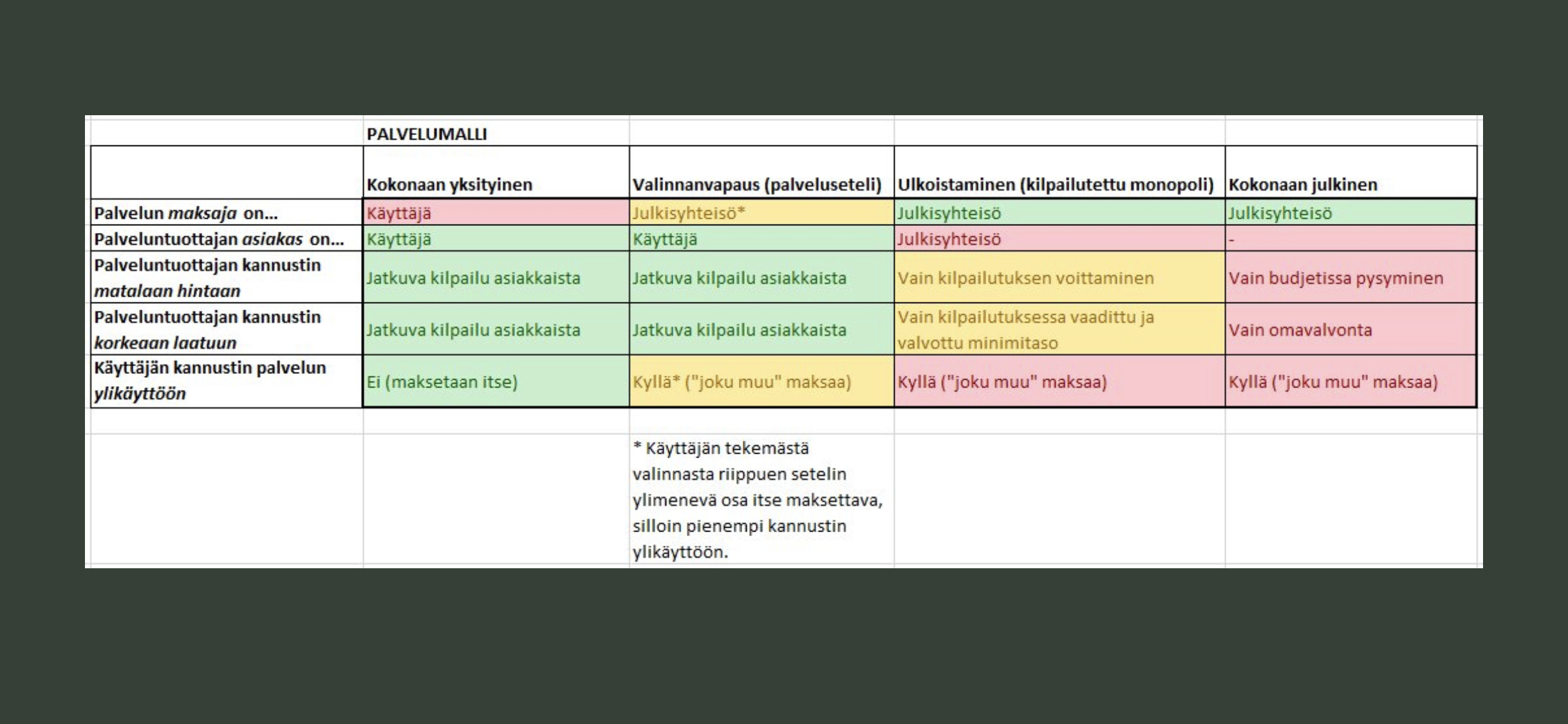
By the way, here’s an interesting picture I spotted on Twitter

Now we’re in dangerous waters. How about the car tax as a short-term solution?

The public sector should not plan any temporary solutions that are enshrined in law. They tend to stick around. Therefore, the problem must be addressed immediately where it is, i.e., in supervision. So let’s not complicate things with any “temporary” laws.

1 Like

Yes, that’s true. You’re right about that. In addition to oversight, the level of fines should be such that it practically acts as a deterrent. Both for municipalities and private entities. It doesn’t matter who provides the service.

Also, political ties to these care services should be questioned more broadly, from the National Coalition Party going to Terveystalo (a Finnish private healthcare service provider) and so on. And the political left owns Medgroup.

I don’t understand how one can first work in decision-making and oversight, and then jump to the other side of the fence.

It is indeed immoral behavior, but it’s difficult to restrict it.

Watching Ykkösaamu, Jussi Halla-aho managed to convince me again with his rationality. Economic policy could also become more sensible if it were left to Halla-aho to decide. Especially regarding the effects of climate policy on the Finnish economy, Halla-aho seems to be much better informed than other Finnish politicians. This has, of course, been evident before. I have to wonder why Jussi Halla-aho is generally dismissed, even though he is one of the most sensible politicians. I personally do not support the Finns Party as a party for other reasons, but Halla-aho could, as an individual, be in the next government bringing a voice of reason.

Regarding the climate change discussion: HS had a big story this week about how air travel pollutes. At the same time, it was lamented how it can be cheaper to fly a roundabout route with a layover, because it pollutes more. It clearly shows again how journalists and probably many decision-makers don’t really have a grasp of how things work. Roundabout routes with layovers are cheaper because they can be produced more affordably (as passengers flying via a layover are essentially filler passengers), and this also means that overall emissions are lower when planes are filled up instead of flying a separate direct flight, as the journalist suggests.

1 Like

Absolutely brilliant points from Jussi Halla-aho. How many other politicians openly admit that they need to consider which functions belong to the public sector and which can be abandoned? The Finns Party (Persut) wants to shrink the public sector and openly admits it. They want to cut out the unnecessary. Even if someone disagrees with the targets, the principle is the only correct one and light-years ahead of other parties. I read exactly the same points today in Heikki Pursiainen’s “Paska Suomesta” (Shit from Finland).

It’s truly regrettable that other potential ministerial candidates in the Finns Party are far from Halla-aho’s level. But in a way, it’s comforting to think that, considering the Finns Party’s supporters, it wouldn’t be the first thing that comes to mind that they would vote for such a competent and knowledgeable person.

2 Likes

Nothing new in itself, but just a reminder of how cheap borrowed money has led to reforms not being made, as the old system can keep voters happy. It has also been seen in Italy recently that they don’t want to reform when money can be obtained from “the markets” very cheaply. Political tough talk doesn’t really lead anywhere. If indebtedness had not been possible before, Finland would have made the reforms much earlier and the future would be much more secure.

"At least the National Coalition Party, Centre Party, SDP, Green League, Left Alliance, and Christian Democrats propose in their social security models that basic social assistance be bundled with four other benefits.

The parties hope that this will enable them to remove incentive traps, which they consider the current basic social assistance to be.

According to Liisa Siika-aho, the change would cost a lot, as even more people would be entitled to support."

Is this really true? Are there many working-age people in Finland who do not work and do not receive benefits equivalent to a potential basic income?
In addition, it seems that when talking about the costs of basic income, one often hears that it would cost billions. In practice, the costs are stated as the amount of the basic income multiplied by the number of people entitled to it. Of course, it would gradually be taxed back as incomes increase. If taxation is not eased, costs would only arise from those who now live without benefits or earned income, and there aren’t really that many such people in reality.

2 Likes

Morning Kauppalehti: Population growth at the current rate will render climate efforts futile

Indeed. Pentti Linkola already told Masse’s age group in a lecture back in the 70s that there are far too many people in the world for the Earth to cope (even back in the 70s!). Now the situation has spiraled out of control, and unfortunately, population growth is not under control anywhere. Even China ended its one-child policy.

Is it Uncle’s good fortune not to be around to see Linkola’s prophecy?

Tuomio-Masse

2 Likes

And today, when I went out and the temperature in February was +7C, and it seemed like spring was at least a month early, my belief in the severity of climate change only grew stronger. :disappointed_face:

So, Masse is buying a Tesla just for its acceleration capabilities. The uncle no longer believes it would be a world-saving act. What does the forum say?

3 Likes

So, here’s the harsh news as a link.

2 Likes

Uncle asked for comments on the forum about how nothing will stop global warming, because the population explosion alone, now and in the future, will melt the polar ice caps, flood coastal cities, and create massive waves of refugees.

So, doesn’t anyone care? It’s fine. After a short period of depression, Masse will also forget the above and start rambling about new money again :blush: Uncle won’t live to see the bottom of the crisis, so let’s floor it like the Chinese boys.

Ilkku-Masse

It’s not quite like that. Warming will eventually turn into cooling, even if nothing significant is done. Western countries have already significantly reduced emissions, and the same would continue in the future. Developing countries would reach their pollution peak at some point. At the same time, population growth will stabilize as living standards rise in developing countries, and with it, birth rates. Any problems that arise are only temporary, but long in human terms, possibly a few hundred years. After that, the Earth will gradually start to cool again as pollution decreases. So, the Earth will not be destroyed, and nothing that would destroy humanity would happen, even if no climate agreement were reached. Small-scale natural disasters may occur, and people’s lives may become somewhat more difficult.

Biodiversity will experience a change, and several species may go extinct. This has happened at regular intervals ever since organisms evolved and inhabited the Earth. The Earth has never experienced destruction, and humans will not cause it either. At least not with current levels of pollution.

The main issue now is what kind of living conditions we leave for the next few generations and what kind of environment people will live in then. Of course, it would be nicer with less pollution and more biodiversity. That’s why it’s worth doing what can reasonably be done for climate change. However, no ultimate destruction would be faced, even if current goals are not met. The 2% warming target is quite artificial, and there is no ideal level at which warming must be stopped. If we can stop warming at, say, 2.5%, that would also be quite good.

Many people like to exaggerate things, and the same applies to these global warming targets. Scare scenarios are created if the plan is not adhered to. In reality, deviating from the targets does not cause a significant change, but a line must be drawn somewhere when making agreements, and in that sense, it is understandable. We do what we can, but exaggerating the issue of warming is quite unnecessary. The Earth has endured all sorts of even greater upheavals over time, and this pollution problem is not as dramatic as the picture that has been created of it.

I should also add that developing countries will later have access to much newer technology than what Western countries used to develop. So, these countries will not produce the same kind of pollution bomb relative to their population as previously developed countries did. From a climate perspective, it would therefore be best if low-income countries developed later. The crucial factor in the coming decades is the extent to which developing countries raise their living standards and on what schedule. If low-income countries with large populations suddenly experience rapid growth, then strong warming could be seen, which could cause problems for, for example, low-lying coastal cities.

In the big picture, technology will solve climate change anyway, but in the short term, it is mainly about political choices that can ensure smaller upheavals for the coming decades or a few centuries.

2 Likes