Well-being and fitness industry companies

The pursuit of well-being and investment in leisure time is considered one of the megatrends that will grow significantly in the future. People nowadays (I’m not referring to the COVID-19 era, but more broadly) have more time and money to invest in their leisure. Furthermore, the corporate world has started to realize that in expert work, employee well-being correlates with performance.

Unfortunately, there aren’t many companies in this sector listed on the Helsinki Stock Exchange since Amer Sports was sold to the Chinese… :frowning: So I thought I’d ask if there are any forum members who follow this industry.

The industry can be divided into many different parts, but here’s one classification:

Traditional outdoor/sports equipment and apparel manufacturers.

  • In the US stock market, there are companies that have seen strong growth percentages in recent years (e.g., Nike, Lululemon) and then those that have performed less well (Under Armour).
  • As a newer entrant, Peloton has had a rather rapid start on the stock market.
  • In the Nordics, even after Amer, there’s at least Fenix Outdoor, which is listed in Stockholm and owns brands like Fjällräven, etc., as well as the Globetrotter chain, known as Partioaitta in Finland. In this sector, the aggregation of brands into a few companies, similar to Amer, also seems to be a strong trend; for example, Asics acquired Haglöfs several years ago.

So, there are diversified brand portfolios available, or very specific players (like yoga apparel manufacturer Lululemon). Lululemon, by the way, made a handsome “corona dip” and has already risen to ATH numbers from there.

Companies offering wellness services / gym chains.

  • In the United States, new entrants in this field, in particular, have generated quite a buzz around their concepts. For example, Flywheel spinning and Orange Theory Fitness combine technology and group exercise in a new way. Both are, of course, private companies (at least for now). In the Nordics, most gym chains are probably still private, too?
  • Coaching service providers like Hintsa Performance could also be interesting, but are often still small.

Wellness Technology

  • The most well-known Finnish companies are Suunto (went to China with Amer), Polar (private), and among the new ones, especially Oura (private).
  • From elsewhere in the world, there’s Garmin, Fitbit (which Google acquired for $2.1 billion), and probably many others. And for a while, we also had Withings through Nokia, but let’s not go into that… :wink:

Mental well-being / mindfulness industry companies.

  • Companies in this sector have recently seen strong growth figures and valuations. In Silicon Valley, there’s been talk about these for a long time. For example, Headspace is internationally known, and from Finland, Meru Health recently announced its funding.

Companies benefiting from / supporting the trend

  • I personally have unlisted Yeply (mobile bicycle maintenance service) in my portfolio, and there are certainly more niche companies like it.

In the short term, COVID-19 both supports and punishes the sector. It supports it because well-being and local tourism/outdoor activities are increasing. It suffers because this consumption is, of course, non-essential.

Do forum members have any favorites in this sector?

7 Likes

Nautilus is a publicly traded company, so one would assume they are still focused on manufacturing gym equipment.

Arthur Jones, who originally founded the company, was a very interesting person. May he rest in peace. Arthur Jones, MedX, and Nautilus Exercise Principles

It seems that traditional healthcare companies are constantly expanding into this sector and raising their stakes in prevention. If I recall correctly, for example, Terveystalo in ROAST and the healthcare sector podcast have discussed this topic in relation to Terveystalo, Mehiläinen, and Pihlajalinna. Of course, it is still a relatively modest part of the aforementioned companies and their business, at least for now.

1 Like

True. Pihlajalinna, at least, already bought a gym chain. It will be interesting to see if “traditional medical centers” can pivot to this side nimbly enough. Traditionally, a medical center’s bread and butter comes from people not taking care of themselves, and by entering this sector, they can, in a way, create “protection” from the wellness trend. The strongest growth will likely come from companies focused on this industry.

Hello,

Due to a significant increase in free time, I’ve been reading this forum almost daily for the past couple of months, and I learn something new every day! :+1:

This thread resonated so strongly with me that I thought I’d take the plunge and write something myself. :smiley: I have a background in endurance sports (despite my username) and currently work in the sports sector, so the field interests me, and I know a fair bit about it. I’ve been considering these things Musti mentioned, from an investment perspective, and I’m particularly interested in the Oura-type products you mentioned. I’ve never used Oura myself but have heard great things about it in my circles, and heart rate variability, which I believe Oura primarily uses to measure recovery, is familiar to me through other devices. There are surprisingly many of these products on the market, especially in Finland, and they have gained considerable popularity in sports circles, particularly in recent years.

How to make them more globally popular is a more difficult question. Of course, almost every activity tracker now has these light monitoring features, but I don’t feel they are very different from each other. I’ve also considered buying Garmin shares at some point, but I didn’t think their sports devices differed significantly enough from competitors (Polar, Suunto) to warrant an investment. One possibility could be to use this recovery monitoring in the medical field, for example, to monitor whole-body recovery after major surgery. This somewhat touches upon the point Mauri raised, but from a slightly different angle. It may well be that this is already done extensively today, but if one of the companies in this sector could get a significant foothold in that area and prove its benefits, then we would certainly be talking about bigger things than just selling activity trackers.

Peloton is also an interesting case; I actually bought it at around $33 when I read about it, and it seemed like a good experiment for the current moment. It has done quite well so far, but I intend to sell at least half, at the latest, during any potential Q2 earnings announcement hype. I’m curious to see where that goes, but it’s hard to believe that upgraded exercise bikes will ultimately conquer the world… as a shareholder, I’d gladly be wrong at this point. :smile: And regarding Peloton, I’m sure there will be more things like this in the future… Strava is also a good example that has become incredibly popular in sports circles. Strava is a GPS data-based app through which you can access training information. Practically all the latest smartwatches support this, so you get the data on your phone automatically when you sync the watch with your phone.
A bit off-topic, but then there’s esports, which I don’t personally have much contact with. However, I understand that it will surely continue to grow and grow. When today’s 15-year-olds reach 35, they will likely consider esports a bigger deal than today’s 35-year-olds do… This is also recognized in the sports sector, and although many are not yet ready to count it among traditional sports, it will surpass bigger and bigger sports in popularity in the future. I haven’t checked, but there’s probably already a thread about esports on the forum, so I’ll go read those next!

8 Likes

Worth a look. Juurikki would think.

My niece plays CS more hours a week than Juurikki does anything useful, including social media. She doesn’t need sponsorship. Thanks for the offer, though.

1 Like

“One possibility could be to use this recovery monitoring in the medical field as well, for example, to monitor whole-body recovery after some major surgery.”

There’s a light-year’s distance (a bit exaggerated) from these recreational measurement devices to hospital-grade equipment. Accurate biosignal measurement has certainly developed significantly, but there are completely different requirements on the hospital side.

Remote diagnostics in hospitals will be the thing in the future; it certainly offers opportunities. A good concrete example of this is provided by Bittium’s Medical side (Faros product family) – I recommend checking it out.

1 Like

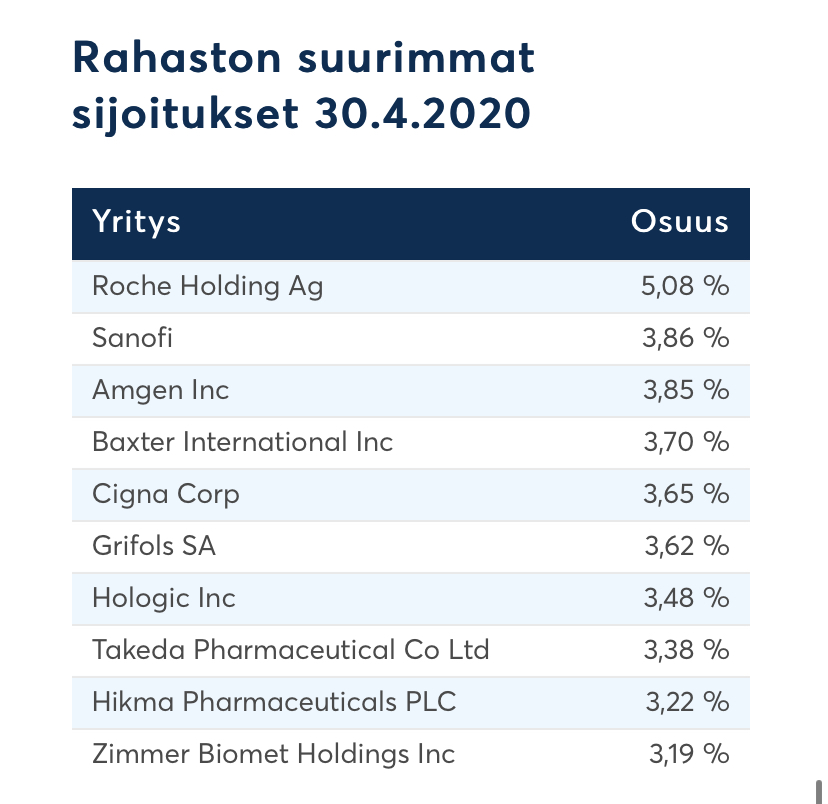
Thanks for the tip. This, however, seemed to invest mainly in pharmaceutical companies and thus perhaps didn’t hit my target group.

I would also keep these two things (well-being and real medicine) separate for now. Well-being meters are, of course, already used for “home monitoring” of exercise and similar, in the same way as consumer thermometers or blood pressure monitors, but there is still a long way to go to official medicine.

I still see that there may be a demand for Oura-style services as part of health maintenance on a larger scale, but it is certainly not hospital-level diagnostics. Lähitapiola already offered insurance that included a smartwatch in the deal.

1 Like

So we’re on the same wavelength :slight_smile:

Oura has grown quite impressively and just received additional funding, though I haven’t followed it super closely. I personally use a sports watch, but nowadays I only wear it when exercising. I used to wear it more often, but I think I got some kind of “data overload” and its use decreased.

You mentioned Nike in your opening post. It’ll be interesting to see how much the Last Dance documentary boosts Nike’s sales.

Thanks for the tip, I’ll have to look into that Bittium case more closely! :+1:

And yeah, I’m sure it’s true that these recreational devices have a long way to go. In fact, it just occurred to me that a few years ago when I was doing my master’s thesis for a smaller IT company, we discussed the same topic with the client. He was dreaming about being able to combine the expertise of IT companies even better with these wellness-side meters, which would provide better opportunities to reach the next level in monitoring.

What about these sleep clinics/doctors etc.? Do you have more detailed information on how far apart “home devices” and those used in medicine are? Or rather, do they have devices available for home use that aren’t too far off from these wellness products?

As far as I know and remember, consumer meters are still very unreliable in measuring sleep, some more accurate than others, but they don’t quite stand up to sleep clinic models, for example, in detecting apnea, except in extreme cases. Or perhaps it’s more like, a consumer device can indicate problems, but a lack of indication is not proof of a lack of a problem.

I somehow see this as requiring a medical-specific device for diagnosis/treatment. Then, for broader basic health monitoring and improvement (wellness), even consumer devices work okay at their best. For example, Oura’s and others’ heart rate variability measurement is already quite accurate, for instance, in identifying/indicating stress levels and the illness caused by it (at least in masses).

This also reminded me of one company, the Finnish Firstbeat, whose heart rate variability measurement technology Garmin, for example, licenses. It’s a private company, of course, but they’ve had great success in advancing technology (if I could get this or Oura on the stock market, I’d buy it…):

"The company gained significant global brands such as Suunto, Garmin, and Huawei as clients. To this day, Firstbeat’s technology has been utilized in 100 products. This year, 15 more products have been added.

– Our technology is an integral part of our customers’ devices, in the same way that Intel is in computers and Dolby in music devices. Our licensing business is global and generates a significant portion of our revenue, Kettunen says.

Alongside licensing, Firstbeat has developed two other business areas: elite sports and the Well-being Analysis aimed at occupational well-being.

The sports business is the smallest of Firstbeat’s three pillars, but significant in terms of credibility. Currently, Firstbeat’s methods are used by over 900 teams and training centers. These include, for example, NBA, NFL, and NHL teams, as well as top European football clubs.

– The greatest growth potential is in occupational well-being. Well-being Analysis helps people understand their own bodies better. The service shows how changing harmful habits can improve overall well-being, work performance, and learning ability. In Finland, Well-being Analysis has already been used by 250,000 people."

https://op.media/alueet/keski-suomi/sykkeella-kasvuun-firstbeat-hakee-kasvua-ulkomailta-5982b6c578cb46ee92b2f175f8f9c7fc

2 Likes

Jees, that’s kinda what I thought.

And yep, Firstbeat is probably the most well-known of these. That’s actually why I was asking about sleep tracking, because the teams in the sports sector that use Firstbeat are such big businesses, for example, the Golden State Warriors, who have won 3 NBA championships in the last 5 years. So you know that recovery tracking and device selection won’t be limited by resources. How big a role Firstbeat ultimately plays with different teams and what other devices are used probably varies, but as it says in the article you linked, these are big deals for the credibility of the products.

Lululemon went shopping and snagged Mirror for 500 million. Mirror sells “mirrors” for homes, through which guided exercise is streamed as a service (a bit like Peloton).

https://www.wsj.com/articles/lululemon-to-buy-at-home-fitness-company-mirror-for-500-million-11593465981

Garmin has now acquired a part of Firstbeat, Firstbeat Analytics. That is the same one they have previously used under license. Firstbeat itself will focus on occupational well-being and elite sports.

https://newsroom.garmin.com/newsroom/press-release-details/2020/Garmin-acquires-Firstbeat-Analytics-a-leading-provider-of-physiological-analytics-for-health-fitness-and-performance/default.aspx

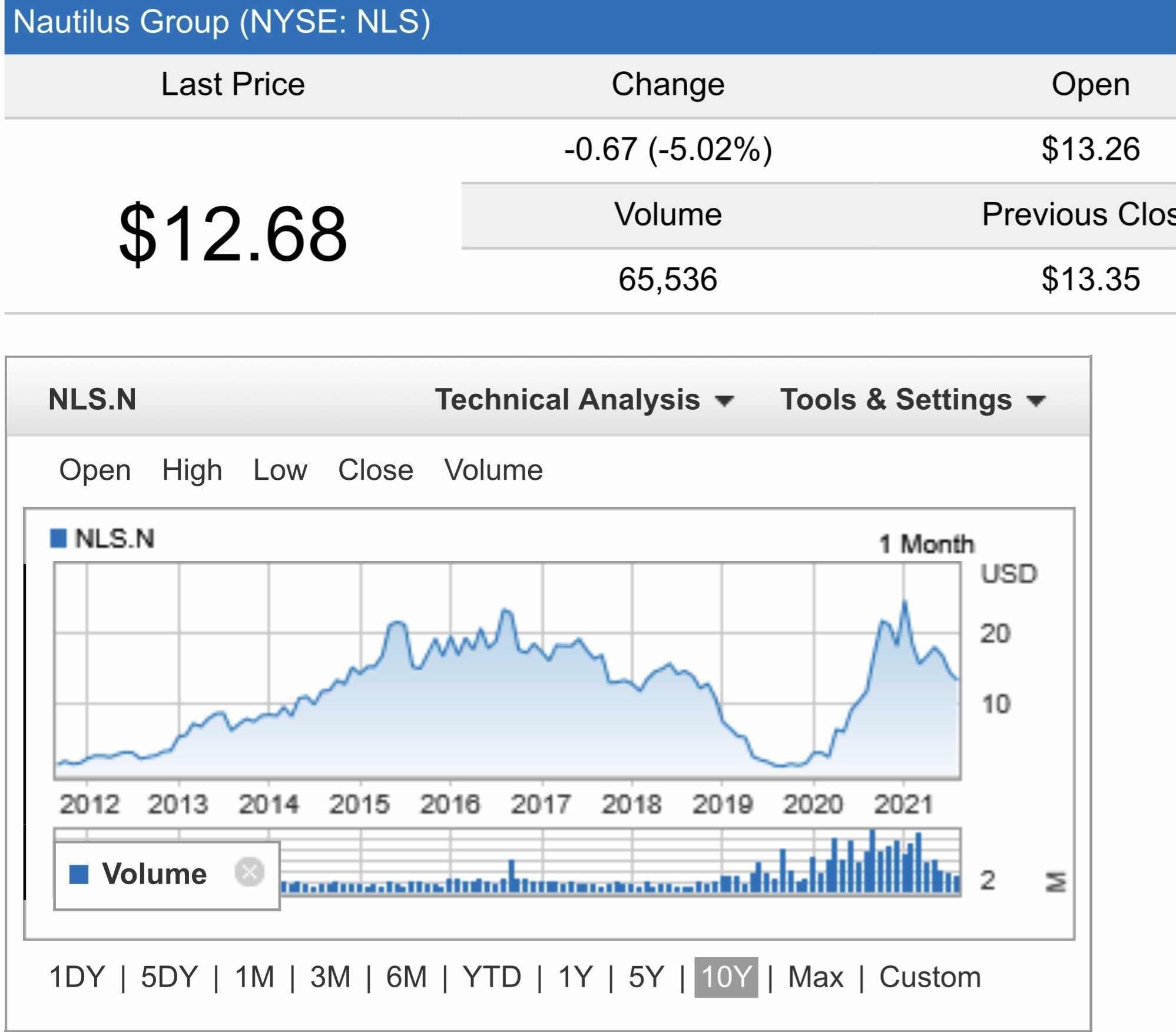
The thread has been a bit quiet lately, but I guess this is the right place to ask if there are any fellow investors on the forum who have looked into Nautilus? I stumbled upon the company through Salkunrakentaja, where the case was already thoroughly discussed:

Nautilus manufactures, among other things, connected fitness exercise bikes and treadmills, clearly placing it in the basket of companies that benefited from the pandemic. However, they are guiding 55–75% YoY revenue growth for Q1 2021, and despite this growth, the stock trades at a P/E of ~9. The company’s history has apparently been quite turbulent, and investors don’t seem to show much love for it. Nevertheless, the CEO changed in summer 2019, and since then, the direction seems to have been right. Peloton is probably the best-known company in the same basket and has garnered the most investor attention, so let’s compare some of the companies’ 2020 figures:

Nautilus Peloton
Revenue $ 553 million $ 1826 million
Revenue Growth 79% 100%
Profit $ 60 million $ -72 million
Debt-to-equity ratio 11.18% 18.62%

Nautilus trades at a P/E ratio of 9 based on realized earnings, whereas Peloton trades at a P/S ratio of 12 :smiley: Is Peloton’s product somehow superior, or is there quite a hefty price tag placed on investor confidence here?

9 Likes

Apparently, I also found a slightly more comprehensive article about Nautilus by the same Salkunrakentaja guy on Seeking Alpha. If you’re interested in the company, I recommend reading it through:

https://seekingalpha.com/article/4417996-nautilus-low-risk-high-reward-play

It just occurred to me what a big impact the ongoing semiconductor shortage will have on the earnings capability of an equipment manufacturer like Nautilus this year. Even if the earnings turnaround is on a sustainable basis due to the company’s strategy reforms and product demand, will these new devices equipped with large screens hog more hardware than is available? :smiley: Apparently, despite excellent results last year, the company had significant supply chain issues and a backlog had accumulated. Supply chain development was quite central to the new strategy.

Regarding long-term potential, the investor day presentation heavily discussed the belief in achieving $1 billion in revenue by 2026, which would mean a 10% CAGR for revenue over the next five years. If the company progresses somewhat according to its goals, one would think there would be upside in the stock, as it is currently priced for declining earnings rather than growth.

Here is the recorded investor day presentation. It was quite a hefty set, but it went down in smaller pieces: https://youtu.be/sXLxXqLThns

3 Likes

Nautilus’s (Nautilus) earnings report has been published, and the presentation left a rather conflicting impression. Semiconductor shortage, rising costs, supply problems, all-time high demand, and excellent sales growth over the past year. But in the future, melting profit margins are expected, and let’s hope that JRNY memberships will create a Pay As You Sweat revenue stream, or should I say SAAS (Sweat As A Service), so that the share price can get more air under its wings? But at first glance, it seems that Nautilus’s JRNY service has not managed to hook customers, and it’s questionable if it ever will.

The company has been performing exceptionally well for a year now, but was this it? Does Nautilus have the potential to gain app service customers paying a monthly fee, or is the focus on the wrong thing? No dividends are paid despite the profits, should the shares be sold?

1 Like

Tell me now: what is this about Nautilus never paying dividends? What the hell is the point of owning a company whose share price mopes around for 10 years, albeit quite volatilely, sometimes making a loss, sometimes a profit, but never even trying to pay a dividend? Now it has come down quite sharply, but in my opinion, far too low compared to its earning potential and the latest results. I will definitely sell these within this year, as soon as the price corrects above my purchase price… It was a bit of an impulse purchase, an educational experience as it is, but I would still like to understand, with the same tuition fee, why they never want to pay a dividend?

Technogym Milanonosta is an interesting company. The valuation is currently too high (just like all stocks). Keep Technogym Spa in mind when the market takes a dip.