Boreo - Industrial owner and serial acquirer

I own shares in the company. It’s my latest addition, which I decided on because, at least based on the multiples, the company is dirt cheap. Look at these ratios calculated based on the 2018 financial statements:

P/E 7.8
EV/EBITDA 6.2
Dividend yield 4.2 %
Equity ratio 63.4%
Return on equity 21 %

Of course, it should be remembered that there are reasons for the low valuation: the company is illiquid and small, the competitive advantage is questionable, and the Russian operations increase currency, market, and political risk.

Despite these factors, I bought the company because I see growth potential. In my own scenario, I bought moderate growth, a stable and growing dividend yield, and the potential of the Russian market at very low risk.

What are the thoughts of other forum members? When will Inderes initiate coverage? (So the real question is, when will YE loosen the purse strings and buy the coverage?)

6 Likes

I’ll continue my monologue: the self-sufficiency ratio and return on equity are high. This indicates some kind of competitive advantage. The company acts as a reseller of electronic components to corporate customers in Finland, the Baltics, and Russia, so brand value is probably in order. Already established customer relationships and supply reliability are also likely assets, especially in Russia.

The company is also growing, both organically and through acquisitions. There’s also room in the cash reserves for additional acquisitions.

I’ll follow with interest. Next week the Q1 earnings report will be released, after which I’ll have to make additional purchases if the stock still seems cheap based on the new numbers.

In such a small company, communicating in Finnish and investing poorly in investor relations, a Warren Buffett of one’s own life, digging through the company’s financial statements, has the opportunity to find that famous hundred-dollar bill lying on the ground.

6 Likes

Excellent result! 0.27 EPS, up 23%!

This joy was short-lived. I’m not entirely convinced that the offer will go through, though.

1 Like

Do you think the offer will go through? The premium is not huge

1 Like

And the offer didn’t go through.

Now we’re living with Preato, who is the main owner of the company. That’s not necessarily a bad thing at all. The company’s hidden potential can be brought out better with this owner. Who knows.

Liquidity probably didn’t improve, as small shareholders were left with a good 20% of the shares. I consider it likely that in the future the company will make acquisitions using shares as a means of payment. For this, its share price should be boosted, so perhaps this too will end up being followed by Inderes. However, additional information in such a company is likely to raise the share price.

The first six months went excellently for the company! EPS 0.43 euros, equity ratio is safely over 60%. Return on equity and return on invested capital were already approaching 20%. Equity per share at the end of Q2 was 5.41 euros. The company is therefore not overpriced at less than nine euros. On the contrary, I see the risk/reward ratio as extremely attractive.

2 Likes

Today, the earnings report came out and the company’s financial performance looks good.

This year’s figures (comparison period in parentheses):
Revenue 43.9 (41.6) M€
Operating profit 2.7 (2.5) M€
EPS 0.7 (0.69) €
Shareholders’ equity / share 5.73 (4.91) €
Operating profit (OP) return 18.5 (18.1) %
Solvency ratio 62.7 (59.1) %

The estimate is that the year will proceed similarly to 2018, and this will indeed be achieved. Brexit is a factor of uncertainty: when it happens, the result will decline. In addition, it will be interesting to see how the new owner will affect the business.

The company’s dividend is expected to increase next spring. Last year’s dividend was 0.33€, so a dividend of 0.35-0.4€ could be expected for next spring. This stock thus offers a dividend yield of approximately 3.5%. This is a quite reasonable compensation for the fact that the company’s stock liquidity is, frankly, dismal. So, this should not be put into a short-term trading portfolio!

E. I should also add that the rising ROE warms my heart. A quality company reaches over 20%, and this one should get there during 2019, if there isn’t any total slump :slight_smile:

2 Likes

From GlobeNewswire 3.2.2020:

Yleiselektroniikka Oyj (“Yleiselektroniikka”) has today signed an agreement to acquire the entire share capital of Machinery Group Oy (“Machinery”) from Yleiselektroniikka’s largest shareholder, Preato Capital AB (“Preato Capital”), and other shareholders of Machinery, for a cash consideration of EUR 18.750 million. The completion of the acquisition is conditional on the approval of Yleiselektroniikka’s Extraordinary General Meeting. Yleiselektroniikka’s Board of Directors will convene an Extraordinary General Meeting on 2.3.2020, which will decide on the approval of the acquisition and the expansion of Yleiselektroniikka’s articles of association.

1 Like

Initiating coverage

By the way, the company has an unusually boring name and industry. Should I buy it just for that reason, there can often be hidden value in such cases :smile: especially if it’s a slightly smaller kiosk

2 Likes

I don’t follow the company, but Juipi’s latest message definitely piqued my interest as to what this situation is all about.. Could @Joonas_Korkiakoski or some other expert shed some light on this?

Inderes’ own report can be found online, it mentions the Machinery store etc.

Hi Emilio and Juippi!

Machinery, founded in 1911, is a company with a long operational history specializing in component, machine tool, and equipment deliveries for basic and construction industries, as well as maintenance and spare parts services. In recent years, the company has grown both organically and through acquisitions that strengthen its principal portfolio and thus expand into new product areas (e.g., the Tornokone arrangement in June 2019). Machinery’s operating profit margin has been at a good level of approximately 6% in recent years, relative to the industry’s earnings logic, despite goodwill amortizations from acquisitions and the resulting margin pressures (the company follows the FAS standard, where goodwill is amortized over a maximum of ten years). In 2019, Machinery’s revenue was EUR 52 million, and its operating profit margin, converted to IFRS standard, was 7.4%.

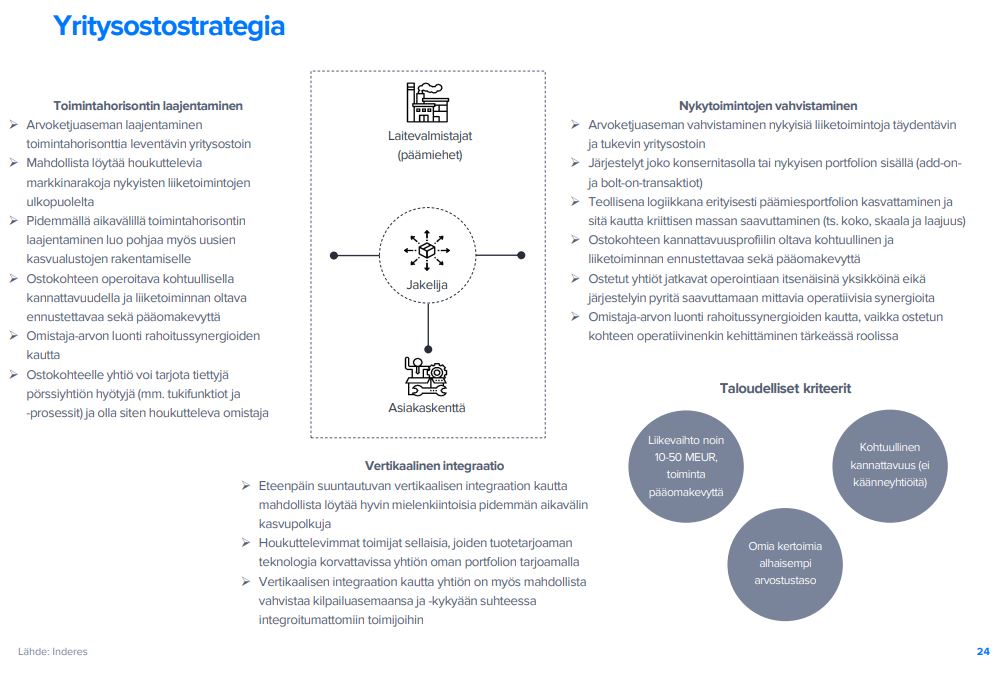
Yleiselektroniikka’s ownership structure completely changed in 2019 when investment company Preato Capital became the new main owner. Preato Capital is a privately owned investment company whose goal is long-term ownership and continuous operational development of target companies. With the new owner, the group’s strategy and goals clearly became more growth-oriented. The first step on the path outlined by the new strategy was taken in February 2020 when the company announced it had acquired the entire share capital of Machinery. We have extensively covered the company’s acquisition-driven growth strategy in our initiation of coverage report published last week (link to report: Teknistä tukkukauppaa ja yritysjärjestelyjä - Inderes). In a nutshell, the company aims to strengthen its current businesses (YE and Machinery) through arrangements supporting them (e.g., small bolt-on transactions) and to broaden its operational horizon beyond current businesses, thereby creating new growth platforms. In the big picture, we believe the company is profiled as an industrial owner with a diversified business portfolio consisting of companies whose operations are predictable, capital-light, and operate at least at a reasonable level of profitability. Of course, in the long-term value creation, the focus is also on developing the operational activities of the companies in the portfolio.

2 Likes

You are absolutely right that if one looks purely at the elevated goodwill and its share of equity, one might observe a certain unease. However, when examining goodwill, whether from an absolute or relative perspective, I believe it is very important to try to grasp the overall picture and the write-down risk associated with goodwill, and thereby see beyond just a balance sheet item. I believe the overall picture and the write-down risk of goodwill should be considered through two reference points: 1) what kind of and in what condition the operational activity associated with goodwill is (i.e., bankruptcy risk and the threat of a full write-down of goodwill), and 2) how much has been paid for this business (i.e., the risk of weakening income generation capability).

I partly touched upon the first reference point in my previous message, but even a short repetition is known to be the mother of learning. Machinery, therefore, has a long history, supported by a strong principal portfolio (the newest representation being Sany excavators and wheel loaders: Machinery Oy on uusi Sany kaivinkoneiden edustaja Suomessa - Machinery) and a cost-effective operating model, resulting in a good level of profitability and, due to the capital-light nature of the business, both strong cash flow and high return on capital. Under normal operating conditions, the business is also quite predictable. Thus, Machinery is in very good overall condition. Consequently, the bankruptcy risk and thus the threat of a total write-down of goodwill are very minimal.

The purchase price, on the other hand, corresponded to an IFRS-converted approximately 4x EV/EBITDA multiple and approximately 5x EV/EBIT multiple. Inversely, Machinery thus pays for itself at last year’s operating cash flow level in about four years and at the operating profit level in about five years. Furthermore, when considering that last year’s performance provides a reasonable indication of the sustainable level in the longer term, the purchase price cannot be criticized as expensive in any way. Thus, no air has been blown into goodwill due to massive earnings growth expectations being absent. Therefore, even when examined through the second reference point, the risk of even a partial write-down of goodwill does not, in my opinion, become significant, reflecting the aforementioned factors and Machinery’s key competitive advantages.

3 Likes

Why isn’t there any enthusiasm for this company on the forum, at least in this thread?
The quiet creeper’s stock development beats many others. What’s the deal? The rise only began in November, maybe that explains it. It has comfortably doubled its stock price in the current month :blush:

3 Likes

This is one of those companies that flies under the radar, or rather, glides. I’ve read my own “more dip” suggestion at least three times and concluded that €14 was a long shot and probably won’t return.

1 Like

Last week’s news review in the trade magazine included a short segment about Machinery and the company’s recent SANY representation. The entire news review can be watched here: https://www.youtube.com/watch?v=dYqS-UTjfN8&feature=youtu.be. The Machinery segment starts around 2:30.

Machinery’s own website also regularly features interesting publications about the company itself / its customers, and these are definitely worth reading. The latest publication can be read here: Suomalainen raskas levytyö on selvinnyt haasteista ennenkin — salaisuus on muuntautumiskyky ja osaaminen - Machinery. These provide a good concrete feel for everything Machinery does in addition to actual equipment and component sales. At the same time, you also get a small cross-section of the customer industries and their operational dynamics.

1 Like

Yleiselektroniikka’s Swedish peer company, Lagercrantz Group, announced today that it has acquired the Norwegian company VP Metall AS. According to Lagercrantz, VP Metall is a market leader in electrical connectors suitable for high-voltage applications. VP Metall’s operations appear very stable, as, according to the Orbis database, its turnover has been around €4 million in 2015-2019, excluding minor peaks. As a niche player, profitability has been excellent, and return on capital employed has averaged over 45%.

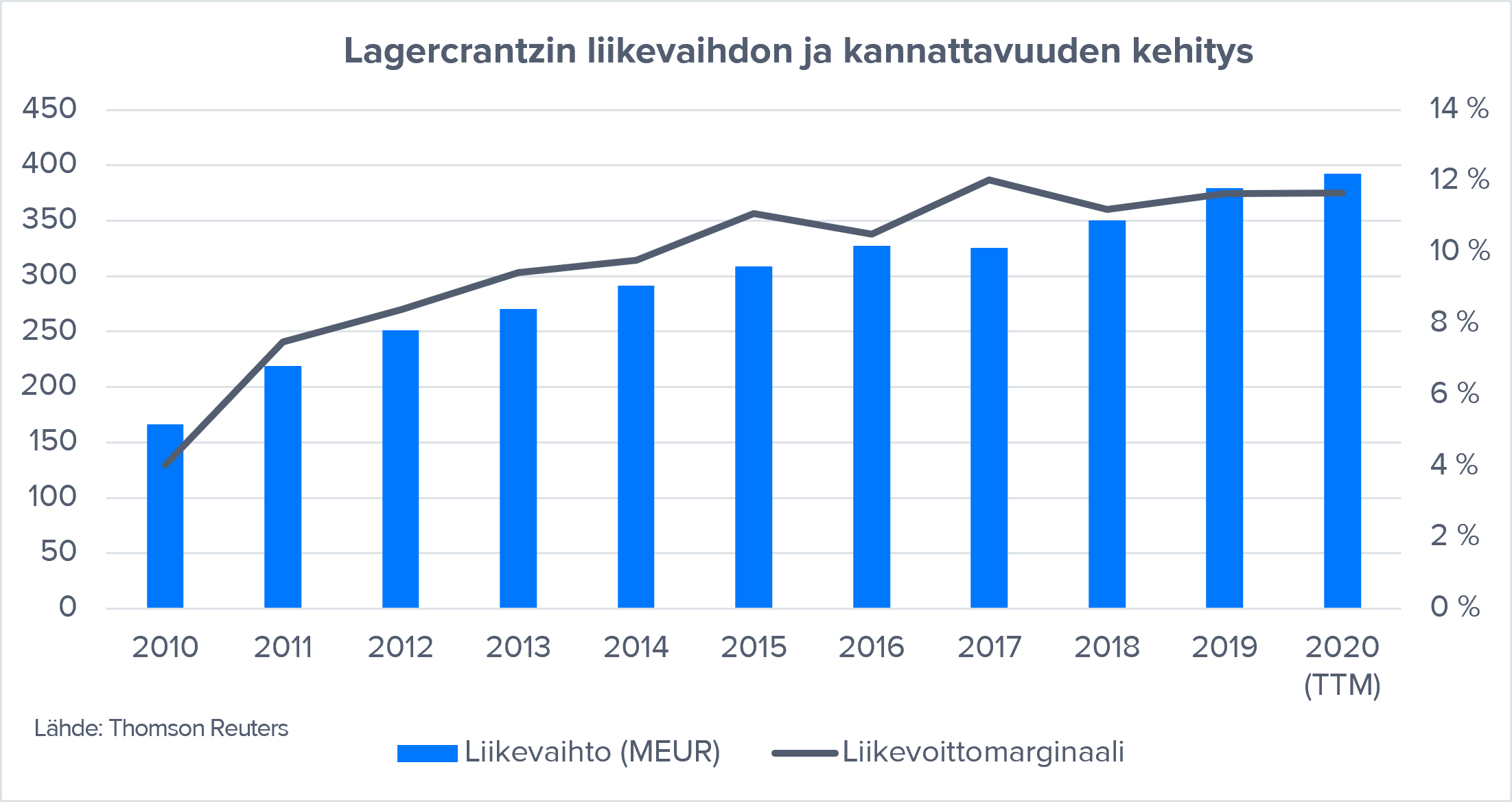
Lagercrantz itself, perhaps most simply put, is an industrial owner of companies in niche segments that hold leading positions within those segments. This makes corporate arrangements a central part of Lagercrantz’s DNA, and the company has executed over 40 such arrangements since 2010. The group has also been active in Finland, which suggests that Lagercrantz could, at least to some extent, be competing for acquisition targets with Yleiselektroniikka. In total, Lagercrantz’s portfolio includes over 50 companies. The companies below are mainly operators in the electronics industry and its various value chain parts. Thus, it includes both manufacturing companies and wholesale trade. Roughly 50% of the group’s turnover comes from wholesale trade and 50% from manufacturing. In recent years, however, the group has gradually shifted its focus towards manufacturing. This has also been reflected in the development of the gross margin.

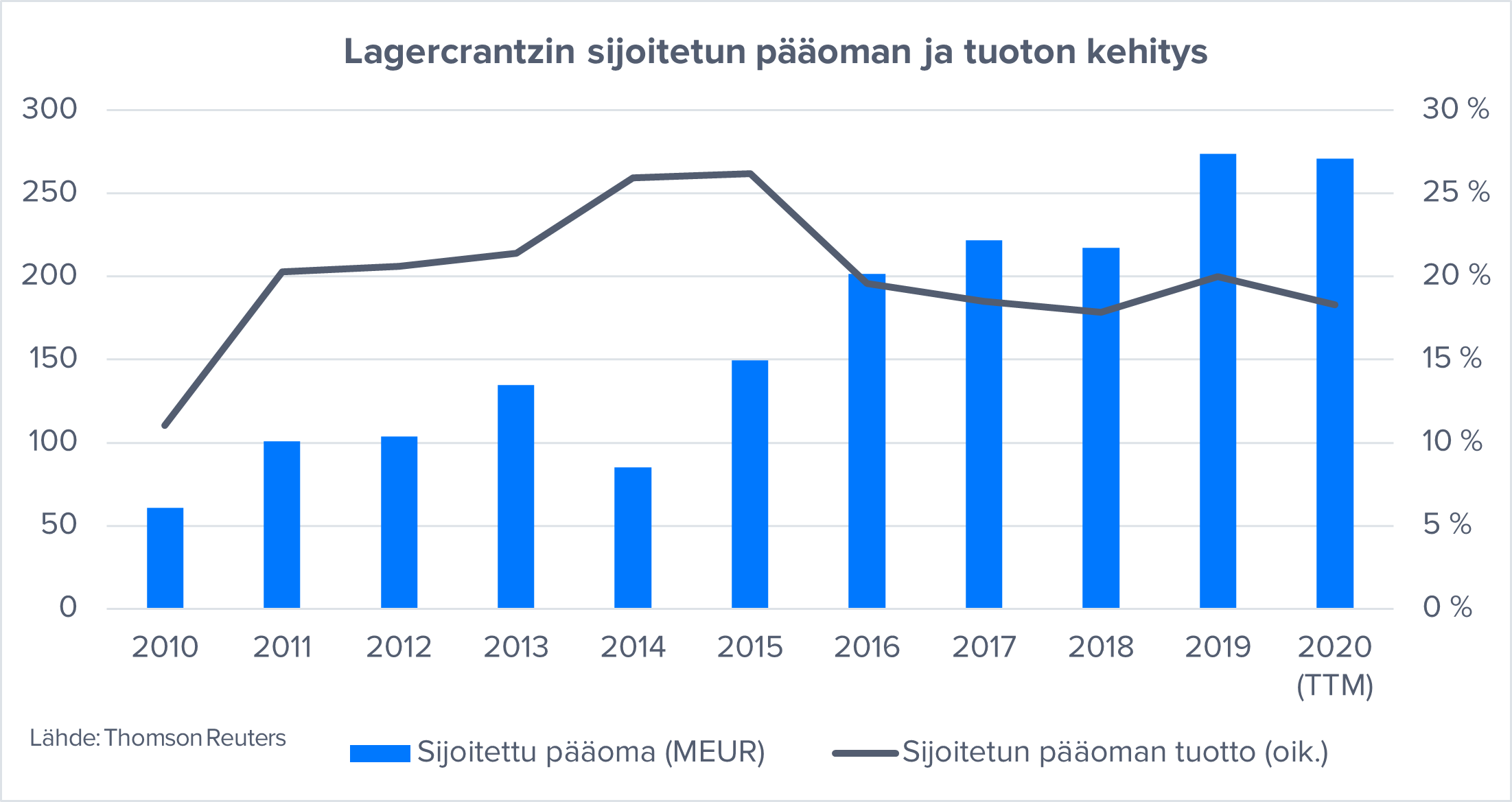
Like Yleiselektroniikka, Lagercrantz grants its units complete autonomy. Accordingly, operational decision-making is not guided from the group level. Corporate arrangements do not aim to find significant operational synergies; instead, the acquired target must already be in good condition both financially and in terms of market position. Organic successes also have their place in the growth strategy. The financial targets are at least 15% annual earnings growth and over 25% return on equity. These at least ambitious targets have also been met, as the operating profit growth has averaged 22% and adjusted return on equity 23% in 2010-2020 (TTM). In terms of corporate arrangements, the goal is to complete 3-5 arrangements annually. It goes without saying that the operational development mentioned above has also led to a massive amount of shareholder value creation.

7 Likes

We also received a small M&A announcement from another Swedish peer today. This time it was Lifco, which announced the acquisition of Swedish Sendoline. Sendoline is a niche manufacturer specializing in dental care products and has also generated sales of around 4 MEUR in recent years. According to the Orbis database, the last couple of years have been somewhat lean from a profitability perspective, but in 2015 and 2016 the company made a very robust 14% net profit margin.

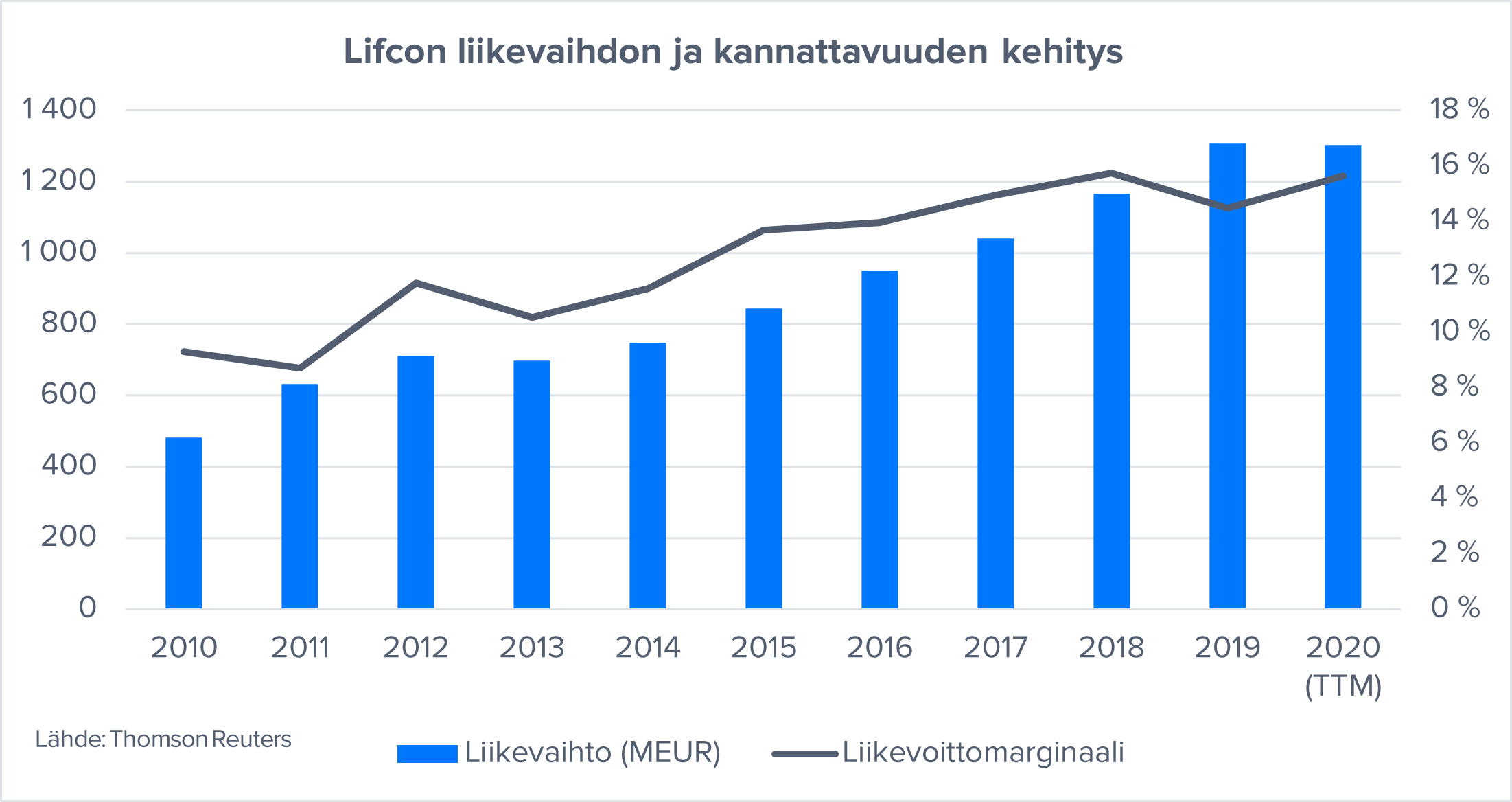
Lifco itself is a company operating on a very similar basic template as Lagercrantz (i.e., an industrial owner for leading players in niche areas). According to its own words, Lifco aims to be a safe haven for small and medium-sized companies. Acquisitions are therefore the alpha and omega of its operating model. These have been carried out quite vigorously, as 11 arrangements have been implemented in the past year alone. In total, Lifco’s portfolio includes over 160 companies.

Lifco directs its operations through three business areas: Dental (as its name suggests, manufacturers and distributors specializing in dental care), Demolition & Tools (operators specializing in servicing heavy equipment such as cranes and excavators), and Systems Solutions (operators offering various industrial solutions, such as contract manufacturers). Lifco’s and Yleiselektroniikka’s businesses therefore have certain commonalities (e.g., presence in the construction industry’s value chain). However, the geographical footprints of the companies are still quite different (Lifco’s companies operate at most indirectly in Finland, while Finland is the main market area for the Yleiselektroniikka Group), and among the companies under Lifco, there are no players fighting on exactly the same fronts as Yleiselektroniikka’s counterparts. Of course, competition can be waged, at least to some extent, at the level of potential acquisition targets, despite the structural and focal differences of the groups.

In a nutshell, Lifco’s acquisition strategy is touchingly simple. Lifco aims to be a long-term owner for companies operating at good profitability levels, carrying low technological risk, and being in healthy value chain positions. The company also gives acquired companies the freedom of independent decision-making and emphasizes the importance of an entrepreneurial culture. Thus, Lifco’s model also does not aim to create value through seemingly attractive operational synergies on paper. A concrete example of this is that Lifco has not changed the location of any of the companies it has acquired in its history.

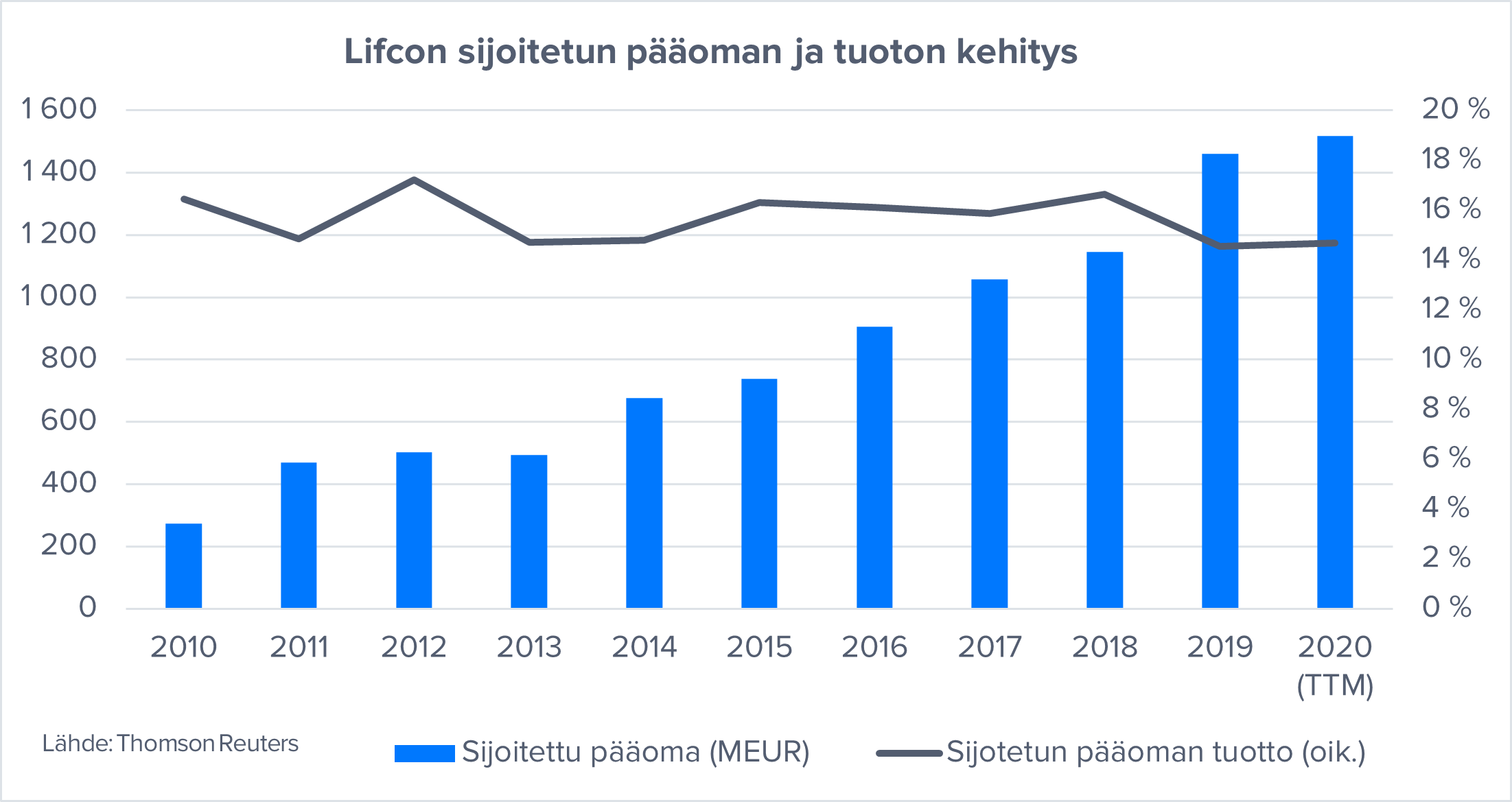
Lifco’s primary financial project is to achieve sustainable earnings growth. In the company’s terminology, this means that operational earnings growth organically exceeds the target market’s GDP growth. This is then supplemented by corporate arrangements. In terms of its balance sheet, the company aims to keep net debt/EBITDA in the 2-3x range. This is in the same ballpark as the comfort zone we estimate for Yleiselektroniikka. In 2010-2020 (TTM), Lifco’s performance has been strong, evidenced by an annual growth of 10% in sales and 16% in operating profit. The financial targets have therefore been met more than handsomely in this light.

6 Likes

Lagercrantz announced this morning that it has acquired the Finnish company Oy Esari Ab. Esari is Finland’s leading supplier of equipment shelters. Most of the company’s customers are telecom operators, but it also serves players in the energy industry. In 2019, Esari’s net sales were approximately EUR 5.2 million and its operating profit was EUR 0.4 million.

Within Lagercrantz’s structure, Esari will fall under the Mechatronics business unit and will complement the offering of Elkapsling (acquired in 2012), which was already there. The Esari transaction was Lagercrantz’s third in the past year and the 56th in the Group’s operating history.

Just before Christmas, Yleiselektroniikka also joined the acquisition spree, as the company announced yesterday its expansion into Sweden. More detailed comments can be found fresh off the press here:

In the extensive report published in April, we aimed to visualize how we perceive Yleiselektroniikka’s M&A strategy. The playbook is very clear, and the arrangements implemented over the past year, in our opinion, prove that the company is also purposefully executing these strategies.

5 Likes